Tuesday, 1 October 2013

KAESONG AND PANMUNJOM

30th Aug 2013

View over the old part of Kaesong

Kaesong was the capital city of the Koryo empire in the 10th century. On leaving the Janamsan Hotel we walked to the nearby ancient stone Sonjuk bridge ( right ) built in 1215 by some emperor or another, a relic from the old Koryo empire days. There is a long story about it concerning some bloody feud and murder and how a subsequent emperor fenced it off in 1780.  Blood is still supposed to stain some of the stonework, but Song Sim rather gave up trying to find it.

There is quite a long and involved ancient history to many sites in North Korea, but not many original buildings or structures left standing ( US bombs often to blame ). There are are several reconstructions and the occasional ancient engraved rock or statue.  We called in at another, the Nam Gate, the original southern gate to the inner city, which houses a large 14 ton ( original ) bell made in 1346. To be honest, I was rather more interested in modern day life so won't bore you with old dynastic legends which I found rather long-winded and confusing.


Of course we walked up to the mandatory bronze statue of Kim Il Sung on a small hill south of the centre where, as is becoming the norm, one of us volunteered ( only one from now on ) to present some flowers before we all stood in line and bowed. It would be unthinkable to do otherwise. Despite a lack of electricity in general, this statue is always floodlit at night, or so we were told because we could not go out at night.


Immediately at the bottom of this small grassy knoll is a T junction ( left to right in the photo ). The locals on bicycles all dismounted and walked, to show respect, when they passed abeam the statue. The hill in the distance is supposed to resemble a pregnant woman.

There were a lot of bicyclists, and even the odd wood burning powered truck, presumably going to work, but I seem to have developed a knack of taking photos with nobody in them. There were lots of bicyclists about, honestly.

We walked up another sharp little hill to get a view over the old part of the city ( as per photo at top ). Neat and tidy little pointy-roofed houses in the traditional Korean style, all with metal chimneys. This place gets cold in the winter and most Korean houses are heated by underfloor hot water pipes fuelled by wood-burning stoves.


Left: A traffic cop on duty, and very smart he was too. This is a common site in all cities. Big roads, big roundabouts and junctions, mostly manned by similar traffic police who, frankly, are not exactly overworked. If a smart car does happen to pass by ( BMWs and Mercs were seen in Pyongyang ) then he/she will throw up a snappy salute.


I still found the apparent lack of any shop fronts or markets somewhat bemusing. More about this and the reasons later. Suffice to say it is decreed in the Juche Socialist system that there should be no  overt capitalist selling of things for profit. The State provides. I read about this in a chapter of that best selling little booklet written by The Dear Leader, snappily entitled 'Let Us Brilliantly Accomplish The Revolutionary Cause Of The Juche, Holding Kim Jong Il In High Esteem As The Eternal General Secretary Of Our Party'. I have a spare copy if anyone is interested.

Next on the agenda ( a packed one ) was a visit to the Historic Koryo Museum on the outskirts of the city. Many  rather dull relics and pottery were on display in several buildings which, of course, had been visited by The Great Leader at some point. It is the first and foremost thing you are told by the local guides at every venue; how many times the places have been visited by Kim Il Sung, his wife and Kim Jong Il. Lots of ginseng products ( not cheap ) were on sale at the museum shop. Much ginseng seems to be produced in N.Korea. It is good for you.
There were also some very ancient recently reconstructed houses and pagodas, plus a new Technology University which was notable, as with many other large buildings, for the lack of people going in and out of it. A holiday no doubt.

Then on to the De-Militarized Zone ( DMZ ) at Panmunjom, about 12 miles east. ( I will post a simple map later on to orient you ). This is a regular tourist spot. As you may be aware the DMZ is a 'no-man's-land' 4 kms wide, straddling the Military Demarcation Line ( MDL )  and follows, roughly, the 38th parallel across the peninsular. It was at Panmunjom, on the MDL, that the Imperialist US Aggressors signed, on bended knee, the armistice in front of the Korean People after 'giving up' in 1953. The DMZ is anything but demilitarised, and we had fun spotting all the pill-boxes, tank traps, disguised sentry posts, machine gun nests and artillery emplacements approaching the northern DMZ fence. Understandably, no photography was allowed. After a stop at the smartly guarded military entry point, de-busing to make use of a souvenir shop and much filling in of forms, we re-boarded and with military escort and in convoy with several other buses ( mostly filled with Singaporeans and Chinese as it turned out ) we made our way to the MDL. I recall that tourist visits from the North are timed so as not to coincide with tourist visits from the South ( to avoid a shouting match at the MDL I suppose ).


Here we visited the room where the armistice talks were held, which included a museum, mostly photos, of the main protagonists. Also the room ( in another building ) where the armistice was actually signed ( left ).  They did actually display a UN flag alongside the North Korean one, but that is the only hint of 'UN' involvement that I recall seeing or hearing. There were some photos of British officers.


Right: A copy of the armistice agreement. 


Then on to the 'viewing' platform which overlooks the three blue sheds straddling the actual 'line', and towards the equivalent viewing building on the Southern side. Lots of viewing and listening devices were in evidence, although there didn't appear to be much activity on the other side. It was all rather low key if you ask me.

On most occasions it is permitted to enter the central blue shed and walk across the actual 'line', but, for some unexplained political reason, this was off limits during our visit.

I had been rather hoping for some 'action' here such as a good bit of haranguing between one side and the other. It was very quiet. Perhaps a holiday.

Of course, to formally mark the place, there was a plaque commemorating a visit by the Great Leader, Kim Il Sung, on 7th July 1994, and displaying his signature ( right ). If that date is correct, it must be one of the last visits he made anywhere as he died of a heart attack on 8th July 1994 ( maybe I've got that wrong! ).


After a 13 ( yes, thirteen! ) course lunch at a restaurant somewhere in Kaesong we set off again for an hour's journey north-east along the DMZ to a viewing site, equipped with some high powered binoculars and telescopes, to look across the DMZ at the US/S.Korean defensive wall on the southern side. This wall is 30ft high, punctuated by defences and guard-posts ( a bit like the old Soviet East/West Germany fence ) and stretching for 274 kms across the peninsular. We were first given a briefing on this ( history and current tensions with the South ) by a very charming and smiley ( genuinely! ) army Colonel.


My camera is not up to much, but you might be able to make out the distant wall and a guard-post / watchtower in the photo here ( right ).


The gallant Colonel was keen to have his photo taken ( he was the only military guy we met at the site and perhaps appreciated the attention ), so I display it again for his benefit in the unlikely event that he ever visits this blogsite. 


The officers do wear such impressive hats, don't you think?


Not content with this, he hitched a lift with us back to Kaesong and proceeded to sing us some rousing patriotic Korean songs over the bus PA system. We cheered him. The North Koreans enjoy their singing, as we were to discover.

One of our party was subsequently encouraged to respond ( I had slid very low in my seat at this point ). The brave volunteer whacked out fine and word perfect renditions of 'It's a Long Way to Tipperary' and 'Pack Up Your Troubles in Your Old Kit Bag' ( sort of demonstrates the average age of our group ), and our reputation was saved. 


We weren't finished yet. A detour took us to a Buddhist monastery up on a hill to the west of Kaesong. The walls on the side of the road ( quite a narrow mountainous one ) for many miles were painstakingly and artistically decorated with well laid stonework, white paint and colourful statues of bears and tigers etc. The labour and imagination that had gone into this was impressive. Left and below: a couple of pics to give you an idea of the countryside on the way.
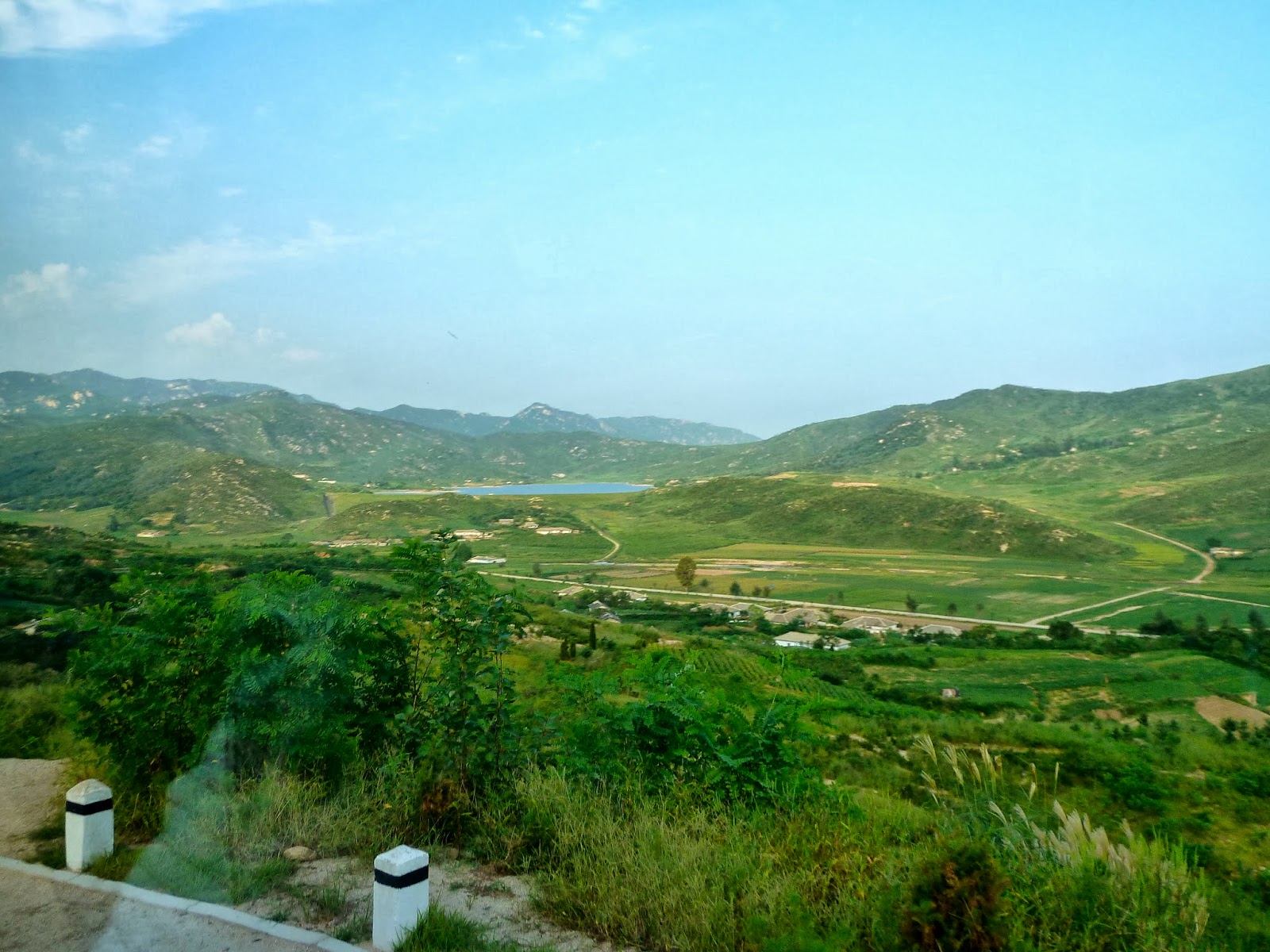


Right: More countryside. We passed locals fishing and swimming in the rivers, and farming. All very bucolic.


The Ryonton Monastery ( left ), was largely a reconstruction. There were a few original engraved stones and statues from it's  construction in the 14th century ( I think ). As with many of these structures, the Imperialist US Aggressors were blamed for bombing the originals flat during the Korean War.


Those in the know reckoned that the three Buddhist 'monks' in residence ( albeit admitting that they actually lived in Kaesong ) were perhaps not quite the real McCoy. We asked how many Buddhists lived in the area and came to worship here. "Five hundred" was the answer. I think.

Finally back to the hotel in Kaesong at 6.30pm. It had been a long day but, as it turned out, a fairly average one in scope and variety of sights visited.

Dog and Ginseng Chicken were specialities on the menu tonight. The dog ( special ones are bred for eating ) was OK and the chicken a bit watery, but we ate well again nevertheless.

I seem to remember several of us stayed up rather late in the bar that night drinking cheap ( but surprisingly good ) beer and polishing off a bottle or two of some ginseng spirit. Ginseng is supposed to be good for you, but does leave you with one hell of a headache in the morning.  I suspect we had doubled their takings for the past year. 

Our schedule continues, non-stop, tomorrow....phew! Balli-balli


Sunday, 29 September 2013

PYONGYANG 2

29th Aug 2013

Heroes of the Korean War
It was pissing with rain as we left the hotel to visit the Fatherland Liberation War Museum. My Union Jack umbrella was put to good use. We arrived, in our bus, at the museum to find many cadres of military personnel and students formed up and waiting to visit outside the entry gates about 500 yards from the main building entrance.  Being tourists we were ushered through and dropped off ahead of the locals.


The new War Museum ( left ) has only recently been opened. It is indeed impressive. Sadly no photography is allowed inside ( not uncommon with many military museums ), so you will have to take my word for what we saw inside.            What was displayed was, technically and artistically most impressive. Indeed I have not seen  anything so elaborate and well displayed anywhere else. Very 'state of the art'. I asked who had designed all this and was told it was done by committee, instigated and approved by the Dear Leader, Kim Jong Il.
The main displays, almost exclusively, feature the 1950/53 Korean War. As you are no doubt aware,  and we were certainly made aware, this war was started by the Imperialist US Aggressors ( IUSA ), and their puppet regime in the South, who invaded the North in 1950. After being surprised by this unprovoked attack, the Great Leader, Kim Il Sung, inspired and, with great military genius and bravery, led the heroic North Korean forces ( ably assisted, one of out party pointed out, by Shock Troops of the Frampton-on Severn WI ) against all odds and succeeded in pushing the invaders back to the 38th Parallel, the original demarcation line. There are some extremely realistic and clever dioramas displaying military scenes, battle positions and equipment. They include a magnificent 360˚ revolving panorama depicting a great, and victorious, battle against the IUSA south of Seoul, incorporating much 'son et lumiere et smoke' etc. Also displayed are many 'Top Secret' documents, proving the IUSA's intentions to invade, recovered from the US Embassy in Seoul when the DPRK forces captured it during their subsequent advance into the South ( before honourably withdrawing ). The documents did look genuine, I must say.

Sadly, there was not much indication of the involvement of other UN troops ( only one diorama featured a few flags from other nations ) and no mention of UK forces or even, curiously, the Chinese. I must have been misinformed previously.

Outside, and the rain had stopped by now, was a series of well reconstructed trenches leading to a large display of captured and destroyed US military hardware ( armour and aircraft ). Whatever your 'take' on the historical accuracy, this museum is visually quite brilliant.

Then a short walk to where they have re-located the captured Imperialist US ship, USS Pueblo. As you will recall this was a US spy ship captured by the DPRK naval forces off the east coast of North Korea ( near Wonsan ) in January 1968. The crew were held in captivity for a long time, having confessed to spying, and the ship, still on the US register, never returned. A fine trophy ( right ). I think the GER2 marking stands for their 'cover'; General Environmental Research, or some-such.


Left: The main instrument monitoring room in the ship. I don't know much about electronics but this array of screens, dials and switches certainly looks 'state of the art' for the 1960s.


...and a couple of bullet/shell holes through the bridge window. Lots of the personal clothing and kit left behind by the crew was on display.


We were escorted around the ship by a most enthusiastic lady soldier. She was only too happy to have her picture taken with us.

If nothing else, the DPRK military uniforms look a lot smarter than the Banana Republic camouflage outfits that UK forces are now required to wear. 


Right: Another view of the Fatherland Liberation War Museum. Following behind us there was a large number of military and student contingents being led into the museum to be inspired by the displays; and I'm sure they were.


We then visited the Koryo Hotel, the other smartest hotel in Pyonyang, where we could buy rations and other goodies before embarking on the next phase of our tour, a longish bus journey to Kaesong on the south-western border.


Talking of hotels, the one which dominates the Pyongyang city sky-line is this one ( left ), the Ryugyong Hotel, a vast pyramid ( shaped like Thunderbird 3 ) 105 stories high with 3000 rooms and with no less than 5 revolving restaurants on top. Truly impressive, or at least it would be if it was half-way finished. There is nothing much behind the outside concrete shell and shaded windows. This building was conceived in 1987, when an Egyptian company began construction, and it is, as yet, awaiting completion which will occur, we were told by our guide ( with barely concealed rolling eyes ) in 2014.


On by bus via the Reunification Highway ( right ) south towards Kaesong ( 90 miles distant ). We stopped for an excellent picnic ( great nosh and beer provided by the tour company ) in a 'service station' en-route. We were the only people in the service station and the picnic was laid out in an empty room ( with tables and chairs ). Another bus and one car was seen thus far. This road is a vast improvement on the M25, and no roadworks either. Or speed cameras. Or police. Or traffic.


Then on again and a detour to view some beautiful falls, the Pakyon Falls. These have great early (pre-history) Korean legendary significance. Lots of very ancient engravings and charming, if convoluted, stories concerning them which, unfortunately, I failed to note down. There was also a much appreciated bit of exercise; a 50 minute climb up to a fine Buddhist temple above them. Got a good sweat on but no pics of the temple.


On again, a further 40 mins, to Kaesong, a largish city which, we were told, had some light industry. It was noticeable that all N.Korean cities proved to be immaculately clean, but no sign of any overt shops or markets and absolutely no advertising signs. Very few motorised vehicles and most of the population travelled by bicycle ( very limited fuel is the problem ). They even have a few vehicles powered by burning wood; noticeable some miles off by the thick black smoke they produce. Not sure how they work.

Anyway, into the Janamsan Hotel where, we were reliably informed, there would be hot water and electricity. This proved partially correct even if the water was a rather interesting colour. One suspected it had not flowed for some time. It was a clean and friendly place with a good bar ( for us ) and good nosh. Even the lift worked, if only to get our luggage upstairs. Not many other guests, but the staff looked after us very well. In fact they were charming and, I felt, genuinely glad to see us. We learnt another Korean word "kahm-sa hah-mee-dah", "thank you".

More excitements to follow....stay tuned.

Wednesday, 25 September 2013

PYONGYANG 1

28th Aug 2013

The Grand People's Study House
Off at 8.45am this morning in our bus after a good breakfast ( but a bit of a struggle to get enough tea. I ordered five cups at the same time which seemed to work )  Our driver, whose name I never found out, was an admirable chap who, over the next couple of weeks would drive us faultlessly, and safely,  hundreds of miles, often doing 12 hour days. He religiously polished and cleaned his vehicle before the start of each day. We learnt a new Korean word from the delightful Song Sim this morning; "balli balli", which means "quick quick" or possibly "hurry up you lazy loafing idle foreign tourists".


First stop was the Mansudae Fountain Park ( left ). A pleasant enough rocky grassy area which features various ponds and fountains. Apparently some of them spout 80ft up. Unfortunately, today, which was National Youth Day and a day out for students, the fountains weren't working. We were told they were undergoing maintenance.

There did not seem to be many people in evidence.


Right: Another view across one of the fountain ponds to the Grand People's Study House, of which more later.


At this point it may be helpful, if in danger of boring you, to explain a bit about the North Korean philosophy, behaviour and traditions. One quickly learns that the ( late ) Great Leader, Kim Il Sung ( and President for eternity ) is not just highly respected; he is revered. He is modern day North Korea, and his son, the ( late ) Dear Leader, Kim Jong Il ( who died in December 2011 ) only just less so. Not so much mention is made, yet, of Kim Jong Un although he is elaborately feted wherever he goes. The worship of Kim Il Sung reminded me, perhaps to a slightly lesser extent, of the Buddhist's worship of the Lord Buddha. Large bronze statues of the Kims dominate the centres of all North Korean cities, and their portraits hang outside all major buildings. There are also portraits inside all main rooms, and every private household or apartment has to hang the Kims' portraits on their living room walls, and to use a specially dedicated duster to keep them clean.
Kim Il Sung embraced two main philosophies; 'Juche' ( pronounced Ju-Chay ) meaning, literally, 'master of oneself' and 'Songsun' meaning 'army first'. You can look up Juche on the internet if you are that interested, but it accounts in large part for the North Korean intense nationalistic pride, extreme socialist dogma and unshakable determination to remain isolated and, as far as possible, self sufficient. Children, from kindergarten upwards are well educated ( perhaps a touche cerebrally purified? ) in both Kims' histories, achievements and teachings. This history might occasionally be slightly manicured to enhance their standing.
Any newspaper, banknote or document carrying a picture of the Kims must also be treated with respect.  We were told these should not be folded, crumpled up or thrown away. It was also not permitted to take a photo of a statue which did not show the whole figure, or from the side, or back.


Then a walk up Mansu Hill towards the most sacred spot in North Korea; the Mansudae Grand Monument, 70ft high bronze statues of the Great Leader, Kim Il Sung and the Dear Leader Kim Jong Il. It was relatively recently that Kim Il Sung had to step two paces to the right to make room for his son, Kim Jong Il. In the background is a mosaic of Mount Paekdu, the highest peak on the Korean peninsular and place of spiritual importance for North Koreans.


We were 'encouraged' to buy a bunch of flowers to present at the monument. A lady was selling these at 4 Euros a go. If this wasn't a socialist country I thought, and if she was allowed to keep the money, she would probably be driving a Ferrari and holidaying in Gstaad for the winter. Amongst many contingents of soldiers ( almost equal numbers of male and female ) and students we walked up to the monument and dutifully placed our flowers on the shelf in front. Then we stepped back and were asked to stand in line and bow, in unison, respectfully. This is a holy place. I began to wonder if the flowers were recirculated.


Another short walk to view the grand Chollima statue ( left ). This, similar to Pegasus, was adopted as the symbol for massive national development after the Korean war; The Chollima Movement. Are there two people riding it? Reminded me of a horse jumping Bechers Brook before the emasculation of Aintree. The jockey, as you can see, is 'calling a cab'. Ma is the Korean word for horse.


On to the Grand People's Study House, an eight storey traditionally built edifice overlooking Kim Il Sung Square ( thats the one where all the grand parades take place ). It houses  the national library and is open to all citizens to promote reading, computer studies ( on the 'intra-net' ) and language courses. ( photo at top ).


There is a fine statue of Kim Il Sung in the vast foyer ( right ) and we were met by a local guide to escort us around and explain. Escalators and elevators took us to various floors.

The reading rooms were devoted to different subjects and purposes.


At the back of these rooms were libraries full of interesting technical, literary and scientific tomes....


....which were being assiduously studied by the local population ( right ). It was National Youth Day holiday, don't forget.


Further upstairs there was a music room where those interested could take out and listen to western music. We were played some Beatles tunes, the Yellow Submarine in particular. There was also a class being taught English by the innovative method of repeating after the teacher, verbatim, a random selection of English words.
Also a display at another floor, of how you could go to the counter and order any book you liked, which was then sent out from a back room on a conveyor belt. They demonstrated this for us by conveying out, by magic, copies of Gone with the Wind, Stories by Shakespeare and Introduction to Home Computer Programmes. One of our team asked for a copy of Fifty Shades of Grey. This request was met with a rather blank look.


Up near the top there is a balcony from which the parades on Kim Il Sung Square are monitored and controlled. It provided a good viewpoint. The building in the foreground is from where the leaders take the salute.
Other grand buildings such as the Korean Central History Museum and the Korean Art Gallery surround the square. The tall monument in the distance across the river is the Juche Tower. We went up it, later.


Another view, to the north, over the Fountain Park, looking towards the vast monolithic Mansudae Assemby Hall ( the National Parliament building, or Supreme People's Assembly ) at the far left.
Doesn't the place look clean and tidy and pleasantly uncrowded and devoid of traffic. I bet Boris and TFL would appreciate this. Makes commuting less stressful.


A bookshop at the top was selling DVDs ( many of the Arirang Mass games of which you will hear  more later ) and some fascinating books. A selection of which ( left ). Click to enlarge and make sure you get your order in soon.
It also sold soft drinks, but no coffee ( too expensive ) for which, by now, I was gagging.


Right: A bit of the square where you can see, maybe, an array of marks and numbers painted on the ground. These are part of the highly complex parade and display markings which enable such impressive performances which take place on several occasions. If there's one thing the North Koreans do brilliantly, and in vast numbers, flawlessly, it is parades and displays.
Nothing we do here, in the west, holds a candle to them. Not even our Trooping of the Colour ( sorry Guardsmen ) or, dare I say it, the opening ceremony of the Olympics. Except I doubt if they could manage parachuting their Leader into the square or finding someone like Mr Bean to entertain the crowd. Laughs is not what it is all about. Having said that, they don't have to feel obliged to dig up the likes of Paul McCartney to embarrass the audience.


Off to lunch at a restaurant which specialised in chicken dishes. I won't bang on too much about our dining venues, except to say that we were very well fed and watered. The food was healthy and delicious, often in smart restaurants where we were given a private room or table and excellent service. I have no doubt that we were very specially looked after.


After lunch it was on to the Juche Tower on the south bank of the river. In front of which is this monument depicting the North Korean emblem of the Hammer ( Industry ), Sickle ( Agriculture ) and Writing Brush ( Intellectuals ). A slightly alternative take on the mere Soviet Hammer and Sickle.


For 5 Euros we went up, by lift, to the top for more good views of the city. It was a bit hazy.


A view north showing the enormous Mayday stadium in which we were later to see the famed Arirang Massed Games.


In the hall at the bottom were hundreds of plaques donated ( left ) by many nations and organisations sympathetic to, and offering their support for, the Juche system. The UK contribution was notably lacking but, surprisingly, there were many from French organisations and lots from African countries and Peru. I couldn't work it out. The US and Japan definitely did not feature.


Onwards to the Korean Workers Party Monument ( right ). Another local guide was there to tell us all about it ( this was all magnificently organised ). Many vital statistics of measurements were painstakingly described which pertained to years and dates concerning Kim Il Sung and the history of the Peoples Workers' Party. I have no recollection, sadly.


Off next in our bus, which had followed us around like a loyal gundog, to the Mangyongdae Revolutionary Site, about 10 miles south of the city. This is another holy place where The Great Leader, Kim Il Sung, was born ( in 1912 ) and spent his first few years. His father was a small time farmer. This is another place of pilgrimage for North Koreans. It consists of a very 'refurbished' collection of huts and shows the 'original' tools and domestic implements used by Kim Il Sung's family. There is a well nearby from which we were encouraged ( I did ) to pull and drink some water which would make us 10 years younger. As it transpired this was one of many water sources connected to Kim Il Sung which, if drunk, would make you 10 years younger. By now, if true, I should be looking about 12 years old. I am still eagerly awaiting the results.


Can't remember what this 'street' is but it was on our way back into the city. One of several large and ostentatious roads which put the M25 to shame and yet to experience a traffic jam. Or road works. Or cars.


Next stop on the agenda was a Middle School in the south of the city. We were guided around it by the headmistress. Lots of children ( 12 to 16 yr olds ) were playing sports outside. We arrived at about 5pm and general school had finished ( school hours are, I think, 9am to 2pm with extra-curriculum activities afterwards; sports, music, dancing etc. ). The classrooms were impeccable and each boasting portraits of The Leaders. There are special classrooms for the teachings and history of Kim Il Sung, and Kim Jong Il.

We were then treated to a song, music and dance performance by the pupils lasting a full hour. They were brilliant! Incredibly jolly and immaculately, skilfully, performed. All in rather elaborate  costumes and at a standard that would be inconceivable in UK schools. OK, it was done to impress us foreigners, but seriously impressive nevertheless. As mentioned before, it maybe somewhat robotic, but the North Koreans can certainly put on a show, even at this level. I have some video film of this, and of subsequent performances, but they don't seem to work on this blogsite, more's the pity.

Back to the hotel and another magnificent dinner. Pool and bar afterwards. This was a very busy first day of touristing. Non-stop and a full programme. Many other sites were seen and explained to us but I have exhausted myself describing the main ones. It continues like this, have no fear, and I will do my best to keep up the record ( primarily for my benefit I hasten to add ).

Impressions from day 2:
1. Again, everything so immaculately clean and tidy.
2. Impressive lack of traffic.
3. Impressive lack of shop fronts and any form of advertising.
4. Extraordinary influence and reverence of Kim Il Sung.
5. Good food.
6. Extraordinary organisation. Like clockwork.

Another packed programme for tomorrow... this is going to keep me busy.


Tuesday, 24 September 2013

TO THE DEMOCRATIC PEOPLES' REPUBLIC OF KOREA ( NORTH KOREA )


The Great and Dear Leaders

24th - 27th Aug 2013


Off by tube to Heathrow to catch a BA flight to Helsinki and onwards with Finnair to Beijing. Naturally the only parts of this trip ( written in retrospect as there is no internet in North Korea ) which did not run like clockwork were the bits in England. Of course I gave myself tons of time to get to Heathrow and just as well because the tube, graunching and grinding reluctantly down the Piccadilly Line with the normal bossy, often unintelligible, overlapping and entirely unnecessary 'announcements' ( why on earth, if they have nothing else to pester you with, do they have to announce "there is a good service on all Underground lines"? I always think "Let me be the judge of that" and it is meaningless anyway because a signal failure or someone flinging themselves under a train can, and often does, happen the next minute ) juddered to a halt somewhere near Turnham Green. After about 5 minutes waiting we were informed by the driver that "there is a tree branch hanging over the line somewhere"!! Well there's a surprise. We got going again after about 15 minutes. Of course I had no need to worry about being late ( which I wasn't ) because the BA flight, in true tradition, was delayed 45 minutes. I did worry, however, that I might miss my connection in Helsinki. Heathrow airport is on a par with the London Underground system; chaotic, antiquated, noisy, uncomfortable and unreliable. In short, a dump. After sacrificing the 'K' in my emergency 'KFS' set which I had inadvertently carried in my small bag, we departed.

Fortunately, due to many other pax attempting to catch the Finnair flight onwards from Helsinki, the transit through was quick and the gate held open until all had got there ( otherwise they would have had the problem of having to off-load our checked through hold baggage ).

The 7 hour flight to Beijing T3 arrived at 6.50am. Things now became more civilised. There is a  shiny new hi-tech 'Airport Express' which takes you effortlessly, comfortably and cheaply ( £2.50 ) into the city centre ( 40 mins ) and the only announcements were to tell you, in Chinese and English  "you are now approaching Yingtongtiddleyepo", or wherever, and "Please prepare for your revel". I think they mean "arrival". It connects after only two stops to the Beijing Metro; another example of hi-tech efficiency, and so cheap! 2 Yuan ( 20p ) for any one journey of whatever length.

I booked into the charming little YoYo Hotel in Sanlitun ( highly recommended at £35 per night ). and spent the next couple of days visiting a few old haunts and a few new ones in the area which boasts many amusing shops, bars. pubs and restaurants including 'Paddy's Irish Bar' which does a fairly respectable 'bangers and mash' for the jaded western palate. 

So now, morning of 27th, back to the airport ( T2 ) to meet up with our group due to leave for Pyongyang.

From here on, and with genuine respect for our excellent tour guides and travel agent, I shall  resist writing this journal in my usual somewhat 'piss-taking' fashion. To do so would cause 'umm' and possibly serious consequences for them if, in the unlikely event, this is read in certain quarters. I must be careful and uncontroversial. You might have to read between the lines a bit.


Left: Our Air Koryo Yakolov 124-100 aircraft, a Russian Airbus A320 equivalent, which took us on the 90 minute flight to Pyongyang. Comfortable enough with in-flight refreshment of beer and a roll containing a substance which tasted fine but caused much inconclusive discussion about what it actually was. All this accompanied by a patriotic video with soothing marshal music.
Literature provided included the admirable 'Korea Today' magazine containing fascinating articles on 'Story of a Tank Division', 'Victorious Anti-Japanese Armed Struggle' and 'Kimilsungism-Kimjongilism'. Most revealing.


Our group was 15 strong, led by the charming, efficient and unflappable agency rep, Carl. Other than he, I couldn't help feel that our party somewhat resembled a Derby & Joan Club outing. Mostly retired people with considerable travelling experience including a retired French professor/businessman for whom this was his 6th trip to North Korea in 8 years ( he was fascinated by, and very knowledgeable about, the place ), a retired engineer and his wife ( a luminary of the Frampton-on-Severn WI ), two professional American ladies, a retired American businessman and a retired couple from North London. As it turned out they were a most amusing and, indeed, adventurous bunch. We got along with each other remarkably well. This at times became a sort of 'team building' exercise.

On arrival at Pyongyang 'Sunan' International, about the same size as George Best ( City ) airport, Belfast. Our passage through immigration and customs was relatively swift and trouble free. The only things the customs seemed interested in were our mobile phones. When I showed my antediluvian model I sensed he felt rather sorry for me.

We met our chief guide, Miss Kim Song Sim and her oppo' Mr Lee. They were well known to Carl, our agency man, and he rated them highly. As it turned out he was proved correct. Kim Song although only 31 years old had been doing this job for 8 years, spoke perfect English ( and now a bit more due to some helpful and polite slang which we taught her ) and was understandably quite knowledgeable about 'The West'. They did, however, have to conform strictly to various protocols concerning do's and don'ts, mostly involving photography. We had been well briefed on this previously. As it turned out, provided you asked, she was remarkably easy-going and flexible about this. They were to be with us for the full 18 days. The only no-nos on photos were of the military personnel and establishments, and of people working ( not sure why ), and we should ask other locals if they mind before photographing them ( only polite, really ).
Right: Kim Song Sim on the mike.


Onto the bus and before heading to the hotel we stopped at the 'Arch of Triumph' ( looks familiar? ) in the city centre.
This is dedicated to the 'home return of the Great Leader Kim Il Sung' who, as you are no doubt aware, liberated Korea from the hated Japanese Colonialists in 1945.
All the statues and monuments to Kim Il Sung, and his son Kim Jong Il, of which there are more than you can shake a stick at, are constructed with dimensions or ornaments which symbolise some date relating to their birth or achievements. These dimensions are all painstakingly described by a guide at every monument/stature. Forgive me if I can't remember them all or, to be precise, none of them.

We then wandered across the road to where a large ladies' choir was singing some jolly songs ( all choirs and performances, as I came to discover, are 'large' in this country ) in front of an engraved monument extolling the virtues of The Great Leader and his achievements. Lots of guitars and accordions. As well as jolly songs there were also some rousing military ones. This was the equivalent of the Army Wives' Choir.


We had only been in the country for a couple of hours and already seen a few of the Pyongyang sights. Also instructed by Song Sim on our first word of Korean "Anh nyuhng hah se myko" which means "hello". Even by the end of the tour not many of us could remember this. Seemed a rather complicated way of just saying 'hello' if you ask me.

Then on to our hotel, the Yanggakdo, on Yanggak Island in the Taedong river which runs through the city. A 47 storey job with a ( sometimes ) revolving restaurant on the top.  It was very comfortable. Contrary to warnings the lights ( on our floor ) and hot water all worked. There was even BBC 24 TV in rooms occupied by foreigners, if you can call that a bonus.

We were fed delicious and plentiful dinners, (with beer courtesy of our 'package') and breakfasts while here. Most Korean meals feature their local delicacy 'Kimchi' which is a sort of pickled spicy cabbage. I rather liked it. The only thing they seemed to skimp on was tea ( Liptons ) where one tea bag was used to make several cups, each individually. Coffee and tea ( imported ) are very expensive. There were a surprising number of tourists in the hotel from many different countries. This, according to our French professor, was a big and positive change from even a year ago.


 The Yanggakdo ( right ) has a extensive basement area which boasts a casino, ping-pong room ( at which the Koreans are ace ), a pool/billiards room, additional restaurant, ten-pin bowling alley, swimming pool. sauna and massage facility amongst other things probably.
Once in the hotel for the night we were not permitted to leave it. No problem because there was not much to go to or see at night, and we were on an island, and the beer in the pleasant ground floor bar ( local lager and very good too ) cost 1 Euro per large 640ml bottle. A cup of coffee cost 3 Euros. Most foreign spending was done in Euros but it was sometimes problematical to get change. The local currency, the Won, could not be used by foreigners.

First impressions on a busy first half day ( and it got much busier ) were:
1. Pyongyang is spotlessly clean.
2. Remarkably uncrowded and very few cars.
3. Our tour 'guides' seemed  charming and helpful.
4.  The nosh, so far, is good and beer is cheap. I was hoping to continue my rigorous diet here but this might have to be shelved.

....onwards tomorrow on a tour of the city.


Friday, 23 August 2013

STANDBY FOR MORE.....

Uncle Matt is off on his travels again. This time a shortish trip to North Korea, via China. I have had to abandon ( temporarily ) my no-fly principles and will be flying initially to Beijing for a couple of days where I hope to revisit a few favourite watering holes before going on to Pyongyang. There I will be joining a small group of, hopefully, amusing fellow travellers . We will be in the country for 18 days visiting several outlying districts which I doubt many tourists will have seen, accompanied, no doubt, by officially approved 'guides'. We are to be shuttled around by mini-bus and Antonov 26. It will be fascinating to experience domestic North Korean piloting skills, amongst all else.

Why a visit to the People's Democratic Republic of North Korea?...Out of sheer curiosity, that's why!

I am told that there are no public internet facilities out there so this journal will have to be continued on my return, sometime around the middle of September. Hopefully.

Stand-by for further revelations.......