Tuesday, 4 October 2016

TALLINN 2

3rd Oct 2016


Monument to the War of Independence

After a hearty breakfast at the Schnelli, I decided to do the walk around the old town as described in my Lonely Planet (Estonia, Latvia and Lithuania) guide book (page 59 if you want a reference). Actually the breakfast was slightly spoilt as when the coffee ran out and I politely asked one of the serving girls for more the answer was a curt "no, we have no more". The Soviet style still lingers in places.

It was a lovely sunny day and the start point was Freedom Square (left) at the southern point of the Old Town, the medieval 'jewel' of Estonia. The Square is used for all sorts of entertainment and the monument (above) stands just above one of the former town's gates. It was built to commemorate the Estonian War of Independence.
Walking around the cobbly medieval streets it was pleasantly apparent that the busy tourist season was coming to an end. Very few cars in this part of town and the pedestrians I saw, whether tourists or locals, appeared smartly dressed and very well behaved. It definitely had a tranquil and, indeed, elegant feel to it, and the streets were so clean. I suspect I probably lowered the tone bit.
Right: One of the small cafés overllooking Freedom Square.


Left: The Keik in de Kok, built as a canon tower in 1475 overlooks the southern gate. It is now a museum with a café on top. The walls of Toompea castle in the background. Up there is housed Estonia's Parliament.


Right: Alexander Nevsky Orthodox Cathedral. A rather elaborate onion-domed Russian Orthodox little chapel. This town has more churches than you can throw a stick at.                               


Inside of which are  strikingly lavish frescoes and icons (left). I only discovered that photos are prohibited after taking this one. Sorry! 


Right: One of many 'Glogg' stalls dotted around the town. Gluwein by any other name. I tried some and found it rather too sweet for my taste.


The route took me past several 'lookouts' from the castle ramparts over the lower city.  This one (left), Patkul Lookout, offered decent views to the north towards the sea.


Right: I didn't go in, so not well informed about the Estonian Drinking Culture. I wonder if there are any museums dedicated to the British Drinking Culture? They certainly have a reputation for it in this town. I suspect a display of broken bar stools, smashed up pubs, comatose lager louts and police charge sheets is not something they wish to advertise.


Many delightful cafés/bars/brasseries were established on most streets. Although sunny, it was a little chilly but this did not seem to deter drinking and dining 'al fresco'. 


Right: Another part of the fortified wall. Along the gallery on top was a café. To get to which, and I did, involved climbing a very steep narrow staircase aided by a chain rail to pull on. If you met someone coming down you had a traffic problem. I also noted that the steps here, and  in this town in general are often remarkably high; perhaps early Estonians had very long legs and, with the low roofs, very short bodies. An interesting anthropomorphical question. 


Left: The café along the top. Rather expensive, but once you had struggled up there you were somewhat committed to accepting the price. I expect deliveries were expensive too. 


The Short Leg gate tower is considered to be haunted by a crucified monk and a black dog with burning eyes. I didn't see any sign of the dog....but had a chat with the monk.


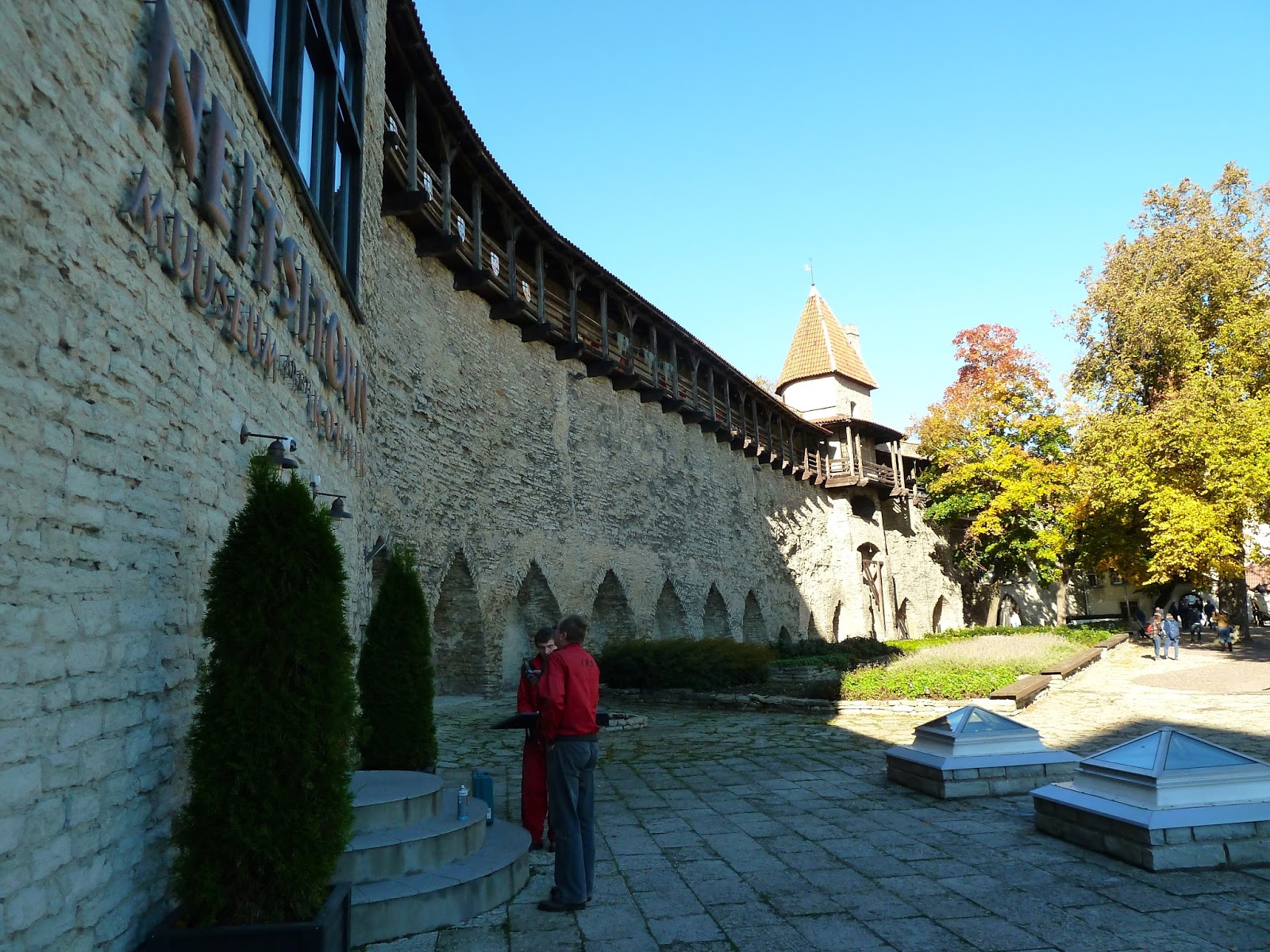
Left: The Lower Town Wall, on the west side of the town. All these bits of city wall are remarkably well restored.


Right: St Olaf's Cathedral. Another large church with a pointy spire. I forked out 3 Euros to climb up the tower. Why? Because it was there. 221 very high and steep steps.,,,.yes, I counted. Very knackering. Anyway, good views from a narrow viewing platform around the top.


......view to the North and out to sea in the direction of Finland, 50 miles away. The port here is host to many cruise liners.


....and to the South. May have shown this earlier but worth repeating because it shows where I walked from...over the high bit.


Left: Inside the church. I only took this because I was fascinated to see so many video screens in situ. There was one behind every large pillar. Nobody was going to miss out on seeing the vicar. 


The Great Coast Gate. Noted for it;s impressive architecture and coat-of-arms on this side. An elaborate ancient carved wooden crucifix is on the other.


Left: The former KGB Headquarters at 59 Pikk now, I presume, private apartments. Bricked up basement windows were to prevent the sounds being heard from the street. Locals joked that this building had the best views in Estonia...all the way to Siberia.


On the front wall is a plaque which translates 'This building housed the headquarters of the organ of repression of the Soviet occupational power. Here began the road to suffering for thousands of Estonians'.


Left: Also along Pikk are several 16th/17th/18th century Guild Halls. One of these is known as the 'Brotherhood of Blackheads'. Don't ask.


Right: The oldest coffee house in Tallinn, and a very pleasant pit-stop it was. Good sticky buns, proper coffee and excellent service. None of your naff 'Americanos' etc. Just large or small coffee, cappuccino or espresso.


Left: The Great Guild Hall, on Pikk, It is mentioned in all the guide books, so I do, and houses a museum. It looks pretty boring from the outside and the museum (5 Euros) featuring things from the City Guild days plus a rather uninteresting collection of old coins and a poorly displayed arsenal, is, frankly, nothing to write home about. 


Back to the Town Hall Square for a beer in one of the surrounding bars.


Left: A typical narrow cobbly street.....and we are nearly at the end!


Right: Finally the last gate, the Viru Gate. Go out of this and you enter the modern high-rise commercial city centre to the east. The tall building ahead is the Viru Hotel. This 23 storey hotel was, during Soviet days, the only hotel in Tallinn where foreigners could stay. It made life easier for the Soviets to keep an eye on them. It is now a normal 3/4 star hotel.


...and into the modern world. Left: Part of the extensive shopping mall around the Viru Hotel.


I thought I was going to get to the end of this walk blessed without seeing one, but woe, no such luck. Just approaching the Vinu Gate there it was....a bloody MacDonalds! Aaaargh! The scourge of  world health. St Ronald MacDonald, the patron saint of the obese and diabetics.

That took in most of Old Tallinn. Got a couple more places to visit tomorrow before heading south.

Chin chin.


Monday, 3 October 2016

TALLINN

2nd Oct 2016


Tallinn Old Town from the spire of St Olaf's Church


After a pretty grim night spent at Stansted, the early morning flight left and arrived on time at Tallinn. At least I got a couple of hours kip on the plane albeit resulting in a painfully stiff neck.
I must say the cheapo EasyJet and Ryanair flights out of Stansted attract a seething crowd of the 'great unwashed' (I suppose I'm one of them). Overnight the airport had the appearance of a refugee camp or a serious massacre with bodies slumped and lying in all available space. Even at 4.00am, when I thought  I would get to 'bag drop' early, I was at the end of a series of long queues of remarkably unattractive members of the human race; most bleary-eyed sporting 'cargo pants' revealing hairy legs tattoed with daggers, fat, pot-bellied, bull-necked, baseball capped, unshaven, pierced faces, slack-jawed with pendulous lower lips....and that was just the women. Give Stansted it's due, this mob of bovine humanity was herded through security and passport control with remarkable efficiency and good humour. I expect they have had a lot of practice.

Tallinn airport was uncrowded, efficient and really quite attractive (but then most airports would seem so after Stansted). I had a reviving cup of coffee there in the pleasant little café (left) before a 10 minute taxi ride to my hotel; the Schnelli, beside the railway station and convenient to the Old Town. No traffic hold-ups and the city appeared, at first glance, clean and well ordered.


After a much needed kip, I took a wander downtown (the Old Town). All very pleasant; relatively quiet, lots of picturesque cafés, bars and cobbly streets. I had supper at  the quaintly named 'Hell Hunt' on Pikk St. which boasted an impressive array of beers and the menu looked pretty decent. I just ate a modest Shepherd's pie which was perfectly acceptable. Also bought a pub polo shirt because I liked the logo, and it had things written in Estonian on the back....probably 'gullible foreign tourist' or similar.


It was getting towards dusk and a short wander took me to the Town Hall Square. A large square with the Town Hall (left) on one side (the only surviving Gothic town hall in northern Europe, completed in 1404, I was informed). The other sides are bordered by pastel coloured old buildings and restaurants. 


Right: Restaurants surrounding the Town Hall Square which, despite the slight chill in the air, had lots of (heated) outside seating.


......and of course boasting an Oirish bar, Mad Murphy's (left).


Right: The side entrance to Mad Murphy's. It was here that I witnessed a group of well-oiled Brits (a stag party?) accosting one of the small 'pedicab' taxis. They were asking the poor 'pedaller' for a lift and how many could he fit into his pedicab. The driver said "three". They said "there are 14 of us; can we see how many we can get in". "I'll call for more cabs" said the (as of now) good humoured driver. "No", replied the well-oiled ones, "Let's see how many of us can get in this one...ha ha ha"..... I left them to their negotiations.


Left: Inside Mad Murphy's where I was introduced to a local drink called 'Vana Tallina'. I don't think I will be introducing it to any of my friends.
English Premier League football was being shown on the TV screens (as it was in Hell Hunt). Ars v Bur as it happens. Ars scored the winner in extra time. Note the West Ham United scarf pinned on the wall. As I think I've mentioned previously, the only three things for which Britain is noted abroad are; The Royal Family, Premier League football....and Mr Bean.


Right: The Estonian flag. Not a good pic colourwise..supposed to be blue, black and white. They hang everywhere. I think the Estonians are still immensely proud that they finally escaped foreign domination (other than by the EU) and gained independence from the Soviet Union in 1992.


That was my introduction to the city of Tallinn. So far so good. Off on a good walk around town tomorrow.


Saturday, 1 October 2016

DOWN THE BALTICS

1st Oct 2016

INTRO


The aim of this excercise is to get a feel for the Baltic States by journeying by land down from Tallinn, Estonia via Riga, Latvia to Vilnius, Lithuania and then on through Poland back home. Due to time constraints I forced myself to accept the indignity of flying from Stansted to Tallinn with Ryanair. I have pre-booked a hotel in Tallinn for the first couple of nights but after that it is all planning on the hoof and take it as it comes. On the plus side, the tourist season is over which should make finding accommodation cheaper and easier. On the minus side I suspect some 'facilities' will be closed, the nights are rapidly drawing in and the weather could be dodgy. We shall see.

I write this introduction sitting in the Stansted Airport terminal building at some godforesaken hour. When I bought the very cheap Ryanair ticket for £29 I hadn't appeciated that they then charge an extra £40 for the privilege of putting a bag in the hold and, due to the reporting time being 0445hrs, it would either involve staying a short night at one of the exorbitantly expensive airport hotels or, as I am doing, sitting it out in some discomfort in the terminal. Such are the disadvantages of being a miserly old git and why nobody in their right mind would ever want to travel with me.


We should arrive in Tallinn at 11.35am (local time....they are 2 hours ahead of UK). All will be revealed......

PS. Leafing through my admittedly rather old guide book I learn that Tallinn is, or was, noted for 'cheap booze and rampant prostitution'. Sounds interesting.


Thursday, 29 September 2016

UP THE KENNET

1st July 2016


The Rose of Hungerford


Ahoy there me hearties! All aboard for a gentle cruise up the Avon and Kennet Canal westbound from Hungerford. The canal links London to Bristol and was first opened in 1810, but fell into disrepair following the advent of railway transport and the last through passage was made by the Queen in 1951. It was fully restored and reopened in 1990 and an inaugural trip was made by HRH Prince Charles.

Our voyage would last a mere 4 hours and we passengers brought our picnic lunches with us. There was a bar on board but this proved entirely surplus to requirements considering the vast quantity of liquid refreshment brought on board with the picnics.

There were 22 of us 'passengers', a crew of 4 and a dog. A couple of the initially sober compliment were a bit disappointed as they were hoping we would be driving this ship ourselves. In retrospect this would have been an unmitigated disaster.  


Left: The crew. The skipper, Mike, in foreground, a barman, a lady helper and the driver (whatever you call that on a boat....helmsman, perhaps).

It is noticeable that all the 'crew' are wearing lifejackets. We certainly weren't. Not sure if they were expecting rough weather or the boat had lots of holes in it and was prone to sinking. We were told it was due to national 'elf n safety' regulations which, absurdly, are the same for canal boat crews as they are for ocean-going ships. 
We had to be subjected to a 'safety briefing' which was a formality and competed with the ship's compliment getting stuck into glasses of Pimms. Can't remember much of it except it was pointed out that the maximum depth of this part of the canal is about 3 feet. So, in the event of 'man (or woman) overboard', the survival technique is simply to stand up. Having said that, and after copious intake of vino collapso, it might not have been as easy as it sounds.

Off we set, or 'cast off', at 1.00pm and the first thing that we had to do was turn the boat around which involved an intricate 10 point turn. The max speed of this craft is about 3 mph, so waterskiing is definitely out of the question. 
As you are no doubt aware, a journey up a canal involves negotiating a series of locks. We met our first lock after about 300 yards and the crew set about opening it, entering it, letting water in, or out, and exiting. Much interest in this performance was shown by us pax. After another couple of locks interest had somewhat waned, Several got out to walk along the towpath...and made rather better  headway than the boat. The remainder continued to eat, drink and be merry on board. To be honest, I think a few would not have noticed had we never set sail. 

I must say I'm not sure I would like to spend my time cruising up and down canals ad infinitum. The process is remarkably slow and sedate which would be fine if you didn't have to put your glass down every 10 minutes to open and close a blasted lock. In the Devizes area (a good 25 miles west of where we were) there is a collection of 29 locks in the space of a couple of miles, known as the Devizes Flight. One section, at Caen Hill, consists of 16 locks (right) which takes about 6 hours to negotiate. I mean, I can think of better ways of passing the day. Like walking perhaps.

Left: Our skipper, Mike, originally from Rhodesia, gave a few little talks en-route about the canal and the water pumping system which maintained the levels. Quite interesting really and he even got the attention of several who were well into their second bottle of wine and merrily banging-on to old mates. He did have the advantage of using a microphone. 


One significant part of the canal system is the Crofton Pumping Station at the summit of the canal, about 5 miles upstream from us. We didn't get that far but (right) here is a photo of it. This station contains two steam powered Beam Engine pumps which keep the water supplied to the highest point. One of the pumps, a Boulton & Watt-style beam engine was built in 1812  and is the oldest beam engine still capable of performing the job it was built for. They actually only operate part time to entertain visitors. For day-to-day operation automatically controlled electic pumps are used. Nevertheless, these steam engines are much treasured and expensive to keep going. We were politely asked to contribute a little donation for their upkeep.

It would be nice to report a significant incident on this trip, just to add a bit of spice. You know, like someone falling overboard, running aground, storm force winds, boarded by pirates, a mutiny or even a minor sinking. Sadly, perhaps, nothing very exciting occurred. Everybody survived unscathed. The nearest we came to anything out of the ordinary was when a cow, watching us from the bank, fell into the water just ahead of us. Even at full speed ahead (3 mph) the cow managed to get out again without us hitting it.

After about two hours, having travelled about 4 miles upstream, we about-turned and retraced our steps back through the same locks and returned to Hungerford. A very jolly afternoon out and even the weather had been kind.

I list below a series of photos of those on board. This is for my record and their interest, so no names because they know who they are, some reading this will know who they are, and if you don't know who they are....then you probably don't care.


Hello sailor!


Ship's dog.


Stand-by for the next adventure...a trip down the Baltics.


Tuesday, 26 April 2016

THE TURKISH BATH

30th - 31st Mar 2016


Hamam entrance. 

After showing much lack of enthusiasm I was persuaded to visit a Hamam (Turkish Bath). The origin of the Turkish Bath was as a communal wash-house in the days when people didn't have suitable 'facilities' at home. Similar to most countries in the olden days I suppose, except that the Turkish Bath has gained a reputation and has plenty of imitations world-wide. I was told that the standard of these institutions varies from the very seedy to quite luxurious. I was taking as little risk as possible and went to one near the affluent Istiklal Cad (the Oxford Street of Istanbul).

It was not cheap at 180 Lira (about £45) a go for a hour's session, and there was a more expensive and longer 'de-luxe' service. I stuck with the one hour job. Quite a smart marble entrance foyer with armchairs and exotic decoration, and a desk with a charming smiling moustachioed attendant plus credit card machine. I was handed a sarong sort of thing and taken upstairs to a private changing room where I changed into my sarong. Back downstairs I was told to put on some wooden clogs and then escorted into a spacious domed marble (everything is marble here unless otherwise specified) chamber with a large central raised platform. It was hot, very hot, in there. At first sight it reminded me of a (hot) morgue with supine figures covered in their sarongs, both male and female, around the outside and a few more draped on the central platform. I was told to lie down on the (marble) floor which I did, and waited, sweating. After 15 mins I was approached by a large hairy pot-bellied gentleman who might have been a retired Turkish wrestler and taken to lie on the central platform. It was like being put on a griddle. Yes, painful. Just as I was beginning to go from 'rare' to 'medium' the Turkish wrestler came up with a bucket of soapy water and a sponge. He proceeded to baste me, soapily, all over which at least slowed the cooking process. I was then, accompanied by much soaping, given a massage. Well, when I say massage it was more like a serious kneading and pummelling and my neck, arm and leg muscles were quite painfully tenderised. I remembered, having seen it on telly many years ago, what you do in a wrestling match when you submit; you bang your hand down three times on the canvas and the ref stops the fight. I tried. It didn't work. There was no ref. I can't recall how long this torture lasted, but I was then led, hobbling, to a (marble) bench where said ex-wrestler poured buckets of warm water over me before donning what looked like an oven glove. The palm of this had a kind of sand-paper covering. With more soap he proceeded to scrub me all over. I believe the human body has three layers of skin. After this I only had two left. More slooshes of warm water over my now well scoured and very tender body and I was led out to another room with showers. It was a freezing cold shower and by God Almighty it came as a shock to the system. I was then wrapped up in a thick towel and taken back out, somewhat dazed, to the reception room and given a glass of hot sweet tea to recover along with other survivors. Well, that was about it and I suspect that whatever was left of me had never ever been cleaner. I'm only glad I didn't go for the 'de-luxe' treatment.

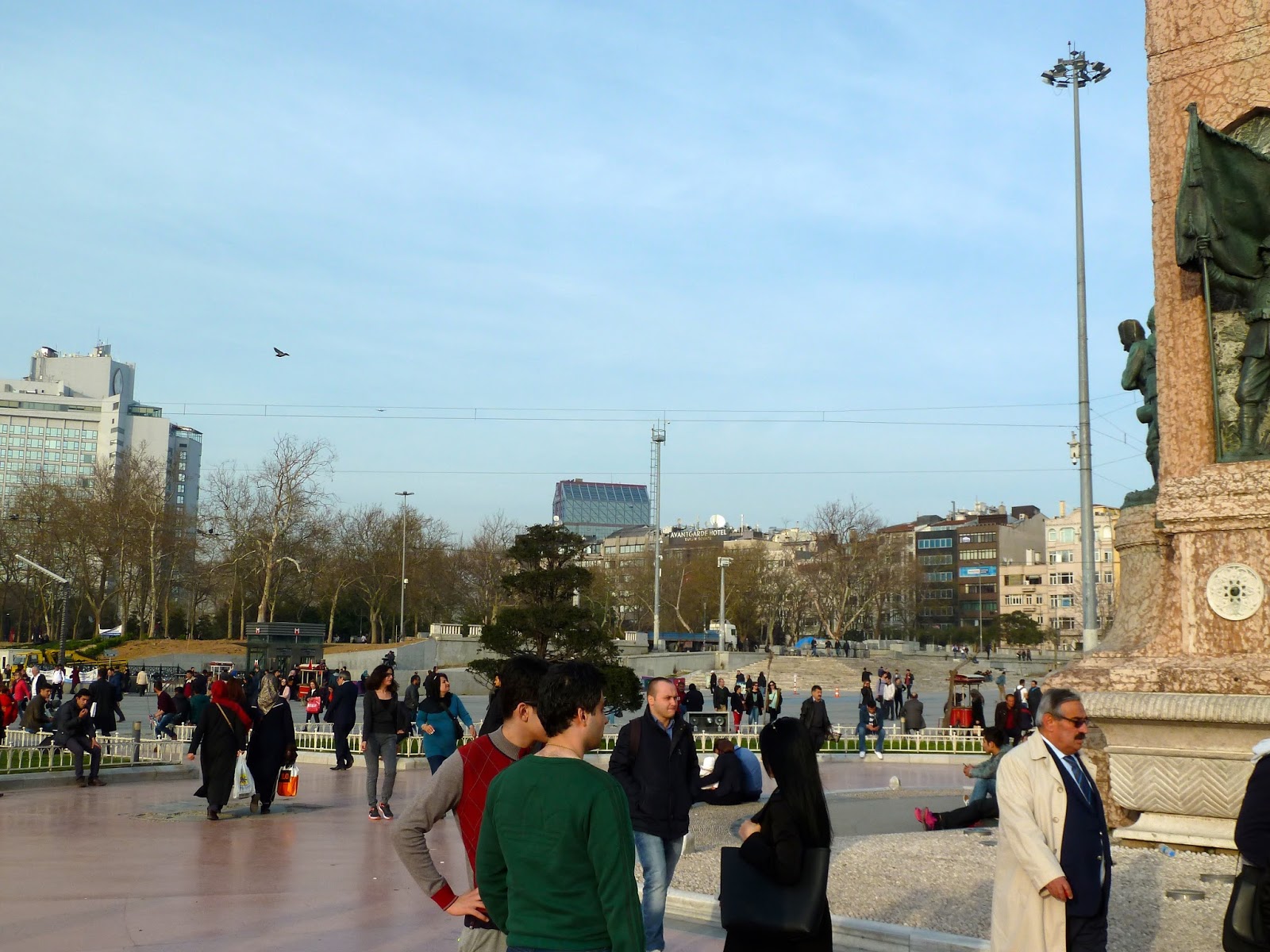
After this I decided to take a recuperatory walk on up Istiklal Cad to Taksim Square (left) at the northern end. I'm told that there are occasional demos here which quickly turn into riots involving well practiced and none too gentle police who cause stampeding rioters to swarm into the side-streets and it can all become rather alarming for any passing tourist. It didn't happen while I was there and so I don't have anything very exciting to write about.


Right: A statue of some military significance in Taksim Square.


There is a marvellous old tram system which chugs, slowly, up and down Istiklal Cad. It is a 'hop-on hop-off' and free service. It doesn't even have to stop for people to hop; no elf 'n safety nonsense here. I hopped a couple of times.


Right: Inside the old tram.

I was well entertained in Istanbul and visited several excellent and amusing restaurants. One especially notable one is a Georgian restaurant near the Galata Tower run by a charming Turk who, I think, had spent much time in UK. His wife is a Georgian who played old Russian/Georgian music on her piano and to which we were all encouraged to dance. The food was good also. It is that sort of place.

Having bought a few souvenirs including several boxes of Turkish Delight, that about concluded my short visit. I must say, I rather recommend Istanbul (and going there by train). It is a fun place for a city break.

The next day it was a fast journey by taxi to Ataturk airport, and I mean fast. My driver obviously fancied himself as a F1 pilot. I flew home, a 4 hour flight. Incidentally, having arrived at the airport with time to kill, I pulled off another coup by (again) inveigling my way into the VIP lounge. I'm getting quite practiced at this having worked on my 'technique' on many occasions, with several failures it must be admitted. It's always worth trying because once you're 'in' they are not going to chuck you out, and the freebie wine and food on offer is well worth the effort. 

Much of this journey was arranged for me by an excellent travel company based in London called 'Railbookers' and in particular a very helpful employee there, Gareth Jones, who had done this rail journey himself so knew the ropes. In hindsight it would have been relatively simple for me to have just bought the tickets as I went, point to point, but not being familiar with the eastern European rail system (thinking, mistakenly, that it would be as crowded, chaotic and unreliable as the British one), using Railbookers made it less of a hassle. I strongly recommend them.

Monday, 18 April 2016

UP THE BOSPHORUS

29th -30th Mar 2016


Ferries on the Bosphorus


A morning spent on the Bosphorus involved, unsurprisingly, a couple of ferry trips. There is a myriad of different sorts of ferries and cruise boats which ply the Strait and Golden Horn.
First a short trip over to the eastern (Asian) part of the city known collectively as Üsküdar. The main port area is called Kadiköy and nearby is the now defunct, but very grand, Haydarpasa railway station (left). 


This station was designed by Turkey's great ally, Germany, and built in 1909. It was Turkey's largest and busiest railway hub with much traffic out to Asia but was closed down 'indefinitely' in 2012. It is now a vast parking lot for unused rolling-stock. The building and platforms are 'out of bounds' but there is a little cafe open on the riverfront terrace.

Up the road from this is a large army headquarters (photography not permitted and knowing the reputation of the Turkish armed forces I wasn't going to risk it). In fact I only saw one uniformed soldier inside, who was sweeping the road. He must have been on 'jankers' while his comrades were out fighting Kurds or some such entertainment. Further on is the Marmara University university building and then the huge barrack like building in which Florence Nightingale and her staff attended up to 10,000 casualties at a time during the Crimean War. There is a small room in some far off part of this building (the size of at least 4 football pitches) which houses a little museum dedicated to Ms Nightingale but, as I discovered, it is indeed a military barracks and you need authorisation in advance to enter. Bollocks to that! Coincidently I had an old matron at school called Miss Nightingale, but I never asked if she was any relation. She might have been; she was very keen on disinfecting things which was one of Florence's strong points.

Anyway, onto another 'cruise' type boat for a short trip up the Bosphorus. It only went as far as the second, Fatih, bridge. I could have gone all the way up to the Black Sea but it would have taken most of the day and, on balance, there is not that much of interest that you can see from a boat and I had other things to do.
We passed several palaces such as this, the Dolmabahçe Palace on the western bank (left), which is famous for it's opulent interior, I'm told.


...and a few forts such as Rumali Hisari (right), built in a mere four months on the orders of  Mehmet the Conqueror in 1452 in preparation for his seige of Byzantine Constantinople. Apparently he appointed his three Grand Viziers to do this, each taking reponsibility for the construction of a tower area. If any of it wasn't completed in said four months the Vizier responsible would have his head cut off.  An effective incentive and one sadly under-used in UK nowadays. Needless to say it was completed on time (and within budget).


The afternoon was spent on a walk through the 'bazaar' area of the city (south bank). I decided to start off in the spice market and meander up to the Grand Bazaar which, according to my map, should have been quite straightforward. Needless to say, the place is a maze of small and badly marked streets and I got completely lost.

Left: Colourful spices on display, and there were many of these stalls. They must get through a lot of spices.


....some displaying mountains of Turkish Delight (right). Shops in all parts of the town displayed mountains of Turkish Delight, which may not come as a complete surprise I suppose.


 I eventually found my way to the Grand Bazaar. I had imagined it would be similar to the Medina Souk in Fez; you know, an inescapable maze of lots of little dusty alleyways with primitive canvas covered stalls flogging everything from carpets to camel dung manned by dodgy looking hook-nosed bandits and smelling faintly, and sometimes strongly, of often unpleasant substances. Nothing could be further from the truth. The Grand Bazaar is a series of flash and shiny clean arcades more reminiscent of Harrods than the Medina.


There were maps to guide you around, well signed arcades, a few smart cafés (thankfully I saw no MacDonalds) and even immaculately clean loos.


Some of the shops (and they are shops really, not stalls) sold very elaborate and expensive jewellery, gold and silver pieces, some smart clothes, carpets, handicrafts, anything you could think of and, of course, some cheaper tat. Sure, you haggled, but it often only brought a sky-high price down to just a very expensive price. I took a particular interest in a shop selling belly-dancer outfits complete with bells and tassels. I might have bought one as a Christmas present for someone if I could have afforded it, although I'm not sure there are too many opportunities to wear such garments on the British social scene nowadays. I ended up buying a Galataserai football scarf instead.
On my way out of the main archway exit/entrance two large black 4X4s with tinted windows and motorbike escorts pulled up. A fat moustachioed man and his fat wife got out of one, surrounded by burly bodyguards. Either this was 'Mr Big' come to collect his debts, or some Oligarch type come to do some shopping. The place obviously caters for the very wealthy.

The main post office (left) is an impressive building as are so many main post offices in far flung parts of the world. They are important places and they choose to look important. I remember admiring superb examples in Mexico City and Saigon. Other than the imposing architecture, this place has many well designated desk areas with, and this is seldom the case in Britain, plenty of staff to man them. No crowds and interminable queues. I had a few post-cards to buy stamps for and post. I was dealt with courteously and efficiently. On the down side, two weeks later, the cards have not arrived. Well, you can't expect everything.

Back over the other side of the Golden Horn on the hill in the Galata district is this imposing tower, the Galata Tower. Built in 1348 it has served a variety of purposes during the course of it's history and been damaged and repaired several times. Originally an observation post guarding the approaches to Constantinople, then in Ottoman days a fire station from which (when much of the city was built of wood) fires could be spotted and the fire engine accurately dispatched. It has also housed prisoners. It is now a tourist venue with a restaurant affording spectacular 360˚ views over the city (but no alcohol licence which rules it out of my list of eateries) plus an open air observation deck around the top. They charge 25 Lira (£7 equivalent) for entry which is a bit steep if you ask me.


Left: An example of a cat-loving local. So many damned cats! I've yet to discover why.


One thing I have yet to do is visit a Turkish Bath. Somewhat dubious about the prospect I was encouraged by my host to try it. I did, and will report the gory details in the next issue.