Wednesday, 12 October 2016

RIGA FINALE- AND STUCK UP A STEEPLE

7th - 8th Oct 2016


Blackheads House

Situated in the Town Hall square is the impressively ornate Blackheads' House (above). I remember there is also one in Tallinn. Originally built in 1344 it is was a meeting house for the Blackheads' Guild of unmarried German merchants (dread to think what they got up to). They got the name because their patron/founder was an African born Roman soldier. The original building was badly bombed in 1941 and then totally flattened by the Soviets in 1948. The blueprints survived and it was  completely rebuilt; completed in 2001, for Riga's 800th birthday. The statue out the front is of St. Roland. Who?!


Left: The ornate doorway with the carving of the founder, St Maurice, the Afro-Roman soldier, on the right side pillar.

There is an excellent Tourist Information office on the left side of this building....if ever you are passing.


Just to one side of this square is St. Peter's Church (right). I saw it advertised that there is a lift which takes you up the steeple and from which there are excellent panoramic views of the city. So I went in.......

The interior was rather dull and cavernous but with a somewhat weird display of contemporary art down one side, along with a few gloomy religious pictures on the walls. The only other people in there were a couple of old women in a side chapel, praying vigorously. I had the place virtually to myself. 
Ticket for the lift cost 3 Euros, sold to me by a hatchet faced  woman at the entrance and I had to climb steps for the first three floors before finding the lift ("why couldn't they start it at the bottom?", I asked myself). I was told to sit down and wait, by the lift operator. Anyway, nobody else turned up, so I got into the lift and up we went. Just me and the lift operator. I was deposited out onto a narrow little open-air gallery running around the base of the pointy bit at the top, and the lift disappeared down again. I was left alone. There was, as promised, an excelllent 360˚ panoramic view. I duly took photos, which took about 3 minutes, and waited for the lift to return. And waited. And waited some more. It was chilly up there with a brisk northerly breeze blowing. After 10 minutes waiting I was getting a bit concerned as to when the lift might return. There was no other way down. There was a metal man-hole cover bolted to the stone floor, and an iron ladder going further up inside the pointy spire. After 10 minutes I began to wonder if I had been left stranded. The lift man might have gone off for his lunch or he might have forgotten about me or, if he was waiting for more customers, I could be there all day....and all night! There was a button to push outside the lift door, but that didn't light up or seem to do anything. I pushed it firmly and often. After 15 minutes I was beginning to get rather cold and wondering what to do if nobody came, ever. I don't have a smart-phone which could connect me to the Riga Tour Office web-site. I didn't know what emergency number to ring. I was thinking I might have to call someone in England on my trusty basic 20-year-old Nokia telling them I was stranded up the steeple of a church in Riga. I suspect they might have just laughed. Perhaps I could start yelling for help at the ant-sized pedestrians below but, in the unlikely event of them hearing me, they would probably think I was one of those muezzins calling them to prayer. OK, after over 20 anxious minutes the lift did reappear....but it did seem a very long 20 minutes I can tell you. No punters got out and I was taken, shivering, back down. I suppose I got my 3 Euros worth.
....anyway, here are a couple of the pics I took.


Left: Looking to the north-west over the Daugava River.  Riga Castle is just to the right of the bridge and Riga Cathedral in the centre.


Right: South down the river over the bus and railway stations.


Left: Those four enormous hangar-like buildings were indeed German built hangars for WW1 Zeppelins. There is a fifth just to the left. They were imported from elsewhere in Latvia. They now house the Riga Central Market, and there is more open-air market spilling out behind them.


Each hangar, five of them, and they cover an enormous area, is full of meat, veg, cheese and all other kinds of foodstuff. There are also numerous spill-over stalls to the sides and behind. One hangar is completely dedicated to fish. I just couldn't fathom out how they managed to sell so much stuff before it started to go off. There is enough food in there to supply a city twice the size of Riga for a month!
Right; This is just the fish hangar....and not that many customers.

OK, I think that is about enough on Riga. Off to Vilnius, Lithuania, tomorrow by bus because, again, there is not a feasible railway system linking them.  I noticed in my guide-book there is a hotel in Vilnius called the 'Grotthaus'. I would dearly love to have booked in there, just for the name, to complete a trio of 'Schmelly, Draughty and Grotty', but it is obviously quite smart and outside my budget. I have settled for the more modest Hotel Panorama. All shall be revealed.
.

Tuesday, 11 October 2016

AROUND RIGA

6th - 7th Oct 2016


The Freedom Monument. 'Milda'.
The Freedom Monument, above, affectionally known as 'Milda', replaced a statue of Peter the Great in 1935. Along wth Estonia and Lithuania, Latvia has not had much freedom and independence. If it wasn't the Swedes, it was the Germans or Russians who ruled the roost here. They did gain independence between 1919 and 1940 and again in 1991. I expect they are hoping for a longer innings this time. They are now part of NATO and the EU so they should be safe...shouldn't they?

My wander starting at the Freedom Monument on the north-east side of the Old Town, took me south, then west towards the River Daugava, up the river side and to the north. The first thing I encountered on entering the Old Town at the bottom of Brivibas Bulvaris was, yes you've guessed it, that icon of Western (US) greed, gluttony and bad taste, a bleedin' Macdonald's. Not a good start.


Left: Looking south down the main drag, Brivibas Bulvaris, towards the Old Town, overlooking the Nativity of Christ Cathedral (gold domes) and the Freedom Monument at the far end of the row of trees. Photo taken from the bar on the top floor of the Radisson Hotel

As with Tallinn, I'm amazed to see so many churches of so many different denominations in these cities. Haven't a clue what they all worship, but it must keep a lot of clergymen employed. However, I have yet to see a Mosque. In fact, come to think of it, I have yet to see a Muslim.


Believe it or not the mayor of Riga, and the man who presided over it's 'Belle Epoche' between 1901-1912, was a Brit; a Yorkshireman called George Armitstead. By popular consent he was considered 't best bloody Mayor towns ever 'ad. He was responsible for 'joost abart all 't improvements, architecture and t'cosmopolitan elegance what's 'ere today. His statue, together with that of Mrs Armitstead and their dog, is outside the Opera House (right). Don't know how he got the job, but he obviously did the city 'reet proud'. The present Mayor of Riga is a Russian.

The Latvian National Opera Company is considered to be one of the finest in Europe, as is the Riga Ballet. Can't say I've seen either of them playing a match yet, but I'll take my informant's word for it.


Left: My meandering route took me past what I gathered are called the 'Three Brothers'. Three adjoining houses, architectural gems, in Maza Pils Iela that are from 16th, 17th and 18th centuries respectively.  They are still lived in. Small upper windows in the centre one due to property tax in the Middle Ages being based on window size.


For some unknown reason there was a group of Danish tourists standing here listening to a couple of chaps playing jolly tunes on horn and tuba. The Danes must have known the tunes because they started singing.
I'm sure I recognise the chap on the tuba. It's Bernie from Plaistow if I'm not mistaken.


Strolling on down an alleyway behind St. George's Church (13th century), I passed through the Konventa Seta (left), another courtyard containing what was a retirement home for widows of rich merchants..............


.......before turning into a little lane which led me to the Black Magic Bar (right); an 'Ye Olde Worlde' coffee shop cum bar which specialises in dispensing it's Black Magic drink...Riga Balsam.  Of course I had to try some. It is a highly alcoholic and 'warming' black liquid served in 'shot' glasses which, after swigging the first glass and having regained my sight, I seem to remember tasted rather nice. 


Left: Riga Castle on the eastern riverside. The official residence of the President. It didn't look much like a castle to me. Recently undergone renovations.


Right: The guards outside the front door on the east side of the building. They were ambling around in their hi-vis jackets and, frankly, looked rather scruffy. I think they could do with a bit of renovation.....and a good Drill Sergeant.


Along a street called Torna Ieta (Ieta being the Latvian for Street it seems) which was previously known as Jacob's Barracks (built on the orders of Peter the Great) but is now a long series of retaurants and bars. I stopped for lunch in a Latvian restaurant here and tried a local dish, grey peas and mush. It wasn't as bad as it sounds and the service, by waiters dressed as sailors, was both excellent and amusing. Then on to the Powder Tower (left).
This is (after a few rebuilds) a 14th century tower, the only one remaining of the original 18 around the city wall (which itself hardly exists now). It has served as a gunpwder store, a prison, a torture chamber, and a 'frat' house. It now houses a museum which details the military history of Latvia from medieval times to present day.

.....and what a confusing history it is. It certainly served to confuse me as to who ruled when and who was fighting who. I think the Swedes were the first to occupy the country, followed by the Russians up until the end of WW1, then a spot of independence before the Soviets took over, who were  kicked out by the Germans in WW2 when Latvians fought on both sides and after WW2 the Soviets were back again until independence in 1992. It mentioned things like the Molotov-Ribbentrop Pact in 1939. The same sort of story applies to Estonia and Lithuania. Anyway, this is not a history lesson. If you're that interested you can look it up. I later, the next day, went to the 'temporarily relocated' Museum of the Occupation of Latvia on Raina Bulvaris where, amongst several gruesome photos of dead guerilla freedom fighters in the Soviet days, it was all explained again. Baltic history would challenge a Mastermind Champion.


Nearby the 'Swedish Gate' (right), the only remaining gate from the 17th century when the Swedes were in power. It is set in the largest part of the original wall and not much of that left.


According to a model in the museum, this is what the original area looked like (left).


Then on up into what is known as the Quiet Centre through the neatly tended Kronvalda parks and past the City canal. Most of this area is very pleasant and would be marvellous in the summer I expect, assuming it's not too overcrowded with hung-over tourists. People were canoeing on the canal.


....over a Soviet style piazza dividing the parks....


.....and into Alberta Iela (right), named after that famous character who founded Riga in 1201, the German Bishop Albert von Buxhoeveden. Try saying that after a few Riga Balsams. This and the surrounding streets are notable for their interesting, indeed  intriguing, Art Nouveau architecture (right). So much extraordinary detail.


Left: It wasn't all charming Art Nouveau in this area. I passed through an adjoining street in which the houses looked decidedly 'Art Abandoneé'.

I was told that just nearby is the Albert Hotel with a 'Sky bar' from which one can get excellent views. I found the Albert, it did indeed have a roof-top bar, but it was closed for a private function.

This concluded my semi-planned route for the day. I will repair to Paddy Whelan's for a well deserved bit of Latvian refreshment. There are  a  few more places of local interest to visit tomorrow.


Saturday, 8 October 2016

ON TO RIGA

5th - 6th Oct 2016


The bus journey from Tallinn down to Riga took 4½ hours and cost a very reasonable 19 Euros. They go once an hour; I caught the 11.00am departure. Still can't understand why their trains don't operate a service south, but c'est la vie. Maybe they will in future. Anyway, the bus was comfortable; it had free WiFi, plugs for chargers and entertainment consoles at every seat and loos which were clean and worked. The main road, the E67, took us all the way down the coastal east side of the country. It was a single carriageway road but in good nick (paid for by the EU no doubt, i.e. us) with no roadworks or traffic jams...a smooth steady 70kph all the way. We had a five minute leg stretch in the seaside town of Parnu, about half way down. Parnu is a popular holidy resort in summer, noted for it's pleasant beaches and 'mud treatments'. Can't think why I would be tempted to leave the countryside of England for mud treatment....we have enough already thank you. We crossed the border somewhere but I failed to note where (no stop) because I was heavily engaged in playing Backgammon against my 'entertainments console'. 

The countryside is flat as a pancake all the way. There is, however, a noticable difference between the landscapes of Estonia and Latvia. Estonia has a lot neat and well tended arable, animal and grass farmland, with pretty little homesteads and villages dotting the scene. From what I could see from the bus (trees) Latvia is entirely covered in forest. I remember now that Estonia is noted for grain exports and Latvia for timber.

It took us about 30 mins to negotiate the straggling and rather drab outskirts of Riga before arriving at the central bus station, co-located with the railway station. I wish UK bus and train stations were like that.
My hotel, the Radi un Draughi, was fortunately only a 5 minute walk away. From the 'Schmelli in Tallinn to the Draughti in Riga'; what next...the Dinji perhaps.

Riga is a larger city than Tallinn and, as with Tallinn, has a central cobbly medieval and 'Baroque' (whatever that is) 'Old Town'. Having checked into the hotel I decided to soak up a bit of the local atmosphere, and beer, in the nearby Paddy Whelan's Irish Pub (left) where I enjoyed a refreshing glass of the local Guiness.

On my first walkabout that afternoon my initial impression was that the place somewhat lacks the charm of Tallinn. The 'Old Town' is smaller and exists for about a kilometre up the eastern bank of the river Daugava which  bisects the city. As norm, loads of churches and a couple of cathedrals, many bars, restaurants etc. but as it is all very flat and no left-over city walls to contain the area, it doesn't have quite the same character and wasn't as clean or well manicured as Tallinn. The fact that the weather was cool, grey and overcast...some drizzle...didn't help. I also noticed that it has a more 'Soviet' or Russian feel to it. Estonian, Latvian and Lithuanian are all separate languages and peoples, but here one heard a lot of Russian being spoken. I am told that there is a large proportion of Russians, or locals who like to be Russian, in Latvia; perhaps almost 50%. I suspect Mr Putin could count on a lot of support!

Don't get me wrong, it all seemed quite jolly and cosmopolitan even if a bit brash in places. The old mixed with the new, and I suspect it is much more attractive in the summer when delightful British  stag and hen parties are popular. The city also has the reputation of  being at the forefront of the 'Art Nouveau' architecture movement in the early 20th century.
Right: Is this Art Nouveau architecture? I will have to swat up on that before passing comment.


Before an early night during a quick wander, I passed the enormous Riga Cathedral in Doma Laukums Square (left). It the largest medieval church in the Baltic. Once Catholic, it is now Evangelical Lutheran, whatever that is.


Right: Sitting at the corner of this Cathedral was a chap playing a 'cello to an audience of zero, and I didn't count because I took this from a long distance; zoom lens and all that. When I say playing, he was dragging his bow across the strings and making a dismal funerial tuneless noise. Perhaps this was Art Nouveau music, but I wasn't terribly impressed.


Left: Latvian and Riga City flags.

The aim tomorrow is to do a walk around the whole Old Town. It's not that extensive, and I will report back with my  usual less than erudite and inaccurate observations.


I have been warned that some of the bars around where I  am staying get a bit noisy at night, but I'm not staying up late and  am a heavy sleeper. I hope my snoring doesn't disturb them too much.


Thursday, 6 October 2016

TALLINN 3

4th Oct 2016
The Tallinn Hippodroom. Not exactly Ascot.


Having an interest in horse-racing I decided to take a wander out to the local race-course, or 'Hippodroom' as it's known here. Unlike the Nordic countries, horse-racing in the Baltics is not very widespread. Indeed I believe that they only go in for 'trotting' or 'harness' races which  involves the horses pulling  a buggy, or 'sulky' on which the 'jockey' sits, around a dirt track. Sort of horse and cart racing if you like. For some reason they don't go in for proper horse-racing. As far as I can see there is only one of these tracks in Estonia and another in Lithuania. It would seem to me easier to put a saddle on the horse's back and ride it.


While I was there some of the horses were being exercised. They only have race days on alternate Saturdays. I really have no idea as to the quality of the 'racing' but suspect it is more of a gambling medium than a sport.


When not in their stables the horses seem to be turned out on mud (right). They looked well enough despite that.

The stables, indeed the whole racecourse set-up, looked very dilapidated. Some of the buildings were falling down and bits of broken down cars, smashed up sulkys and machinery littered the place.


I saw very few poeple about, but eventually tracked down a girl who had been excercising some horses. She was called Anna and very charming and chatty. She was so busy as she had 19 (yes 19!) horses to look after that day, single handed, and was talking to me as she harnessed up another horse. Complicated harness for these trotting sulkys. She had to exercise most of them, muck out the boxes, sort out the stable, clean the tack, do the feeding etc. all on her own. Apparently a friend sometimes comes along to help but not today. Phew! Left: Her taking one of her charges for a spin.


Right: More horses on their mud patches. I saw several being excercised but, for the life of me, I couldn't find where they went afterwards...and I looked. Into the woods maybe? Anna was the only rider, groom, stable person I could find on the whole grim looking site. 
I was told she also looked after livery riding horses for clients...in her spare time. 


 .....and a couple of wee Shetland ponies were tied up on long leads  alongside the track. Not sure what their purpose was.

Next a taxi ride out to the seaside on Tallinn Bay, just north of the town. I must mention here, and give credit to, the Tallinn taxi drivers (that I used) who were totally honest, pleasant, with good meters, gave receipts if you needed them and were relatively cheap. 


I had read of the Lennusadam Seaplane Harbour out at Kalamaja. This is a vast triple-domed reinforced concrete hangar built in 1917 to house the original Baltic (British made) seaplane fleet. It has something of a Bond film villain's lair feel to it. It has been restored and now houses a maritime museum, plus some other weaponry. I had only intended to have a quick look around but, because there was so much to see and play with, I spent 3 hours there. Right: a poor pic of the main gallery.....that's a submarine on the right.


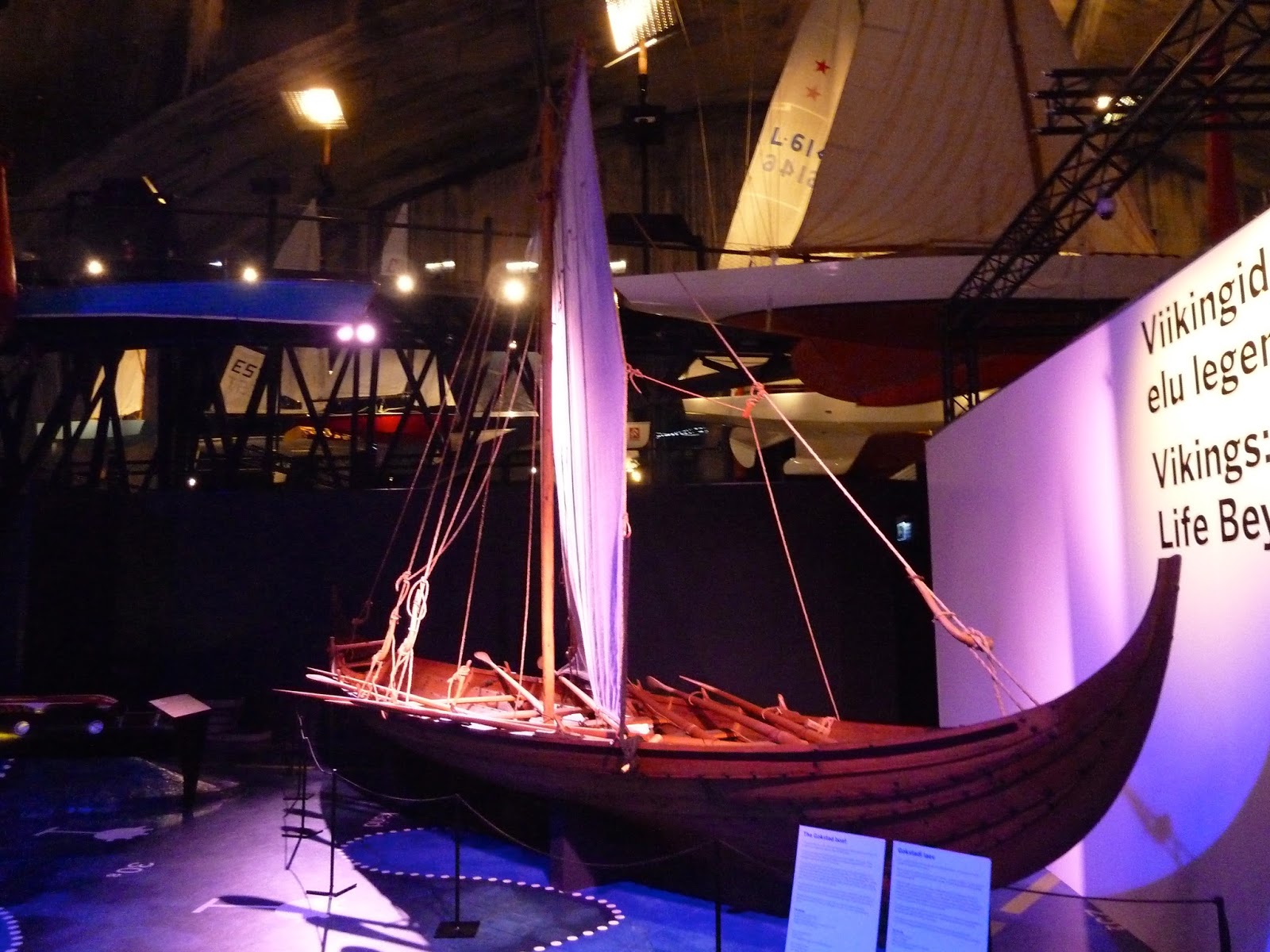
There is a curious and varied amount of stuff on display, ranging from ice-racing yachts (left), to nautical buoys, ship's anti-aircraft guns, ship's guns, old racing yachts, mines, and a large display of Viking history, plus many interactive toys and games for children of all ages (including me) .


Right: One of the original (or maybe reconstructed) 1st World War seaplanes, a Shorts 184 made by Shorts Bros, UK, in 1915. I had no idea!


Left: Many types of anti-aircraft guns were on show including this Soviet ZSU-57-2. A blast from the past.


Right: A Viking fishing boat.


Several interactive displays kept me occupied for far too long. These included identifying an enemy ship and firing a torpedo at it (I failed despite several attempts), a realistic biplane flight simulator aiming to fly, á la Red Bull competition, through a slalom course (failed several times), an anti-aircraft machine gun (left) to shoot down incoming aircraft which exploded realistically if you hit them (not as easy as it looked...I was rated 'well below average - more training required'), a 'round the world' deep sea trip in a bathysphere, sailing a model container ship around and into a harbour (crashed) and many more. You get the picture.


Pride of place in the main hall is the Estonian submarine EML Lembit (right). This is a Kalev Class submarine built in 1936 by Armstrong Vickers at Barrow-in-Furness, UK. It is one of two built at the time for the Estonian Navy. It's sister ship, the Kalev, was sunk in 1941. The Lembit served through WW2 and was subsequently used by the Soviet Navy in their Baltic Fleet. It was the oldest submarine in the world still afloat (if that's the correct expression for a submarine) until finally taken out of the water in 2011. 


We were free to wander around inside. I know diddly-squat about submarines and found it all quite interesting. Being rather out of the tourist season, and there weren't many visitors in the museum while I was there, I had the ship/boat to myself.
Left: The torpedo tube compartment, at the front end, obviously.


The Captains bunk. He lived in some comfort. All the rest of the crew (there were 7 Officers and 31 sailors on board in Soviet days) slept in bunks hanging all over the place or on top of any flat surface. It must have been quite a squeeze in there. I hope they had a good ventilation system.


Left: The operations control centre. Periscope and ladder up to the conning tower at far end.


Right: The galley.


Left: The engine room, at the back end, obviously.
You may wonder where the loos are. I counted three, in little alcoves, one at front, one next to the Mess room and one at the back. Don't know how they worked. I couldn't see any showers or, indeed, any facilities to have a good wash.


Right: The Officers' Mess. I expect they had white gloved livery attired stewards in attendance, a well stocked cellar and all the Mess Silver on display at Dinner.


I will probably regret showing this. We were encouraged, well the kit was hanging there, to dress up and have our photo taken. This was fully automated and didn't cost anything. Very clever, the camera clicked and it sent a copy directly to my computer mail box. 
There were lots of other much sillier uniforms to choose from. Nobody was in attendance so, if this had been in UK, all the costumes would have been nicked in ten minutes flat. 


On my way back I decided to drop in at the Telliskivi Creative City. This is advertised as the 'cutting edge' of avant garde alternative shopping, art and creative activities. It is a series of reclaimed and restored factory buildings which were in a previously dodgy industrial area on the other side of the railway from my hotel. Lots of trendy bars and cafés and craft shops flogging a miriad of odd things, plus artists' studios and antique shops. It was getting late when I got there and some of the shops were closing (not the bars). Maybe worth another visit if ever I return.


Right: The walls around the area were festooned with some rather clever 'wall art'.


Left: More wall art. This one was about 30' high.


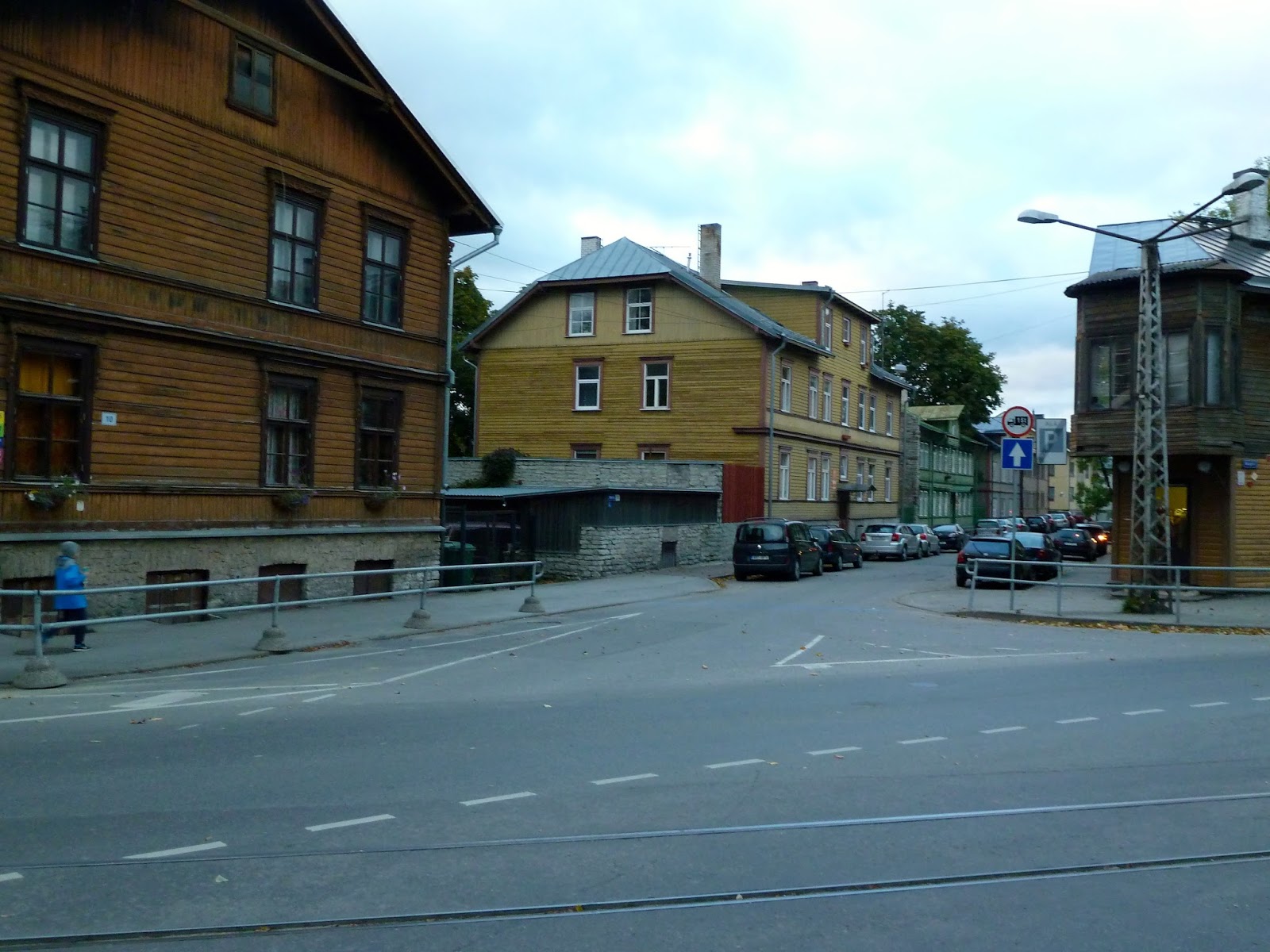
Interestingly, a lot of the streets in the outlying areas consisted entirely of 'clapboard' style wooden houses as per photo (right). I believe this is a common feature of Baltic towns, and, as I discovered previously, in many Nordic towns and cities as well.


Off south to Latvia tomorrow. I had hoped to go by train. There is a smart 'International' railway station with swish looking trains just next to my hotel but, as I discovered, there is no service operating between Tallinn and Riga during the week. No problem if you want to go to Moscow, St. Petersburg, Baku or any place east, but not down through the Baltics. There must be some political reason for this...I don't know.

Anyway, I am assured there is a good bus service. "Hold very tight please. Ting Ting!". So, as they say (apparently) in Latvian "Turpināsies Rīgā".