Wednesday, 23 May 2012

UP TO KIRKENES - NORWAY

19th - 22nd May 2012

A semi-frozen lake with forest
There were only five of us on the bus north out of Rovaniemi for the 8 hour trip to Karasjok, just over the border with Norway. We may have collected and dropped a few en route.


As maybe said before, initially we passed through the rather forlorn and deserted SantaLand Inc. and up lots of not very interesting forested countryside, with some parts tundra-like  ( left ).


Right: Forested countryside, plus lakes, a la northern Finland. All very pleasant in it's own way I suppose, but a touch monotonous.
Not even much animal life to see. The reindeer were mostly away somewhere in their herds and any domestic animals ( they do have cows and sheep I was told ) are yet to be let out into the fields from indoor winter accommodation. Actually I didn't see many fields in northern Finland. No elks, wolves or any other interesting wildlife on parade.


A couple of hours out of Rovaniemi we had a coffee stop at a shopping mall in the middle of nowhere at which everything was closed except, luckily, a small cafe and that was a few hundred yards from where the bus stopped. Left: Lots of these skidoos/snowmobiles were left parked around...somewhat redundant at this time of year. No risk of joyriding I suppose.  
We crossed the Norwegian border without any checks, or checkpoint for that matter, just south of Karasjok. This town's main claim to fame is that it is the 'capital' of Norwegian Lapland, and home of the Sami Parliament. The Sami ethnic grouping has become quite powerful in northern Scandinavia due to some successful challenges to Norwegian industrial enterprises which would have damaged the reindeer herding and salmon fishing interests of the Sami tribes. Good on them.
Karasjok is otherwise a very unremarkable place and gave the impression, this being a Saturday, that it was almost completely deserted and most of the few shops and facilities were closed. The major hotel here, the Rica Hotel where the bus stopped, proved to be, as most places in Norway are, iniquitously expensive.
They were expecting NOK1500 ( Norwegian Krone of which there are 9 to the UK£ ) for a single, nothing special, room. Half a pint of cat's piss lager here costs NOK80 ( which works out at about £18 per pint! ). By the cringe, that is testing one's gullibility to breaking point I thought. I had a magazine which gave the name of a local guest-house. After about a 25 min walk I found it and they were happy to put me up for NOK300 for the night. That was a bit more like it! The room on offer was fine. Admittedly I had go back to the hotel ( 20 mins ) and drag a couple of suitcases quite a distance across country, down 80 steps, through a wood ( short cut ) and 2 kms along a deserted major road ( 30 mins ) because no way was I going to pay Norwegian taxi rates...it would probably be cheaper to buy a car. I regarded it as good exercise.
Forgive me a little rant here. Considering you ( or I do, anyway ) spend about 80% of your time in a hotel room asleep, there are only a few things which really matter; a comfy bed in a clean room, a working loo, a wash-basin, a shower with hot water and....that's about it. The only major differences that are offered by a vastly expensive 5 star joint are gold taps on the bidet and a frighteningly expensive 'mini-bar' which nobody in their right mind should consider using. My little guest house was comfortable, had all the basics and even had a HD satellite TV with CNN ( not that I like CNN much, and that might become the subject of another whinge later ) and even free Wi-Fi. So why pay 5 times the price for bugger-all use extras? Who bloody cares what the wallpaper, carpets and pictures on the walls or the decor in general looks like! You can't see them in the dark anyway...not that it gets dark in this part of Norway at this time of year and, admittedly, the curtains in my guest-house did little to keep out the 'midnight sun'. In fact the expensive hotels often charge you extra for internet and other services. So, I reckon most of the time you are being completely ripped-off by very expensive hotels. On the other hand, its fine being pampered with unnecessary luxuries as long as someone else is paying! I had a comfortable night.
Off by bus again the next afternoon to Kirkenes, the most north-easterly port in Norway, not far from Murmansk, in Russia, as it happens. I had a bit of time to kill before leaving so thought I would do a recce of Karasjok. It was incredible how little life was visible, either human or animal. It was Sunday, I suppose, so much lying in was being done and there is a little church which might have been packed to the rafters for all I knew; but otherwise the only place which showed any sign of human habitation was the local filling station where I bought a sandwich for the ongoing journey. Everywhere else was firmly shut. I walked around this uninspiring town/village ( hence no photos ) and eventually saw a shambling figure in the distance. Out of curiosity, if for no other reason, I wandered across; I would ask 'where the bus left from' as a harmless and vaguely sensible question to which I hoped I already knew the answer. It was soon apparent that this gentleman, for he had a white beard but maybe that's no definite marker in this part of the world, was incredibly old and stooped with no teeth, spoke not a word of English ( or possibly any other known language for that matter ), and seemed, not to put too fine a point on it, 'one sandwich short of a picnic'. He even began to look rather aggressive and started to dribble and spit at me. OK, I know I was a stranger in town but I didn't feel prepared to stay and further antagonise the old chap, or troll, or whatever.
The bus journey initially followed the river Tana which marks the border between Finland and Norway.
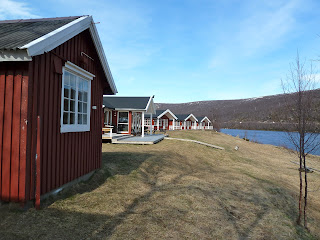
Right: A series of fishing huts along the river Tana at a place called Lavajok. The salmon fishing on this big powerful river is apparently excellent in the months of June and July.
What next; we arrived in Kirkenes at about 7.50pm and, with the help of the bus driver, I booked into the only hostelry which offered reasonable rates.
I'm sorry if this journal is getting a bit boring and repetitive, and  maybe I should make up a few horror stories to keep myself, and anyone else, awake and amused, but I won't. This is for my record and I really am not going to elaborate or invent. So bear with it. Something interesting might happen soon.
I spent that, and the following night here. It is a decent place; the Barents Frokostel. Recommended ( not that there's much choice ) if you ever need accommodation in Kirkenes.
During the day I did something which, later, I did not regret. I went into the local wine shop, there is only one, and bought some victuals at quite expensive prices.
Not a lot on offer in the port town of Kirkenes, and it was grey skies, windy and cold. However, the reason for me getting here was to catch one of the Hurtigruten cruise/mail/cargo ships which sail daily on the six day north coast route between Kirkenes and Bergen calling at 31 stops in between. This was to be the last major 'leg' of my round-the-world voyage. It had better be good! All aboard.............

Monday, 21 May 2012

ROVANIEMI - FINLAND

18th -19th May 2012


Rovaniemi is 5 miles south of the Arctic Circle which, as you should know, is at latitude 66º 32' North. I was only stopping here because one has to on the journey further north. The railway line ends here and the bus routes onwards don't operate until the next day. I decided to give myself a full day to look around nevertheless.

The train journey up here was again most comfortable and took about 10 hours from Helsinki. The double-decker train had a decent dining car ( left ) and even good WiFi which I used to catch up on a blog or two behind. It passed the time pleasantly enough.
Quite interesting to note the relatively flat countryside which consisted of much forest and lake. I was made aware that 86% of Finland is forest and lake. We passed a few parks in which I saw several people doing this extraordinary excercise which consists of walking with exaggerated strides using ski-poles to push yourself along. It looked like langlaufing without the skis. Weird!

Rovaniemi is most popular around the Christmas period because it seems to have appointed itself as the home of 'Santa Klaus' and has made a highly profitable business out of it too. There is a large airport nearby. Swarms of tourists ( and children ) come here to visit Santa Village, Santa Park and, even more curiously, Santa Technology Park which are all parts of a big 'theme park' just over the Arctic Circle about 6 miles north. There are 'authentic' colourfully dressed Laplander ( Saami, or Sami ) tribes-folk in local villages to flog you souvenirs,  hundreds of reindeers, huskies and sledges pulled by either, skidoo expeditions, lots of bloody jingle bells and of course the visit to see Santa. I suspect there is more than one. This Festive Fandango ( some might mention rip-off ) rather depends on Christmas and lots of snow, which they certainly get for most of the year. Right now it has all but melted and so the theme park looks somewhat deserted. No doubt Santa and many of his faithful Saami tribesfolk, and trusty elves, have decanted to their holiday isles and yachts in the Bahamas to enjoy their Christmas profits in sunny climes with hot and cold running flunkies and scantily clad hostesses. Not a lot of them in Lapland!

The only sight I had of all the winter goings on was at the local 'Arkticum' museum. I must say the Saami tribes folk do have some pretty garish outfits. I suppose to keep them warm and easy to spot out in the snowfields. They can't all work in Santa's theme parks.


The Saami tribes, and there are many dotted around northern Norway, Sweden and Finland depend on fishing, hunting and herding reindeer ( and tourists ) for their survival. They have their own tribal dialects and languages. They live in what look like wooden sided tepees. I never got to see any of these people or their villages. I suppose I might have done if I had gone to Mustique.


Left: Reindeer feature widely up here. They can live at incredibly low temperatures and can dig through the snow to eat moss. They are primarily used for pulling sleds and being eaten. Their horns make nice knife handles and their skins for clothing. On my journey north of here I passed the mostly deserted Santa theme parks and for some hours only saw one poxy reindeer. The infamous Lone Reindeer, I presume.
Left: These ones are stuffed.


Right: Later on, approaching Norway, we saw a few more. There were no vast herds of them sweeping across the tundra, that I noticed, but I don't suppose its the right season. Anyway, why should they be near a road when they have squillions of acres of open space elsewhere. They are probably kept under the watchful eye of the herders anyway.


The weather up in Rovaniemi was not bad; even sunny when I arrived, and a bit drizzly the next day. The most significant meteorological feature up here at this time of year is that it doesn't get dark at all. It is slightly disconcerting to wake up at 1.00am and look out on bright daylight. Left: Of course the opposite is true in winter when another attraction is the Northern Lights ( Aurora Borealis ). There was a demo of these lights in the museum where you lay down on a comfortable mattress in a warm dark circular cinema and the lights were played out above you. Saves freezing your gonads off out there on a winter's night at minus 35ºc.


Other animals which feature in these parts include elks, bears, arctic foxes, snowy owls and wolverines. On my travels I didn't see any of them. Just the Lone Reindeer ( and a few nondescript birds ).
The first meal I had in the town was a small dish of marinated raw reindeer meat with mushrooms and fried berries. Interesting taste and texture. Of course reindeer features on all the menus including reindeer burgers.


Left: The museum features a polar bear, but I'm sure they don't exist in Scandinavia, do they? Apart from this stuffed one and maybe a few in zoos of course.
Lots of other quite interesting features in the museum about ice, and the history of Rovaniemi.


Right: There were lots of these little people dotted around. I think they represent some fabled Lapland folk. They were rather charming in a funny sort of way. This one reminds me of someone and I daren't say who!


Left: Plus some notices displayed amongst them which were written in Finnish and English and contained some apt sayings. I have only bothered to learn two words of Finnish; "kiitos", which means "thank you" and "kipis" which means "cheers". The only other main language which resembles Finnish is that spoken by the Magyar people of Hungary. Both peoples emanated from the same area of central Asia, moved west and then split north and south.
It is an interesting language and sounds like nothing else around the area. So many words end in the letter 'i'. For example: hotelli, kioski, polisi, saami, taksi and, indeed, Helsinki to name but a few.
Continuing the M. Python theme "You're so near to Russia, So far from Japan, Quite a long way from Cairo, Lots of miles from Vietnam.....".
Onwards northwards... to Norway.


HELSINKI - FINLAND

15th - 17th May 2012

Senate Square Helsinki
"Finland, Finland, the country where I quite want to be" ( c/o M Python ). The landscape en-route changed subtly on leaving Russia. Still lots of silver birch trees but the countryside houses looked much more prosperous and there were neat and cultivated fields. Not a lot of those seen, by me, in Russia. So arrived at Helsinki station by speedy Allegro train on the dot at 1355hrs (L)  


Left: A cheerful looking place with lots of greenery about. I got a city map at a very helpful tourist info office at the station. Most things seemed in easy walking distance. Not a particularly big city is Helsinki. Population 561,000;  about the size of Sheffield.


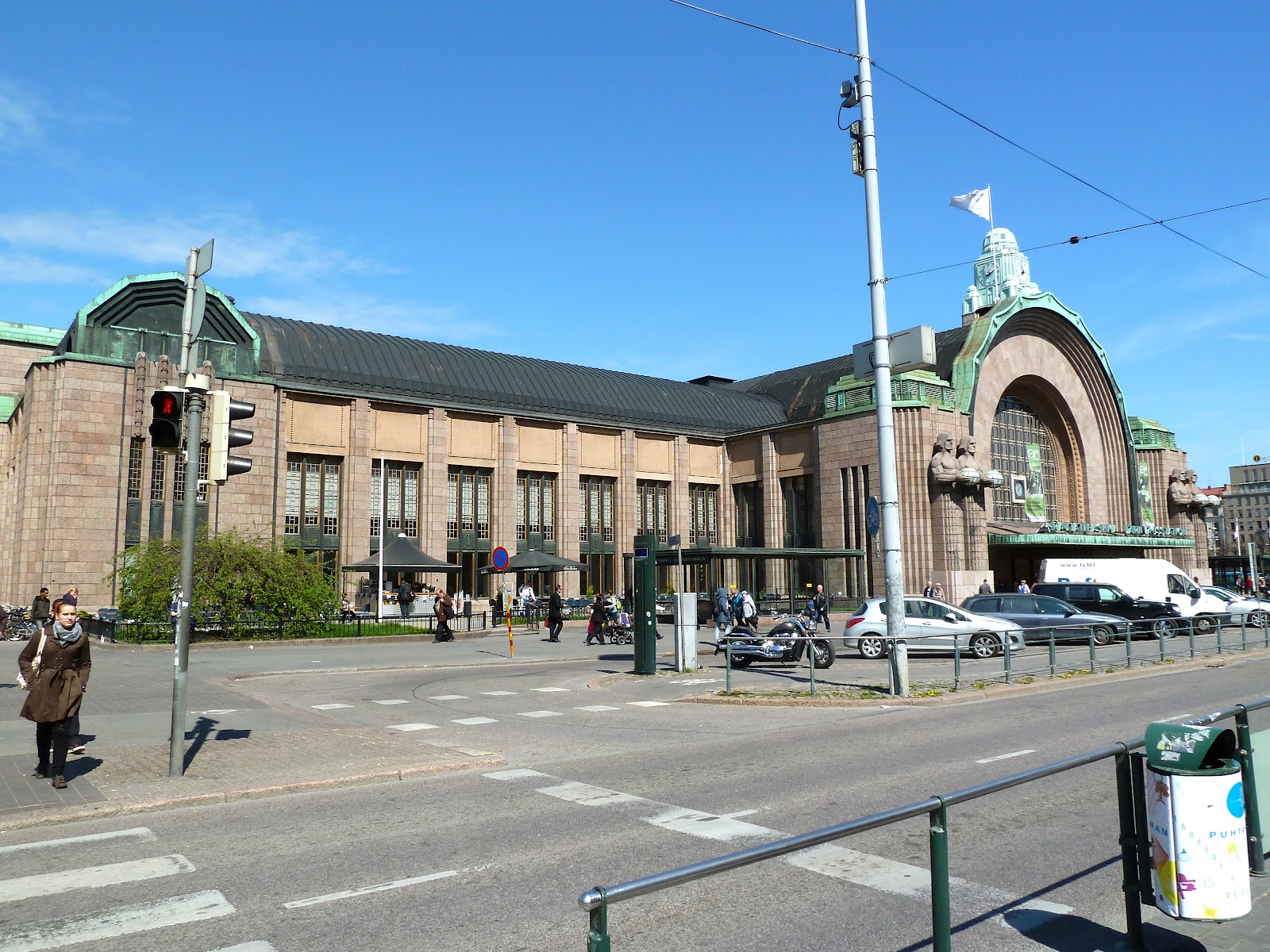
Right: Helsinki railway station. A pleasant enough looking place. Very efficient ticket office set-up as I experienced later.


Left: Entertainment on the street. This accordionist and his floozy were rather good. They played and sang jolly tunes. Finland is in the EU so they were probably from Romania.


Right: Difficult to capture on a photo, but one of the things I noticed was that a lot of the Helsinki citizens  were very well, indeed elegantly, dressed. I saw many business types both young and old, well groomed and with rather well fitting expensive looking suits and ties. I got the impression they take their appearance seriously.
Lots of eating 'al fresco'. It was cool outside, but probably a heat-wave by Finnish standards. The food and drink at these smart cafes was not cheap.


Left: Several well appointed and spacious streets with, in this case, a park down the centre. The streets all have their names written in Swedish as well as Finnish. I was told that Swedish is an official language here. I presume it comes from Finland's complicated history when they were once part of Sweden, then part of Russia and, during WW2, occupied, with the willing acceptance of the Finns ( to keep the Ruskies out ) by the Germans. I think they are safely independent now...so why Swedish? Don't know.


Right: This one, Esplanaadi, had a bandstand on it. The 'youth' Big Band was belting out some good music a la Glen Miller. There was a decent sized audience too.


Left: For some reason there were several of these street-side stalls all selling the same stuff;  big strawberries, peas in pods and blue-ish berries of some kind ( are they mulberries? I noticed a lot of mulberry jam and wine in shops ). It must be the season for all these I suppose.


Right: ...and many 'Kioskis' like this picturesque little place selling ice creams and suchlike. There were so many 'kiosks' that I though the word might be Finnish in origin. After all, the Finns haven't exported too many words have they? I looked it up and, would you believe,  the origin of the word 'kiosk' is thought to be Persian.


Another observation. Most of the many statues of people I have seen, worldwide, have a bird sitting, and shitting, on their heads. If they are inland the bird tends to be a pigeon. If they are by the sea ( i.e. Helsinki ) the bird is a seagull, as per this one ( left )......Haven't a clue who the statue is of.


.....and this one, in Senate Square. Alexander 11 of Russia, I believe ( the Tsar who was assassinated ). How many famous Finns are there anyway? I remember Lasse Viren ( the runner ), Matti Something ( ski jumper ), Sibelius ( composer ), Mika Hakkinen and two Rosbergs ( F1 drivers ), Armi Kuusela ( Miss Universe 1952 ) and Santa Klaus. Can you think of any others? I'm sure there must be some more.
By the way, when they come to erect a statue of me I shall insist that it features me wearing a large wide-brimmed hat, or one of those Imperial German helmets with a spike on the top.


The main harbour is another pleasant area, just off the city centre. Several cruise liners were docked there and there are lots of ferries which call in on many routes around the Baltic. Left: This old lightship was tied up alongside and is a museum-cum-cafe. Some weird exhibits.


Right: Sitting on the side was this rather gruesome deep sea diver. Can't work it out.


Left: Spot the rat. Not too long spent in Helsinki, but long enough to get a feel for the place. It is quite expensive, as is all Scandinavia, but most civilised and the people I met seemed to be remarkably polite, cheerful and helpful. I expect their morale goes up as spring gets under way and the days, and nights,  become light.


Next stop up north, initially to the town of Rovaniemi which is 5 miles this side of the Arctic Circle. Another smart double-decker train.
Continuing in the vein of M Python "...You're so sadly neglected, and often ignored, a poor second to Belgium, when going abroad" etc. etc.


Thursday, 17 May 2012

ST PETERSBURG - RUSSIA

12th - 15th May 2012

The Winter Palace and Hermitage at St Pete
The train left Leningradsky station, Moscow, at 2300hrs and arrived at the Moscovsky station, St Pete, at 0650hrs the next morning. I shared my compartment with a helpful young chap who worked for an oil company and a rather strange lady who was somewhat dour. I couldn't work out how old she might be. She had a very youthful body but an old looking face. Odd maybe, but none of my business I suppose. As the custom goes, myself and the oil chappy vacated the compartment while this young/old lady changed into her jim-jams. I slept well; can't speak for the others.
My first impressions of the city were good. I got off to a promising start by negotiating a reasonable price for the taxi from station to hotel and the taxi driver was cheerful, polite and didn't try to rip me off. The secret with these taxis ( which don't have meters ), I have discovered, is never to get one just after your train has arrived. Wait; go and have a cup of coffee and hang about until the station is, as far as possible,  clear of incoming passengers. Then any remaining taxis standing idle are more amenable to offer a good rate.


Left: At first sight the place reminded me a bit of Amsterdam; there were lots of canals linking up a complex river and docks system with pretty bridges and elegant canal-side buildings. I was told that Peter the Great was enormously fond of water in the form of canals and fountains. Many of his wilder plans to make many more canals throughout the city were shelved after his death.
Canal and river boat tours of the city were obviously popular.


Right: Lots of bars with curious names such as this one which was dedicated to Oscar Wild of all people. I didn't go in. The clientele in there might have been a bit suspect.


Left: Nevsky Prospekt which is the main drag through the city leading west for 3 miles from the Admiralty to the Alexander Nevsky Monastery. It looks a smart and prosperous street with lots of bars, restaurants and hotels. It is the focus of much nightlife, celebrations and parades.


Right: My hotel was opposite this opulent edifice, somewhat similar to St Basil's place on Red Square, called The Church of the Saviour on Spilled Blood. It was thus named because in 1881 Tsar Alexander 11 was blown up and killed on this spot by a disgruntled subject. Actually he was dragged back mortally wounded to the Winter Palace and pegged it there. The coat he was wearing at the time is on display at the Hermitage. It looks in need of much repair work.

My first priority ( the Hermitage could wait ) was to visit a museum in the east of the city. This place was in part of a VD clinic and has amongst it's exhibits, according to my guide book,  Rasputin's willy. I thought you would appreciate a photo of this important relic. Sadly, when I got there after quite a long walk, the museum was totally bloody zakrito and had been since last September! What a blow. Obviously Rasputin's plonker was not a big enough pull ( at 30cms ) to keep the place going. I wonder what they have done with it. Maybe it's in the Hermitage somewhere. I determined to find out.

Left: The next day I duly went to the Hermitage ( which includes the Winter Palace ) and has the large Dvortsovaya Ploschad ( Square ) in front which, as I arrived, was hosting a big running event, might have been a marathon, starting off to great fanfare with bands and dancing girls. I never really discovered which bit was Winter Palace and which wasn't. The whole place is linked up by a series of long interconnecting passageways on three floors. There are about 350 rooms with exhibits or just Imperial State rooms as used by the succession of Romanov Emperors and Tsars. Much of the collecting and expansion of buildings to accommodate this vast treasure trove was done by Catherine the Great. She had a good reputation as an Empress. There are exhibits ranging from Sumerian tablets, Egyptian mummies, Roman statues, Imperial furniture, artefacts, jewellery and portraits, through paintings by Leonardo da Vinci and Carravachio to modern impressionists. It would take a few days to see all the 3 million items on display....and there is much much more stuff kept in storage which they alternate with current exhibits ( especially the more modern paintings on the third floor ).
I was warned to expect long queues to get in. As it turned out there was no queue...must be a low-tourist time of year, thankfully. It cost R550 to enter plus another R200 to take in a camera. No tripods allowed. There was the offer of an audio guide, but I didn't use that; I find they rather control you. I prefer to wander. I was issued with a map ( in English, or Chinese if I had wanted ) which was absolutely essential. Without that you would be disorientated and totally lost within minutes. A compass would have come in handy too.

Right: A trio of Egyptian sarcophagi; Mrs Tut, Mr Tut and Tut Tut I've just popped down the pub. I was told there were some actual mummies but I couldn't find them. Maybe they had gone walk-about. Our maps did not say exactly what was in each room. Fortunately most of the exhibits were labelled in English as well as Ruski. The rooms were numbered so you knew where you were, but not necessarily where you were going.


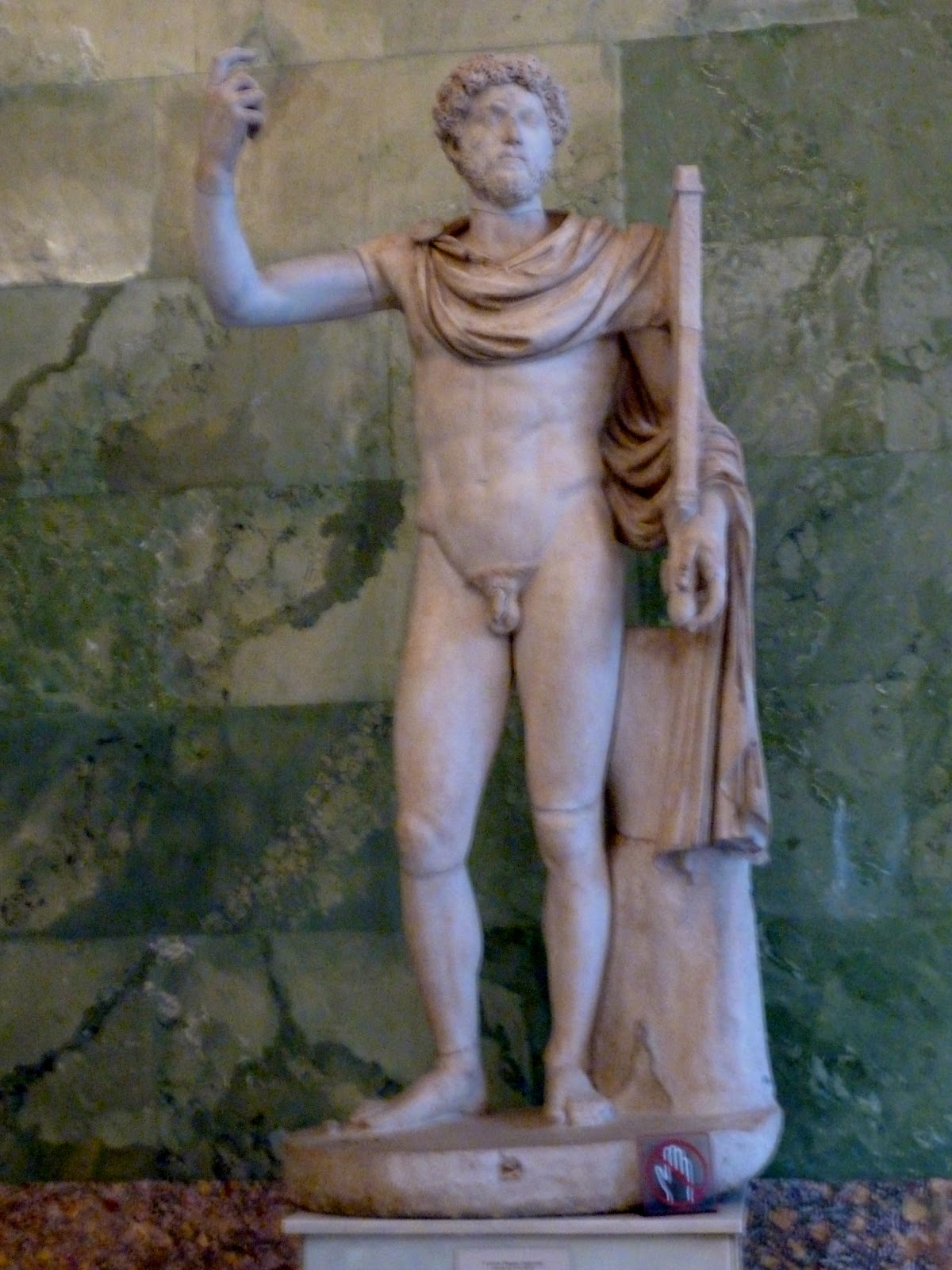
Left: One of hundreds of statues and busts of Roman Emperors and other people and animals from that period. I forget who this one is...some Caesar or  other......and that's not Rasputin's..... is it? No it can't be. It was stone. I checked. How long is 30 cms anyway?


Right: The Grand Jordan Staircase leading to the second floor.

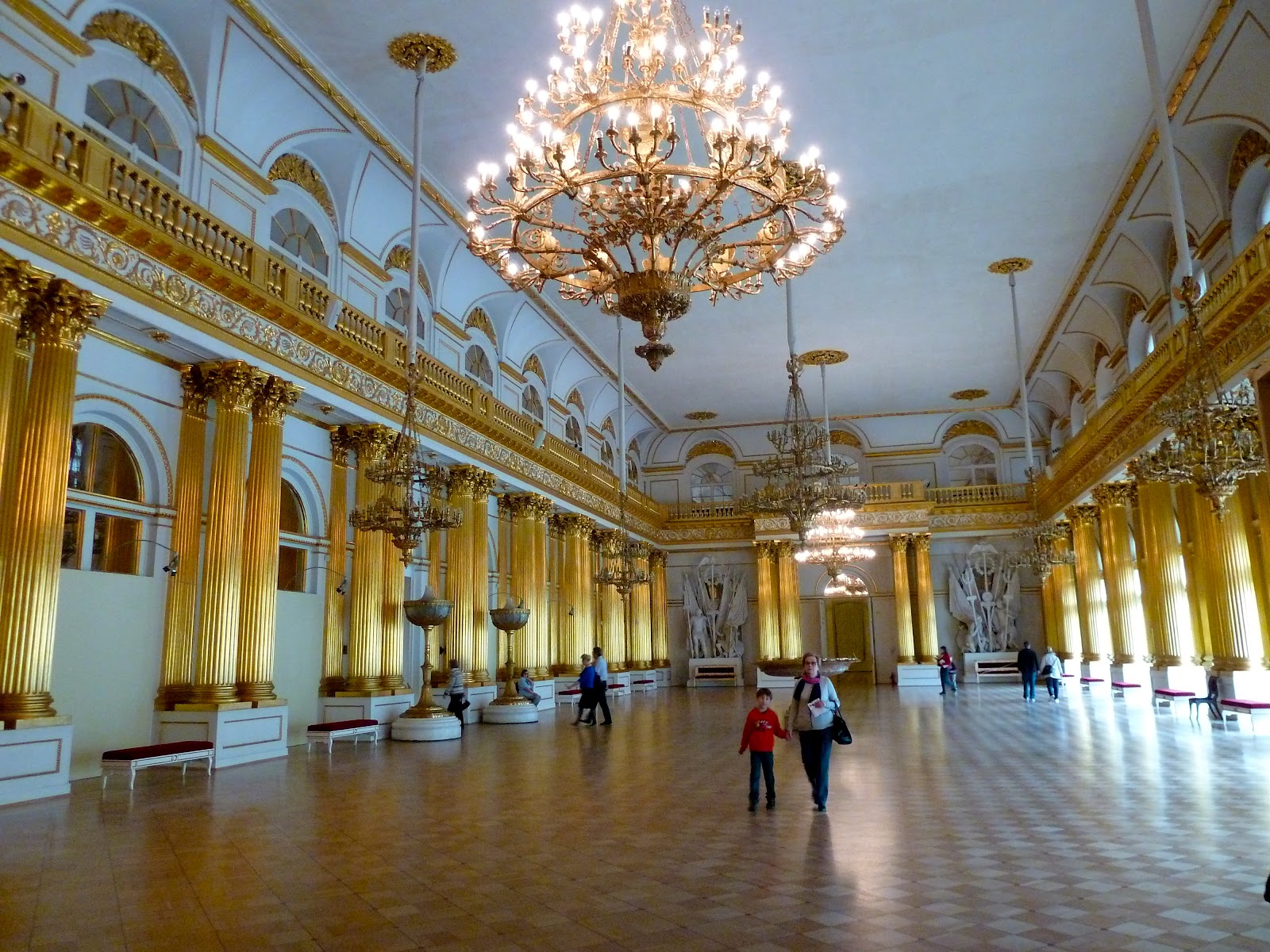
Left: The Golden Drawing Room. The windows overlook Dvortsovaya Ploschad. It could double up as an indoor tennis court.


Right: A magnificent bit of silverware table decoration. This thing was about 4 feet high. You would need a big table...and I pity the poor silver-storeman who had to polish all these things.


Left: A wine jug. It was about 4 feet high too. I can't imagine how the wine-waiting flunky managed to pour from this. A spillage wouldn't just wet your dinner jacket, it would probably drown you.


Right: One of the Throne Rooms. There was a much bigger throne room, but this one was more attractive.


Left: A beautiful wood panelled library. I didn't recognise any of the books. They were, of course, written in Ruski. No Dick Francis section that I could find.


Right: This is the famous Peacock Clock. It has a complex mechanism which not only powers a clock in the base and spins a mayfly on a stalk which is the second hand but, on the hour, operates the opening of the peacock's tail, makes the cock nod it's head and crow, and the owl in a cage bottom left does something as well. The operating mechanism still works but is only switched on a few times a month ( at random ) to a.) save wear and tear on the mechanism and b.) because when it was left to operate on the hour the room at these times became dangerously over-crowded with gawping tourists!
The clock was made by an English clockmaker, James Cox, for Catherine the Great's chum Potemkin and transported in 1790 in kit form to his palace nearby where it was, over a long period, reassembled. In fact Potemkin died before it was operational and Catherine purchased it from his estate and brought it here.

There is one long passageway along which is displayed portraits of all the Romanov Tsars and Emperors, and Tsarinas and Empresses. Left: This is Emperor Peter 1,  Peter the Great. He ruled from 1682 to 1725.


Right: Empress Catherine 11, or Catherine the Great. Strange dress...a couple of people hiding under there maybe? She was Empress after sacking her husband, Peter 111, and ruled from 1762 to 1796.
In each of the display rooms there sits a lady, always a middle-aged lady it appeared, who acts as guard and guide. Some of them spoke excellent English and were immensely helpful in answering queries. They were obviously dedicated to this museum and were most knowledgeable about the stuff on display. The lady on duty in the Romanov gallery was especially keen to explain the stories behind the portraits.
Somehow it didn't seem appropriate to ask her the whereabouts of Rasputin's missing part.


Left: Upstairs somewhere is this portrait of a young and dashing Napoleon Bonaparte.
There is a fantastic display of paintings from all eras. It includes several rooms devoted to all the famous early 20th century impressionists, including Manet, Monet,Van Gogh, Picasso, Matisse, Gauguin, Pissaro, Degas, Renoir, Cezanne, O'Reilly and many others. As someone once said, "I don't know much about art but I know what I like". Or, "I know a lot about f*****g art, in fact I know f**k all".
This is only a glimpse of the stuff inside this enormous museum. You'll have to go and see it yourself. I got rather engrossed and in fact never did find Rasputin's whatsit. It may be somewhere else.
PS. There's an amusing story about O'Reilly paintings involving a scam in Germany. Beware buying an O'Reilly.


Right: A view out of a third floor window over the Dvortsovaya Ploshchad, the Alexander Column and the General Staff buildings with the arch in the middle. Note the carriages which take visitors on trips around the square.


Left: There were several Imperial impersonators loitering around the square, such as these, waiting for someone to ask to take their photo, or have photos taken with them. They were trying to charge around $5 a shot. I didn't see many takers.


The next day I took a hydrofoil ( right ) ride from the river behind the Winter Palace into the Bay of Finland to visit the Peterhof. This is a palace complex designed by Peter the Great about 30km away from St Pete, and takes 30 mins to get there on the speedy hydrofoil. There are lots of these boats, all identical, which ply their trade around the rivers and sea nearby.


The Peterhof features several buildings as well as the central Palace ( left ). As said, Peter the Great ( PtG ) loved water features and so he made sure there were lots of fountains and ponds around the place; some of them very unusual and amusing. All these fountains are 'gravity powered'. He was also a great party animal and hosted many wild dos here involving vast consumption of alcohol, I was informed.


Right: Looking back from the Palace down the central avenue towards the sea jetty. Most of the additional buildings, the little Hermitage, the Monplaisir Villa, Catherine Building, Bath Building, Marly Palace and several others were dotted along the sea shore. The 'lower' gardens towards the sea contained many more fountains, ponds and folly style buildings.


Left: This funny little pond with spouting ducks and, curiously, a spouting dog chasing them rotates and makes quack-quack noises with the occasional woof-woof from the dog. PtG must have had a sense of humour.


Right: The fountain in front of the Palace has a gold figure of Samson tearing open the jaws of a lion. It spouts water over 100ft up. I don't know how the 'gravity' system generates such power considering I didn't notice any big hills down which the water flowed. Many of the statues were painted gold.


Left: The back of the Palace looking down the 'upper' gardens. Lots of maintenance is obviously needed to keep this place with it's extensive array of gardens in good nick. I noticed quite a number of workers hard at it, presumably sprucing the place up for the influx of summer visitors.


Right: The Monplaisir, a relatively small villa looking out over the sea which was apparently PtG's favourite place;  a sort of retreat to get away from the formal Palace environment and where he could have a relaxing time entertaining his drinking buddies ( just call me Pete, boys ), have a lie-in on Sundays reading the papers in bed, watch the footy on TV and generally slob about.


Left: The pyramid fountain. Quite elaborate and must have taken some skilful engineering in the 18th century to get this to work...just using gravity.


Right: ....and another curious arrangement whereby the spray in the middle rotated laterally.


Left: The small Hermitage building ( I don't know why it is called Hermitage...anyone know? ). It was interesting because it only consisted of two rooms and a staircase joining them. On the ground floor are the kitchens and larder. Upstairs is a dining room with a circular table that seats about 16 people. To avoid servants coming and going, and possibly overhearing indiscreet conversation, the centre section of the table and each individual place setting is mounted on it's own sort of pulley operated lift.  When plates needed removing and replacing you pulled a bell cord and your plate disappeared downstairs, or the whole centre section of the table did,  where it was duly replenished or replaced and hoisted back up again. I suspect it still works. Neat, huh?
My first whinge about this place is that each building has it's own different times and days when closed for repair or cleaning or whatever. The main Palace was zakrito, as was the Monplaisir Villa while I was there. It is difficult to work out exactly when you can get inside these places, if indeed you want to that is. I say that because my next whinge is that each building charges it's own separate entrance fee ranging from R550 for the main Palace which is only open at certain hours during the day, via R360 for most of the other places to R150 for the Hermitage dining room. To go inside them all would be very expensive, and not many visitors seemed to, understandably. I went into the Hermitage to see the table and lift arrangement, but none of the others. My third whinge is that photography is prohibited in all of them. You can't even pay ( as per most other museums ) to take photos. I asked one of the five ( yes, five and that didn't include the lady in the ticket office ) women on duty guarding the Hermitage why no photographs. This was after I had played ignorant and got my camera out. I was nearly wrestled to the floor as they shrieked "Niet photo" or similar. I got the message. They didn't answer my question ( maybe no understand English ). I said "this is crazy". One of them replied "Da, crazy!" I was their only visitor at the time; possibly the only one all afternoon. It was probably me they thought crazy. So, sorry I can't show you a snap of this fascinating dining arrangement.


Back to St Pete by speedy hydrofoil and we passed this stadium ( right ). It is presumably the St Petersburg United football ground.


Left: Amongst loads of very magnificent and elegant buildings, including several Palaces, the gloriously impressive and domed Admiralty adjacent to the Winter Palace ( now Russia's main Naval Academy ), museums and boulevards is this place, Kazan Cathedral.


Right: Even the main post-office is a work of art, as is the case in many countries.... with the notable exception of Britain. It is spacious and beautifully built and decorated inside and also had what seemed  a most efficient operating system. Different desks, all manned, for specific functions. No long queues, and I think I saw that it is open 24hrs. I called in at 7.30pm and it was fully functional then.


Left: The bronze statue of Peter the Great clearing the last in the St Pete 'Faberge' Grand National. It is in the park near the Senate building. Someone told me that the Senate here is the top court in Russia, something akin to our High Court, or whatever its called now.


I climbed up lots of steps to the colonnade on St Isaaks Cathedral in the city centre. It is the place which affords probably the best panoramic view of the city. St Pete is very spread out over islands and rivers and difficult to get a decent view. Right: This is looking east over the Admiralty Gardens ( the trees ) towards the Hermitage ( at the end of the trees ) and the Bolshaya Neva river to the left. There was a very affluent and senior looking English couple up there ( you know, him wearing a tie with highly polished brogues, her with headscarf ). The husband suffered from an extreme form of vertigo, he told me so. It was amusing ( how cruel ) to watch him clinging to the inside wall while shaking like a leaf. The poor guy was obviously panic-stricken. I didn't ask why he decided to go up there in the first place.

One can't help being impressed by St Petersburg. As well as all the majestic and historic buildings and things on display in museums it also has a rather jolly feel about it. More smiles and helpful people around than Moscow, I felt. I suspect they are a bit more 'liberated' and 'cosmopolitan' here, influenced no doubt by the many tourists who swarm into the place from America and Western Europe in particular. There were a lot of 'posh' Brits in evidence. The staff of most of the places I visited, including my small hotel, were very polite and helpful and spoke excellent English, and they did a lot of smiling.


Apropos Russia in general, as a matter of curious interest, in Irkutsk, Moscow and St Pete I never once saw a single black person or, with the exception of a couple of tour groups in the Kremlin, no Indians either. I don't just mean not many, I really mean none! There must be some Afro-Russians or students or visitors from black countries or the sub-continent somewhere? They were notable by their absence. This must be peculiar to Russia, because that can't be said for any of the other cities I have visited where Indians, at least, abound. I even started to look for them, but no sign. There must be a reason for this.
I had a most enjoyable and educational time in Russia, and even became quite accustomed to the Cyrillic script. The only things which slightly pissed me off were the rather paranoid, inconsistent and illogical reluctance to allow photography, the lack of information and erratic unannounced closure of many tourist sites and sullen reluctance to explain, the 'zakrito and nye znayu' response ( in Moscow mainly, but then I was there at a difficult time ). I also think that the tourist sites are a bit greedy and try to charge too much for too many co-located buildings with complicated disjointed visiting hours and, as a consequence, rather put people off.
It must be said that whatever the failings, occasional brutality and sometimes aristocratic insensitivity of the old Imperial Tsarist regime ( and some of the rulers did a good and well respected job don't forget ) they did at least leave Russia with some glorious buildings, art and treasures. The Bolsheviks and Soviets, bless them, were equally if not more brutal ( Stalin's purges...the biggest mass murderer in history ) and they served mostly to eliminate opponents, destroy things ( especially churches ) and erect monstrosities in their place while managing to terrify their public into cowed obedience. They did not leave a good legacy. I get the feeling that Johnny Ruskie is really quite proud of the old beautiful things of bygone days as indicated by the amount of reconstruction and restoration of many Soviet destroyed statues, monuments and buildings. Good on them.


I set off to the bright and sparkling Finlandsky station to get the speedy Finnish Allegro train to Helsinki. The journey time is a mere 3.5 hours. It is a very modern, comfortable and hi-tech train indeed. It also has a remarkably easy and quick internet booking site to buy one's e-ticket. I was impressed. I took a photo ( right ). I was then shouted at by a Russian policeman "Niet photo!. You must delete!!". I asked why. "Strategy" was his reply. I said I wouldn't 'delete', strategy or not, and asked what is so secret about this train anyway. He rather gave up at this point and said "OK, you can photo one time only", I suppose not wishing to get into a protracted argument with a clearly lunatic foreigner. I then offered to take his and his mates' picture which was not altogether enthusiastically received. They will get the message one day that we are no longer their enemies, hopefully. I refrained from asking him if he knew or could find out, using the police computer, where to find Rasputin's infamous 30cm appendage.

Left: Inside the smart Allegro. Free coffee on offer and a trolley buffet service. Even the customs and immigration staff, which swiftly did all the Russian and Finnish formalities on board, were impressively smartly turned out, courteous and efficient. We were back in a very civilised world. Oh, and they didn't have any infuriating announcements either!

So Finland here we come. I can't get that Monty Python song "Finland, Finland, the country where I want to be....." out of my head.