1st - 14th March 2012
 |
| Uncle Ho |
Bus from Phnom Penh to Saigon ( Ho Chi Minh City ) was comfortable and took about 6 hours. There was not much hassle at the Bavet border crossing where a lot of rather flashy looking casinos have sprung up. These are on the Cambodian side and cater for the gambling mad Vietnamese because gambling establishments are prohibited ( for the Vietnamese ) in Vietnam. Arrived at what is known as the 'back-packers' area in downtown Saigon at about 1500hrs. Actually, I had meant to get out on the north-west side of the city where I was to be staying, but was sound asleep as we passed.
I spent the next few days visiting old haunts and meeting up with some ex-colleagues who are still slaving away on the end of interminable rosters for Vietnam Airlines, so no touristing.
The name Saigon is still used by locals to describe the central city districts. Ho Chi Minh City, the more politically correct, and indeed official, name describes the whole conurbation which is vast and growing. It is actually difficult to tell where the city begins or ends nowadays. The whole city area is thought to contain a population of about 9 to 12 million, but nobody seems sure. The French designed Saigon and riverside districts which they developed in the 18th and 19th centuries were built to accommodate a projected population of 250,000. So you can appreciate that it is a bit of an uphill struggle to provide the infrastructure to meet present day needs. The traffic still predominantly consists of small motorcycles and scooters ( motos ), although the number of cars is increasing and will, sooner or later, lead to total gridlock. I rode a moto around here for a few years and found it tremendous fun.
 It is utterly anarchic, and proves my theory that the more dangerous the situation appears, people take more care, 'prenez garde', and as a result survive quite happily. Right: Waiting at traffic lights ( yes they have them and occasionally, if a policeman is standing nearby, riders stop at the red lights ), reminded me of the start of the Grand National but with about 500 horses and riders jockeying for position. I take pride in the fact that my precious moto did not receive a single scratch during the 4 years I rode it here and nor did I.
The secret is to keep your eyes scanning in front, expect someone to whizz out of a side road unexpectedly and don't drive when you are too pissed. Indeed, forgive me if I side-track myself a bit here, having spoken to a lot of 'travellers' over the past year or so it is apparent that roughly 90% of the people who meet with misfortune during their travels, you know, muggings, robberies, fights, losing things, accidents, missed transport, getting arrested, tripping over kerb stones and losing teeth, being conned, falling off things, drowning etc. etc. do so as a result of unwise quantities of alcoholic intake. Stay alert and you tend to stay safe. Also, abide by the philosophy ( utterly alien to 'western' culture ) that any accident that befalls you, whether you are technically in the right, or not, is your fault and don't go looking to blame anyone else. Wealthy lawyers and insurance companies would all go bust in USA and Europe if people there did this. Where was I? Oh yes, Saigon city........
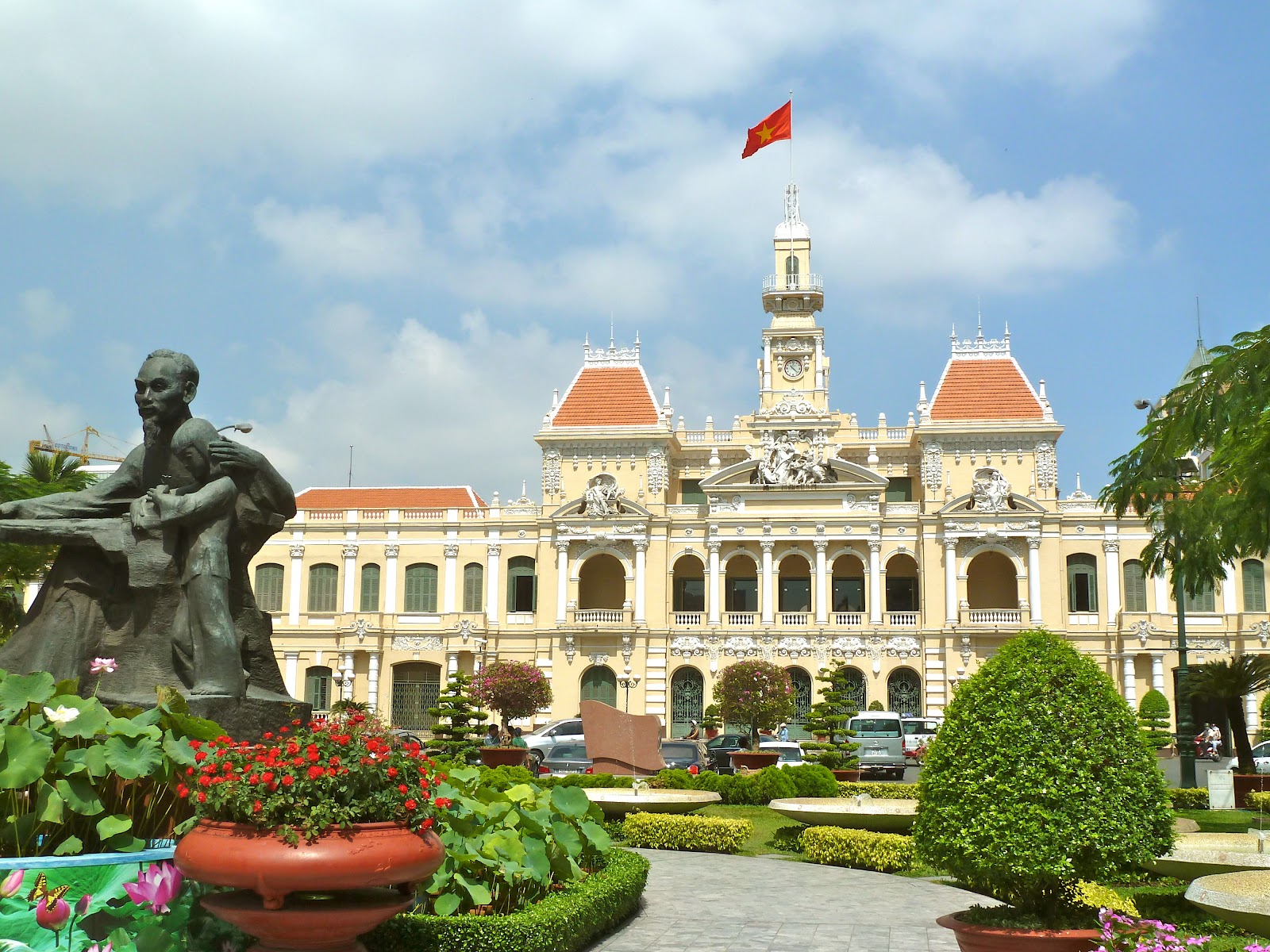 Left: The City Hall. Some of the better built and more iconic French colonial buildings, like this, are still standing and well kept. Many less famous have been allowed to fall into dilapidation and pulled down to make way for profitable new high rise glass and concrete monstrosities.
Right: The Opera House on the right and Continental Hotel, with the red roof, to the left ( built 1880 ) in Lam Son Square in upmarket District 1. I remember a famous film scene from The Quiet American, starring Michael Cain, where lots of explosions were going off around here. Graham Greene wrote the book The Quiet American and had a long term room in the Continental. The old bar is still there at an inside courtyard where, reputedly, he sipped his dry martinis. The area behind the Continental used to be a pleasant little park with grass, trees and fountains but is now built on by that obnoxious blue coloured high-rise shopping centre and apartment block, the Vincom Centre Monstrosity, which is still mostly empty. In Vietnam money making enterprises triumph hand over fist above architectural aesthetics or cultural merit. In fact that is the case in most post-colonial Asia. Sad, but inevitable. Back-handers, bribes and personal gain play a large part in development projects, i.e. corruption.

A notable building in District 1 is the 19th century Notre Dame cathedral ( left ). I have never been inside, but the outside gives the area a more elegant appearance. The walls and grounds of this building are popular with Vietnamese for pre-wedding photo venues. There are always couples dressed-up to the nines in their exotic wedding outfits, weeks before the big occasion, doing 'romantic' poses for photographers here. Comprehensive, vast, and probably expensive wedding photo albums, and elaborate videos, ( some unkind people might think them rather tasteless ) form a vital part of Vietnamese nuptials.
To the right of this cathedral is..............

.....the French built central Post Office ( right ) which is another work of art. It is also very functional and efficiently run. The service provided is second to none. There are 20 different desks, all manned, and I mean all, by elegantly dressed ladies in yellow and silver traditional Au Dais ( pronounced 'Ow Yies', the loose fitting silk trousers covered by a long figure hugging dress split at the sides from the waist down ) and men in smart yellow shirts and black trousers. They all tend to speak reasonable English. It is open from 0800 - 1900hrs daily, including Sundays. Each of the desks serves a particular function i.e. selling stamps, or dealing with international mail for example. In my case I went in to post some books and documents which they carefully boxed and wrapped for me at one desk, and then weighed, documented and posted at another. It is a busy place, but entails very little queuing and provides a slick service. It is a system entirely alien to the endless queues at the half-manned and often scruffy British post-offices.
 It provides an information service, a currency exchange service, and has international telephones in smart old fashioned wooden kiosks, as well as kiosks with computers and places to buy lots of postal commodities, sheets of collectors' stamps and memorabilia. The vast, spacious interior ( left ) is decorated with extraordinary murals, maps and portraits. It is a popular venue on the tourist trail with lots of guided tours being shown around.
Right: On the other side of the Opera House in Lan Son Square is the Caravelle Hotel. This smart art deco building was the watering hole of choice for reporters and journalists during the Vietnam war. The 'semi' roof bar on the 9th floor ( called Saigon Saigon ) is an amusing and popular venue for expats as well as the better heeled Vietnamese.

It used to host a fantastic Cuban salsa band, 'Warapo', including two spectacularly agile and skilled girl singers and dancers with contra-rotating bums ( left: photo from two years ago ). I made a point of revisiting for old times' sake. Bugger it; they have been replaced by another band not nearly so good, if much louder. I'm told Warapo still perform in several different venues around town. I aim to find them again before I leave.
Skilled 'western' entertainment is hard to find in Saigon. The Vietnamese, unlike the Philippinos, Thais and other Asian countries do not seem to produce many quality acts.

Right: The Reunification Hall is at the end of Le Duan ( pronounced Lay Wun ), a large central boulevard in District 1, and surrounded by a pleasant park with tanks as ornaments. This was originally the site of the Presidential Palace which was bombed by renegade Air Force pilots in 1962 in an unsuccessful assassination attempt on the then President. It was so badly damaged that it was pulled down and completely rebuilt, designed by a Vietnamese architect, and completed in it's present form in 1966. What an ugly building. It was again attacked and bombed ( for aesthetic reasons? ) by another renegade South Vietnamese pilot in his Phantom jet on 8th April 1975, sadly without much damage being done this time. This pilot then flew on in his jet to land up at Hanoi and became a national hero of the North Vietnamese. His name is Nguyen Thanh Trung who, after 'unification' of North and South, subsequently flew B767s for Vietnam Airlines. He is affectionately known as 'Bomber Trung' and although now retired from the airline still flys as a corporate pilot. I have met him; he is a charming and amusing man, as is his son who is an F/O on the Vietnam Airlines ATR fleet and with whom I flew while working here.
There is a well publicised photo of a North Vietnamese T52 tank crashing through the gates here on 30th April 1975 which signified the final victory of North over South. The South Vietnamese flag was unceremoniously hauled down and the red one with yellow star hoisted in it's place. Subsequently lots of South Vietnamese had to do a 'runner'.
 Left: The Bitexo Financial Tower. This is new; only recently completed down by the riverside. It is the first 'skyscraper' in Saigon and they charge $10 to go up it which, of course, I did. Good enough views from the viewing floor directly underneath the heli-pad. Not sure what goes on in the pointy bit above which is a very skinny addition to the more substantial lower floors.
Right: View from the skydeck, or whatever its called, looking north-west towards the airport. The City Hall is mid-picture at the top of Nguyen Hue street.

Left: It features a bar and restaurant with good views but extortionately priced food and drink......

.....unlike places such as this ( right ), Restaurant 63 in Pham Van Hai street which supplies plentiful and delicious Vietnamese cuisine including at least 5 bottles of Tiger, or San Miguel, beer all for about £5 per head. Plus excellent service by some very pretty waitresses. There are lots of marvellous Vietnamese restaurants even if they are a little noisy at times. The Vietnamese enjoy noise. "Mot, hai, ba Yo!"

Left: Another social gathering. Dietmar, ATR Capt ( German ), Susan, English teacher ( Northern Irish ), Claudia, another teacher ( Swiss ) and Michael, Airbus Capt ( German ). Dietmar wanted his ugly mug to feature in this blog, so here it is. " Ein, zwei, drei, Klop!"
I have been spending all my time in the city being well entertained and calling on 'unsuspecting' old friends.

At the moment I am recovering from a mega-party thrown by a group of Polish ATR pilots ( left ) some of whom who are leaving to return to fly in Poland. By crikey they are a generous bunch! I now own a smart Polish football scarf as well as a monumental hangover. Thanks boys!
However, this blog gives me the opportunity here to dig out a few old photos for reminiscence sake. There are many things to do and places to visit around the south and centre of the country which indeed I did in earlier years.
 Such as trips around the Mekong Delta area ( right ) by boat. This area appears, from the air, as a vast lattice-work of interconnecting canals running between rivers and their tributaries for endless miles. It must be the biggest rice producing area in Asia. I may stand corrected on this. It also produces a lot of fish.
Interestingly, most Vietnamese are scared stiff of water and relatively few learn to swim. They regard water as a medium for travel, obtaining fish, cultivating crops and drinking. It is certainly not for swimming in. As a result many lives are lost by children ( and adults ) falling into canals and fishermen falling out of their boats at sea. I remember some of us trying to persuade ( with honourable intentions ) some Vietnamese girls to join us in a swimming pool and teach them to swim. It was like trying to stuff cats into a bucket of water! If they did get into the water they could not be persuaded to let go of the side. It was a similar experience when doing water 'emergency' drills with cabin crew in a local pool. Even with life-jackets on many were terrified of getting into the water.

Left: A typical bit of Mekong river tributary. Boat trips up the rivers and canals feature floating markets, restaurant stops and local village entertainment. As well as the small motorboats on day trips, there are smart boats with upmarket accommodation for trips lasting a few days along the wider stretches.
There are also the old Viet Cong tunnels near the town of Cu Chi in Tay Ninh district, about 70 miles north-west of Ho Chi Minh City. This is an area, amongst others, where in the Vietnam war of the 60s/70s an entire Vietnamese community lived below ground, both civilians and Viet Cong guerrillas. The underground town consisted of three levels of accommodation, hospitals, armouries, workshops, kitchens etc. all interlinked by hundreds of miles of tunnels from which their fighters emerged, did their stuff, and retreated back into. It was an incredible feat of engineering and perseverance. The Americans and South Vietnamese forces tried to destroy this system by any and every means possible; bombing, flooding, gas, dogs, using the infamous 'tunnel rats', you think of it, they tried it all and failed. The Viets had devised many clever means of protection using water sumps, ventilation systems, reinforcement and booby traps to deter invasion of their underground system. A small section of this warren has been preserved and some mock-ups of accommodation and life underground reconstructed.
 Right: The original tunnel entrances could just be squeezed into by a Vietnamese sized person. No 'Big Macs' on sale to them in those days, or even nowadays for that matter ( MacDonalds do not have outlets in Vietnam ). There were U bends and even parts where occupants had to dive underwater to enter or get from one place to another. This is an example of a camouflaged trap-door into a tunnel.
 Left: Of course some entrances have been sufficiently modified to allow access for 'normally' built westerners. This one is sweating a bit.
Right: The present 'original' tunnel area has been reinforced with concrete and somewhat enlarged. There is a length of about 50 yards of tunnel down which tourists can crawl with a couple of escape holes for those who get a bit panicky. Even though it is obviously wider and higher than the real original, it is still a squeeze and somewhat claustrophobic. I wondered what happens in the event of a slightly larger than average tourist actually getting stuck solid in here. Perhaps they just wait until he/she has lost sufficient weight to become unstuck?

Left: And the booby traps are kept outside on display only. There were many ingenious variations of pits with stakes at the bottom, dangling ropes that hauled you up by your ankles and triggers which when released shot arrows through you. The idea of these traps is to wound not to kill. The well proven theory being that one wounded man takes out several more who have to stay behind to look after him.
There are also a couple of holiday islands to visit. The most developed is called Phu Quoc, which is about 50 minutes domestic flight from HCMC off the south-west coast ( near to the coast of Cambodia ). It has some quiet and unspoilt beaches with good seafood restaurants and pleasant hotels. The other is the island of Con Dao, a rocky island surrounded by other little ones due south of the mainland. Nice beaches and hotels also and, as yet, unspoilt. This was the island on which the French built a prison to house Viet Minh prisoners. The Americans used it to imprison Viet Cong, and after North Vietnam won the war in 1975 they used it to imprison South Vietnamese. The prison facilities are now abandoned and derelict ( I think ).
 Right: The approach to the easterly ( 11 ) runway on Con Dao ( the airport is called Con Son ). It is an easy approach unless you get brisk north-easterly winds over the hills, left, which can produce quite violent turbulence and wind-shear on short finals. It caused a few minor anxious moments.
There is a 'Five Star train' to the resort town of Nga Trang on the coast about 200 miles north-east of Ho Chi Minh City. I did this, there and back, once. Due to there being only a single track railway the journey takes about 8 hours because the train has to keep pulling into a siding to let others pass. A recommended trip nevertheless. Nga Trang has lots of scuba diving schools and rocky islands which provide good( ish ) diving opportunities. There is also an island known as Vinpearland ( left ). This is a sort of theme park place with entertainments and water-slides, amusement arcades and the like. I think it is sponsored by a Russian company. You reach it either by boat or by a very long distance cable car. The cable car trip must be one of the longest in the world. It takes about 20 minutes to cross. I was put into a car by myself and felt quite uncomfortable swaying about up there alone suffering a mild attack of vertigo. I confirmed to myself that I don't like cable cars.

Further on up the coast, just south of the major central coastal city of Da Nang is the popular touristy town of Hoi An. This place has amusing markets, clothes manufacturers and tailors who are famous for running you up a suit in the time it takes you to eat lunch. The trouser leg probably falls off before dinner. It has a lot of Japanese architecture such as this quaint little bridge ( right ).

The old town is built on a river, about 5 miles inland from the sea. Every October, regular as clockwork, this river floods and swamps the town. There are always pictures of streets inundated with water up to the top of signposts and national appeals put out to help those unfortunates who have been affected. I don't understand why they haven't built the riverside houses on stilts as per Burma and Malaysia in flood prone areas. I mean, this annual flooding comes hardly as a surprise! I think if I was a Hoi An resident I would let my house to tourists in October and move out to higher ground with my carpets, paintings and valuables.

There are many attractive junk style boats and other craft which take tourists on tours up and down the river. The old part of the town is indeed a pleasant and amusing place to visit, except maybe during October when, if nothing else, the famed 'water puppet' shows presumably still go on. The coast nearby also has some resort hotels. The Vietnamese are still way behind the rest of the world in terms of recreational amenities, and the east coast sea is always a dirty brown sandy colour, but if you want to get away from it all, then these are places to go. I once asked a local why there are no entertainments such as wind-surfing, yachting and such-like at popular resorts like Phu Quoc, for example. There is room for all this without disturbing the peace of the place. I was told "Vietnamese people don't like". What the Vietnamese do like is gambling. I have a horrid fear that, one day, these places will become meccas of the casino world. I hope not, and maybe they will get there with pleasant and tasteful entertainment eventually. The beach area local to Ho Chi Minh is 30 miles east, and a 1 hour ( amusing ) hydrofoil journey from the city. It is a rather dull place, but with a nice harbour area, called Vung Tau. Does anyone remember Garry Glitter?
There is, however, a beautiful golden sandy beach at Mui Ne, about 50 miles north-east of HCMC which is an internationally renowned spot for the new(ish) activity of kite surfing ( not started up here by a Vietnamese I suspect ). There are boundless possibilities for many terrific sporting and leisure activities in Vietnam ( sport fishing, yachting, hiking, para-gliding, wind surfing and many more ), but they will take a long time to realise them. For all their qualities, the Vietnamese do not show much imagination and they certainly don't like foreigners coming along and telling them what to do, or how to do it better. Their 'education' does not really encourage imaginative thought; it could be dangerous. People might even openly start to criticise their superiors, heaven forbid! They are programmed to do what they are told.
 Further on north is the ancient Imperial capital city of Hue. This is where all the old emperors hung out and there was a token 'emperor' in situ until as recently as 1945. The main landmark building is the large fortified 'forbidden' palace area of the Citadel ( left ) on the north side of the Perfume River ( bottled as L'eau de Vieux Poisson, perhaps ). When the communists came to power they regarded this place as being 'feudal' and 'reactionary' and for a long time left it to rot after being much damaged during the 1960s/70s Vietnam war ( the Americans virtually blew it to bits....the normal American legacy of their many futile conflicts ).
The Hanoi government eventually came to their senses and realised the commercial advantage of renovating the place and making it a profitable tourist venue, if for no other altruistic reason. It is now a popular venue with tours around the Citadel and boat trips up the river to visit the many elaborate temples and pagodas where most of the late emperors are entombed. There are also some pleasant hotels such as the one I once used called La Residence. This is a fascinating art deco building on the opposite side of the river to the Citadel. It was formerly the residence of the French Governor. The place is worth a visit for a couple of days max.
 I am writing this while my Polish headache is wearing off. I met and enjoyed the hospitality of many old comrades here, such as this chap ( right ). This is Mad Michel from Belgium, an ATR pilot who once flew in the Congo where he had some interesting experiences with crocodiles. He is also a self taught authority on black magic, various forms of meditation and weird and wonderful spiritual cures for all known ailments. He also builds model aeroplanes and rides fast motorbikes. An interesting and amusing character.
I was also generously entertained by Claudio, an Airbus 320/21 Captain, his beautiful Chilean wife Helene and their children. Matteus and dog are missing. Matteus was in trouble because he hadn't phoned in late.
Before I forget I must register my gratitude to another friend, another Airbus driver, Herr Kapitan Doktor ( econ ) Michael, who most generously lent me his palatial apartment for my stay here while he went off on Urlaub in Deutschland. Danke schon serr much.
I have now managed to get various visas organised which was one of the reasons I have spent so long in this city. Next off by train up the length of Vietnam to Hanoi where hopefully it will be a bit chilly. I have been lugging my heavy cold weather clothes around with me everywhere and have not had the opportunity to wear them since New Zealand. In fact, now I think about it, I cannot remember the last time I even experienced any rain. Onwards and upwards.
PS. I finally located the amazing Warapo salsa group. I found them back in the Caravelle where they still perform on Tuesday nights. Some of the cast had changed but they were still fantastic with the girls contra-rotating various body parts with great gusto.