Tuesday, 3 April 2012

HA LONG BAY - VIETNAM

25th - 26th Mar 2012

Ha Long Bay

Minibus from Hanoi north-east to the coast at Ha Long took 3.5 hours, including a coffee stop. We got there at 1230hrs and were taken by a little boat to our bigger boat ( left ), the Oriental Sails. It was a very comfortable vessel. This was to be a 24 hour cruise including some landings ashore to visit places of interest en route. The little boat, our landing craft, was towed by the bigger boat and off we sailed into the Bay. This is another very tourist saturated place in Vietnam, but despite the numbers of punters and boats it is still a most attractive and peaceful experience. Actually, a large part of the cruise was spent eating and drinking with the odd venture out to take photos.

Right: The dining room and bar. There was a mixed bag of 26 pax on board from several parts of the world; Australia, India, Britain, Canada, Norway etc. and even a couple from Vietnam. The staff were numerous and ever attentive, as always. The meals were Vietnamese style and excellent. Wine was extra. The cabins were very comfortable also. The walls must have been suitably thick because nobody complained about my snoring.


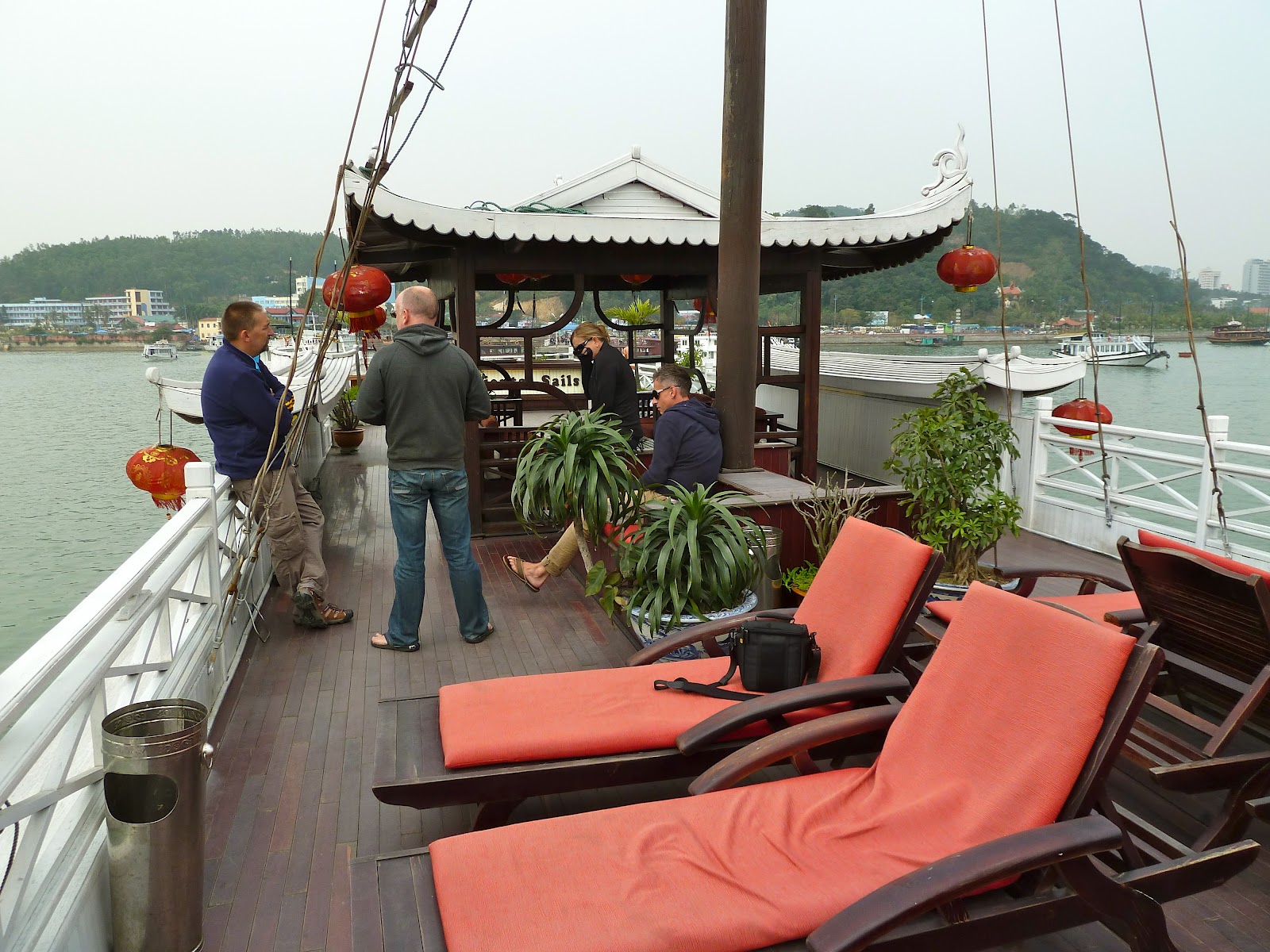
Left: On the top deck. The place was prepared for sunbathing but the weather, although warmish, was somewhat overcast and misty. It got sunnier on the second day.
Right: The bridge and the guy who did the steering. All the navigation around these little islands is done by sight, and there were lots of other boats of varying size around which needed to be avoided. I was told that there are about 500 craft operating in the Ha Long Bay area. I don't think they were fitted with a TCAS system....."traffic, traffic,...whoop whoop!"

Left: The strange rock formations are called ‘Karsts’. There are 1969 of them in the Bay area. They are limestone rock and were formed ( we were told ) by a combination of tectonic activity ( earthquakes ) and erosion over a very long period. Look it up if you are that interested. 


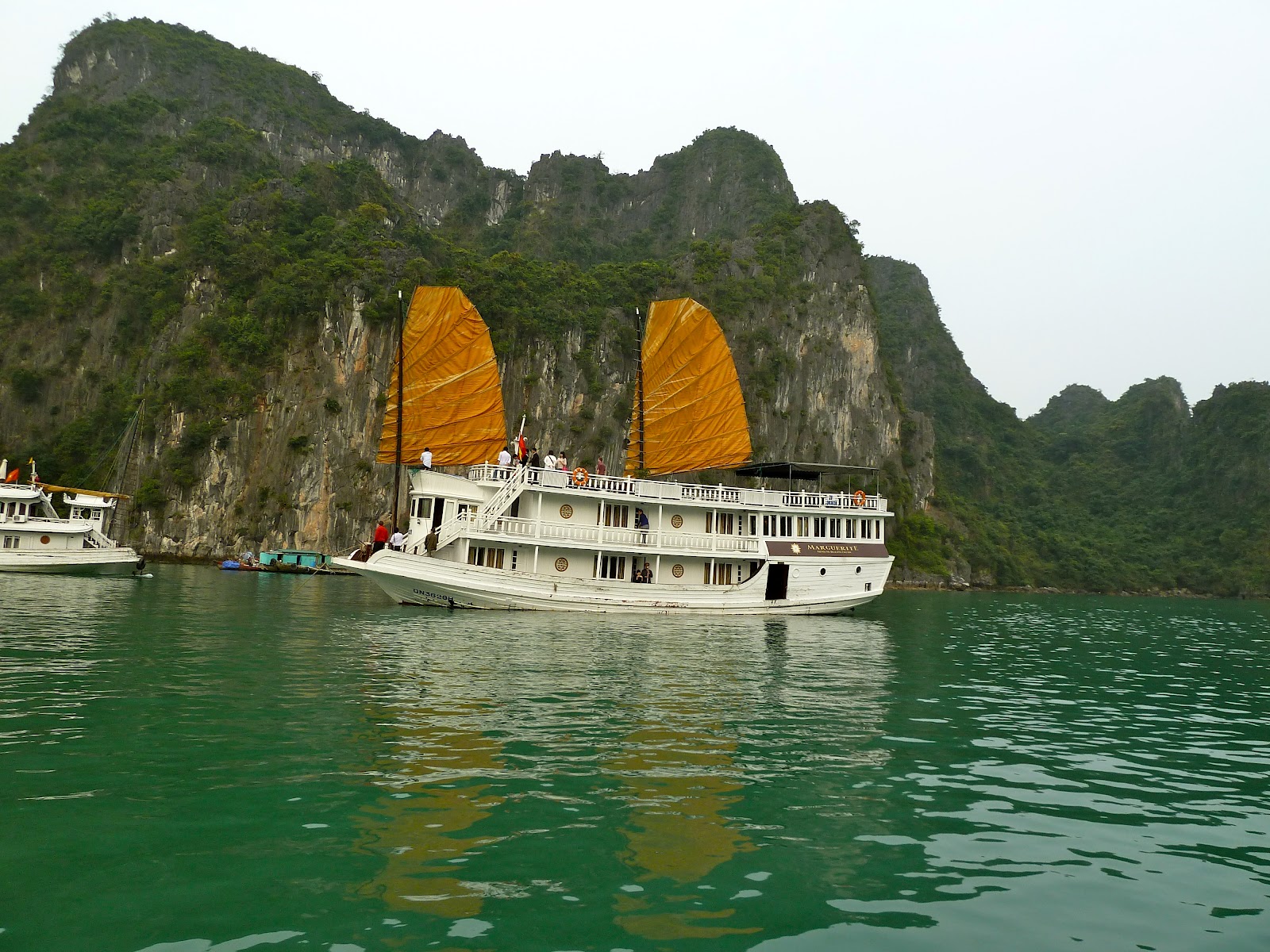
Right: Another similar ship to ours. We never put our sails up. There was no wind anyway. The sails are purely decoration.


At some point we were driven ashore onto one of the islands to wander through some caves. Left: This was a large cave complex. There were hundreds of tourists wandering through it. I wondered if any got lost and were left behind.


Right: Another part of the caves. For some strange reason they were lit up with rather garishly coloured floodlights. Lots of stalactites and stalacmites, and tourists.


Left: For another inexplicable reason the place was dotted with waste bins in the form of penguins. Why penguins? There are certainly no penguins native to Vietnam that I am aware of. I have, however, noticed some penguin waste bins in Saigon. I suspect they were a massive free hand out from some ‘agency’ or other after a big order for the Antarctic was cancelled. 


Right: A photo of some islands from the caves.


Left: More islands and boats. You are never exactly alone on these cruises.


Right: Early morning PT, known locally as ‘Tai Chi’, was organised for some ( 4 ) volunteers who were told it was good for them at 7am, before breakfast. Myself and my recently aquired drinking buddies were certainly not up for this. I got the photo only because breakfast started at 7.30am and I happened to pass by.
Other ‘activities’ were available for those wanting something else to do; such as canoeing around the local islands ( no thanks ), and quite an interesting call in at a floating fish market with some strange fish and luminous sqid on offer. They even suggested a swim.


One of the more amusing aspects of little trips like this is meeting up with hitherto unknown fellow passengers, as one is apt to do when sitting down to meals together. We seemed, by chance, to form an ‘ad hoc’ gang of dissolute retirees plus one somewhat younger chap. Left: John ( Glasgow ), Tim ( Keswick ) and Michael ( Melbourne ). We had a few ‘bevvies’ between us, except for John who was showing enormous self-discipline and not drinking alcohol due to a course of antibiotics. Quite stressful for a Glaswegian I would imagine. He was due to be released from this purgatory two days later when he would be down in Hue to celebrate. History has not revealed, yet, if the police were involved.


Right: The younger member of our gang, Jaques from Winnipeg and a friend.


It was a jolly trip and noone was drownded. Back to Hanoi where I had another day to spend before travelling north. Met up with Christian, the 777 pilot, last seen in Bangkok and the Airbus driver, Claudio, last seen in Saigon. We had a good dinner together. Quite a coincidence that they were there in Hanoi together and free for the evening.


Left: I remember passing this statue of Mr Lenin in Dien Bien Phu Street who was much admired by the North Vietnamese hierarchy. Note that his name is spelt in the Vietnamese vernacular.

The next afternoon was filed in by visiting the old ‘Hanoi Hilton’ ( I had forgotten that they still preserved a bit of it ). It is just to the south of the central Hoang Kiem lake. It was built as a prison by the French between 1886 - 91 and subsequently called Hoa Lo by the Vietnamese. Most of the prison has been knocked down with just a corner left as a museum. 
The gist of the exhibits is that the French were all evil, brutal and cowardly colonists, the Americans were all evil, brutal and cowardly imperialist aggressors and the Vietnamese were all brave, victorious, kind, humane and forgiving heroes. OK, there may be some element of truth in this, but I would respect the Vietnamese position a bit more if they were just a tiny wee bit more even-handed in their judgement. I suspect the American POWs might have some comment to make on their ‘kind and humane’ treatment received here and at other less ‘comfortable’ camps.

Right: One of the dormitory prison cells where the nasty French locked up, and shackled, the brave and kindly Vietnamese revolutionary patriots.


Left: One of the isolation cells where the even more brave and kindly revolutionary warriors were locked up and shackled.


Right: The guillotine which the evil French used to remove the heads of the most brave and kindly revolutionary heroes. I expect the thing still works. I pulled the rope but nothing happened. Might need a bit of oil. The rat was spared.


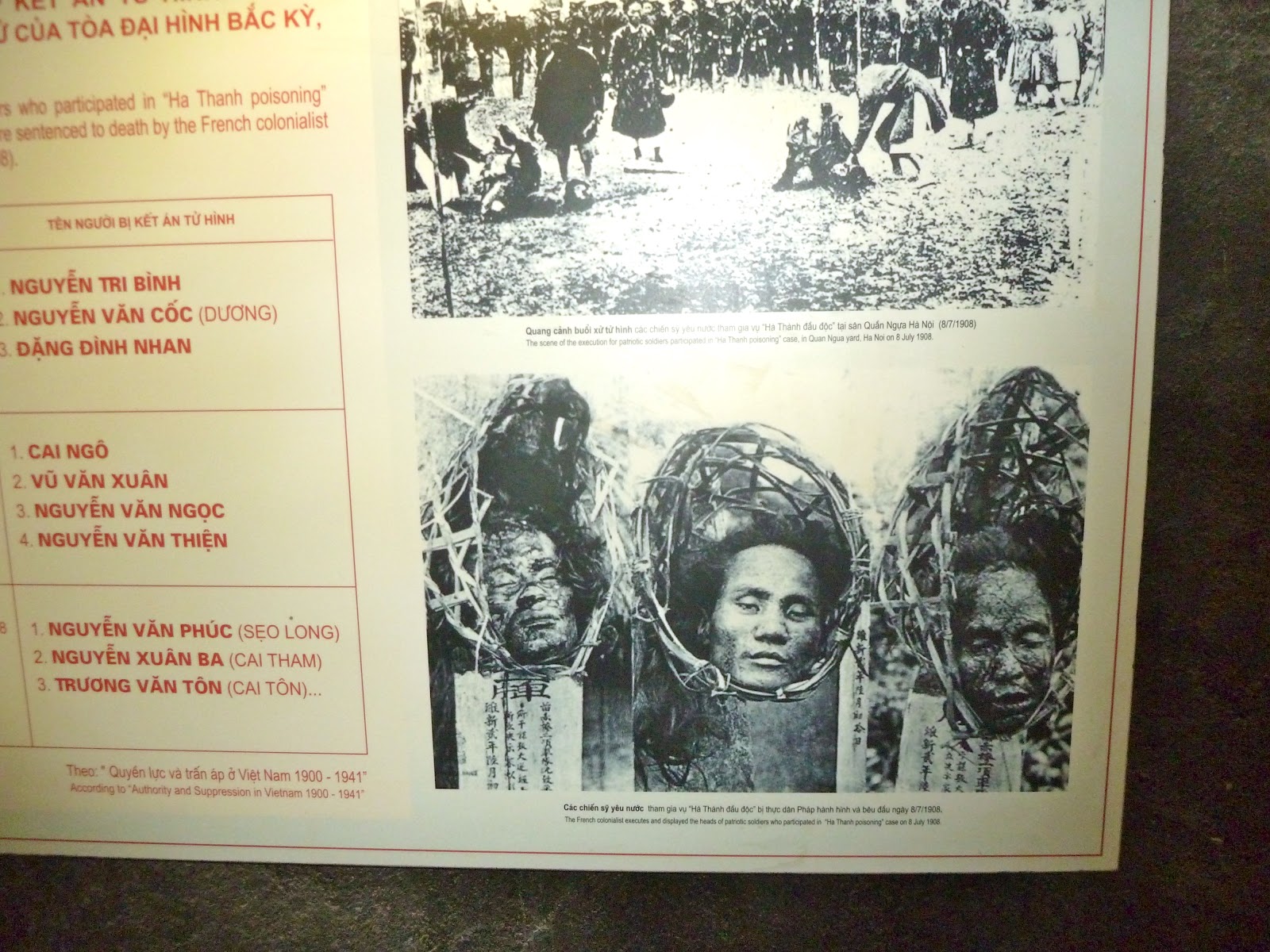
Left: A photo of the removed heads of three once heroic Vietnamese ladies. It did not specify precisely what their patriotic activities were that culminated in this rather terminal punishment.


Right: More up to date; the regulations pertaining to US POWs during the 1960s/70s conflict. There was absolutely no suggestion ( here ) that any US prisoner was ill-treated. Indeed there were photos of POWs playing basketball, chess and having a really jolly time. The Americans called it the ‘Hanoi Hilton’, according to the Vietnamese, because it was so comfortable. I wasn’t there, of course, but it would be interesting to hear what...........


..........Senator John McCain has to say on the subject. This ( left ) is his flying suit and kit, plus parachute, which they have kept and put on display. He is one of the ex-POWs, and recent US  Presidential candidate, who was shot down and parachuted into one of the Hanoi lakes. He has actually made a return visit to this place and was remarkably laid-back about his experience; but he is a politician. I suspect he might disclose more interesting views on the subject in private.
So that is about all from me from Vietnam. I am due next to head up north by train to China. I hope to continue the blogging from there but have heard rumours that many blogsites, and other websites, are blocked in that liberal, free-thinking, go-ahead country. 
It is incredible that in much of SE Asia, Vietnam is a prime example, fast broadband internet and WiFi are so readily and cheaply availble. In Vietnam, internet coverage is brilliant and normally free except, remarkably, at the very expensive hotels. Mobile phones are also cheap to operate. The Vietnamese would be lost without these facilities; they are like air and water to them. It is in stark contrast to the exhorbitant fees and bad service imposed in places like New Zealand and Australia ( where I remember paying $6 per hour for internet use! ) and in Europe for that matter. One presumes that some ‘telecom’ companies have established money-grabbing monopolies and/or governments are extracting punitive tax as always.

OK, onwards and upwards and there may be a gap in transmissions due to Mr Hu and who knows who else.  

Monday, 2 April 2012

SA PA - VIETNAM

22nd - 24th March 2012

Sa Pa
The town of Sa Pa, originally called Xa Pa by the Chinese, subsequently Chapa by the French, for whom it  was a cool hill station and garrison, and now often Sapa for the benefit of tourists. It is, in a way, Vietnam's equivalent of Cusco in Peru. It is at an altitude of 5250ft, and surrounded by the Hoang Lieu Son mountain range in the north-west of the country near the Chinese border. The highest mountain in the locality, the most south-easterly peak of the Himalayas, is Mt Pham Xi Pang ( Mt Fansipan, or even Mt Fancy Pants ) at 10,310 ft. It is home to several 'ethnic minority' tribes, most of which are descendants of Chinese origin.


You get there by train from Hanoi. Initially to the station of Lao Cai, then onwards up the mountains for an hour by bus. There are several 'private' carriages attached to the trains leaving Hanoi and are all overnight jobs. I booked a berth in the Sapali Express carriage ( left ), which departed Hanoi at 2150hrs and arrived at Lao Cai at 0630hs the next morning.


It was actually very comfortable. Soft mattresses ( unusual in Vietnam ), very new and clean, good aircon/heating and a bar-cum-snack counter at the end of the carriage. No complaints, and the cost was only $33. I shared the compartment with a charming Chinese lady and a couple of Vietnamese. All most civilised.


The only problem with the Sa Pa area, especially at this time of year, is that it is more often than not in cloud ( or fog/mist call it what you like ). The bus left the station at Lao Cai and began a steep climb up a zig-zagging mountain road. The bus very quickly went 'IMC' ( into the clouds ). The views would probably have been magnificent if the vis had been greater than 100yds. On arrival at the town the cloud/fog was wafting over and through the landscape with occasional glimpses of a hill, valley or even the sun. Left:  The view out of my hotel window was down into a dramatically steep valley.


This extraordinary looking 'dog' was guarding the front door. It had rather snaggly teeth and it's fluffy bits had been dyed pink. Poor creature must have been the laughing stock amongst it's mates.


Sa Pa town is a tourist magnet. The place is full of hotels and restaurants, and ladies from the ethnic minority tribes selling things, post-cards and handicrafts mainly. It could have been ghastly but, surprisingly, wasn't. I was expecting the hawkers ( mainly ladies ) to be irritating, but they were actually rather charming and smiley with the constant refrain "you buy me something". The main 'ethnic' group are the Black H'Mong tribe who wear black tunics, black leggings and hats, or coloured scarves, and most carry wicker-work baskets on their backs.


Right: The lake in the town centre. The other 'ethnics' were Red Dao, Dai and a couple of other lesser groups. The Red Dao wear spectacular red hats and I forgot to get a photo of one. They are all 'genuine' tribes and do not just dress up for the tourists. I was told that they really don't wear any other dress; even the children. They have known no other life and live a subsistence existence in mountain villages with the womenfolk doing the housework, cooking, making garments and selling things to tourists. The men-folk work in the terraces growing rice, building the houses and with a few animals to look after. Of course the many tourists have brought them money, and some outlying villages now have electricity and even TV. It was tempting to think that they go skiing in Klosters during the winter and keep their Lamborghini Aventadors in Hanoi; but no, they do genuinely lead a simple and seemingly happy agricultural life. How long this will last with 'mod-cons' being foist upon them remains to be seen.

The next day I went on a walking tour. I was met by my guide ( left ), a local lady of the Dai tribe from a nearby village. Her name was Mai, mother of two, whose husband was working in the fields. The idea was to walk for about 9 kms through the countryside including three villages of differing ethic make up. We were dropped off by car at the ‘start-point’, 3 miles from the town. Just myself and Mai, initially. It was extraordinary how many other western tourists we passed walking down the road from the town; all accompanied by local guides. We got a head’s start. Mai was great company and, of course, a fount of knowledge about the area. Fortunately the weather was also a good deal clearer than the previous day.


We were surrounded initially by H’Mong ladies ( right ) but they were happy and smiley and didn’t persist in doing their sales patter “you buy me something” when they realised I was not the buying sort, and following a bit of an explanation by Mai. 
These ladies are responsible for making all the family clothes. Wherever they are they have lots of strands of hemp ( I think ) slung over their shoulders and are continually, as of habit, dextrously joining one piece to another to make long threads. They do it almost subconsciously and without looking. You can see a couple at the front of this pic doing it here.

These threads are then wound onto the very primitive machinery to make garments. I think this contraption ( left ) was used to stretch and dry the basic threads before being dyed and woven on looms


The going started off relatively easy; walking along decent dirt tracks down into the valley. We passed through a Black H’Mong, then a Dai village. Right: All the surrounding land was a mass of terracing used to grow rice. It is this crop which is carefully harvested and stored ( they only get one crop a year ) and is vital to their existance. As I said earlier, the landscape reminds me a bit of the Inca/Quechua terracing in the Andes. All the farming is done by hand with the help of buffaloes to pull plows. I saw no motorised  agricultural machinery.
There is some local industry involving the construction of a projected hydro-electric scheme. One place had several locals busy welding enormous pipe segments together. On the whole it is totally unspoilt countryside with rustic bridges as per this one ( left ). 


Somehow they manage to produce magnificent clothes with incredibly intricate woven designs ( similar to the Andes tribes ). Right: An example of a dress which was on sale for about $80, but could probably be bartered down to $50. This sort of thing would, I was told, take about a year to complete. They do this embroidery instead of watching telly. I wonder how much that would sell for in the King's Road?


Left: Similarly well made were these bags. I think they were on offer for $15 each. If it wasn’t for the logistic problems and, I suspect, exhorbitant import tax imposed by western countries, it would be worthwhile sending a container load home.


Right: At some point in our walk we were joined by an old(ish) H’Mong lady. She was carrying the ubiquitous wicker basket on her back and wearing flip-flops. I’m not sure of her motive for walking with us; maybe to sell me something at the end, or just for company on the way back to her village. The going began to get increasingly rugged with steep and very narrow, slippery paths. At times it meant jumping from rock to rock and with a considerable drop to the side. I began to struggle a bit and on a couple of occasions fell over into the vegetation and was rescued by the old lady following behind. How undignified! She and Mai had absolutely no problems with the going, leaping up and down the steps and footholds in the steep banks....and the old girl with ill-fitting flip-flops on too. They were both considerably fitter and more agile than me. I was beginning to sweat a bit. It felt as if we had been going for much more than 9kms and that was before we stopped for lunch..... 

.........Which we did at the top of this rocky shute ( left ) which, in the wet season, is a raging waterfall. It was steep and a lapse of attention could have resulted in a long and painful  slide. Mai had been carrying our lunch and the old lady just sat and joined together strands of thread. They never stop doing it when static. 


Onwards we marched; at least Mai and the old lady marched. I staggered. At some point we went up and down along a very slippery narrow path through a bamboo forest ( right ). I insisted on stopping on the more level bits to take a photo. In reality it was to get my breath back. For some reason we never came across any other of the many tourists seen first thing in the morning
Left: Looking back up at the dry waterfall. By now back down at the bottom of the valley and only the other side to climb up. Only!


Right: A colourful cockerel which posed for a photo.
We finally ended up in a Red Dao village at the top of the home climb. This, I think,  was the old lady’s home, although I thought she was a H’Mong. Who knows, anyway I bought a woven bracelet from her and she was suitably grateful. There were some other tourists waiting there plus a cafe selling life-saving beer. It had a TV inside; a relative rarity ( on the tourist trail anyway ). For all I know, when the tourists have gone back to their hotels out come the 72 inch plasma screen HD TVs , the computers and all the other hi-tech gizmos. Waiting for our car to pick us up and trying to talk to the locals in my broken Vietnamese ( they speak their own language ) the only two subjects of common interest, and understanding, were inevitably English Premier League football ( this guy was a ‘Man U’ supporter ) and, surprisingly, the Royal Wedding of William and Kate ‘Meederton’. It truly seems that the Royal Family and football are all that Britain is now famous for worldwide, even in the remote depths of the Vietnamese hinterland.

While in the area I was reminded of Dien Bien Phu. I have visited this place several times previously and am using this blogsite to record some of my photos and as a reminder of my visits. It is a regular run for the domestic airline from Hanoi with two, or maybe three, flights per day and usually all full up.
Dien Bien ( they seem to miss out the Phu nowadays ) is now a medium sized town about 100 miles south of Sa Pa close to the border with Laos. It is in the centre of a large valley and surrounded, at a distance of about 10 miles, by high rocky hills and mountains. It was here that the French met their denouement in 1955. At that time the town was a tiny village spanning a small river and had several hillocks around it on which were built forts and formed the defensive positions for the large French military base. It is now renowned for the quality of the rice grown around here.
The airstrip then ( 1954 - 55 ) was the vital logistic link with the outside world and for resupply and evacuation of personnel, together with parachute drops into the valley. This airstrip, initially made from perforated steel plates, is now a 1800 metre commercially operated hard runway with supporting navigation aids and airport buildings attached ( left ). The hills in the distance are, as is often the case, shrouded in mist and fog. An important factor in the vicious fighting which took place here.


Right: This is what is left of the semi-submerged HQ of the base commander, Colonel Castris. Access was blocked to modern day visitors. The story of this prolonged  ( 6 month ) battle is fascinating and involved some real heroics by some extraordinary French military personnel including the infamous ‘para’ Major Bigeard and the one-armed artillery commander who, when he realised his hopeless position and after being much criticised, committed suicide by blowing himself up with a hand-grenade. The book ‘The Last Valley’ by Martin Windrow describes this long battle and makes riveting reading.
Like so many of Vietnam’s historic sites and museums, this battlefield is ( or was ) not well preserved although some of the hill forts are being reconstructed and the town does make a bit of a living from visiting tourists ( many French and German of course ).  
Most of the rusting heavy equipment, like this light tank ( left ), is not so much preserved as left undisturbed where it ended up. There were 4 of these tanks airlifted in in pieces and constructed on site, and they are all still there, just where they were destroyed or abandoned in 1955, some with the grass and weeds growing up around them. Actually, this tank is on top of one of the forts which is being reconstructed and cleared of undergrowth.


Right: One of the forts, all of them given French girls’ names, overlooking the now largish town of Dien Bien. Much of the intervisibility between these defended hills has been lost due to the expansion of the town.


Left: Another hilltop fort under reconstruction. This photo was taken a few years ago and maybe they have now produced a battlefield site which is well and accurately reconstructed. After all, the Vietnamese spare no effort in recalling the ‘glory’ of their brave and patriotic victory under Ho Chi Minh and General Giap over the brutal and wicked French colonists.


Right: A Vietnamese military cemetery. There are at least two large Vietnamese cemeteries in the area each containing thousands of concrete graves and headstones. Interestingly, the headstones that I saw had no names on them. I cannot remember the score of dead Vietnamese to dead French, but it was a factor of about 10 to 1, if not greater. Some of the Vietnamese assaults onto the French positions were positively suicidal, but overall numbers, their almost total disregard for taking casualties and their hidden artillery in the hills eventually, inevitably, won the day. 
There is, or was, a rather basic military museum in the town. Outside is some old dilapidated military hardware, and inside are some of the remnants of the French base including this bath in which Colonel Castris soaked himself while he pondered his predicament. There is also a museum dedicated to the local ethnic tribes and which, in my opinion, is rather better put together. 
That is it, from me, from the outlying mountainous territory of NW Vietnam. It is an area still occupied by the many ‘ethnic minority’ tribes. Hopefully they will continue to live a relatively happy and simple life, uncomplicated by modern technology and material greed. With so many tourists taking an interest, in the Sa Pa area at least, one wonders for how long. I suspect the possession of computers, the odd Lamborghini and holidays in Klosters will beckon eventually. 

PS. There has been a bit of a hiatus. I failed to post a couple of blogs in Vietnam and then found the 'blogsite'  blocked in China. I am now in Hong Kong ( more liberal ) and sending a backlog ( b'log ) of blogs. So blog backlog block bloken. Hu is to blame? 

Thursday, 22 March 2012

HANOI - VIETNAM

15th - 21st Mar 2012

Ho Chi Minh's Mausoleum
The train left smack on time from Saigon Central Station ( the only station ) at 2300hrs for the 31 hour ( 2 night ) journey to Hanoi. I was in a 4 berth air-con 'soft' sleeper compartment. It was clean and reasonably comfortable, and I was to share the initial part of the journey with a Vietnamese lady and two English backpackers. Unusually for this part of the world, the train had a PA system and they proceeded to prattle on about various safety precautions in both Vietnamese and English; you know, all the essential rubbish like not sticking your head and legs out of the windows and refraining from weeing on the floor in the lavatories. The great advantage of this Vietnamese system, however, is that it has an OFF SWITCH. If left on it would subsequently play Vietnamese music. If you listen to Vietnamese music it is almost more irritating and tuneless than the bloody safety announcements. Ours was firmly switched OFF for the duration. I put some parcel tape over the switch to make sure it stayed that way.
We arrived at Nha Trang at 0600hrs the next morning. The train staff went up and down the carriage to wake up those due to disembark. They seemed to know who to shake. I stayed in bed and all the others left. I was alone in the compartment. We then continued on to stop at Da Nang at 1500hrs after which the train had to retrace it's route back south before doing a U turn and again headed north up to Hue. A Japanese lady and two more hairy backpackers ( one a girl ) came into the compartment here. Food and drink was sold from a passing trolley. Another night on board and we arrived at Hanoi at 0600hrs. An efficient and comfortable trip.
I then did something rather silly. I must have still been a bit sleepy. Against all experience and common sense I allowed myself to be persuaded to take the first taxi ( of a no-name company ) offered. I asked the driver how much it would cost to get me to my hotel. He said VND 100,000 ( $5 ). I knew this was too much. I said I wanted a taxi with a meter in it. Stupid! I was shown that his taxi had a meter. Of course the meter was rigged. Before we had got half way to the hotel ( I knew where it was ), the meter was clicking up past VND 100,000. I complained loudly and leant over to make a note of the driver's name and taxi registration. He stopped and told me to get out. Of course I refused; my suitcase was in the boot and I know what would have happened if I did get out. I sat there and he was getting stroppy. I was getting angry too and was fully prepared to whack the cheating little bastard over the head with my trusty Burmese walking stick if he tried anything funny. It was then that I realised I didn't have my trusty walking stick. I had left it on the train. Damn! and Damn again!! So we sat there in a sort of silent hostile stalemate, but eventually he had to move on. The final 'metered' bill came to VND 250,000 ( $13 ). I gave the bolshy sod VND 200,000 ( and some verbal abuse to boot ) to avert a violent scene and possible loss of my luggage. I had failed to follow my own basic rules. I should have waited and looked for a reputable taxi company. For your information, should you ever need a taxi in Hanoi, the three main trusted companies ( that I know of ) are MaiLinh Taxis, ABC Taxis, and CB. There are many cowboy robbers about!
The weather in Hanoi was damp, misty and overcast. It is a foggy time of year up here. As you may know, the climate in the South is very different. Down there they have a wet ( June to December ) season and the rest is dry with the temperature remaining between 30º to 35ºC. Up North there are four seasons including a cold winter and a blazing hot summer. March marks the transition from winter to spring. Albeit damp and  grey, it was not cold. Bother; it looks like I will still just be ferrying my bulky cold weather clothes for a bit yet.

Hanoi, the Vietnamese capital, is a low rise city with many old rather dilapidated, mildewed and peeling stucco buildings and some newer hotels, embassies and offices in the north-western district, together with smarter yellow coloured 'grand' government offices and residences with wide avenues for parades. Left: This is the Presidential Palace in the Government buildings area ( near Ho Chi Minh's Mausoleum on Hung Voung Road ).
The city is situated on the vast Red River and has several lakes dotted around the place, the biggest being the West Lake up in the NW area. It was into this that several American airmen were dunked on the end of their parachutes when shot down by the N.Vietnamese in the war, and subsequently imprisoned in the infamous Hanoi Hilton. I believe one of the previous recent US Presidential candidates was a case in point ( I've forgotten his name ). It reminds me of the sewage farm, with Benny Hill and his fire engine, in the film 'Those Magnificent Men in their Flying Machines'.

Right: Hoan Kiem lake, one of the smaller ones, which provides a 'water feature' in the centre of the Old Town, the popular touristy Vietnamese 'traditional' shopping and cafe area with lots of persistent hawkers selling overpriced tat to gullible tourists. Good on them! They are not unpleasant, as per India. It has a couple islands on it. The one in the foreground has a decorated bridge across to it and contains a water-puppet theatre. I've never seen a water-puppet performance but speaking to others who have it is, apparently, an acquired taste and with indecipherable story lines. I suspect it might be rather dull. There is another island with a small temple on it further down.


Left: Two shop assistants wearing the traditional 'ao day' ( pronounced ow yai ).  These are commonly worn as a sort of Vietnamese uniform in many walks of life, as is the very practical conical hat, the 'non' which serves to protect the wearer from both rain and sun.


Right: A 'non' wearing fruit seller. You will seldom see Vietnamese girls wearing short sleeves outdoors, especially in sunny weather. It is considered unattractive to have sun tanned or darker skin ( the colour Western girls yearn for ), the lighter the skin tone the more fashionable, beautiful and upmarket the appearance ( wasn't that the case in Europe centuries ago?). They will do anything to keep their skin pale including wearing long full arm length gloves and covering their faces with masks or shady hats. They also go in for heavily advertised skin whitening creams and soaps in a big way which probably doesn't do them much good, but are big money spinners for the ever greedy and unscrupulous cosmetics industry.
Whenever two or more ex-pats get together one unavoidable and lively topic of conversation is analysing the fascinating Vietnamese people and their behaviour, which is sometimes charming but often infuriating. It is certainly at odds with western culture. The same is about to occur here as I find myself waiting for a train with time to spare, so warning! I am about to bang on selfishly! There is no doubt that the Hanoi ( northern ) Viets are of different character to the HCMC ( southern ) variety. The northerners have been brought up on a strict Marxist/Leninist one party communist diet, whereas the southerners are slightly more French/American/Western influenced. Even though the country became 'unified' in 1975, there is still a noticeable difference, but the North is Boss! The more relaxed southern way of life, and even their dialect, is still somewhat disparaged by the politically correct northerners. One notices this particularly when dealing with minor Hanoi officials, as I had to do when booking railway tickets, or even when saying a cheery hello to the many ( scruffy ) military guards on Government buildings. They have perfected the ultimate sullen unsmiling look. The lady selling me railway tickets in the main station was as dour and unhelpful as they come and had the demeanour of a concentration camp guard. She was busy eating sunflower seeds when I approached her and was not keen to stop merely to deal with a customer, especially a foreign one.  Silly woman became argumentative and highly unpleasant when I asked for an explanation of various prices. I was saved by a charming young student who spoke good English, who was on my side, and translated for me. We both tried, and failed dismally, to get the miserable bitch to smile. Many northerners seem to have had their 'sense of humour and good manners' surgically removed. I have experienced many examples of this over several years. One begins to feel sorry for those American airmen who were imprisoned by these sort of people!
One must remember that this nation has emerged from a relatively poor and primitive 'tribal' agricultural background, with little knowledge of the outside world, to embracing all the hi-tech gadgetry and first world luxuries in a very short time which has included much struggle and hardship. As someone put it, they ( meaning the Viet hierarchy ) have gone from deprivation to decadence without passing through an intervening period of civilisation.
Actually the 'normal', i.e. not an apparatchik, Vietnamese, especially in the south, are delightful, sweet natured, honest and good humoured. The political and commercial hierarchy can be arrogant, greedy and humourless as described ( and often corrupt ) and they love to show off their wealth. The Party Officials are the original lizard-faced communist 'wax-dummy' autocrats who demand, and receive, total loyalty to The Party. The problem, as I see it, is in this society there is no opportunity to criticise or even 'suggest' from below. If you show any dissent, or even lack of total agreement, you just don't get promoted. Grovelling and nepotism are the routes to success. The Boss knows best; end of argument. The lowly Vietnamese, i.e. about 95% of them, accept this situation and smile and get on with their lives. Nothing they can do about it. They are inherently bright people and literate and good with figures, but they are not so much educated at school, as programmed. They are not encouraged to show imagination or think 'outside the box'. What they are taught is 'correct' and anything else is 'wrong'. Indeed the people are brainwashed into thinking that everything that is done in Vietnam, whether its their airline or their system of government, is the best, and those in charge will certainly not ( openly ) entertain any criticism or even advice from pesky foreigners. Your Government, or boss, or teacher knows what is best they are told. It leads to a society which is in many ways content but somewhat complacent, and it will take a long time for them to catch up with the first world in any inventive or free-thinking fashion. Any clever people down the pecking order with good ideas are not free to express them ( their boss would 'lose face' ), let alone get them implemented; the ideas have to come from up top. Most Vietnamese have no real experience or knowledge or even interest in what goes on far from their home or workplace, and certainly not outside the country. They are singularly incurious. I remember flying with presumably well 'programmed' Vietnamese F/Os who showed no interest whatsoever in what they were flying over. They put newspaper over their windows to keep out the sunlight. When asked by a naturally curious me things like "what's that river, or town down there?" they never even looked up and grunted "don't know" as if to say "I don't know, I don't care and why do you want to know?" Most western pilots take a healthy interest in where they are and a pride in identifying the sights and surroundings. Not so the Vietnamese. They are good with maths, technical subjects and writing ( right or wrong), hopeless with more arty or less defined ( shades of grey ) subjects and seriously naive about foreign countries, even geography. They learn entirely by rote, and it shows.
There are many examples of this. I met an English teacher who told me she had asked her teenage Vietnamese pupils to give their opinions on a particular subject. There was a long silence, and when pressed to reply the reaction was "Sorry Miss, you have not taught us what the answer is"!  There is also a total lack of understanding when confronted with inexact questions demanding a minor ( for us ) shift of imagination. One of many ( I could give you several ) infuriating examples from my own experience was when I wanted to buy a corkscrew in a local supermarket. I knew the word for 'bottle'. I knew the word for 'open'. I could say "I want to open my bottle". The shop assistant understood. I did not know the word for 'corkscrew', so I did a mime. I placed an imaginary bottle between my knees, screwed an imaginary corkscrew into the imaginary cork, and in a grand theatrical flourish pulled it out with a marvellous sounding 'kerplop' and waited for the reaction. Nil! I did it again and again, pointing to my imaginary corkscrew and getting more and more frantic in an over-the-top Basil Fawlty style performance. The girl just looked at me like I was deranged. I must admit I was getting a little red in the face and slightly apoplectic. How could she not understand, or even seem to make the effort to. I had to go to find someone who knew, and then write down, the correct word in Vietnamese and go back to the same shop assistant with the note. She immediately went and got me the corkscrew. I did a repeat of my manic act and she then said "Oh, now I understand, ha ha". They are not being obtuse. I experienced the same thing too often ( I won't even go into my degrading performance on the floor of an electrics shop when I wanted to buy an extension lead and which attracted a sizeable crowd, but not any understanding ), and thought originally that they were just trying, successfully, to wind me up. It is because of the way they are programmed that they just have no sense of lateral thinking or logic and need to be told 'exactly' what you want. The Vietnamese would not excel at the game of charades ( indeed they would not even understand the concept of charades "why you no just ask and he tell?" ). Neither do they really understand the question "why?", possibly the most difficult question to ask many Vietnamese. I gave up asking Vietnamese F/0s "why do we do this?" concerning flying matters. The answer was always the same, "SOP" ( Standard Operating Procedures ). I said "Yes, I understand it is SOP, but what is the reason for doing this?". Again, "Because it is SOP". Or eventually, maybe, when really pressed "Because Captain Tranh ( a training Captain ) says to do this". They do not question the logic of doing something told to them by their superiors, they just do it, always, no argument and without thought! Everything is black or white and no explanation is sought concerning the background or purpose of anything that is done. To question some action might be showing dissent! Also, one must be careful not to criticise or show up self-important Vietnamese, often the spoilt off-spring of important aparatchiks, especially in the company of their friends. This would cause 'loss of face' and result in an enormous sulk. I called it the Saigon Sulk, or Hanoi Hump.  The inimitable plus side of these traits is the extraordinary Vietnamese ability to get things done quickly and effectively without question. The end always justifies the means. I give you two examples. First; early one morning the domestic terminal at Ho Chi Minh ( Tan Son Nhat) International Airport burnt down. I was waiting at another airport to take over a plane due to arrive later that morning and return to Tan Son Nhat. It was delayed by 30 mins and I thought little about it, and no Vietnamese airport or flight-crew personal said anything special. We got back to Tan Son Nhat where I then found out about the previous night's fire. I mentioned this to my ( Vietnamese ) F/O who said he, and even the cabin crew, knew all about it but didn't think it was of sufficient importance to warrant my attention. I gathered that the airport authorities, having extinguished the fire, had simply taped off the domestic terminal and channelled domestic passengers through the international terminal to waiting domestic aircraft. Maximum delay to any flight was 30 minutes, no hassle, no drama and the next day's newspaper carried a four line inner page remark to the effect of "Fire at Tan Son Nhat International Airport in early morning. No casualties and normal service has been resumed". Can you imagine the hysteria and disruption if this happened at any British airport? The place would be closed for weeks, passengers would be sent home or accommodated at great expense, the Government, police and security services would go ballistic, as would all the 'elf 'n' safety bureaucrats, the press would have a field-day and, of course, Al Qaeda would have to be involved somewhere. Second;  the battle of Dien Bien Phu ( 1954/55 ). For those who don't know the story already, it demonstrates the amazing ability of the Vietnamese to get things done against all odds if the situation demands it. I won't bore you with the details, but the French didn't reckon on this insuperable Vietnamese trait and paid a heavy penalty. If you are interested, read the excellent book 'The Last Valley' by Martin Windrow. It is equally amazing that the Americans didn't appreciate this Vietnamese ability before subjecting themselves to an unwinnable situation supporting the South Vietnamese following directly on from the French debacle. Having said that, they still think they can sort out Afghanistan! Nothing changes. Imbeciles.
The Viets are Buddhists, in a fairly relaxed fashion. They do not so much worship Buddha and his toenails, teeth and strands of hair like Burmese, or Sri Lankans. They worship, if anything, their family ancestors and strongly believe that the ghosts of their ancestors are still around. The Vietnamese family is a close knit unit with all property and wealth tending to be shared. It is one of their strengths born out of previous hardships.
There are many other characteristics, and indeed many appealing ones too, concerning the Vietnamese lifestyle. I suppose it comes from their somewhat complicated and harsh recent history. There is another type of Vietnamese, the 'Viet Kieu'. These are the Viets whose parents had to clear out 'rapido' post 1975 and having been educated abroad are now able, and wish, to return. They are a different kettle of fish. As I said, it was a constant topic of conversation for some reason. We probably had nothing else in common to bang on about.

The French influence in Hanoi is still occasionally apparent, although not so much as in Saigon. This old French built water tower, and there are two of them in the city, is still standing and preserved although no longer containing water. It is on the north side of the Old Town and called Chateau d'Eau Hang Dau and was construit in 1894.
The French language is not now spoken by anyone educated after the 1950s, or very few. Russian used to be taught as their second language but now by force of circumstance, as everywhere, English is the preferred option. Lots of commercial English colleges do well here.


Right: The plaque above the door to the water tower. The present Vietnamese language is relatively new. It is the only language in this part of the world to be written in Roman script because it was invented in the late 17th century by a French priest, Alexandre de Rhodes, working at the court at Hue. It is basically a very simple language incorporating little words phonetically similar to Chinese and some French (  ga = rail station, va li = suitcase, bur = butter ), but it is 'tonal', involving 6 tones which change the same spelt word into something completely different depending on how you pronounce it. The words have tonal and vowel symbols to cater for this. It is, therefore , extremely difficult to make yourself understood if you don't say the word exactly right. As previously explained the Viets do not/cannot use imagination to think what you might mean. For example, the word ga, as well as meaning 'railway station' also means 'chicken' and 'to marry off'. You go into a supermarket asking for a chicken and they will be just as likely to direct you to the station or report you to the manager for sexual harassment. Don't even think of doing a chicken imitation!

Decoration, or should I say redecoration, of buildings is not considered top priority. I first visited Hanoi in 1995 and I can honestly say that not many places standing then have received a fresh coat of paint since. This stairwell ( left ) leads up to a series of smart(ish) touristy restaurants in the Old City; the chips in the flooring and scuff marks on the walls are, I am convinced, just larger versions of what they were then. If it works then that is good enough; paint-work...pah!

The same is true of their museums. The only changes to old museums are, perhaps, the occasional dustings the exhibits receive. The layout and exhibits themselves certainly don't alter.


Right: This T54/55? tank is still standing outside the War Museum on Dien Bien Phu Street, which is rather dull inside with lots of photos of famous military commanders, some old and tatty military relics and an ancient son et lumiere display of the battle of Dien Bien Phu. The tone of the museum is to denigrate the actions of the decadent, cruel, imperialist colonialists and show off the glorious, brave and brilliant Vietnamese leadership and fighters. Fair enough, I suppose. They won.


I went this time to see inside the Ho Chi Minh museum, adjacent to the mausoleum. Again, although quite modern in parts, it is not exactly a riveting experience. Lots of photos and letters from the glorious days of the formulation and advance of Ho's revolution and subsequent leaders with fixed smiles receiving or giving awards for further 'glorious' achievements. You can only look at so many photos of bridges and buildings being declared open, and framed documents from the days gone past. One of the fascinating displays was this one ( left ) a reconstruction with purportedly original furniture ( bedside table and cheap wardrobe ) from Ho's unremarkable apartment in a dour area of Paris when he was there, hatching plots, between 1919 - 1923. He was called Nguyen Ai Quoc then. In fact he was born Nguyen Sinh Cung, so changed his moniker a few times. I was interested to note that he lived in London ( as Nguyen Ai Quoc ) between 1913 and 1919, in a grotty bedsit in Crouch End. While boning-up on revolutions there he did various restaurant jobs including working as a waiter at the Connaught Hotel. I will be taking more notice of my waiter in future if dining in such smart establishments and perhaps ask for their autographs on spec. He also worked in an Italian restaurant, somewhere ( forgotten ). He must have been able to improve the local cuisine on return to Vietnam.

Right: This is a statue of him at the museum. He has just dropped the tray behind him when serving at one of his many restaurants. That could be a 1920s Connaught Hotel uniform he is wearing.
"...and make mine a double, Ho!"


Left: This is the sort of notice put in front of any other 'non-reolutionary' exhibits i.e. a few old colonial uniforms and ancient Emperor's accoutrements.

There is considerable respect, worship even, amongst the Vietnamese for 'Uncle' Ho, the Great Leader. He is 'deified' almost to the same degree as the Lord Buddha elsewhere and his embalmed body lies in state in the mausoleum which, when open, is a place of pilgrimage for Vietnamese from old war veterans to young schoolchildren, as well as attracting loads of foreign tourists. I went to have a look. It involves getting to the back of a very long queue, and shuffling forward for about 45 minutes towards the mausoleum. Bags have to be handed in at the start and, further on down the route, you go through a security scanner, then you come to a place where your camera,  if you have one, is put into a little canvas bag, further on these bags are taken away and you are given a plastic coupon to reclaim it later ( at a different place ). The queue is kept shuffling forward by rather strict unsmiling officials and you are permanently being given the 'once over' by white uniformed soldiers. Eventually you shuffle into the building and around three sides of the glass coffin containing 'himself' lying in state. The room is gloomy, but the late Uncle Ho is lit up by bright spotlights and his face looks ghostly white. If he was on telly they would say he needs more make-up. To be honest, you could be looking at a waxwork. Who knows.


On exit you reclaim your camera ( most efficient) and then are directed with no chance to avoid it, around the Palace gardens where other features of Uncle Ho's life are on display, such as this car of his ( right ), a modest Peugeot. I asked someone if he drove it himself but they didn't seem to know. "Maybe sometimes" was the reply.
I never did discover if there ever was a Mrs Ho. If so, she kept a remarkably low profile.


Left: A girl posing. It wasn't for me; some admirer was taking her photograph so I just joined in.


By the by; I have not noticed any Oirish bears in Hanoi. There are several wild ones in Saigon. Perhaps there are, but maybe they are considered too irreverent for this city, the centre-piece of the Vietnamese revolution.


Off next on a few trips to some outlying areas which I haven't visited before. The weather is still a bit grisly up here, so hopefully it will improve.


In the meanwhile, its "Farewell from Him". I think Uncle Ho deserves the last word.


( ...and from Ho Chi Matt )