|
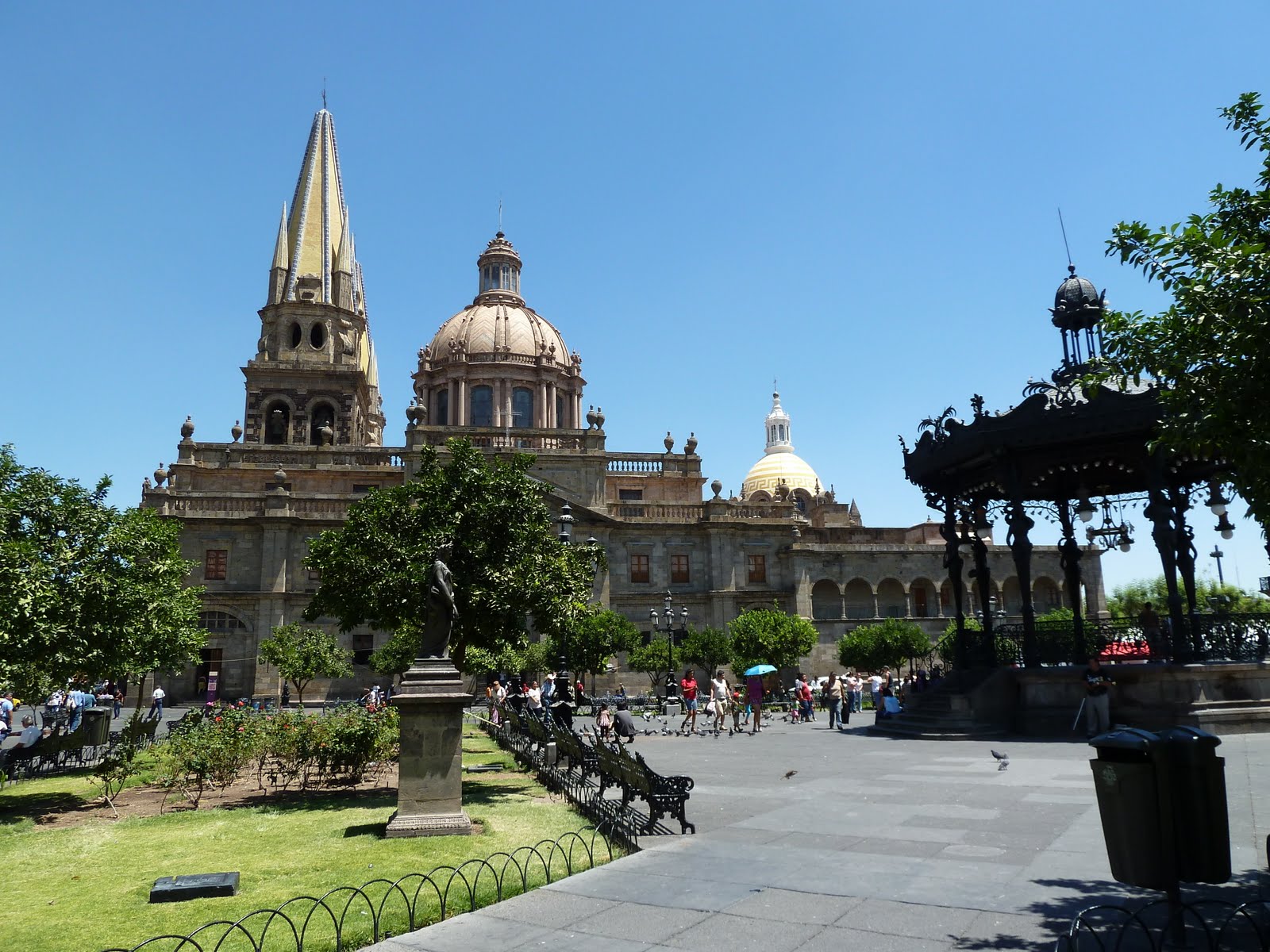
| Monument to the Revolution |
Mexico City. This was Aztec HQ for their empire until 1520 when Señor Hernan Cortez arrived with a boatload of Spics and wiped them out by shooting them, stabbing them and spreading disease. The Aztecs' ( they called themselves the Mexica by the way ) name for the place was Tenochtitlan. It was built on an island in a vast lake, 8000ft up, and surrounded by mountains and volcanos ( up to 17,000ft ). Cortez built his city, The Capital of New Spain, on the top of it. The lake was drained, or dried up, and here we have the modern city, with soggy foundations. It has expanded a bit and now completely fills the old lake and is tidily enclosed by the mountains. The present population, at a conservative estimate, is 22 million, so fairly crowded. And polluted.
My lodgings were just behind the Cathedral on the 'Plaza' in the Central Historic district called the 'Zocalo'. This place, the largest city square in Latin America, is the centre and focal point of the city and contains ,as well as the Grand Cathedral, the Palace and all the old colonial buildings and monuments.
It was extremely grotty. The buildings were blackened and damaged by pollution, and crumbling in places. The enormous square was festooned with tents and tarpaulin shelters with loudspeakers blaring. The Cathedral itself was covered in tacky posters of the previous Pope. The surrounding area was unkemt with weeds and portaloos and crowds of poor ragged people shouting and selling 'tat' on the streets, and some people carrying out what looked to me like 'exorcisms' by wafting smoke over, presumably, paying customers while chanting and brushing them with bunches of sticks. Weird! ( but maybe I'm missing out on some valuable religious function here ). Even the flags flying from the buildings were filthy and ragged. Perhaps I had arrived at an unfortunate time because I think that several 'demos' were taking place on the square which might have accounted for most of the grot. There were certainly lots of police about the place. There is supposed to be a popular 'flag raising' ceremony on the square in the morning and 'flag lowering' in the evening. Big flagpole, big flag. It never happened while I was there. There was no room for military ceremonies and the flag was grounded.. OK, I think I caught the place 'not at it's best' ( it stayed like that for all the time I was there, however ), but it was my first impression; inelegant, grubby, down-at-heel. The place definitely needed a serious wash and brush up!

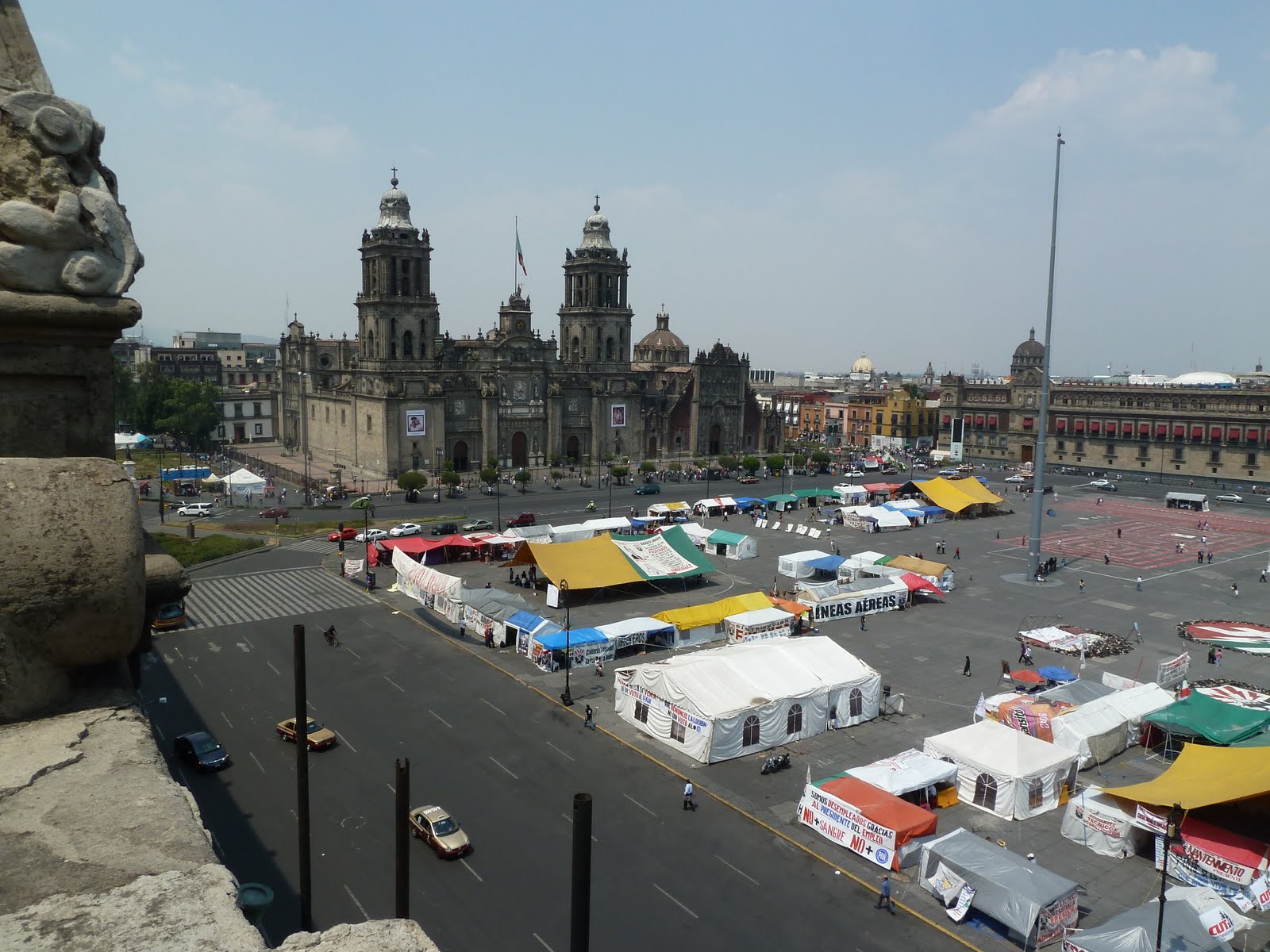
Left: Taken from a pleasant rooftop restaurant, a photo of the central 'Plaza' called the 'Zocalo'. Cathedral left, Palace right, big flagpole ( unadorned ) centre. I don't know what it is with my photos. There appears to be few people about. My recollection is of noisy ( and noisesome ) crowds and vendors around the cathedral selling/buying things, and lots of traffic. Spooky.
At this restaurant I met a NetJet pilot, Matt from Liverpool, and his v. pretty French girlfriend who worked as cabin-crew for Air France. They had just flown in for an overnight stop.
At this restaurant I met a NetJet pilot, Matt from Liverpool, and his v. pretty French girlfriend who worked as cabin-crew for Air France. They had just flown in for an overnight stop.

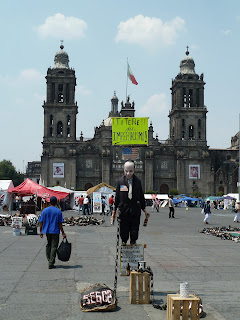
Right: This was connected with the 'demonstrations' about what I never did discover. INJUSTICE, of some kind, presumably. Maybe something to do with...............

...........shoes. Spot the rat!

Right: One of the 14 chapels attached to the Cathedral. It has
an incredibly ornate facade.

Left: Peculiar to Mexico City? These were semi-battery powered tricycle 'taxis'. They look a bit like a modification of the old Sinclair C5. I never went in one, but they were undoubtedy safer than some of the antiquated motor-taxis, of which an unusual number were old VW Beetles. I saw loads of Beetles. Did VW have a factory here? They must have done.
The next morning, Monday, I took my comatose computer ( the VERB thing ) to the Apple/Mac Store in Masaryk Street ( Polanco District ) for a consultation with the computer doctor. I was told that they would give me the verdict within 3 days. I began to discover that this and other Colonia ( districts ) to the west of the city were much smarter and more opulent, and expensive, than the Cathedral area. I also discovered the city Metro Underground system.

Left: Zocalo Metro Station.
This was brilliant. It was easy to navigate, clean, fast, efficient and only a bit crowded at rush hours ( the locals called it ' free massage and sauna' time ), but above all it was cheap. It cost a mere 3 pesos ( 20p ) for any length of journey. Incredible! You just bought a block of tickets or a credit card. The doors opened; five seconds later...beep beep beep for five seconds.... doors closed and off, fast. No arsing about stopping and starting as with the London underground system. Also unlike London there was not an infuriating cacophony of unintelligible, unneccessary and often bossy announcements! ( all for your own safety and security, of course ). They played nice calming music instead. The Metro became, apart from many miles spent walking, my main means of getting around the city.

Behind the often grubby facade of some of the grand old colonial buildings were superb interiors. The photo ( right ) is of the inside of the main city Post Office. You wouldn't find a PO to match this in UK. The one in Saigon comes close though. Having said that, I was told that the actual mail delivery itself is somewhat unreliable. Perhaps the appearance belies the performance.

Left: Just beside the Cathedral there were several people like this who wafted smoke over customers and chanted and brushed them with bunches of sticks. I don't know what it was meant to accomplish but looking at the row upon row of portaloos in the area I wasn't going to risk finding out.
I went on another city bus tour in one of the red double-decker open-topped London cast-offs. It was the 'central' tour which took us mostly out to the west. It showed that my initial impression from the Cathedral area ( Centro Historico district ) was a bit misleading. The colonias of Polanco, La Roma, Chapultepec and Zona Rosa were affluent and clean with leafy avenues and smart shops and houses. A bit like London's West End I suppose. Actually the 'leafy' bits were a bit of a problem on the upper deck of the bus. You had to keep a sharp look-out ahead and prepare to duck or one of the 'leafy' bits would give you a painful smack in the face. Otherwise it was a good orientation of the west end with plenty of interesting things to see. Admittedly the American audio guide was entirely out of sync. What was supposed to be on our left or right rarely was. I got off the bus towards the end of this 'tour' for lunch and was told just to hop on any other bus to continue and finish. I hopped on one at 3.30pm expecting to finish at 4.00, but soon realised that this was a different tour altogrther, to the 'south side'. It was a nightmare. There was nothing of interest to see ( apart, maybe, from the old Olympic Stadium ) and the audio, totally out of sync again, resorted to explaining the significance of invisible street names dedicated to famous? people ( scientists, architects, artists, politicians etc. ). I hadn't heard of any of them. Also a myriad of churches and 'basilicas' ( so boring ) plus the bull-ring. However, worst of all, the 'leafy' bits became more dense and 'branchy'. I received several severe blows to the face and head. These swipes were interspersed with low hanging electric and telephone wires to spice things up which, if you foolishly looked left or right at non-existent 'sights' or inadvertently stuck your head up, could easily have decapitated you and/or given a nasty electric shock. Much of the time, though, was spent static because we were into the rush-hour by now, and it was getting bloody cold. It became an exercise in survival and I reteated downstairs, battered and bored, having lost all interest except in getting to the end, alive, which eventually we did at 9.00pm! That 'tour' cleverly managed to combine boredom with pain, danger, discomfort, hunger and hypothermia. WARNING: Avoid the Mexico City Southern Double-Decker Bus Tour or, if you must, take warm clothing, rations, strong drink, wire-cutters and wear a helmet with goggles. Oh, and take a good book to read too. Just to complete this saga, the bars and restaurants in the Centro Bleedin' Historico district are all closed by 9.00pm. Phew!
Unperturbed, I went on another tour the next day. This was a more cultural and better organised event. It was a guided tour of the old pyramids and civilisation at Teotihuacan, about 40 miles north. There were six of us in the minibus. Me, a couple of Columbian cabin-crew ( Avianca ), two Dutch guys and an interesting Austrian/Russian lady from Vienna called Natalia.

Teotihuacan was the name given to this place by the Aztecs. It was inhabited by a people pre-dating the Aztecs by a few hundred years who had disappeared well before the Aztecs arrived. Nobody, including Sergio, seemed exactly sure of who they were. ( look it up if you are interested ). The site is still being excavated but it is an area about 3kms long with various buildings including two main pyramids. Before we got there we had a stop at a place where 'authentic' obsidian carvings and jewellery are made, plus drinks and medicines from the agave/maguey plants. Obsidian is the hard black glass-like volcanic stone from which the old civilisations made knives, spearheads, tools etc. It was the mandatory 'hard-sell' stop for local produce.

Right: An obsidian carving. The obsidian came in gold or silver flecked varieties. Many of the carvings, done on site here, were actually rather good, but they weighed a ton and were quite expensive. Not souvenirs compatible with travelling light (ish).
 The site itself was big and quite impressive although, something which is common at all these sites, it is difficult to tell what is original and what has been reconstructed. I got the impression that about 90% of these pyramids and buildings were an educated reconstruction. I might be wrong, but nobody was telling. The place was also infested with 'vendors' hawking obsidian carvings, jewellry, woven stuff and, intriguingly, things you blow into to make a loud noise like a Puma growling. Alarming when they snuck up behind you and did this! Actually these `hawkers`were a pain in the arse. I have discovered the Spanish for 'bugger off' now.
The pic (above) is the 'Sun' pyramid. There is another, the 'Moon' pyramid, to the west. Of course it was necessary to climb up it. I was a wee bit puffed by the time I got to the top, but was then reminded that the base is actually at 10,000ft ASL. There are 285 steps, some very high and narrow. Natalia beat me to it and she told me she was the same age as me. I'm sure she is younger.
The pic ( left ) is looking down from the summit. We didn't bother climbing the 'Moon' pyramid.
 Right: There was an extended lunch break after this visit. It is thirsty work climbing pyramids in hot and high conditions.
Much beer, and a little Tequila, was consumed. Natalia ( right ) posed. I think I did too, but the resulting photo was deemed unfit for publication.
Back in the city a lot more wandering around was done. I discovered the charms of Chapultepec Park. It is the largest urban park in this part of the world. It has a boating lake, a large zoo ( probably with yet more sweating Polar bears ), a castle, a fun-fair, many museums, monuments, an enormous 'Auditorio' concert hall and a large wooded areas for people to wander around, have picnics in and partake of, as I couldn't help but notice, a lot of 'canoodling'. It was a pity that, especially around the lake, there was so much rubbish strewn about.
Below right: Chapultepec Castle. It has a long and noble history.

As well as this park district, the 'colonias' of Polanco ( mentioned earlier ), and Zona Rosa feature in the smarter areas for eating and posh shopping. The Zona Rosa is, perhaps, the equivalent of London's Soho. It is advertised as a smart place to go for bars, restaurants and 'entertainment'. I think it has seen better days. There are several rather seedy 'gentleman's clubs' ( and I don't mean the likes of the 'Cavalry and Guards' here ) outside which flashily attired 'Jack-the-Lad 'doormen' entice you to partake of the convivial female company within, i.e they are clip-joints.

Left: A policeman patrolling Zona Rosa. He was most happy to pose. There were lots of them on their Sedgeways. I noticed that they could go rather, and at times very, fast. Maybe the cops have souped-up versions. They certainly looked effective.

Right: More of Mexico City's finest on an alternative mode of transport. These were patrolling near the Memorial Park in the centre. I`m sure they would look better with large moustaches ( the men, I mean ). I would certainly put my money on the Sedgeways in a race.
Reminds me ( old story ) of the, probably worse for wear, bloke who inadvisedly bought a horse at Doncaster sales. When asked by his trainer what he hoped to do with it, answered ''I´m going to race it of course''. The trainer replied....''By the look of it you`ll probably win!''.

Left: For some reason, a curious statue of Sir Winston Churchill in Chapultepec Park. He looks cross, as well he might with this lumbering elephantine unlikeness.

Right: They did a 'changing of the guard' ceremony at the Memorial to the Revolution. I'm sorry, but their drill was appalling! Out of sight of this pic the old guard were shambling about and their officer was chatting on a mobile phone. The 'eternal flame' in front is a bit of orange coloured rag blown upwards by a fan! And their boots were not clean!
My old Drill Sergeant ( Paddy Maine, Irish Guards, Burma 45 ) would have thrown a fit.
Thursday was to be a 'cultural' day with a long walk ( 2 hours ) to the Anthropological Museum. It had been highly recommended. There are loads of museums around the city but I chose this one, on the northern side of Chapultepec. It was indeed an all day job. The museum is of modern design and truly excellent with about 20 'rooms`depicting meso-American history from prehistoric times up to present day ethnic tribal areas. Very well laid out but, like so many Mexican displays, they had an English explanation at the entrance to each room but all the plaques describing the individual exhibits were in Spanish. Sadly I don't do Spanish.

Left: Some old Mayan or Toltec rocks outside the museum at the bottom of some reconstructed temple or other.
On my way to the museum there were some curious sights. Just passing the Almeda Park there was, what I thought, a large demo; thousands of people marching in an endless column through the park and up the streets under vociferous police control. It turned out that this was an earthquake evacuation drill!

Right: This 'human statue' guy was quite amusing. He stood motionless and when a likely target passed by ( normally children ) the little dog leapt at them barking. The results were often dramatic.

Left: I reckon the angelic statue looked a lot better before this old git stood in front of it.
Friday was Red Letter day. I had not heard, by e-mail, any news of my VERB laptop. I went up to the MacStore on Masaryk again. I was told that is was, basically, knackered. It would cost $1400 to get repaired! WHAT!!!! Now, is this a scam or isn't it? 'Bog-off!', or words to that effect, I told the innocent assistant.To put things in perspective, I bought a cheap $5 watch in Tijuana ( as a theft precaution ). I have dropped this watch, stood on it and even been in the shower with it on, and it still works fine. I splash a small amount of coffee on a 1000 pound sterling computer and, effectively, it is dead. One would think, would one not, that with all the mega-hi-tech expertise that goes into building a smart, expensive, supposedly robust laptop it might be possible to make it just slightly water resistant, or at least economically repairable? These machines appear to be allergic to liquid, or even 'hyro-phobic'. Maybe this is a deliberate and cynical ploy to sell more computers and add to Mr MacIntosh's squillion dollar profits. I expressed my displeasure, but I will reserve my real wrath for my return to London where I will visit the place I bought it ( Covent Garden ) in true Basil Fawlty mode at his most hysterical. It will be an event similar, if more vociferous, to the Monty Python 'dead parrot' sketch. Frankly, Mr MacIntosh, you can stick your Apple where the sun don't shine!

Walking back from the MacRippoff Store in a foul grump I passed, yes, an Oirish bear ( left ). You really can't escape them. I went in to drown my sorrows. Any port in a storm. No English, let alone Irish was spoken. Is Tequila an Irish drink too? because they had gallons of that, but no Guiness!

Right: I only took this photo because the statue had quite a facial resemblance to Bryan Cox. Perhaps he had ancestors who performed great military deeds in old time Mexico?
Saturday, and time for more investigation. This time the 'Templo Major' which is the excavation site of the ancient Aztec capital city, Tenochtitlan, just behind the Cathedral. This excavation is relatively recent and restricted because all the ruins are underneath the modern city centre. They show various stages in the Aztec construction and there is another excellent museum at the site with, mainly, Spanish explanations. They did, however, have some computer displays with English sub-titles. I was most interested in the one on Aztec sacrifices.

Left: Part of the excavations of Tenochtitlan. They were right in the middle of the Centro Historico.
The Aztecs were very keen on human sacrifices ( it was the speciality of their death culture religion, unlike Toltecs and the Maya who only did it a bit ) and, on a good day, were reputed to have 10,000 victims put to death ( where did they dispose of all the corpses I wondered? ). They mainly used prisoners of war for this purpose. It was explained that the sacrifice routine was quite complex involving many combinations and permutations. There were 4 main categories of victim namely; young girls, children under 15, captured warriors ( the greatest number ) and, curiously, old women! No mention of old men. There were 5 ways of being put to death depending on which gods were to be appeased. They were as follows; beheading, cutting out the heart, skinning, burning or shooting with a bow and arrow. It was not apparent if you had any choice in the matter. The rest of the museum featured old carvings, rocks and jewellery etc

As always, there was a tall building to go up. In this case the LatinoAmericana Tower ( right ). Not incredibly high in the world rankings but good enough to get a decent view of the city.
There is often a lot of pollution around so views are normally somewhat restricted.

Left: This looks east. The Cathedral/Central Plaza is in the middle and the airport is in the distance. Mountains and volcanos surround the periphery of the city. Many of the poorest areas are constructed, perilously, up the sides of these steep foothills. One big flood, or more likely an earthquake, and your wee hacienda is matchsticks.

Right: And to the west. Almeda Central Park to the right, Polanco in the distance ahead and Chapultepec far left.

Left: There is an excellent restaurant at the top. A very good 'international' menu ( ie some dishes came without tortillas! ) and smart. Good views too, of course. Not too expensive, either.
Mexico City is, as one might expect from a place with 3 X the population of London, a hotchpotch of differing districts and things to see and do. It probably lacked the charm of Guadalajara but hardly surprisingly in a city of this size. Of course I only scratched the surface. The one thing I did find though was that all the people I met were incredibly polite and helpful. I must thank ( in the unlikely event that they read this ) Francisco, the immigration lawyer chap who gave up, quite uneccessarily, his time to guide me to various places when I was sorting out some travel arrangements. Also young Jorge the hotel waiter who, brought up in Greensville, South Carolina, spoke perfect American and gave me lots of good advice and tips on where and, more importantly, where not to go. Against all rumour and advice from several people who had never been there, I did not, at any stage, feel threatened or even in a threatening environment. No more so than London anyway. Perhaps, like Inspector Clouseau, I did not notice the bandits taking a swing at me!

Apart from the bloody laptop saga ( and maybe the southern bus tour ) I had an enjoyable and interesting time.
The Aztecs ( Mexica ) were a nomadic tribe from Aztlan in the north of the country. Legend has it that they would settle and build their city on the 'promised land' where they would see an eagle, perched on a prickly pear cactus holding a snake in it's beak. They saw this eagle on the island in Lake Texcoco, the present site of Mexico City, the image of which is now emblazoned on the national flag. You see, you learn something new every day!
 I am writing this at a delightful internet cafe and bar in the charming town of San Christobal de Las Casas about which I will tell you later, probably from Guatemala. It is the result of a) having been deprived of my VERB laptop ( bastards ) and b) several pints of Corona beer. There may, therefore, be many typing errors and I can never get the blasted pictures to go where I want them. Who cares, it has passed the time pleasantly............hic.