18th - 20th Oct 2019

Right: An aerial photo of the city after the explosion. Wipe out! The Atomic Bomb Dome (the hypocentre) is just to the right of the apex of the central two rivers. In between these two rivers for about 500m south is now the 'Peace Memorial Park'.

The Peace Memorial Park contains several monuments and visitor centres. Including (left) the Children's Peace Monument.
 Right: The Atomic Bomb Memorial Mound. In a vault under this are interred the ashes of thousands of unidentified or unclaimed victims of the explosion.


Right: The instructions.

Left: The Peace Memorial Hall. A softly lit (contemplative) subterranean hall with a fountain at the centre surrounded by a circular panorama of Hiroshima and the names of its neighbourhoods at the time of the bomb. An adjoining room shows the names and photographs of some of those who perished.


Right: At the southern end of the park is the 'Peace Memorial Museum'. Two large buildings connected by a central gallery. It contains many remnants and remains of the bombing such as tattered scorched clothing and bits of debris plus many gruesome photographs of victims. There are moving videoed interviews with survivors (fortunately with subtitles).


Right: A model, before and after, of the Atomic Bomb Dome building.


 The Molly Malone Pub was on the fourth floor of such a building. I was correct. There were lots of Brits, Aussies, Kiwis, Micks and Taffs in there to watch the matches. Quite a packed and very good-humoured crowd. I stuck to a diet of Irish stew and pints of Kilkenny beer. Such is my adventurous foray into Japanese cuisine.

 On the five floors are various museum pieces but most of the descriptions are only in Japanese. At one place you are able to dress up in a complete Samurai costume. Right; Just to look a bit of a prat I restricted myself to putting on a Samurai hat.


Left: A well-dressed lady standing guard outside one of the tourist info centres.


That was my whistle-stop tour of Hiroshima. Decent enough place. Continuing the bomb theme, off next south to Nagasaki.
 |
| The Cenotaph in Peace Memorial Park. The Flame of Peace is at the end of the pond. |
It was a 3 hour Shinkansen train ride south-west via Osaka, Kobe and Fukuyama to Hiroshima. These main railway stations are super modern but have numerous complicated routes within them which makes navigation a bit of a challenge. However, signs and announcements are in English as well as Japanese, as are the sensible and short announcements on the trains, and there is always an Information Office or helpful station staff around to help the bemused Brit tourist. The train was full with many enthusiastic Rugby supporters on their way to Oita for the forthcoming England v Australia match. It was drizzly rain when I arrived.
I discovered that there is a very useful 'Hop on Hop off' (HoHo) bus from the station which operates on three circular colour-coded routes around the city. It is also free with a Japan Rail Pass. It dropped me off close to my hotel (again booked at a v reasonable price on arrival). It was called the Chisum and similar to the APA ones I used previously.
As you undoubtedly know, Hiroshima is infamous for the first atomic bomb, nick-named Little Boy, dropped on it by a US B-29 bomber, the Enola Gay, at 8.15am on 6th August 1945. The explosion instantly killed about 80,000 people and a further 130,000 more died of radiation exposure and other secondary effects, including burns, in the following months. Many more after that. Horrific.
 What they refer to as the 'hypocentre' of the explosion occurred about 2000ft above the city directly over a building now known as the 'Atomic Bomb Dome' (left). It was an Industrial Promotion Hall and unlike other buildings, mostly wooden, in the surrounding area was left ruined but standing although everyone inside it was killed instantly. It is now a Unesco World Heritage Site.

This photo was taken from a large video cleverly showing before and after shots of the city.

The Peace Memorial Park contains several monuments and visitor centres. Including (left) the Children's Peace Monument.
 Right: The Atomic Bomb Memorial Mound. In a vault under this are interred the ashes of thousands of unidentified or unclaimed victims of the explosion.

Left: Nearby is the 'Bell of Peace' at which visitors are encouraged to swing a long pole to ring a large bell hanging in the centre.

Right: The instructions.

Left: The Peace Memorial Hall. A softly lit (contemplative) subterranean hall with a fountain at the centre surrounded by a circular panorama of Hiroshima and the names of its neighbourhoods at the time of the bomb. An adjoining room shows the names and photographs of some of those who perished.

Right: The Cenotaph which is at one, southern, end of a long pool. At the other end, framed by the monument, is the 'Flame of Peace' and beyond that the Atomic Bomb Dome across the river.

Left: There was a sort of parade here by a group of schoolchildren who, in a well-disciplined performance, were laying wreaths at the foot of the Cenotaph.


Left: A child's tricycle dug from the wreckage with a photo of the child who owned it with his mother. Lots of things like this, such as a half melted watch stopped at 8.15.

Right: A model, before and after, of the Atomic Bomb Dome building.

Left: ...and a model of the two bombs. 'Little Boy' (Hiroshima) on the right. 'Fat Man' (Nagasaki) on the left.
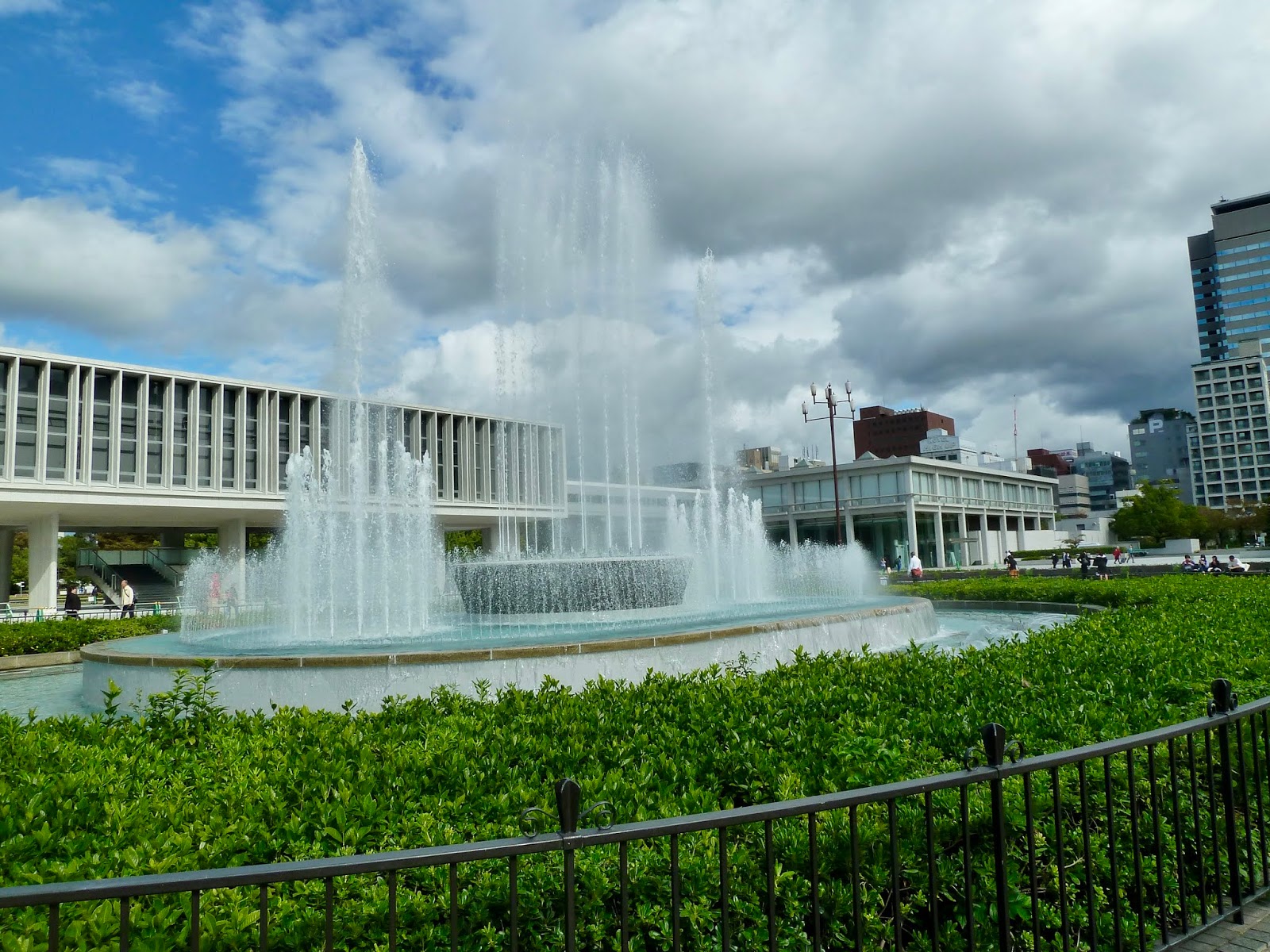
Right: The fountain on the far side of the museum which represents something significant but I've forgotten what.

Left: The busy night-life of the city centres around the Naka ward; a large area of garishly lit streets with numerous bars, shops and restaurants. I was there on the Saturday when England were due to play Australia in the Rugby World Cup. I tracked down the Molly Malone Irish Pub which I suspected might be showing the match.
Bars and clubs are often stacked on top of each other on various floors of buildings. The signs (left) tell you where they are.
 The Molly Malone Pub was on the fourth floor of such a building. I was correct. There were lots of Brits, Aussies, Kiwis, Micks and Taffs in there to watch the matches. Quite a packed and very good-humoured crowd. I stuck to a diet of Irish stew and pints of Kilkenny beer. Such is my adventurous foray into Japanese cuisine.
I stayed for the following New Zealand v Ireland game.
The manager here was indeed a genuine, and amusing, Irishman from Cork.

Left: Next day, courtesy of the marvellous HoHo bus, I visited Hiroshima Castle (Hiroshima-Jo). Originally built in 1589 but was totally flattened by the bomb in 1945. It was rebuilt in 1958. It was one of the Shogun/Samurai residencies and is surrounded by a large park and impressive moat.
 On the five floors are various museum pieces but most of the descriptions are only in Japanese. At one place you are able to dress up in a complete Samurai costume. Right; Just to look a bit of a prat I restricted myself to putting on a Samurai hat.

Left: There are great views from the fifth floor viewing balcony looking south across the park and moat towards the Peace Memorial Park.
Almost forgot to mention; Hiroshima takes its name from this island surrounded by water. It means (I think) 'Wide Island'. Bet you didn't know that.

Right: An interesting 'pet shop' in one of the main streets. Little hyper-active 'toy' dogs are kept in glass tanks where shop assistants go around non-stop cleaning them out. They have very big price tags. I can't think how many they sell, but it looked a bit cruel if you ask me. How long do they keep them before their sell-by date I wonder?

Left: A well-dressed lady standing guard outside one of the tourist info centres.

Right: In the foyer of my little hotel was this display. I began to notice that they take Halloween seriously in Japan. There were many other Halloween themed displays around the place. I suppose the American influence is to blame.

Left: On the HoHo bus. Note the driver, as per standard, with hat, mask and of course white gloves.


