Sunday, 4 December 2011

NUWARA ELIYA - SRI LANKA

27th - 28th Nov 2011

Tea country near Nuwara Eliya.

Met Jim and his smart car and off we set to Nuwara Eliya which is further up in the hills about 50 miles south of Kandy. The place is often referred to as 'Little England'. The place was 'discovered' by the Brits in 1819, and was a pleasant Hill Station for colonials' R&R, grew English type fruit and vegetables with, initially, coffee, before tea planting took over in the 1860s. It is in the shadow of Sri Lanka's highest mountain, Mount Pedro ( Pidurutalagala ), at 8278 ft.


We stopped initially at one of the vast tea estates, which are mostly government owned, called Mackwood's. The factory (left) looked just the same as the museum I had visited previously. A short conducted tour explained the process (of course I was already an expert), but I hadn't realised that tea bushes are picked of their leaves every week and it is a constant process. The leaves grow very quickly. Being Sunday there were no tea pluckers around; it is their only day off. The 'pluckers' are all Tamil ladies, in their thousands, who work almost non-stop. They add much jollity to the proceedings wearing very colourful saris and happy smiles. Sadly I didn't see any of them, so no photies.


Right: I couldn't believe my eyes when we arrived. There was a goddamned sleigh being towed by 'Merry Xmas' blinking reindeer. I mean, incongruous does not satisfactorily describe it. Ridiculous more like. It would be interesting, and maybe impossible, to find some part of the world which has refreshingly turned it's back on this 'winter wonderland' nonsense.


Left: Inside the factory on the 'rolling and shaking' floor. This was exactly like at the museum except the machines were working and making a loud noise. Plus the ever present and quite pleasant smell of tea.
We were, of course, treated to a cup of tea afterwards.


Right: Jim, who has proved a good driver (so far) and is a pleasant and knowledgeable companion. He is setting up his own travel guide service and is great value. His mother is a fan of Jim Reeves ( a deceased singer ), hence his name!


Into Nuwara Eliya after  a very twisty drive up the mountains. I wanted to see the racecourse of which I had heard. Here are the stands (left) and the sign marking the Sri Lanka Turf Club. The place is somewhat dilapidated. They only hold a couple of race-meetings a year and sponsorship, wealthy owners and money in general are in short supply. The main meeting is in April when the feature race is the 'Governor's Cup'.


Left: A look towards the finish. The course reminded me of the old Bogside course in Ayrshire, Scotland (where they once held the Scottish Grand National) in it's point-to-pointing days, even though this is a left-handed track. The going on the day we visited was on the 'heavy' side. It was drizzling with rain. Good British National Hunt weather. It is a good mile and a quarter circuit with a slight climb up the back straight, and lots of weeds and thistles to jump. We were told that the government intends to build a sports complex on the course, which might put an end to it. It is the only racecourse in Sri Lanka.

Left: The stables at the back of the stands housed about 20 horses. They actually looked in quite good nick; well fed and shiny coats. They got exercised every day, but only got to race about twice a year as far as I could make out. Some horses were kept just for hacking around the local hills. The 'lads', about 10 of them, did their 'two' and I don't know who paid them. Some went off to ride in Dubai and even Cyprus.


There are many old colonial style houses and gardens around the town, mostly built in the 19th century, and give the place an almost English home counties appearance. The house here (right) was the Governor's Hill Station Lodge and is now a hotel called 'Ceybank Rest'.


Left: The furniture inside has probably not been changed since the 1890s. This is true of many of the buildings here, both inside and out. The whole place is in a 19th century time-warp. As such it is utterly charming; and the people who serve in such establishments have the delightful manners to go with it.


This is exemplified at the Hill Club (right). Established in 1885 for the use of British Officers on leave, it has not changed one jot since. It has beautifully maintained gardens and tennis courts and even now a full membership and long waiting list for, I suppose, well-to-do Sri Lankans ( although I was told there are some British members still ). It becomes busy in April.


Left: This is the 'men only' bar, as opposed to the larger 'mixed bar' next door. I was allowed to use only this bar because I didn't have a tie on, and am a man, but to use the mixed bar, dining room and other public rooms, including the library, one has to be 'properly attired' (i.e. jacket and tie, or national dress for Sri Lankans). Note the picture of The Queen on the right wall. There were also pictures of Winston Churchill and Prince Charles. To get in here I had to pay for a day's temporary membership (100 rupees).
Keeping Up Standards is important here. If necessary they will even invent Standards To Be Kept Up.


Right: The dining room. Pure old time, with deer's heads and antlers on the walls and a sitting room area at the far end with a large fireplace and comfy chairs. The day's set menu was tomato soup, lamb cutlets, sponge pudding and custard followed by a cheeseboard. I counted 8 waiters on duty in 'full fig' uniform. The chap who gave me a splendid guided tour had worked at the Club for 30 years.  I was the only other person in the building as far as I could see. A lot of sponge pudding must have gone to waste.


Left: There are two billiards rooms; in one you can smoke but not in the other. Why can't we in Britain have sensible rules like that!
This establishment is a magnificent example of a long lost and admirable civilisation.


Next a visit to the Golf Club, est. 1889 ( right ). A very smart looking place as far as I could see, but I know bugger all about golf so can't offer any informed judgement on the course. I was told by an old retainer there that dogs sleeping on the greens is a constant problem. I expect there are rules that cover that hazard. There were some Japanese gentlemen preparing to play. I was given lots of bumph on the course and some score-cards to pass on to anyone who is interested ( Spencer? Bryan? Any takers? ).


...and the town Post Office (left). What a charming relic of a bygone age. It was Sunday, but it was still  open. The old red (Edwardian, I think) British post box is a tribute to a past era.

It is extraordinary that mixed in with all this old colonial and utterly British scenery is a bustling (phrase book jargon for noisy and chaotic) Sri Lankan town with three-wheelers, markets and all that goes with it.

We set off back to Kandy down the wriggly, and now wet, roads. This is definitely a town which deserves much credit for preserving so much history, and keeping it all going in such splendid style. The rain had started again on the way back so I cancelled an intended visit to see the new cricket ground at Palekale. We went instead to see a gem factory and museum in Kandy. They mine, in shallow dirty and dangerous mines, precious (emeralds, sapphires and rubies, but not diamonds) and semi-precious stones. Quite interesting, but I didn't, despite much encouragement, buy any.
More exciting and dramatic visits on the way back to Colombo to follow.

More tea country.

Thursday, 1 December 2011

KANDY - SRI LANKA


25th - 26th Nov 2011

Kandy with the Knuckles mountain range to the east. 
The 3 hour train trip up to Kandy ( 1st class carriage ) was very comfortable if a somewhat rocky ride with air-con, reclining seats, smart grey-uniformed cabin crew handing out bottled water and sweets, and TV screens showing a documentary about Kandy followed by a feature film. Breakfast was served consisting of two sandwiches, a meaty bun and a sort of spicy pasty thing which nearly blew my head off, plus coffee. It was raining quite heavily which slowed us down. I was amazed, it was pissing down with rain don't forget, to see other trains coming in the opposite direction, absolutely packed, with numerous passengers clinging onto the outside of the carriages ( it really does happen; but not sitting on the roof, that's dangerous. There are tunnels around here. Suspect roof-sitting only occurs on 4th class in India on flat going ). It is extraordinary that the track is not littered with those who lose their grip. Maybe it is. I felt quite a few bumps.
It is quite a climb to Kandy up at 1800ft and was a popular place with the colonials for R&R due to it's pleasant climate, fertile land and wooded mountains.
I was staying at the Topaz hotel in Kandy. It is at the top of a big hill and I was told it was within walking distance of the station. You must be joking! I tried but chickened out after 20 sweating minutes and then got a three-wheeler ( like vultures, they hover over any foreigner; unless it's raining and you really need one when they mysteriously disappear ) which only just made it to the top without having to be pushed.

Left: The artificial lake in Kandy. This was built by the last ruler of the Kandy kingdom, Sri Wickrama Rajasinha, as a grandiose gesture in 1807. Some of the local chiefs refused to provide the labourers required. Sri Wickrama had a good worker incentive scheme; he took the dissenting chiefs and had them put to death on stakes on the bed of the lake. The job got done without a hitch after that. The island in the middle was where he kept his harem. The British arrested the aforementioned ruler in 1815 and took over the kingdom. They converted the island to an armoury.


Right: The enormous Buddha Statue, Bahiravakanda, which overlooks the city from the west.


Left: The Asgiriya Cricket Stadium used to be the place where Test matches were played up until a couple of years ago. A smart new ground has been built about 10 miles away at Palekale.


Right: The ground is now in some disarray and is used by a local school ( Trinity College ) for many sports as well as cricket. As with much of Sri Lanka's infrastructure and facilities, funding is an issue. Many things are in need of urgent repair after the financial and administrative drain of the 30 year war with the separatists. The stands, scoreboards and members' enclosure here were weed grown and falling apart. Sad.
There were a few pupils being given some coaching while I was there.


Left: A couple of ladies were busy re-seeding by hand, inch by inch, the several wickets. I suspect it will keep them busy for some time. They were smiling because I gave them 100 rupees ( to have their photo taken ). I think they deserved it, and more.


I called in at the National Museum. The statue ( right ) outside is of some previous Governor, but the plaque on the plinth was missing so I never discovered who he was. The National Museum is, again, in much need of money and refurbishment. It is crumbling and mildewed.


Left:: The exhibits, mostly in fly-blown display cases, are not always totally inspiring, unless you have a particular arcane interest in such things as 19th century betel bags and wallets and similar local tools and paraphernalia.
The lighting in this place was poor to non existent, so many of the peeling labels were difficult to read. I suspect a lot of the clothing exhibits are doomed to rot unless better conditions are provided.


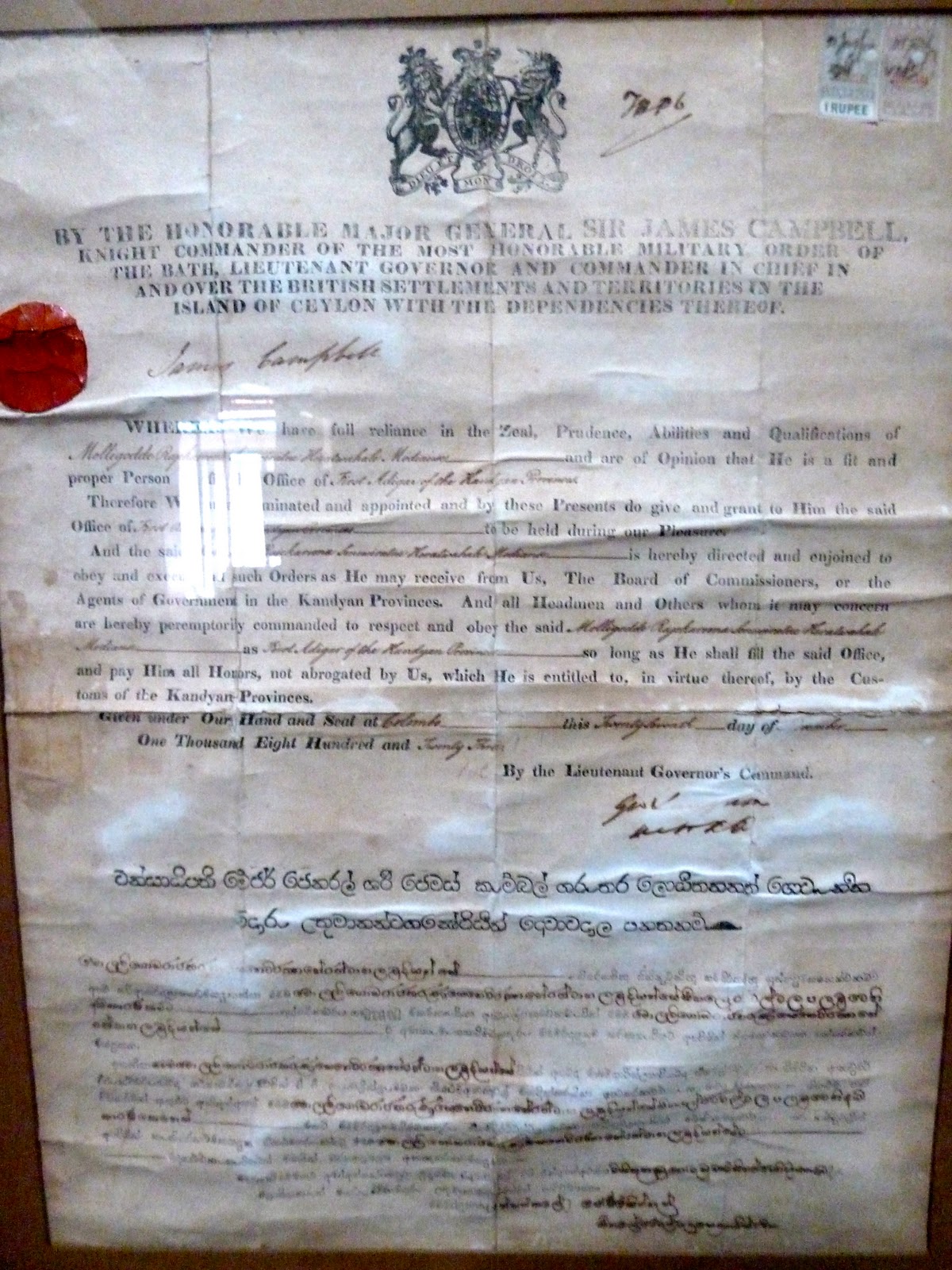
Right: This document is quite interesting. It is ( an old copy I think ) of the original decree which ceded authority over the Kingdom of Kandy to the British in 1815.


Left: Behind the museum is the old Garrison Cemetery. I met the charming old curator who showed me around. He obviously takes a great pride in the place and was keen to point out some of the more memorable graves. One such being the last British dignitary to be killed ( to date ) by a charging elephant in these parts.


Right: This one is even more interesting. It is that of Capt James McGlashan, HM's XIX Regt, who fought gallantly at the battles of Buzaco, Albuera and Waterloo and was commended for bravery. He died, aged 26 yrs,  of a mosquito bite in Ceylon in December 1817. Probably a French mosquito. Such is fate.


Probably the most notable place in Kandy is the Temple of the Sacred Tooth Relic, the Sri Dalada Maligawa ( left ). This Buddhist temple contains, supposedly, the left lower molar tooth of the Buddha. It arrived here from India, apparently, so the rumour goes, having been snatched from the Buddha's funeral pyre in 483 BC and smuggled into Sri Lanka during the 4th century AD, hidden in the hair of a princess.....and if you believe that.....!!!
It is the focal point of much worshipping and praying.
The tooth is contained in a casket which is, in turn, contained in a series of larger decorated gold 'dagobas' ( pyramid shaped containers ).


These are contained in the 'inner shrine' ( right ), which is kept closed. The inner shrine is opened with great ceremony twice a day and 'pilgrims' are permitted to troop past, without stopping, to view from a distance just the outer large gold dogoba. Nobody ever gets to see the holy molar, so it appears. There are rumours that it is a copy of the original anyway, if indeed it ever existed in the first place.


I'm afraid I can't get terribly excited, let alone hold any reverence for what may, or may not, have been possibly, if it's there at all, the glorious gnasher of the Buddha. It does, obviously, hold considerable religious significance for Sri Lankan Buddhists who pray like mad outside the shrine. Good luck to them.
I went on a tour of the building ( 1000 rupees ) which is quite a large complex of rooms, including a Thai sponsored and built temple with a big golden Buddha in it, and a museum. We had to remove shoes and socks before traipsing inside to the accompaniment of chanting Buddhist monks, an audio guide and the slight whiff of smelly feet ( mine, probably ). This place was badly damaged by a terrorist bomb in 1998 which actually exposed many previously unseen paintings and inscriptions, but has been fully repaired since. So much for the Temple of the Sacred Tooth Fairy.


I next went on a visit to the Hanthana Tea Museum, about 3 miles south of Kandy. This old disused tea factory holds examples of all the 19th century tea manufacturing machinery ( in remarkably good nick ) and good descriptions of how the leaf is actually made into tea. The raw leaves are 'withered', rolled, chopped, shaken, fermented, dried and then packed. The machines in the photo ( right ) are the rollers and the present day machines look exactly the same.


Left: A working model of a tea factory floor showing the rollers and shaker. Most of these factories are built  on five floors with lots of space for withering shelves ( to dry out the raw leaves ) and places to blow-dry the final product. Tea product includes lots of Orange Pekoe varieties.
The museum includes much history and photos of two great 19th century tea pioneers; James Taylor ( 1835-92 ) and the famous entrepreneur Sir Thomas Lipton ( 1850-1931 ).


On another floor are some small shops selling tea products and memorabilia, and on the top ( 5th ) floor is a tea shop which serves you a free cuppa ( a pot actually ) of the 'cut orange pekoe' brew. There is also a telescope to take advantage of the magnificent view over Kandy. I was the only person in this museum at the time, apart from the staff! It is definitely worth a visit if only to learn how the stuff is made.


Left: The balcony of 'The Pub' over the noisy main street. It does excellent 'pub grub' and a choice of the local Lion beer, or Carlsberg. These two brands seem to have more or less collared the market.


Right: Tea country. I am off tomorrow for a trip to Nuwara Eliya, 50 miles south of Kandy. This is an old hill station from the 19th century and the centre of the enormous Sri Lankan tea industry. Ceylon tea ( as it is still branded ) is still one of the biggest, if not the biggest tea exporter in the world.
I am due to meet up with Jim, a local driver/guide, who will take me there.
So far so good.

Wednesday, 30 November 2011

COFFEE

I had time to fill in on the ship..........and they used to produce coffee in Sri Lanka in the 19th century.


COFFEE
It is a mystery to me why so many people are so indiscriminating about the coffee they drink. As we are aware, coffee comes from many parts of the world; Kenya, Vietnam, Ethiopia, Brazil, Cuba, Central America and, for all I know, the South Pole, to name but a few places.   
I am certainly no expert. All these coffees have their own distinctive flavour and coffee merchants no doubt spend a lot of time making and marketing different blends. Also, before I start to bang on, I appreciate that there are indeed a very small number of ‘coffee emporia’ which cater for the coffee connoisseur . Personally, I don’t like Vietnamese coffee which tends to have a strong and bitter taste but some people do. Again, there are different types of coffee bean there too. When you buy ground coffee in a British supermarket it normally says ‘blended from abroad’ or something similarly vague on the packet. Perhaps not surprisingly considering the lack of coffee ‘fincas’ in the UK, but would that be acceptable on a bottle of wine or a packet of tea?
When it comes to wine, whisky or even tea everyone likes to wax lyrical about their favourite tipple and even pretends to know something about the provenance of these drinks to try ( and usually fail ) to impress their friends and colleagues. You know...”Oh, this is such a precocious little chateau bottled single malt which leaves just a lingering delicate aftertaste of Lapsang Suchong on the palate”, or somesuch bollocks. But at least people ‘care’ about such drinks. Even gin drinkers worry about whether it is Gordon’s, Plymouth or Bombay ( they all taste exactly the same to me ). So why not coffee?
I suspect the Americans, as always, are to blame. I think it is they who invented all these incredibly naff and supposedly trendy names such as Latte, Americano, Cappuchino, Nochachino, Stickitupyorarso etc. to sell rubbish coffee at exhorbitant prices to the naive ‘lets get with-it’ public, and we have been conditioned to accept it all as ‘good’. In Oz and New Zealand you are expected to order either a ‘flat white’ or ‘long black’. They are thrown into confusion if you ask for a ‘flat black’. I asked a Kiwi what these terms meant. Didn’t have a clue. In fact it just means with or without milk, and noone gives a monkey’s what kind of bean the coffee is made from. Could be acorns for all they care.
Indeed nowadays you cannot order just a cup, or better still a pot, of quality coffee. It is necessary to choose from a list of these dozen or so bizarre  and pretentious concoctions mostly ending in the letter ‘o’. Many years ago I remember ordering and being served a pot of coffee in a French hotel. It came with a jug of hot milk and was absolutely delicious. I have never been able to find the equivalent since. It was certainly not some fancy named frothy fizzing fart-arsed confection with bloody caraway seeds, cinnamon or rabbit’s droppings sprinkled on the top to conceal the revolting taste of the ‘sweepings’ used to make it at £25 per quart sized paper bucketful.
Companies like the American Starbucks are to blame, together with all those many gullible brainwashed people who have fallen for their high-pressure and pervasive advertisements and the almost complete take-over of high-street outlets. I suppose we should give the Yanks some credit for managing successfully to invade, unopposed, the cities of most of the world with their crappy but addictive fizzy drinks, burger joints and coffee shops but it doesn’t say much for local enterprise, or taste, or health for that matter. I think the French once tried to put up some resistance, but failed dismally.
Anyway, I believe a fight-back is long overdue, and we should start by bringing back a discriminating taste for proper coffee. The choice is yours. Will anyone join me? I doubt it. 


Monday, 28 November 2011

COLOMBO - SRI LANKA

22nd - 25th Nov 2011

The Sri Lankan flag

Tea and cricket. As far as I am aware these are the two things that this country is most famous for, apart from a couple of recent disasters. It was hit badly by the Boxing Day Tsunami of 2004, and suffered a prolonged and violent struggle with the Liberation Tigers of Tamil Eelam ( LTTE ) separatists , more commonly known as the Tamil Tigers, until they were soundly defeated in 2009. Both of these episodes caused major social and financial upheavals from which the place is only now beginning to recover. I have only been here a few days, so am not really in any position to judge much yet. However......notwithstanding....
My first impressions of Colombo were mixed. The place has a rather faded, crumbling and dilapidated appearance. The streets are well swept, but in need of considerable renovation. It is hot and humid and fairly choking with exhaust fumes. Many of the shops and buildings look rather run-down but, in amongst it all, are some jewels and, from what I have experienced, the people are delightfully helpful, smiling and keen to make tourists feel welcome.
Like Malaysia, Sri Lanka has been under Portugese, Dutch then British rule. Actually the British were the first to control the whole place because up until 1815 the Kingdom of Kandy was it's own master with it's own, rather brutal, king.
Their are two languages spoken; mainly Sinhalese and, to a lesser extent, Tamil. I am not fluent in either. Fortunately most of the people speak good English. The currency is Sri Lankan Rupees ( LKR ) of which there are about 111 to the US$. Divide the rupees by 10 and you can't go wrong.
I booked into hotels, one reasonably smart, the next less so on Galle Road running south out of the city. It seems as though hotels are pretty full up at this time of year, which is why I had to change,  and are not particularly cheap either. I also discovered that, unlike Malaysia and most other Asian/Oriental countries, they tend to charge quite a lot for internet services and, more irritatingly, have adopted that cursed USA tradition of adding a mandatory 'service charge' and 'taxes' onto bills ( plus plus! ) which, in effect, increases the listed price of things like restaurant and hotel bills by about 30%!

The architecture is a mixture of dilapidated Dutch and British colonial style with a majority of locally designed ramshackle shops and houses, plus a few modern concrete and glass edifices. There is no way you could describe Colombo as being an elegant city.
The place is seething with three-wheeler mini-cabs ( as seen left ). They sort of resemble smaller down-market Bangkok tuk-tuks. Wherever you, as a tourist, are and stop, they are around you like a cloud of midges on a Scottish moor on a summer's day. "uwantaxi" being the war cry. They are actually, even at tourist rates, remarkably cheap and useful. 100 rupees ( less than a $ ) is normal for any local run. I asked what the local name is for these vehicles, but apparently it is just 'three-wheelers'. How unimaginative. However, I quickly discovered such places as The Cricket Club ( off Galle Road ) which is a splendid bar and restaurant in the olde worlde British tradition serving good old fashioned British fare like Shepherd's Pie and Steak and Kidney Pud, all named with a cricketing theme. There are many cricketing mementos like signed bats, sweaters and other kit hanging around the walls. The service, as I have found everywhere so far, is excellent.


Likewise the Galle Face Hotel ( right ). This is perhaps the Colombo equivalent of Singapore's Raffles. Build by the British in the 19th century it retains much of it's colonial charm.


It is on the sea front and features a decent swimming pool and various bars ( nobody would dare swim in the sea near Colombo. If you are not dragged out by the undertow you would die of pollution ).


Right: The Veranda Restaurant with a decent bar of the faded fly-blown fan-cooled Graham Greene style at the far end. Talking of which, I was persuaded to try the local tipple, Arrack. This comes in various differing guises and is made from coconuts. I couldn't make out a similarity in taste to anything I knew. I settled for a solution of whisky mixed with cleaning fluid. If it is an acquired taste, I don't think I'll bother to acquire it.


In the foyer there is a large decorative board listing all the famous people who have stayed at the hotel. Emperor Hirohito and Her Majesty the Queen of Denmark to name but two ( not sharing a room as far as I understood ). There is also a bust of Colonel Uri Gagarin ( left ), the first man into space in 1961, who visited Colombo shortly afterwards. Perhaps he was coming to have something done to his teeth which look rather alarming here; perhaps shaken loose on re-entry.


Right: Another view of a street scene. I have forgotten what the rather interesting looking building is over the road. I was staying a couple of days here in Colombo to plan my further travels with an agency recommended to me. They have proved most helpful ( www.classictravel.lk if you are interested ). They are also sorting out my Indian visa.  Travelling in any form of comfort around Sri Lanka, I discovered, is not easy by bus or train. They come in varying degrees of serious discomfort and danger. There is, however, the recent introduction of a 'first class' carriage on a train from Colombo to Kandy which features lots of mod-cons and is unique to the Sri Lankan rail system.


Left: The Fort ( central ) Station in Colombo. I had booked myself onto the 1st Class carriage to Kandy ( 2.5 hours @ $20 return ). Most rail tickets in the class which includes hanging out of the doors and on the roof cost pennies, so $20 is an unheard of price for locals.


Right: This is the driver. I shall report back on the voyage.


Next stop the hill town of Kandy. I shall be there for a few days.


Thursday, 24 November 2011

MOZART. MALAYSIA TO SRI LANKA

17th - 22nd Nov 2011


I arrived at Port Tanjung Pelepas in good time, and was met at the port admin building by Captain Lalin De Silva, the shipping company’s agent. He is a star. Not only did he smooth the way for me boarding the ship, but because I was early ( the ship was not due to sail until that evening ), he most generously took me out to lunch at a fantastic traditional Malay seafood restaurant nearby; the enormous buttered fresh prawns being particularly memorable. Originally from Sri Lanka himself, he also gave me comprehensive advice on where to go and what to see in that country. I was very well looked after. If you ever end up in PTP, Captain De Silva is your man. By the way, his wife’s grandmother was Scottish, from Edinburgh.


Left: The redoubtable Captain Lalin De Silva. If you are ever passing PTP and need any assistance, his office is on the 4th floor of the Port Administrative Building Block B, and I am sure he would be delighted to help.


Right: I was taken out for lunch by Capt Lalin at this seaside restaurant. It was the start of what turned out to be a five day gastronomic extravaganza. Enjoyable, if somewhat debauched. 


He dropped me at the Seaman’s Centre, the place I had previously visited 12 days ago with the two Incas. Karsten, the affable Dane who runs the place, was again behind the bar. It really is a most ‘up-market’ seaman’s mission and from there I then got the port shuttle bus to the ship; CMA-CGM Mozart. CMA-CGM is a French company based in Marseille.


Left: Karsten the Dane at his Seaman's Centre at PTP. All mod cons and gallons of Carlsberg lager available. He is a bit overworked at the moment because of staff shortages. He is looking for a Philippino speaking Malay national to help him. If anybody knows one who is available...please advise ( Bernie? ).


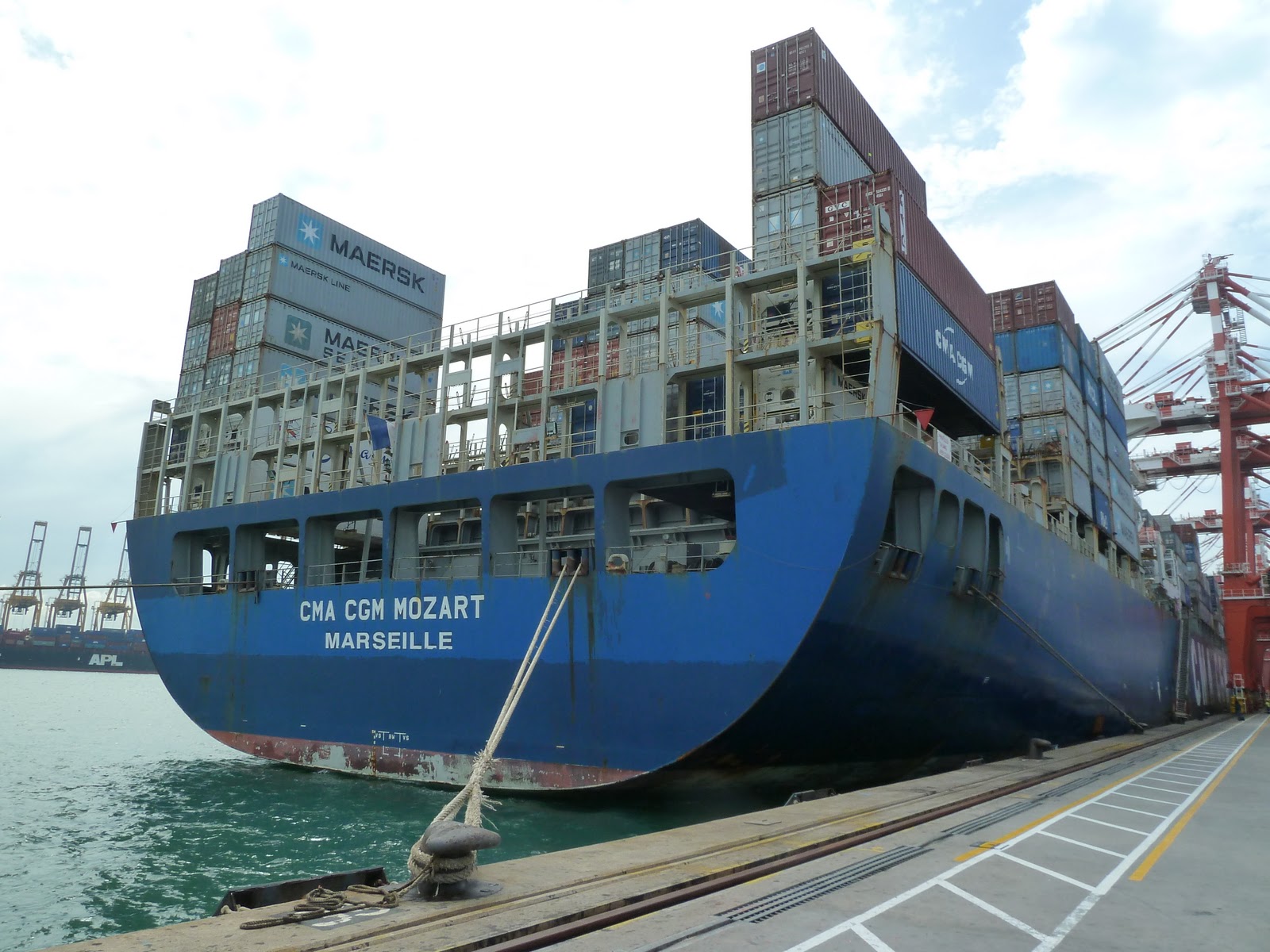
The Mozart ( right ), another container ship, is somewhat larger in capacity than the others I have been on. It is 277 metres long with a beam of 40 metres and carries max 5782 TEU. Did I tell you, the Titanic was 268 metres long with a beam of 28 metres? I may also have explained; a ‘TEU’ is the space equivalent of a 20 ft long container. It also has a lift!


I arrived in time for dinner and it was soon apparent that procedure on this ship is a completely different kettle de poisson than the previous, Eastern European/Philippino manned, vessels. C’est chalk et fromage compared to the Carelia, Bahia and Cap Cleveland. For a start, all the ship’s officers wear neatly pressed uniform of white shirts and black trousers for all meals and when on duty, they shave properly, look smart and they all meet for pre-dinner drinks in a sort of ante-room/bar and, apart from the officers on watch, all eat together and don’t leave the table before the Captain. The French ( Breton ) chef wears whites and hat and there is a carefully prepared menu. The food is superb, and a full bottle of wine is provided with both lunch, 1230hrs, and dinner at the more respectable time of 1930hrs. It is all remarkably civilised. I’m surprised they don’t have a ‘palm-court orchestra’ to accompany the meals, a la Titanic.


Left: The table set just for me. I am the only passenger. I think this was the Sunday Lunch starting with smoked salmon and hot toast. 


Right: An example of a menu. Zut alors!


Left: Les Officiers ( or most of them ). Le Captaine, Jean Hasle, on the right. All most civilised.


Right: Encore un menu. Ceci de Dimanche. 


The steward, a Romanian called Adrian, again in uniform, is both charming and efficient. Unlike the idle and uncommunicative Philippino stewards ( or more likely just badly instructed ) on the ex-Soviet manned ships, this guy punctiliously makes the beds and cleans the cabins each day, as well as serving the food.


On the second afternoon the whole ship’s company, plus myself, assembled on the bridge to be given safety briefings, including procedures in the event of ‘piracy’, a demonstration of how to get into your immersion suit ( left ) and who was responsible for what. The fact that this briefing was given in French by the Captain, Ist Mate and Bosun, and consequently I didn’t really understand much of it, was immaterial. This sort of collective ‘briefing’ would never have occurred on the previous ships. The ship’s company numbers 27 ( I think I counted ) which is considerably more than on the other vessels. They are mainly French with some Romanians. This is peculiar to the ‘French’ half of the CMA-CGM shipping company; the other half of their 360 ships is crewed by ‘international’ crews i.e Eastern European, Indian and Philippinos.
The Captain, a smart and charming Frenchman, a Breton, called Jean Hasle ( pronounced, I was told, ‘Allez’ ) is quietly spoken and exudes calm efficiency and authority. The other officers include an amusing ( good line in jokes ) Romanian 3rd Mate, and an attractive French lady 2nd Engineer. As I said, a different ‘joue de ballon’ to what I had experienced before.
We rounded the north of Sumatra and set a westerly course across the Indian Ocean for Sri Lanka. The sea being calm so far ( as I write this on the night of the 19th ), it is very much a pleasure cruise.


 I am worried about putting on more weight so shun the lift, quel luxury unnecessaire, and use the stairs to my cabin ( right ) on E Deck ( 8 decks from main-deck to Bridge. The mess dining room is on B Deck ). This is my token gesture in the face of irresistible cuisine. Zut Alors! There is a g*m ( unspeakable ) and a ping-pong table, a special lounge on my deck with DVD player and an enormous library of ( many English ) books and DVDs , a bar in the ‘ante-room’, a laundry room, nice pictures on the walls and lots of home comforts. C’est manifique.


I visited the bridge after breakfast on Sunday, 20th, where the Romanian 3rd Mate, Catalin, and one of the three helmsman were on watch. Very peaceful up there with some pleasant 1960/70s music playing quietly in the background. There were a lot of large ships in the area either ahead of us, we overtook a couple, or coming in the opposite direction. It is obviously a very busy shipping lane. Apparently on Sundays the chef makes an even greater effort to provide ‘le repas memorable’. Dejeune was certainly a case in point. After this gargantuan feast I felt a little bit like that enormously fat man in the Monty Python film ‘The Meaning of Life’ who, when persuaded to eat a final ‘waffere-thin mint’, explodes. I must, I will, go on a serious diet when reaching shore.
Monday 21st, much of the same routine and later in the day we were in sight of Sri Lanka. I am told the pilot comes on board at 0100hrs and we should dock about an hour later.
Woke up on the morning of the 22nd to find that we had indeed arrived. Petit dejeune, said my 'au revoirs' and, together with the lady 2nd engineer ( she was on her way back to Paris ), disembarked. After much paper stamping by various Sri Lankan customs and immigration officials it was " Hello Colombooooooooo!!!!!"

Wednesday, 23 November 2011

SINGAPORE 2


15th - 16th Nov 2011


Raffles Hotel
Back in Singapore for a couple of days. Some ‘admin’ to do arranging the next leg of the journey plus a bit of sight-seeing. So much to see and never enough time. I have to be at Port Tanjung Pelepas ( Malaysia ) to catch my next ship on the morning of the 17th. It is the ships which cause my only dead-lines and the only aspect of this worldwide meandering which I have had to book well in advance. All the rest is done on the back of the proverbial fag packet as I go along.
Down-town to do doing some necessary shopping ( boring ) and the first thing I noticed was that the blasted Christmas decorations had gone up in the few days I had been away, with a vengeance. Why on earth do places like this persist in displaying Christmas trees, Rudolph the Stupid Red Nosed Reindeers, tinselly snowflakes, polystyrene winter scenes and playing non-stop ‘Frosty the Snowman‘, ‘Jingle Bells’ and other tacky rubbish in streets, department stores and shopping ‘malls’? ....and it’s still only November! Nobody has seen any snow or ice in this place for millions of years and never will! Money, that’s why, and the excuse to sell more and more tat on the back of a Christian/Pagan festival of greed, gluttony and materialism. If I had my way, a flame-thrower would come in very handy at this time of year.
I went back to Marina Bay to go up the Marina Bay Sands ( MBS ) building, the one that looks like an airship moored on the roof of a skyscraper, to the SkyPark thereupon. Good views, although as is so often the case in this part of the world, the conditions were hazy. 


Left: City view from the MBS viewing balcony. That flower shaped building is where they had, maybe still have, the Titanic ( highly recommended ) and Dali ( slightly recommended ) exhibitions.
The floating footy pitch must provide a few problems collecting the balls booted well into touch.


Right: View to the south showing the vast armada of commercial shipping traffic which forever hangs around the port area, and all the way up the Malacca Strait ports.


I also called in at Raffles Hotel. I suspect it was nothing like it is now in Sir Stamford Raffles’ day ( 1819 ) even though they insist it has been ‘faithfully restored to it’s former glory’. I doubt if Sir Stamford would recognise the prices. The cost of a ‘basic’ room is $1350 per night per individual, rising to $5800 for the ‘grand’ suites. Bloody Hell!!! That is more than the annual salary for most of the world's population.The cost of an ‘original’ Singapore Sling in the famous old ‘Long Bar’ ( left ) is, including service charge and tax, $30 a glass. Quite a whack for what, in effect, is a sweet sickly pink tart’s drink. I think, judging from what I saw, the Americans fall for it. It probably explains the glum looks on the faces of the customers in this photo who, having just drunk the filthy concoction, have been confronted with their bills.


Right: Inside one of the shopping 'malls'. Malay style boat trips throughout  the shopping area seemed popular. Not enough space for waterskiing.


To go by road from Singapore across the causeway to Johor Bahru ( JB ), unless by private car, it is necessary to get either a bus or specially licenced taxi from the JB depot in Queen Street. It is, inconveniently, not possible to go direct to the Singapore border, cross on foot and get a taxi on the Malaysian side. The Malaysian check-point is on the far side of the causeway. I would need to do this later the same day, so I thought a recce was in order. On the way to Queen Street I passed the one time, during colonial days, infamous Bugis Street. 


Left: The modern boring Bugis Street.
It was once a well known haunt for very friendly ladies and, more intriguingly, for very friendly boys that looked like ladies, who provided intimate social entertainment for the often rather over-indulged and licentious soldiery, with sometimes unexpected results. 
It is now just a covered market selling food and junk.


The last bus running to JB was to leave at 1730hrs, so I would have to get a taxi; later. So, back to my ever patient and generous hosts in Seletar Hills to re-pack and generally sort myself out.


Right: Goodbye and many thanks to my generous hosts David and Louise, plus Poppy the dog and the cat. Also to their indefatigable maid Virgy who, against all the odds, washed and ironed all my clothes with inexplicable enthusiasm.


 Return to Queen Street and a taxi ( S$40 as a standard fixed rate....not too bad for delivery to the front door of a hotel in JB ) across the causeway through the two separated check-points, with no baggage checks, to the Puteri Pacific Hotel. This is a quality 4 star hotel and a very comfortable room, including breakfast, cost S$68 (  £35 approx ). This is about half the price of a single YHA room with shared facilities in Oz and NZ.
Mr Zak is due to pick me up at 0830hrs tomorrow to take me to Port Tanjung Pelepas ( PTP ) to meet the ship, the French container vessel CMA-CGM Mozart which will, hopefully, take me to Colombo, Ceylon.
So far, so good.................