Thursday, 8 December 2011

BACK TO COLOMBO - SRI LANKA

28th Nov - 3rd Dec 2011

Local industry.

Before the train left from Kandy back to Colombo there was time to go to visit the elephant orphanage at Pinnewala, about 20 miles west. This place is supposed to look after orphaned and injured elephants.


On the way there we passed several sights including this ( left ) across the hills to Bible Rock on the horizon in the distance. Also dozens of roadside stalls selling snacks to passers by and seemingly not many takers.


The Elephant Orphanage is a very tourist oriented commercial concern. It is suspected that elephants are deliberately bred here to keep the herd strong and available for human viewing. Having said that they all look in remarkably good health and are obviously well fed. Not much need for them to do much foraging, and some young elephants are selected every morning to be hand-fed bottles of milk by eager tourists which they drink by the gallon.


There were about 80 elephants on display which live in a large enclosed area and in a life of comparative luxury. Lots of photo opportunities to be had with tourists ( me included ) standing next to the creatures and patting their heads. The 'mahouts' make lots of pocket-money from this. They probably all have second homes in Monte Carlo and drive Ferraris.


Right: One of the more impressive 'tuskers' being given a pedicure. I didn't gather which elephants grew big tusks and which didn't. Maybe it's obvious? I know that Indian elephants have smaller ears, but that is about as far as my knowledge goes.
I expect someone will explain.
These elephants are fed at 10.00am each day for both their and the tourists' benefit. They are then, at 12.00pm, herded down to the river for a bathe, and for more gawping at by us tourists.


On the way down to the river we, and the elephants, pass through a sort of shopping street. Lots of hustlers selling all kinds of tat as always. There are many places ( as per left ) advertising the sale of 'elephant dung' paper products.
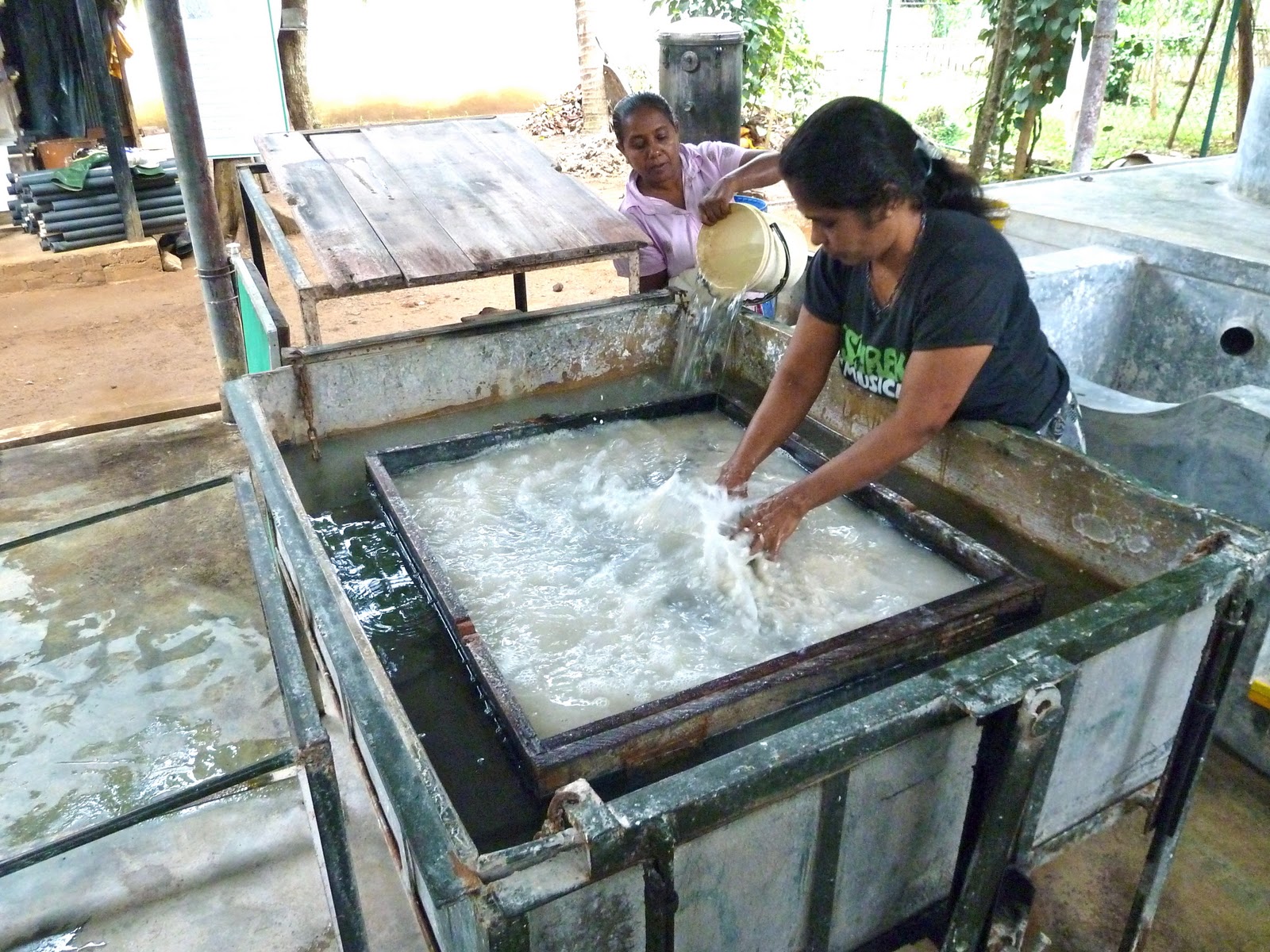


Right: We were given a demo of how the shit is converted into paper. Quite a simple process really. I was then persuaded to by a notebook made from the stuff. Is is possible to write on it with biro. I doubt if it will ever be a best seller in Smythson's of Bond Street.


Left: The jumbos wade in. They seem to enjoy themselves, especially the little ones which cavort about and play with each other, frequently submerging themselves. The mahouts, armed with long poles with spikes and hooks on the top, make sure they don't wander away too far. Actually the elephants seem remarkably biddable and responsive to commands.


Right: This one ( right ) is not dead. It was singled out for a special wash and scrub. The beast seemed to think it was in seventh heaven. It languished like this for over an hour, occasionally raising it's trunk to breathe, only moving at the half way point to turn over onto it's other side.
PS. I never saw any injured elephants.


On the way back to the station in Kandy we passed this tree, amongst others similar, over a river which was crowded with hanging bats. They go eating fruit after dark. We also stopped at a 'Herb Garden' where I was taken on a most interesting tour of a large area of many different exotic herbs and plants and included a back and neck massage with some special gunge or other. Of course it was a clever way of convincing the customer ( me anyway ) of buying some exotic life-enhancing herby liquid at the shop at the end. I was told I would look ten years younger if I drank it, or was I meant to rub it on somewhere, can't remember.
We returned via a visit to the nursery school which Jim's wife ran; it looked a very smart and jolly place with, I was told, 80 children under 5yrs. A quick lunch at The Pub in Kandy and then the train ( the 1st Class job ) back to Colombo. So far so good.
I had booked into the Mount Lavinia Hotel for that night. It is a fairly luxurious place on the beach at Mount Lavinia which is about 15 miles south of Colombo. Because I was already at the station I decided to go by train. In the rush hour. This was cheap ( 15 rupees, 10 pence ) and because I didn't know where to go a local chap kindly went and bought my ticket for me! He didn't even want repayment. Extraordinarily generous, and the train was on time. I had a bag and small backpack with me. I managed to get inside the carriage, as did about 5 thousand others with another few hundred hanging onto the outside. To say it was a crush is something of an understatement. It was suffocating and impossible to move any part of my body. I have never experienced anything like it before. The rush hour tubes in London are positively deserted in comparison. I lost contact with my bag and all feeling in one leg and an arm. It was difficult to breathe. There are 8 stops, I was laughingly told by a bloke with bad breath standing on my foot with his elbow in my ribs, before Mount Lavinia. For the next 4 stations even more people, incredibly, fought their way on board and clung to the windows outside. It was actually quite frightening! I was not sure if I would last the journey and had every confidence that if I did get off alive it would be without most of my possessions.  By stop 6 ( after an interminable 25 painful minutes or so ) people started to thin out a bit. I made it to Mt Lavinia alive if dazed, sweating profusely, numb and desperate. Curiously I found my bag on the floor and as much as I checked I could find nothing missing from my person. I will think more than twice before doing that again.
It was a short walk to the hotel.


Right: The grandiose colonial style Mount Lavinia Hotel. In the foyer/reception area there was, inevitably, a decorated Christmas tree. We were welcomed to the refrain of "Walking in a Winter Wonderland". Winter Wonderland, MY ARSE! People here would be no more familiar with a poxy Winter Wonderland than the Sea of Tranquillity on the moon.


Left: The beach, outside the the fish restaurant, was surprisingly deserted. The hotel had several bars and restaurants, all quite expensive but good quality.  My only complaint about the place was that the distances you had to cover between these facilities and rooms ideally required a taxi ( or three-wheeler ).


Right: View of the beach from one of the bars. Nobody tends to swim in the sea. They use the hotel pool instead, because there are strong currents and under-tows which would tend to make you late for dinner or, indeed, entirely 'late'.


Left: One of the quaintly, and smartly, dressed staff in his colonial outfit. Reminds me a little of the wee chap 'Lofty' in the old TV series ( now too politically incorrect to receive repeats ) 'It Ain't 'Alf Hot Mum', if memory serves me right. It is a good hotel, no question.

I spent a second night at Mt Lavinia in another ( cheaper ) hotel. I won't bore you with more beach hotel photos. It was delightful too.

Back to Colombo central by taxi. I was not risking another 'normal' train for a bit. I had to be there for the next three days to 'organise' my Indian visa.

By another complete quirk of coincidence a friend of mine, Barbara ( she owned that magnificent old pub, The Grapes, in Narrow Street, Limehouse, until last year ), was holidaying in Sri Lanka and was due to spend her last night at the Galle Face Hotel in Colombo on Thursday ( 1st ). I think I showed a few pics of this antiquated establishment ( Colombo's answer to Singapore's Raffles ) previously. We arranged to meet for drinks at the Veranda bar at 6.30pm. Champagne was provided ( Barbara must have sold the pub well ) and then had dinner. A great treat, for me. Incidentally The Grapes is now owned by Ian McKellen ( actor ) who lives nearby and it is an iconic Dickensian London pub and fish restaurant that is utterly unspoilt and traditional and does the most fantastic Sunday Roast Lunch. Can't recommend the place highly enough despite some rather eccentric old fashioned 'locals', and their equally eccentric dogs, who prop up the bar.
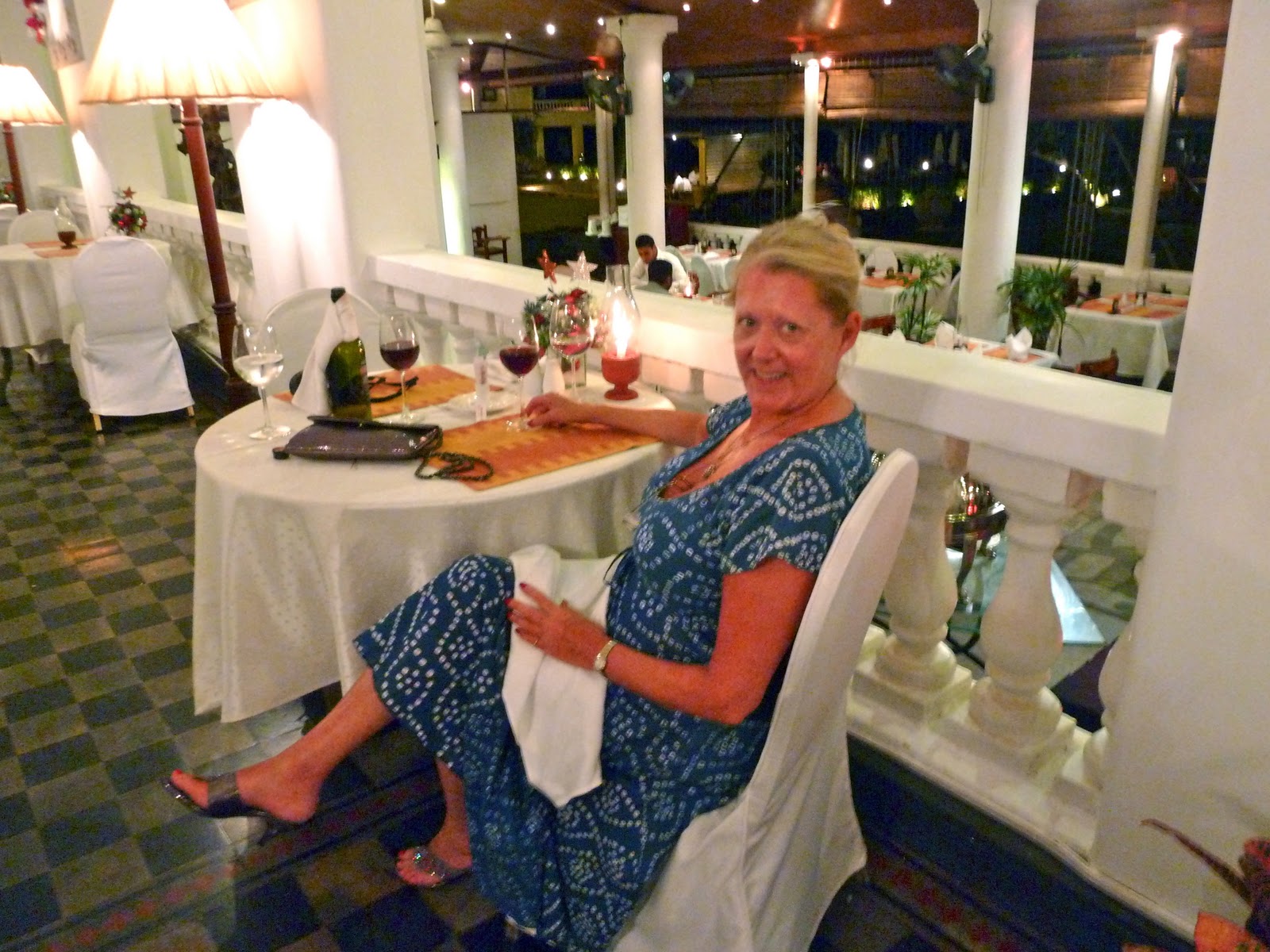


Right: Barbara looking sun-tanned and glamorous, with matching shoes and handbag, after a very good dinner at the Veranda restaurant at the Galle Face Hotel.
I'm sure Barbara won't mind if I tell you that she was a very senior and respected 'Bunnygirl' at the Playboy Club, Mayfair, in it's heyday in the 1960s. They had very high standards in those days, and Barbara has always sought to maintain them. Ex-Bunny Barbara ran her pub with a rod of iron.


Left: This is the board, mentioned previously, which hangs in the reception area of the hotel. It lists all the guests considered to be 'important' to have stayed here ( well, up to whatever date it states on the board ). For some reason it features the Queen of Denmark three times. She was obviously a popular guest. If you 'click on' to enlarge you might be able to make out a few names. You might even feature!
I like the entry of Prince Philip who, apparently, bought his first car in Colombo which is now owned by Cyril Gardiner, the director and chairman, who instigated this  board.


While in Colombo I took the opportunity to visit the International Cricket ground at The Sinhalese Sports Club, District 7, the posh part of town. There was a cricket match ( 50/50 ) in progress between two league sides; MAS Intimates v MAS Active. The captain of the Sri Lanka team, T. Dilshan, was playing for MAS Active. He was out for a duck.
The noise of trumpets and banging drums was continuous, plus thunderous volleys of firecrackers ( forbidden in UK, 'Elf 'n' Safety of course ) which belied a rather small crowd.


This was the final of the Singer Trophy. MAS Active won quite convincingly. Here they are ( left ) celebrating their victory. The presentations went on for ages and featured awards for everything from the Batsman of the Series to the Best Groundsman with about 20 others in between.
The Sri Lankan team are just about to depart for a Test match with South Africa. Locals tell me that it will be considered a 'success' if they manage to hold out for three days. The Sri Lankan team is going through a rough patch with lots of 'politics' and lack of pay at the heart of their problems. Good luck to them. The first Test ( maybe only one ) is on the 15th Dec. Good luck to them.


I adopted the Cricket Club Cafe ( district 3 ) as my watering hole of choice ( right ). It was close to my cheap hotel. This place was of Brit pub appearance and served very good Shepherd's Pie amongst other old fashioned English fare.


The service, as just about everywhere in this country, was superb. Lots of ex-pats were in evidence, not surprisingly perhaps.


Off next to have a look at Galle and it's nearby beach areas. I think I will be trying out the public bus services to get there. I am told there is a certain 'thrill' value to be had experiencing the skill of the bus driver over-taking using three lanes on a crowded two lane road. "Hold very tight please, ting ting".

Sunday, 4 December 2011

NUWARA ELIYA - SRI LANKA

27th - 28th Nov 2011

Tea country near Nuwara Eliya.

Met Jim and his smart car and off we set to Nuwara Eliya which is further up in the hills about 50 miles south of Kandy. The place is often referred to as 'Little England'. The place was 'discovered' by the Brits in 1819, and was a pleasant Hill Station for colonials' R&R, grew English type fruit and vegetables with, initially, coffee, before tea planting took over in the 1860s. It is in the shadow of Sri Lanka's highest mountain, Mount Pedro ( Pidurutalagala ), at 8278 ft.


We stopped initially at one of the vast tea estates, which are mostly government owned, called Mackwood's. The factory (left) looked just the same as the museum I had visited previously. A short conducted tour explained the process (of course I was already an expert), but I hadn't realised that tea bushes are picked of their leaves every week and it is a constant process. The leaves grow very quickly. Being Sunday there were no tea pluckers around; it is their only day off. The 'pluckers' are all Tamil ladies, in their thousands, who work almost non-stop. They add much jollity to the proceedings wearing very colourful saris and happy smiles. Sadly I didn't see any of them, so no photies.


Right: I couldn't believe my eyes when we arrived. There was a goddamned sleigh being towed by 'Merry Xmas' blinking reindeer. I mean, incongruous does not satisfactorily describe it. Ridiculous more like. It would be interesting, and maybe impossible, to find some part of the world which has refreshingly turned it's back on this 'winter wonderland' nonsense.


Left: Inside the factory on the 'rolling and shaking' floor. This was exactly like at the museum except the machines were working and making a loud noise. Plus the ever present and quite pleasant smell of tea.
We were, of course, treated to a cup of tea afterwards.


Right: Jim, who has proved a good driver (so far) and is a pleasant and knowledgeable companion. He is setting up his own travel guide service and is great value. His mother is a fan of Jim Reeves ( a deceased singer ), hence his name!


Into Nuwara Eliya after  a very twisty drive up the mountains. I wanted to see the racecourse of which I had heard. Here are the stands (left) and the sign marking the Sri Lanka Turf Club. The place is somewhat dilapidated. They only hold a couple of race-meetings a year and sponsorship, wealthy owners and money in general are in short supply. The main meeting is in April when the feature race is the 'Governor's Cup'.


Left: A look towards the finish. The course reminded me of the old Bogside course in Ayrshire, Scotland (where they once held the Scottish Grand National) in it's point-to-pointing days, even though this is a left-handed track. The going on the day we visited was on the 'heavy' side. It was drizzling with rain. Good British National Hunt weather. It is a good mile and a quarter circuit with a slight climb up the back straight, and lots of weeds and thistles to jump. We were told that the government intends to build a sports complex on the course, which might put an end to it. It is the only racecourse in Sri Lanka.

Left: The stables at the back of the stands housed about 20 horses. They actually looked in quite good nick; well fed and shiny coats. They got exercised every day, but only got to race about twice a year as far as I could make out. Some horses were kept just for hacking around the local hills. The 'lads', about 10 of them, did their 'two' and I don't know who paid them. Some went off to ride in Dubai and even Cyprus.


There are many old colonial style houses and gardens around the town, mostly built in the 19th century, and give the place an almost English home counties appearance. The house here (right) was the Governor's Hill Station Lodge and is now a hotel called 'Ceybank Rest'.


Left: The furniture inside has probably not been changed since the 1890s. This is true of many of the buildings here, both inside and out. The whole place is in a 19th century time-warp. As such it is utterly charming; and the people who serve in such establishments have the delightful manners to go with it.


This is exemplified at the Hill Club (right). Established in 1885 for the use of British Officers on leave, it has not changed one jot since. It has beautifully maintained gardens and tennis courts and even now a full membership and long waiting list for, I suppose, well-to-do Sri Lankans ( although I was told there are some British members still ). It becomes busy in April.


Left: This is the 'men only' bar, as opposed to the larger 'mixed bar' next door. I was allowed to use only this bar because I didn't have a tie on, and am a man, but to use the mixed bar, dining room and other public rooms, including the library, one has to be 'properly attired' (i.e. jacket and tie, or national dress for Sri Lankans). Note the picture of The Queen on the right wall. There were also pictures of Winston Churchill and Prince Charles. To get in here I had to pay for a day's temporary membership (100 rupees).
Keeping Up Standards is important here. If necessary they will even invent Standards To Be Kept Up.


Right: The dining room. Pure old time, with deer's heads and antlers on the walls and a sitting room area at the far end with a large fireplace and comfy chairs. The day's set menu was tomato soup, lamb cutlets, sponge pudding and custard followed by a cheeseboard. I counted 8 waiters on duty in 'full fig' uniform. The chap who gave me a splendid guided tour had worked at the Club for 30 years.  I was the only other person in the building as far as I could see. A lot of sponge pudding must have gone to waste.


Left: There are two billiards rooms; in one you can smoke but not in the other. Why can't we in Britain have sensible rules like that!
This establishment is a magnificent example of a long lost and admirable civilisation.


Next a visit to the Golf Club, est. 1889 ( right ). A very smart looking place as far as I could see, but I know bugger all about golf so can't offer any informed judgement on the course. I was told by an old retainer there that dogs sleeping on the greens is a constant problem. I expect there are rules that cover that hazard. There were some Japanese gentlemen preparing to play. I was given lots of bumph on the course and some score-cards to pass on to anyone who is interested ( Spencer? Bryan? Any takers? ).


...and the town Post Office (left). What a charming relic of a bygone age. It was Sunday, but it was still  open. The old red (Edwardian, I think) British post box is a tribute to a past era.

It is extraordinary that mixed in with all this old colonial and utterly British scenery is a bustling (phrase book jargon for noisy and chaotic) Sri Lankan town with three-wheelers, markets and all that goes with it.

We set off back to Kandy down the wriggly, and now wet, roads. This is definitely a town which deserves much credit for preserving so much history, and keeping it all going in such splendid style. The rain had started again on the way back so I cancelled an intended visit to see the new cricket ground at Palekale. We went instead to see a gem factory and museum in Kandy. They mine, in shallow dirty and dangerous mines, precious (emeralds, sapphires and rubies, but not diamonds) and semi-precious stones. Quite interesting, but I didn't, despite much encouragement, buy any.
More exciting and dramatic visits on the way back to Colombo to follow.

More tea country.

Thursday, 1 December 2011

KANDY - SRI LANKA


25th - 26th Nov 2011

Kandy with the Knuckles mountain range to the east. 
The 3 hour train trip up to Kandy ( 1st class carriage ) was very comfortable if a somewhat rocky ride with air-con, reclining seats, smart grey-uniformed cabin crew handing out bottled water and sweets, and TV screens showing a documentary about Kandy followed by a feature film. Breakfast was served consisting of two sandwiches, a meaty bun and a sort of spicy pasty thing which nearly blew my head off, plus coffee. It was raining quite heavily which slowed us down. I was amazed, it was pissing down with rain don't forget, to see other trains coming in the opposite direction, absolutely packed, with numerous passengers clinging onto the outside of the carriages ( it really does happen; but not sitting on the roof, that's dangerous. There are tunnels around here. Suspect roof-sitting only occurs on 4th class in India on flat going ). It is extraordinary that the track is not littered with those who lose their grip. Maybe it is. I felt quite a few bumps.
It is quite a climb to Kandy up at 1800ft and was a popular place with the colonials for R&R due to it's pleasant climate, fertile land and wooded mountains.
I was staying at the Topaz hotel in Kandy. It is at the top of a big hill and I was told it was within walking distance of the station. You must be joking! I tried but chickened out after 20 sweating minutes and then got a three-wheeler ( like vultures, they hover over any foreigner; unless it's raining and you really need one when they mysteriously disappear ) which only just made it to the top without having to be pushed.

Left: The artificial lake in Kandy. This was built by the last ruler of the Kandy kingdom, Sri Wickrama Rajasinha, as a grandiose gesture in 1807. Some of the local chiefs refused to provide the labourers required. Sri Wickrama had a good worker incentive scheme; he took the dissenting chiefs and had them put to death on stakes on the bed of the lake. The job got done without a hitch after that. The island in the middle was where he kept his harem. The British arrested the aforementioned ruler in 1815 and took over the kingdom. They converted the island to an armoury.


Right: The enormous Buddha Statue, Bahiravakanda, which overlooks the city from the west.


Left: The Asgiriya Cricket Stadium used to be the place where Test matches were played up until a couple of years ago. A smart new ground has been built about 10 miles away at Palekale.


Right: The ground is now in some disarray and is used by a local school ( Trinity College ) for many sports as well as cricket. As with much of Sri Lanka's infrastructure and facilities, funding is an issue. Many things are in need of urgent repair after the financial and administrative drain of the 30 year war with the separatists. The stands, scoreboards and members' enclosure here were weed grown and falling apart. Sad.
There were a few pupils being given some coaching while I was there.


Left: A couple of ladies were busy re-seeding by hand, inch by inch, the several wickets. I suspect it will keep them busy for some time. They were smiling because I gave them 100 rupees ( to have their photo taken ). I think they deserved it, and more.


I called in at the National Museum. The statue ( right ) outside is of some previous Governor, but the plaque on the plinth was missing so I never discovered who he was. The National Museum is, again, in much need of money and refurbishment. It is crumbling and mildewed.


Left:: The exhibits, mostly in fly-blown display cases, are not always totally inspiring, unless you have a particular arcane interest in such things as 19th century betel bags and wallets and similar local tools and paraphernalia.
The lighting in this place was poor to non existent, so many of the peeling labels were difficult to read. I suspect a lot of the clothing exhibits are doomed to rot unless better conditions are provided.


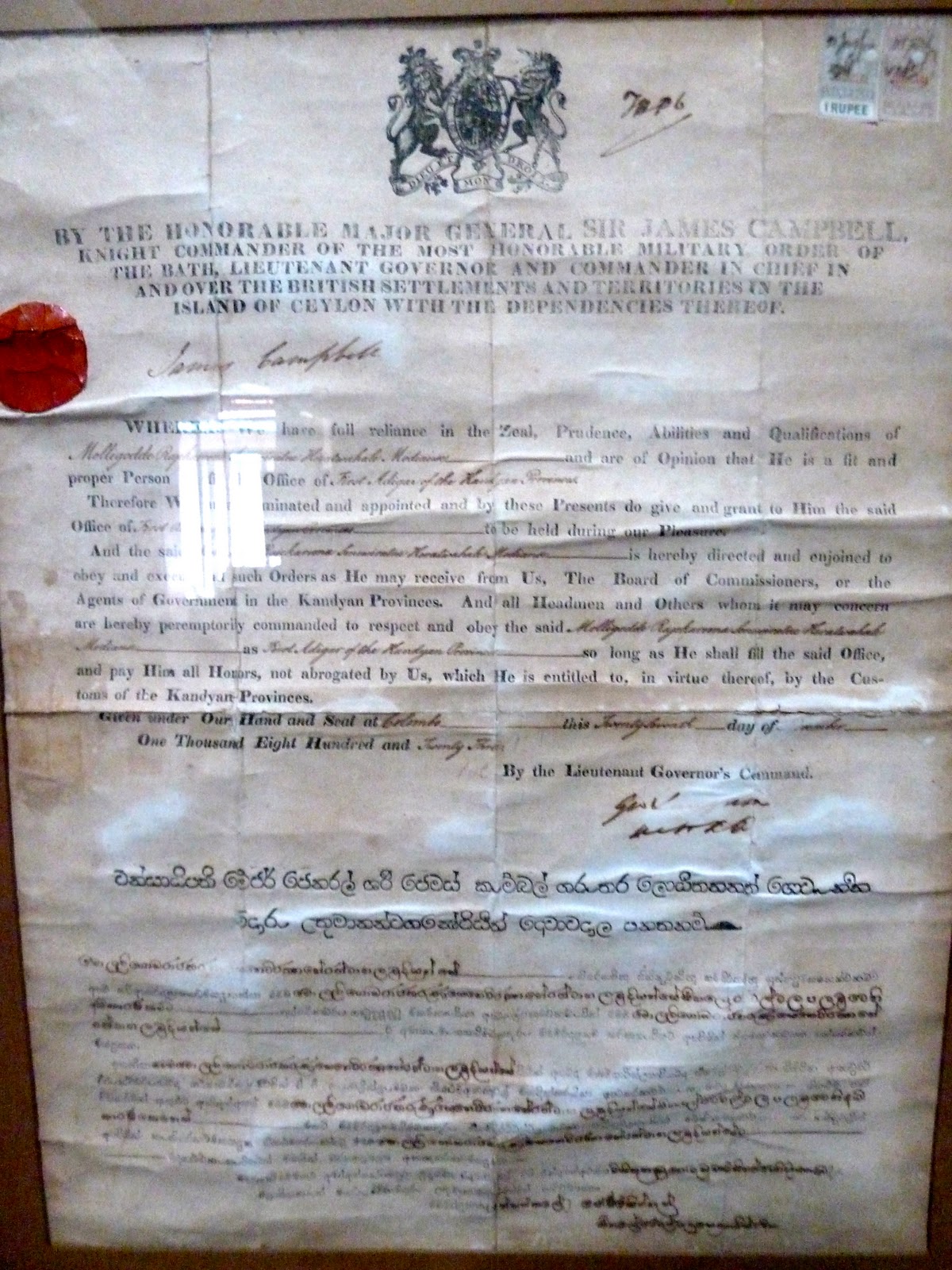
Right: This document is quite interesting. It is ( an old copy I think ) of the original decree which ceded authority over the Kingdom of Kandy to the British in 1815.


Left: Behind the museum is the old Garrison Cemetery. I met the charming old curator who showed me around. He obviously takes a great pride in the place and was keen to point out some of the more memorable graves. One such being the last British dignitary to be killed ( to date ) by a charging elephant in these parts.


Right: This one is even more interesting. It is that of Capt James McGlashan, HM's XIX Regt, who fought gallantly at the battles of Buzaco, Albuera and Waterloo and was commended for bravery. He died, aged 26 yrs,  of a mosquito bite in Ceylon in December 1817. Probably a French mosquito. Such is fate.


Probably the most notable place in Kandy is the Temple of the Sacred Tooth Relic, the Sri Dalada Maligawa ( left ). This Buddhist temple contains, supposedly, the left lower molar tooth of the Buddha. It arrived here from India, apparently, so the rumour goes, having been snatched from the Buddha's funeral pyre in 483 BC and smuggled into Sri Lanka during the 4th century AD, hidden in the hair of a princess.....and if you believe that.....!!!
It is the focal point of much worshipping and praying.
The tooth is contained in a casket which is, in turn, contained in a series of larger decorated gold 'dagobas' ( pyramid shaped containers ).


These are contained in the 'inner shrine' ( right ), which is kept closed. The inner shrine is opened with great ceremony twice a day and 'pilgrims' are permitted to troop past, without stopping, to view from a distance just the outer large gold dogoba. Nobody ever gets to see the holy molar, so it appears. There are rumours that it is a copy of the original anyway, if indeed it ever existed in the first place.


I'm afraid I can't get terribly excited, let alone hold any reverence for what may, or may not, have been possibly, if it's there at all, the glorious gnasher of the Buddha. It does, obviously, hold considerable religious significance for Sri Lankan Buddhists who pray like mad outside the shrine. Good luck to them.
I went on a tour of the building ( 1000 rupees ) which is quite a large complex of rooms, including a Thai sponsored and built temple with a big golden Buddha in it, and a museum. We had to remove shoes and socks before traipsing inside to the accompaniment of chanting Buddhist monks, an audio guide and the slight whiff of smelly feet ( mine, probably ). This place was badly damaged by a terrorist bomb in 1998 which actually exposed many previously unseen paintings and inscriptions, but has been fully repaired since. So much for the Temple of the Sacred Tooth Fairy.


I next went on a visit to the Hanthana Tea Museum, about 3 miles south of Kandy. This old disused tea factory holds examples of all the 19th century tea manufacturing machinery ( in remarkably good nick ) and good descriptions of how the leaf is actually made into tea. The raw leaves are 'withered', rolled, chopped, shaken, fermented, dried and then packed. The machines in the photo ( right ) are the rollers and the present day machines look exactly the same.


Left: A working model of a tea factory floor showing the rollers and shaker. Most of these factories are built  on five floors with lots of space for withering shelves ( to dry out the raw leaves ) and places to blow-dry the final product. Tea product includes lots of Orange Pekoe varieties.
The museum includes much history and photos of two great 19th century tea pioneers; James Taylor ( 1835-92 ) and the famous entrepreneur Sir Thomas Lipton ( 1850-1931 ).


On another floor are some small shops selling tea products and memorabilia, and on the top ( 5th ) floor is a tea shop which serves you a free cuppa ( a pot actually ) of the 'cut orange pekoe' brew. There is also a telescope to take advantage of the magnificent view over Kandy. I was the only person in this museum at the time, apart from the staff! It is definitely worth a visit if only to learn how the stuff is made.


Left: The balcony of 'The Pub' over the noisy main street. It does excellent 'pub grub' and a choice of the local Lion beer, or Carlsberg. These two brands seem to have more or less collared the market.


Right: Tea country. I am off tomorrow for a trip to Nuwara Eliya, 50 miles south of Kandy. This is an old hill station from the 19th century and the centre of the enormous Sri Lankan tea industry. Ceylon tea ( as it is still branded ) is still one of the biggest, if not the biggest tea exporter in the world.
I am due to meet up with Jim, a local driver/guide, who will take me there.
So far so good.