1st - 4th Jan 2012


Right: Photo of a splendidly dressed, bedecorated and bewhiskered Maharaja. There were many others equally, if not more, exotic. I admired this one for his extraordinary facial hair. They all appeared to have great independence of rule in their respective 'states' and the relationship between them and the 'Raj' seemed to be mutually beneficial.

Left: One of the bars at the Imperial Hotel. The dining room beyond is superb with many more old paintings and prints. If you are wealthy enough, this is a great place to stay.

Right: One of the streets leading off Connaught Place. It is another ‘bustling’ ( BR 8 ) bazaar. The appearance of the city was not helped while I was there because of the permanent mist or haze present. Not sure if this was due to the cool weather or smog.

The Delhi auto-rickshaws are coloured uniform green and yellow. There were so many it was always possible to get a good deal, although the drivers usually tried to persuade you, for a cheaper than offered fare, to go to ‘see’ a favoured shop ‘en-route’ where they get a commission for introducing a tourist. It may have been cheaper ( provided you didn’t buy anything ), but added an hour or two onto the journey time! I fell for that one. Twice.

The newish underground Metro system ( right ) is quite impressive. It is unbearably crowded at rush hours, and by crikey the Indians know how to do crowds, but at other times it is quick, efficient, easy to understand and cheap. It is very high tech and clean. As with any important public facility or large hotel in India everyone is subjected to body and baggage scans before entering.

Left: This photo is of the slightly more expensive but very up-market high-speed city to airport express, stopping at a couple of useful intermediate stations.
Amongst all the dilapidation there are the beginnings of some impressive and high-tech modern public systems.
 I made a point of visiting the Delhi Racecourse, the smartly named ‘Delhi Race Club’ on a day, by chance, when there was a race-meeting scheduled. The first race was due off at 2.15pm and I turned up a bit early, at 1.00pm, to enjoy what I hoped was going to be a relaxed introduction to the racecourse with a few drinks and pleasant lunch at, what was advertised at the entry gate, as the members’ restaurant.


....and that they are obliged to keep suitable company.

Amongst the touts, hawkers and beggars on the streets are quite a few of these disfigured unfortunates with withered legs ( left ). I saw several similar begging around the beaches at Kerala and Goa. This affliction is normally the result of polio. I believe the disease is now contained but was quite widespread up until about ten years ago.There are many crippled beggars on the streets to feel sorry for.


Left: Further east down the Rajpath is the India Gate, another Lutyen’s creation. It features the inscription ‘ INDIA. 1914 - 1921. To the dead of the Indian Armies who fell and are honoured in France and Flanders,( plus several other places...my abbreviation here ) on the North Frontier and during the 3rd Afghan War’.
Big military parades take place here. The next major event being the annual Republic Day Parade on the 26th January and all the stands were starting to be erected either side of the Rajpath.

It took me a bit of time, and I was only here for a few days, much of it being spent on ‘administrative’ tasks, to discover some well hidden little oases of excellence; one of which being a Balluchi restaurant near my hotel. Delicious food. Right: This was a close-up of the doorman. He had a most impressive set of moustaches which, according to a waiter, had taken him 10 years to perfect. I am sure that there are many other marvellous places to visit in Delhi but they do tend to be rather well hidden amongst the dust and rubble.
I didn't manage to get up to Old Delhi in the north part of the city to visit the vast Red Fort and other ancient relics of a bygone age. I suspect I will be seeing a lot of that stuff soon because I am leaving on a train trip around Rajasthan tonight ( 4th ). I aim to get to the somewhat obscure suburban train station of Safdarjung somehow, probably by auto-wreckshaw, and will be setting off very early because the driver who will ‘know the place well’ will be absolutely 100% guaranteed to get hopelessly lost and have to ask directions from, possibly, the opposite end of town. I have ‘recced’ this place and will know my way there and recognise it better than him. This is a necessary precaution because these bandits tend to say “ we are here now”, kick you off and you then find that you are stranded in totally the wrong place! I may next report if and when back in Delhi in a week's time. Tally ho!
 PS. I'm sure I recognise the chap on the right. I think he served in the British Army Air Corps? Can anyone help me? He is now working as a very smart doorman at a prestigious hotel in New Delhi and calls himself Jagdesh.
 |
| Presidential Residence ( ex-Viceroy's Palace ) New Delhi |
The AC 2-tier train compartment from Bombay to Delhi was pretty crowded. I think an extended family had moved into the carriage with two extremely noisy children and not much space left for luggage. There certainly were more than four of us in our compartment but the number kept changing because they were constantly moving around and it was all a bit tiresome. I opened my 'New Year' bottle of wine, well before midnight, and offered a glass to a quieter older guy sitting next to me, but he didn’t want any. I drank alone. Somehow it was decided to sort out the bunks and lie down at about 10.00pm; I had a top bunk. Those damned brats started to yowl as soon as the lights were dimmed and they were eventually taken away and not heard from again. I was obviously not the only one who had had enough of them. We had left at 1640hrs and arrived at New Delhi Central at 0945hrs the next morning. Happy New Year.
I decided to try a hotel on Connaught Place ‘outer circle’ in the centre of New Delhi. The taxi and rickshaw touts here were particularly irritating, and even a bit threatening. I eventually found a ‘pre-pay’ taxi booth and made an escape from the station with a youthful driver who, of course, knew the way. Of course the silly arse got lost, and the hotel wasn’t even very far away.
Dirty, dusty Delhi was my first impression. The small hotel was fine and the lady running it was charming, but the outside area was pitifully awful.
The whole city covers a vast area and is, basically, divided into four distinct regions namely; Old Delhi to the north including the Red Fort complex, New Delhi Central around Connaught Place, south of that are the Governmental Secretariat buildings and further south and west the large military cantonment area including a modern shopping centre. It appears from the street map that you can walk between a lot of these places, but ‘no way Jose’. Its all very spread out.

Connaught Place ( left, the inner circle, and it is much grottier than it looks in this rather flattering photo taken quite early in the morning ) was designed for the British Raj as the civic focal-point for their new captal city of New Delhi. It was completed in 1931 when it must have looked truly magnificent consisting of three elegant concentric Georgian style white colonnaded circular streets of about 1000 yards in diameter with beautiful shiny patterned marble pavements, interlocking alleyways and a sumptuous grass and tree covered park in the centre. In true Indian fashion, and due to total neglect over the past 60 years, it has been reduced to a rubble and garbage strewn wasteland. The once beautiful pavements are grimey, torn up in places and broken, the colonnades hold some decent shops but consist mostly of tacky little cheapo joints infested with predatory aggravating touts, the plasterwork is cracked, crumbling and dirty and the central park is now mostly a filthy crowded bazaar. The alleyways connecting the three concentric streets are indescribably foul and stinking; they have become public toilets. Everywhere is covered in a thick layer of dust. I think some effort is being made to renovate the place, but too little and far too late I fear. It is the finest example of urban vandalism, on a truly epic scale, that I have ever seen. The neglect and demise of this once proud edifice is a disgrace that successive Indian governments should be thoroughly ashamed of. It is a very depressing sight.

Walking the streets at night around here was a bit dodgy and quite alarming. When you passed the dark stinky alleyways malformed, malodorous and filthy beggars with wild staring eyes lurched out at you, like zombies, clutching at your clothes and soundlessly pleading for money. It was a horror film brought to life. Right: This is one of the ‘open’ areas in the centre of Connaught Place. It had relatively few people on it but was covered in rubbish nevertheless. It is difficult to get a photo showing the full scale of the horror.

Connaught Place ( left, the inner circle, and it is much grottier than it looks in this rather flattering photo taken quite early in the morning ) was designed for the British Raj as the civic focal-point for their new captal city of New Delhi. It was completed in 1931 when it must have looked truly magnificent consisting of three elegant concentric Georgian style white colonnaded circular streets of about 1000 yards in diameter with beautiful shiny patterned marble pavements, interlocking alleyways and a sumptuous grass and tree covered park in the centre. In true Indian fashion, and due to total neglect over the past 60 years, it has been reduced to a rubble and garbage strewn wasteland. The once beautiful pavements are grimey, torn up in places and broken, the colonnades hold some decent shops but consist mostly of tacky little cheapo joints infested with predatory aggravating touts, the plasterwork is cracked, crumbling and dirty and the central park is now mostly a filthy crowded bazaar. The alleyways connecting the three concentric streets are indescribably foul and stinking; they have become public toilets. Everywhere is covered in a thick layer of dust. I think some effort is being made to renovate the place, but too little and far too late I fear. It is the finest example of urban vandalism, on a truly epic scale, that I have ever seen. The neglect and demise of this once proud edifice is a disgrace that successive Indian governments should be thoroughly ashamed of. It is a very depressing sight.

Walking the streets at night around here was a bit dodgy and quite alarming. When you passed the dark stinky alleyways malformed, malodorous and filthy beggars with wild staring eyes lurched out at you, like zombies, clutching at your clothes and soundlessly pleading for money. It was a horror film brought to life. Right: This is one of the ‘open’ areas in the centre of Connaught Place. It had relatively few people on it but was covered in rubbish nevertheless. It is difficult to get a photo showing the full scale of the horror.
I spent a morning wandering around the place and found a few semi-respectable shops and restaurants. There are also some good local 'bazaars' selling cheap clothing and many tailors who attract a large clientele making bespoke garments at very competitive prices. The restaurants have that tiresome habit of quoting a price on the menu and stating at the bottom ‘taxes not included’, but they don’t say how much. There is a service charge and three different taxes which, effectively, increase the menu price by over 30%! Bloody annoying, as I told the manager of one place who sympathetically wobbled his head at me.
One real gem is the old Imperial Hotel. It is almost hidden away up a main street, Janpath, not far from Connaught Place. It has many interesting old prints and pictures on the walls of British/Indian battles fought long ago, jackal hunting, pig sticking and also portraits of splendidly attired Marharanas, Maharajas and Nawabs of the day. It is a lovely hotel and presumably highly pricey to stay there but I called in for a drink just to wander around and admire all the bits and pieces on display.

There are several old photos of Delhi Durbahs on the occasions of visits by British royalty, notably in 1903 and 1911. The city looked immaculate then ( OK, maybe only the bits involved in the Durbar ).
Left: The Durbar in 1903 on the occasion of the visit of the Duke and Duchess of Connaught.

Right: Photo of a splendidly dressed, bedecorated and bewhiskered Maharaja. There were many others equally, if not more, exotic. I admired this one for his extraordinary facial hair. They all appeared to have great independence of rule in their respective 'states' and the relationship between them and the 'Raj' seemed to be mutually beneficial.

Left: One of the bars at the Imperial Hotel. The dining room beyond is superb with many more old paintings and prints. If you are wealthy enough, this is a great place to stay.

Right: One of the streets leading off Connaught Place. It is another ‘bustling’ ( BR 8 ) bazaar. The appearance of the city was not helped while I was there because of the permanent mist or haze present. Not sure if this was due to the cool weather or smog.

The Delhi auto-rickshaws are coloured uniform green and yellow. There were so many it was always possible to get a good deal, although the drivers usually tried to persuade you, for a cheaper than offered fare, to go to ‘see’ a favoured shop ‘en-route’ where they get a commission for introducing a tourist. It may have been cheaper ( provided you didn’t buy anything ), but added an hour or two onto the journey time! I fell for that one. Twice.

The newish underground Metro system ( right ) is quite impressive. It is unbearably crowded at rush hours, and by crikey the Indians know how to do crowds, but at other times it is quick, efficient, easy to understand and cheap. It is very high tech and clean. As with any important public facility or large hotel in India everyone is subjected to body and baggage scans before entering.

Left: This photo is of the slightly more expensive but very up-market high-speed city to airport express, stopping at a couple of useful intermediate stations.
Amongst all the dilapidation there are the beginnings of some impressive and high-tech modern public systems.
To the south of the city are much smarter shopping, diplomatic and military areas. The city down here is more open-plan and, although still a bit dusty ( and hazy ), is really quite pleasant. The ‘diplomatic’ area to which I had to pay a call is clean and hosts some very opulent ambassadorial buildings. The cantonment area is home to many military ‘headquarters’ and barracks. I passed an impressive display of a squadron’s worth of horse mounted Lancers in full dress uniforms, plus lances, parading up the road ( in my haste the photo failed ). This is, presumably, the Aldershot equivalent in India and holds some ostentatious army, airforce and even naval establishments with accompanying sportsfields and golf courses.
 I made a point of visiting the Delhi Racecourse, the smartly named ‘Delhi Race Club’ on a day, by chance, when there was a race-meeting scheduled. The first race was due off at 2.15pm and I turned up a bit early, at 1.00pm, to enjoy what I hoped was going to be a relaxed introduction to the racecourse with a few drinks and pleasant lunch at, what was advertised at the entry gate, as the members’ restaurant.
 I quickly discovered that Royal Ascot this place most certainly ain’t! It is, to put it mildly, a grotty ‘flapper track’ of the most dilapidated and insalubrious kind. Firstly, I was told at the gate ( entry R50/$1 ) that cameras were strictly prohibited due to ‘security’ reasons. I objected strongly and when threatening to walk away the little Hitler on the gate relented.

Inside it was a typically dusty, dirty and ramshackle place. No alcohol of any kind was permitted and the ‘restaurant’ was certainly cheap but most of what was on the menu was not available. It was a chicken curry, chicken sandwich and/or chips, plus tea, coffee or coca-cola or nothing. There were no stands to speak of and only the final 3 furlongs, or 3 hundred metres, of the ‘hockey stick’ shaped weedy grass or dirt track were visible. The parade ring ( left ) was enclosed by a 10ft high mesh security fence and the only well attended area was a dismal betting ‘yard’ in a shed in the centre.

Seeing a ‘westerner’ in the thin crowd quickly attracted various ‘helpful’ touts to give tips in the expectation that said grateful tourist would offer remuneration. Some hope in my case. Frankly, it was a seedy, run-down place geared entirely to betting for a down-market exclusively male clientele and, I suspect, not above involving somewhat ‘pre-arranged’ results. By chance I met an amusing couple on holiday from Leeds who, along with me, were the only foreigners present. We had a bit of a giggle together. They even had an each-way bet and, when the horse they backed came second, were approached by a ‘tout’ who wanted a share of their winnings! It really was all quite ghastly and I only stayed for two races. This place must be a serious contender for the most horrid racecourse in the world. How do the Indians manage to make such a complete horlicks of these things!

Just around the corner from the racecourse entry was this sign ( left ) indicating where the ‘media’ should ‘go’. It’s nice to know that they deserve special ‘facilities’.

....and that they are obliged to keep suitable company.

Amongst the touts, hawkers and beggars on the streets are quite a few of these disfigured unfortunates with withered legs ( left ). I saw several similar begging around the beaches at Kerala and Goa. This affliction is normally the result of polio. I believe the disease is now contained but was quite widespread up until about ten years ago.There are many crippled beggars on the streets to feel sorry for.
A trip by metro to the Secretariat area, on Raisina Hill, south of Connaught Place, was interesting. This area holds the Presidential Residence ( ex- British Viceroy’s Palace ), Government buildings, the enormous Parliament building and processional route, the Rajpath ( Kingsway ). It is all magnificent and beautifully maintained. The buildings and monuments, mostly designed and constructed by the English architect Edwin Lutyens, are large scale and most impressive. This is where all the ‘pomp and ceremony’ takes place. No expense is spared here to keep things immaculate, in stark contrast to much of the rest of the country.
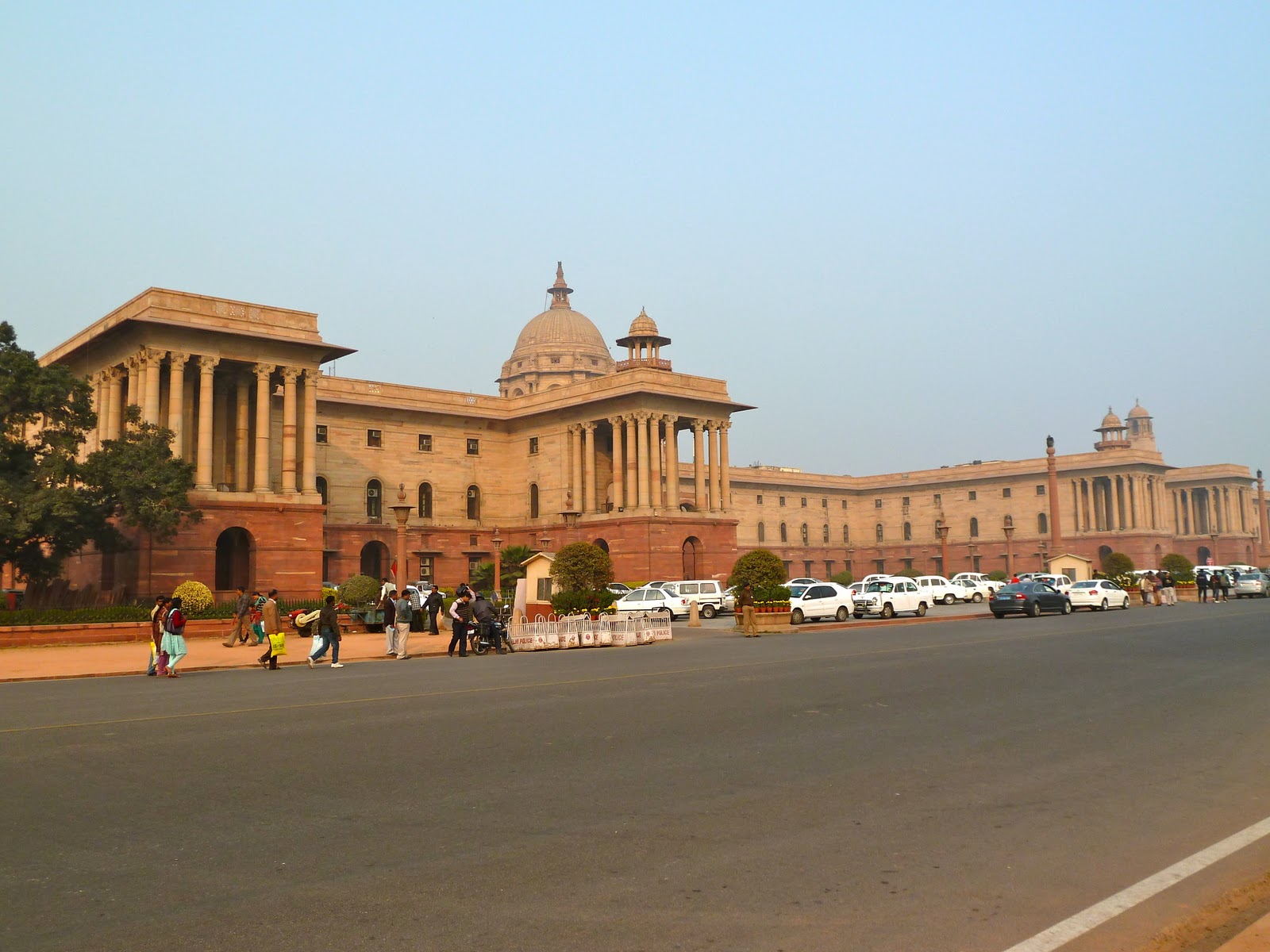
Right: This imposing building is directly opposite it’s twin and both house Government ministries. They are just east of the Presidential Residence featured at the top of this article. Fleets of ancient looking white 'Amby' cars are waiting to convey 'very important' officials from place to place. I saw many 'very important looking' military and civil personages strutting about. The Indian hierarchy does 'strutting' very well.

Left: Further east down the Rajpath is the India Gate, another Lutyen’s creation. It features the inscription ‘ INDIA. 1914 - 1921. To the dead of the Indian Armies who fell and are honoured in France and Flanders,( plus several other places...my abbreviation here ) on the North Frontier and during the 3rd Afghan War’.
Big military parades take place here. The next major event being the annual Republic Day Parade on the 26th January and all the stands were starting to be erected either side of the Rajpath.

It took me a bit of time, and I was only here for a few days, much of it being spent on ‘administrative’ tasks, to discover some well hidden little oases of excellence; one of which being a Balluchi restaurant near my hotel. Delicious food. Right: This was a close-up of the doorman. He had a most impressive set of moustaches which, according to a waiter, had taken him 10 years to perfect. I am sure that there are many other marvellous places to visit in Delhi but they do tend to be rather well hidden amongst the dust and rubble.
I didn't manage to get up to Old Delhi in the north part of the city to visit the vast Red Fort and other ancient relics of a bygone age. I suspect I will be seeing a lot of that stuff soon because I am leaving on a train trip around Rajasthan tonight ( 4th ). I aim to get to the somewhat obscure suburban train station of Safdarjung somehow, probably by auto-wreckshaw, and will be setting off very early because the driver who will ‘know the place well’ will be absolutely 100% guaranteed to get hopelessly lost and have to ask directions from, possibly, the opposite end of town. I have ‘recced’ this place and will know my way there and recognise it better than him. This is a necessary precaution because these bandits tend to say “ we are here now”, kick you off and you then find that you are stranded in totally the wrong place! I may next report if and when back in Delhi in a week's time. Tally ho!
 PS. I'm sure I recognise the chap on the right. I think he served in the British Army Air Corps? Can anyone help me? He is now working as a very smart doorman at a prestigious hotel in New Delhi and calls himself Jagdesh.