Thursday, 16 February 2012

MANDALAY - BURMA ( part 1 )

1st - 2nd Feb 2012

Mandalay Hill, in the mist, north of the city

"On the road to Mandalay, where the flyin' fishes play" as the words, written by Rudyard Kipling, go. Do they bollocks! I believe Mr Kipling was not in Burma very long; maybe just for a night stop-over when, after a few too many pink gins at the bar of the Strand Hotel in Rangoon, he wrote this poem. There are certainly no flyin' fishes in, or over, the Irrawaddy. At least no more than there are pink elephants and green spiders.
Early morning, 0515hrs and pitch black, we boarded by means of a long wobbly wooden plank the good ship Schwe ( that word again ) Keinnery and left the riverside at Old Bagan bound for Mandalay on the 13 hour voyage up the Irrawaddy. It left in the dark so I hadn’t a clue how the skipper knew where he was going. They probably do it from memory and cross their fingers that they don't hit a sandbank. It was a normal river boat, nothing luxurious, but had fairly comfortable reclining chair seating and a bar and restaurant upstairs plus an upper ‘promenade’ deck with deck chairs. It had the capacity for about 150 passengers. There were only six of us ( tourists ) on board including two amusing English ladies from Kent and a Frenchman from Lyons . Plenty of room.

The journey up the river was uneventful and there was not really much of great interest to see sailing through the flat countryside. At this time of year the river is low and many sandbanks have to be avoided. At some potentially very shallow parts a chap hung over the bow with a long bamboo pole to check the depth and yelled words of encouragement or caution to the helmsman up above. I think they were following, or avoiding, a line of bamboo poles sticking out of the water.
Left: There were occasional tugs towing rafts of teak logs downstream. These rafts had temporary houses built on top of them for the workers to sleep and cook in.

     
Right: We also passed one of the super-luxury Pandaw ships, a restored ex-British Irrawaddy Flotilla Company vessel from before WW2. These do cruises up and down the river with comfort levels and tours ( and prices ) similar to the Indian ‘Palace on Wheels’ train, I read.
It was noticeable how little bird life was present; just a few seagull types. No sign of any fish rising either, let alone flyin' fishes or the strange bulbous headed Irrawaddy dolphin that I'd read about. Maybe that was just another figment of the inventive Mr Kipling's imagination. 

Left: On the east bank approaching Mandalay. Not sure what this temple complex is but it looked quite impressive. We arrived, again in the dark, at 1900hrs. The skipper was using spot-lights to do the landing.

Mandalay was the last Burmese royal capital city with King Thibaw as ruler until the British removed him and packed him and family off on holiday to India in 1885. It is a pretty uninspiring place, low rise and sprawling with a sort of street grid system where most of the streets are known by numbers ( 1 - 50 E-W, and 51 - 100 N-S ) It is situated below Mandalay Hill, which was reputedly visited by Buddha, and from which it got it’s name. It is also mostly very clean and well swept if a little on the basic side. These Burmese take a pride in their local environment and enjoy a bit of personal space, unlike some neighbouring countries to the west that I could mention.
I had a lady guide for the next two days. Her name was spelt Htet Htet Wai Hiang. She pronounced it ‘Tit Tit Wee Ing’ which, I thought, was not very flattering. I don’t know who was responsible for translating the squiggly Burmese writing into Roman script, but he, or she, must have had a tin ear because the spelling you read in the translated aural version often bears scant resemblance to the Burmese pronounciation. As a case in point, the word for their currency, the Kyat ( as spelt in guide books ), is pronounced more like ‘Chet’. It was probably done by some well refreshed British civil servant in a couple of hours after a very good lunch.
The only other Burmese word with which I have become familiar is 'Mingulabar', which means hello, or good morning, or good evening or whenever you greet someone.


We started off by visiting another blinking temple, the Mahamuni Paya, which is extraordinary for the fact that the star feature in this enormous complex is the highly venerated 13ft high Buddha ( right ) which attracts thousands of devotees daily to stick gold leaf squares on it. The Buddha now looks very lumpy with about six inches of solid gold splodged onto the exterior after years of gold leaf being added. Women ( including Miss Tit Tit ) are not allowed to approach this Buddha.


..... but I was able to walk up to and around the back of this lump of gold and watched as a continuous stream of men came up and each stuck several small gold leaf patches onto it ( left ). I was working out if I could accidently dislodge an inch or two. This Buddha is also subjected to it’s teeth and face being scrubbed in a ceremony at 4.00am every morning. It all gets stranger and stranger.


Right: I'm not sure if it was in this complex, or another ( who cares ) where there are some ancient bronze statues which supposedly have miraculous healing powers. You are meant to rub the part of the statue which corresponds to that bit of your body which needs rectification. You can see from the photo by the parts which shine, or have been completely rubbed away, those areas which most commonly trouble the afflicted believers.


Next on the agenda was a visit to a factory where tapestries, wood-carvings and marionettes are made. As with all these ‘workshops’, the skill, effort and sheer time which goes into producing a complex design and beautiful end product, all painstakingly hand made using primitive equipment, is not reflected in the price charged. The ladies making these highly intricate tapestries sit and stitch with minute accuracy for a solid eight hours per day, every day of the week. The pay they get for this work is minimal and the cost of the finished product is small for the labour put in. Nowhere in the western ‘first’ world could such skill or work ethic be found. Noone would be prepared to do this for any price, I suspect.


Left: An array of exquisite embroidery and cheap at the price. The wood carvings and beautifully dressed large and small puppets were equally impressive. Truly a labour of love or, more likely, no other means of earning a living.
Then on to one of the places where they make and sell the gold leaf. This is another extraordinary workshop. They take a small ( memory stick sized ) 12 gram mini gold bar and initially heat and then roll it into a 5 metre long gold strip. This strip is cut into 200 pieces. Each of these 200 pieces is progressively hammered, by hand, into 1600 2” squares of tissue thin gold leaf. I tried to get the details written down correctly, but don't bank on them! The hammering is done in 30 minute sessions, timed by a coconut shell with a hole in it sitting in a bucket of water until it sinks, over a total aggregate of 5 hours hammering. I didn't ask why they don't just use a clock. Each little almost transparent square of gold leaf costs K1000 ( about 1.2 US$ ). I bought two as souvenirs. This gold leaf is the stuff that the worshippers stick onto the Buddhas etc. It is all very weird to my way of thinking.

Right: The hammerers and the coconut shell timer in the brown bowl of water. Keeps them fit, no doubt. I had a go and it is jolly hard work. Maybe they have a machine that does it much more efficiently when the tourists' backs are turned.


Left: This is the girl who did all the explaining. She sold me two bits of gold leaf but failed to sell me lots of the more expensive gold items.


We then went on the old Royal Palace complex in the centre of the city. This is a big fortified area. Each crenellated outside wall is about 2 miles long and has elaborate Chinese style watchtowers along it’s length and a large covered gate in each side plus a 50 yard wide water filled moat surrounding it all. It became a military base in British days known as Fort Dufferin. It was bombed flat in WW2 and all the old palace structures were destroyed. The bloody Japs were to blame.


Right: Replicas of, supposedly, the original palace buildings have now been rebuilt ( with red corrugated iron roofs ) and look a little tacky and artificial, and the central area is open, at a price, to tourists. Most of the tree covered inside area is still a Burmese army base which is strictly out of bounds. This is looking down on the central palace buildings where King Mindon and finally King Thibaw presided. The pic was taken from the top of a rather rickety tower. Miss Tit Tit was completely knackered when she got to the top. It wasn't that high but she could scarcely get her breath back. She is not fit. Obviously been neglecting her physical jerks in the mornings.


Left: King Mindon on his throne. There are other dummies around the place; supposedly look-alikes of long deceased royal personages.


Right: A part of the wall and moat. Alongside much of the railings on the footpath between street and moat they have built a sort ‘excercise’ route with push-me-pull-you machines and things you stand on and swivel your hips plus lots of other body toning devices. They were being well used, I noticed, on leaving the city early one morning. Not by me, I hasten to add. 
The majority of people in this part of the world ( Thailand and Vietnam included ) get up very early and regularly do some form of exercise, in the dark, before going to work. I also saw squads of ladies and gents doing choreographed dance routines and complicated things with long sticks. They take their physical jerks quite seriously before going away to smoke their heads off and chew the carcinogenic betel nut gunge. Miss Tit Tit must be an exception to all this. 


Then after lunch by small boat up-river to Mingun about 10 miles north on the western bank. Myself and Miss Tit Tit had a boat to ourselves. Left: Boarding involved clambering from boat to boat from the shore along more wobbly planks. One needs to be relatively sober to complete this boarding procedure without falling in.


Right: The deck of our boat. The skipper plus his sister and mother were the crew. They supplied refreshments and got us safely there and back.


Mingun, another ancient royal site is famous for three things. An unfinished stupa, a large bell and a big white pagoda.


Left: This unfinished construction was to have been the biggest stupa in the world. It was the brainchild of a previous king and building commenced in the late 18th century. What you see here is only the remains of the base level. It would indeed have been enormous and by far and away the biggest stupa in the universe but the king died in 1819 before it was completed and the project died with him. I imagine the workers and the next regime got supremely bored of this mammoth task. It has also some big cracks and much damage caused by earthquakes. In fact it resembles nothing more than a gigantic pile of bricks; millions of them. You can climb to the top up a series of rickety debris-strewn steps but, believe it or not, you are obliged to take off shoes and socks to do this. I need to use my feet again so wasn't tempted. Inside the doorway in the white front porch is, yes you've guessed correctly, a Buddha ( rather a small and unimpressive one ) plus collection boxes for the 'maintenance' of this heap of rubble.


Right: Then there is the bell. Another mega-project by the same size obsessed king and made in 1808. It is cast in bronze, is 16 feet in diameter, 12 feet tall and weighs 90 tons. It is the largest intact bell in the world. There is a much bigger and heavier one in Moscow but that is cracked and not hung. The done thing here is to climb inside and get your friend to whack it with a big heavy stick provided for the purpose. It does indeed make a loud 'BONG', and I only heard it from the outside.


Left: Lastly, a strange white pagoda. We climbed up to the top of this ( sans sabots, obviously ) where a couple more Buddhas were waiting in situ, together with a security guard who expected a small donation to reward his sedentary efforts. I was told what the significance of this pagoda is but, to be honest, I've now forgotten.
That was Mingun and concluded the first part of the tour of Mandalay and environs. 
Quite an interesting and enjoyable day and I only had to do the shoes off/on routine 5 times.

Monday, 13 February 2012

BAGAN - BURMA


30th Jan - 1st Feb 2012

View over Old Bagan
Bagan, previously the Burmese capital city from 11th to 13th centuries, was originally known as Pyugan, then Pukam after which the British called it Pagan and finally the military ‘junta’ switched it to Bagan. The barbaric Imperial Jap Army might have called it Nippan for all I know. One problem in this country is deciphering the original, intermediate and new place names. It gets most confusing because the names change depending on their context and who you are speaking to or what books you read. For example, Mrs Michael Aris ( aka Aung San Suu Khi, the popular local politician ) still refers to the country as ‘Burma’ not ‘Myanmar’ because she believes that the military junta had no authority or legitimacy to change all these names whatever the historical rights and wrongs. 
The ‘Royal’ capital of this country switched location several times. Over the past 1000 years it shuttled between Bagan ( Pagan ), Ava ( now Inwa ), Taungoo, Mokesebo ( now Shwebo ), Sagaing, Amarapura and finally Mandalay before the British deposed the Burman monarchy in 1885 and established the new capital in Rangoon ( now Yangon ), and the latest government has moved it yet again to a new city called Nay Pyi Taw somewhere up country but which is out of bounds to foreigners. It is all a bit muddling. I shall refer to Bagan as Bagan. I didn’t know it as anything else.
On the east bank of the Irrawaddy river, about 90 miles south of Mandalay, Bagan now consists of three seperate areas;  Old Bagan, New Bagan to the south and  Nyaung U to the north. It is remarkable because the kings between the 10th and 13th centuries went on a fanatical non-stop Buddhist temple/stupa/monastery building binge. In an area of 42 square km ( 32 square miles ) over 5000 temples were constructed of varying size and opulence. These were built of brick and stone and some marble whereas the palaces and houses were made of wood and have as a consequence disappeared. Following a big earthquake in 1975 many of these temples were either completely flattened or damaged.
There has been a vigorous programme of reconstruction since and there are now 3122 standing and the figure is growing! There has been some international ‘heritage‘ criticism of the standard of this rebuilding. Some of the reconstructed sites are already looking a bit dilapidated and some have not been very tastefully done. Whatever your viewpoint the scale of this over-the-top ‘temple-fest‘ is quite incredible. Wherever you look there are stupas and pagodas sticking up, most within 100 yards of each other. On a conducted tour of the area, to which I was subjected, it is adviseable to wear easily removable footwear. The shoes on/off ( and socks please ) routine here goes into overdrive. The view ( above ) gives a poor impression of the landscape which is crowded with temple and stupas.

I was booked into a very pleasant hotel, the Thanzin Garden ( reception area right ). Bagan area now has lots of hotels and restaurants due to an increasing tourist trade and is, as a consequence, bumping up it’s prices considerably. It has a rather captive market. A beer here costs twice as much as in Rangoon. The internet works, but very slowly and sometimes various ‘servers’ cannot be accessed. My AOL system seems often to be blocked. Some experts know how to download and use ‘proxy’ servers which gets around the problem but I have failed to manage this. I expect any schoolchild could do it.

Left: My rustic looking but very comfortable 'chalet' style room.


I will not even begin to describe individually the loads of temples, stupas, monasteries and squillions of Buddhas I was guided to see but I think this was the biggest ( right ), the one with the gold stupa, the Schwezigon Paya ( that ‘schwe’ word again ). They all have names, often including ‘schwe’, but I soon gave up trying to record what they are. If you are that interested buy a copy of the Lonely Planet.


....and this ( left ) was taken of another which I took because I thought it made a decent photograph. Talking of photographs, I have been amazed at the enormous size, and probably cost, of many of the cameras and lenses that so many tourists lug around with them. Some of their equipment looks as if it requires wheels. I expect they might produce marvellous photos but the hassle and effort of carrying these hefty and easily breakable ( and stealable ) bits of kit around without a team of porters, must be considerable. I use a little point and shoot thing which fits in my pocket and does the job. I mean, most people only want photos as ‘souvenirs’ with which to bore rigid their friends on return home, or put in a blog. I doubt so many require the quality of image necessary to fill the pages of National Geographic. 
Some tourists travel around the area by pony and trap, some by oxcart, some by bicycle and some, the idle ones like me, by car. Some structures you can climb up via crumbling stonework, some you can’t. Some have rooms and steps inside, some are solid. Right: A troop of the oxcart brigade.


The Buddhas come in a variety of sizes and are made of differing materials. Where a rectangular temple houses up to four ‘big’ Buddhas ( one on each side ) they normally have lots, hundreds in some cases, of alcoves holding smaller Buddhas. Following on are a selected few.
Left: The girl here was deputed by Mr Tun to show me around for a bit while, I suspect, he went off for a smoke break. She was very pleasant and as you can see wore rather a heavy layer of the thanakha make-up.


This ( right ) was one of the larger ones. It reminds me of someone; other than Buddha I mean. Bernie; you looking?


and ( left ) this one’s mouth intriguingly changed from a straight line close up, to a broad smile as you walked back from it. I am now aware of the difference between Indian, Burmese and Chinese Buddhas. I’m sure this knowledge will come in handy one day.


There was never a shortage of collection boxes. It was explained that each box is to collect money for a different purpose, ie. electricity, building, monks’ food, cleaning, security, rat traps etc. etc. Not whisky and wild women one supposes. Who is responsible for collecting and distributing this money was not made clear. An honest and sober senior monk perhaps.
I resisted the temptation to put the rat on the desk in front of this little Buddha before which several people were fervently praying. I was getting a touch bored by now.
I spent the day being escorted around and was told that to cover the whole site would take about three days! To be honest I’d seen more than enough blasted temples etc. before lunch. It was taking a lot of effort to appear interested in the elaborate descriptions of Buddhist buildings, history and ‘legends’ given by my most enthusiastic and knowledgeable guide, Mr Tun, plus the non-stop tedious shoes on/off routine.
I was by now more than well aware that most Burmese are devoutly religious ( superstitious one might say ) when it comes to the Buddhist faith, but I gathered quickly, and this was confirmed by Mr Tun, that they have another equally and obsessively observed religion; English Premier League Football. Mr Tun is an avid Chelsea supporter. It is expected that if you come from England you have a comprehensive knowledge of all the Premier League teams and their goings on. I have had to start making notes on this because I am somewhat ignorant in this direction. It is simply not accepted that you are not a devout supporter of one English team or another and know all the players in it. Almost on a par with the Lord Buddha are David Beckham, Alex Ferguson and, curiously, Alan Shearer plus some others of whom I hadn't heard. They, the Burmese I have met who speak English, wax lyrical about English footy teams and all support one team or another. They are much more knowledgeable than me. The main 'sects' of Burmese Footy worship seem to centre around Manchester United, Arsenal, Chelsea and Tottenham Hotspur. I mentioned Newcastle..."Aah, Alan Shearer very good" is the inevitable response ( hasn't he retired?; but then so has Mr Buddha ).
For reasons I never really fathomed, the soles of Buddha’s feet play an important role. These ‘feet’ ( left ) were ancient ( 11th century ) paintings on one of the ceilings. Maybe this is the connection with football. I never thought to ask.
By the time we got to the ‘fabulous sunset viewing’ from the summit of the final pagoda or temple or whatever it was ( right ), I was suffering from a serious temple/pagoda overdose and just wanted to go home for a strong drink. I could not imagine spending three days here, unless you are a fanatical temple viewer. Frankly, once you’ve seen a couple you’ve more or less seen ‘em all. I was absolutely ‘stupa’d’, pagoda’d and well nigh Buddha’d by the end of the day which was marked by climbing up this precipitous temple amongst loads of other camera wielding tourists to take a photo of the area looking towards the Irrawaddy at aforementioned sunset ( photo at top ).


Left: Tourists wielding their big bodies and long lenses at sunset.


Right: It was a steep climb down and, having got to the top, there was a big queue in front. It was almost dark when I got to the bottom. They will need to build a few more temples of equal height, and they probably will, if the tourist market booms further.


The weather here, especially in the afternoon, was bazzing hot. I believe that all of the central plain of Burma becomes a semi-desert with temperatures soring to the mid 40s ( degrees C that is ) in March/April before the monsoon rains come.
The other thing for which this area is renowned is it’s cottage industry for lacquerware. Some of it looks very pretty but I have no way of knowing the quality. The fact that Bagan is a tourist magnet has led to an overpopulation of temple-side stalls flogging the stuff, plus other tat and junk. I have a horrible fear that these will soon take on Indian proportions but, as yet, the Burmese are far too polite to be aggressive hawkers and touts. The problem is that due to the meagre wages people earn on the land or doing hard manual labour, they only have to sell a tiny amount of ‘souvenirs’ to generous tourists to get more money for comparatively little effort. 
Onwards tomorrow. Up the Irrawaddy by boat to Mandalay.

Saturday, 11 February 2012

THE TRAIN TO BAGAN

29th - 30th Jan 2012

Rangoon railway station.

We set off with a jolt from Rangoon Central smack on time at 1600hrs on the overnight train for the scheduled 17 hour journey to Bagan. My carriage was an ‘upper-class’ sleeper which was the second to rear of a nine carriage train on a very ancient narrow guage railway track built by the British in, I suspect, 1325 AD. 


The compartment ( left ) had four bunks and I was to share it with a Dutch/Indonesian father and son; the father being an anaesthetist in Nijmegen and the son an economist on holiday from working in Phnom Penh, Cambodia. It was quite comfortable, when static, with a window, or rather a large square hole in the wall with a pull-down blind, an air-con machine which didn’t work and a fan which did, noisily. The Dutch couple were to prove amusing company.


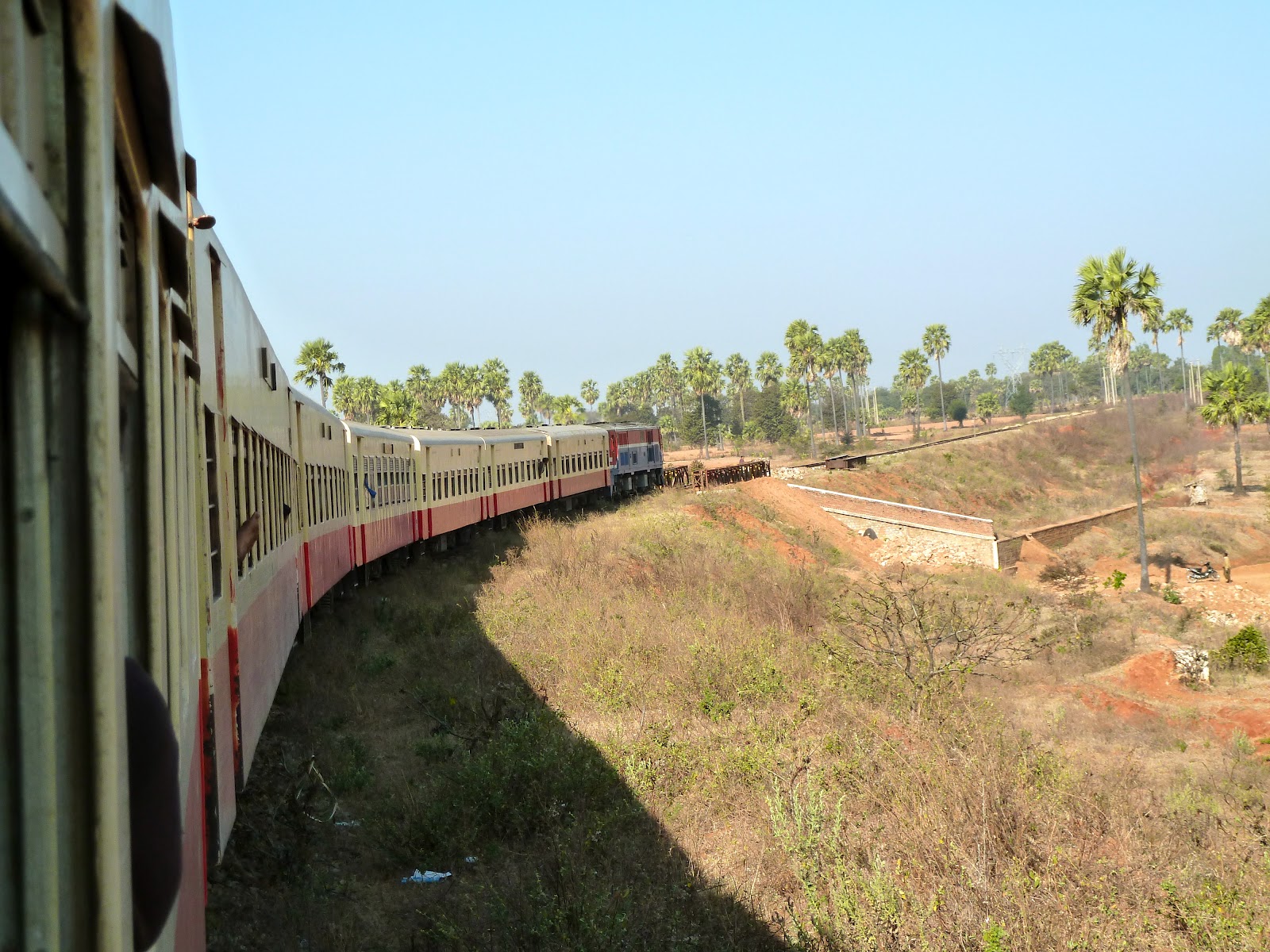
We ground to a halt five minutes later at a station called, curiously, Athlone Road. And then again after another five minutes at another halt with an undecipherable name in squiggly lettered Burmese. If this was going to be the routine it was going to take an awfully long time to cover the 420 miles to Bagan. It then sped up and, by crikey, we soon realised that either the train wheels were scew-whiff or the track was seriously warped, or both. It didn’t just rock ‘n’ roll, it leaped up and down and tilted to the point where we were wondering how it was going to stay upright. It brought to mind those cartoon trains, the rear carriages of which left the rails on bends and hills waggling about like a dogs tail. The three of us were hanging on and giggling nervously. I was sitting next to the open space ( window ) and sat back carefully in case a sudden lurch saw me do a quick sideways exit. The noise was deafening. A ‘waiter’ entered to ask what we wanted for supper and as we didn’t really understand, or even hear, him we said we would get something to eat later. Therefore, at some point, we decided to go to the restaurant car which was two carriages in front. This turned out to be an exciting expedition. On staggering down the narrow corridor it was necessary to keep both hands on the walls to avoid spinning out of the conveniently located open ‘windows’ which ran from thigh to neck height and the even more perilous wide-open outside carriage doors through which it was eminently possible to be ejected. It was like walking on one of those ‘fun-fair’ wobbly floors with added screeching, crashing and banging sound effects plus extra dangers. Conversation at less that a scream was impossible. On reaching the joins between carriages we were confronted with a further interesting, indeed alarming, hazard. The gap was about a yard wide and open-air down to the coupling and track rushing past beneath. The edges of this gaping void added to the challenge by moving up and down about two feet in opposing directions. It was necessary to judge when both sides would be roughly approaching level before making a leap and grabbing the sides of the opposite doorway. The potential for a slip and subsequent disaster was high. We made it over two of these lethal gaps to the dimly lit restaurant car safely, laughing uproariously as one does having survived near death experiences. I then realised I had left my camera and bag of valuables in the compartment! If these were nicked I would be devastated, so back I went. Only to find the door to the compartment had been locked. Fearing that someone obviously has access and might return to borrow my stuff, if they hadn’t already, I then had to go back to the restaurant car where I found a waiter who ‘helpfully’ gave me the key to the compartment. Back I went on another life threatening journey to open the sliding compartment door ( after a violent struggle because it had jammed ), gratefully retrieved my valuables and returned again over the obstacle course to the restaurant. To be honest, I was becoming rather adept and almost blasé at leaping the bucking ‘chasms of death’. We sat and drank that beer which did not spill out of glass or bottle and shouted to one another. The food, sweet and sour chicken with rice, took a while to appear because, I suspect, the chef had to scrape most of it off floor, walls and ceiling in the mini-kitchen. It tasted pretty good. Two other foreign tourists stumbled in looking rather shell-shocked who, now I think about it, I never saw again. Maybe they are still lying out on the track somewhere. They might have overdone the beer. We passed several picturesque little villages as night drew in and then had to do the final fraught return trip in total darkness this time. Doing it in daylight without drink taken was no challenge any more. So reaching the relative safety of our compartment unscathed we congratulated ourselves ( now ‘night and day qualified’ as they say in the world of aviation ). There is something quite satisfying and invigorating about making a journey which has a certain ‘frisson’ of danger thrown in. Something which is rather lost in the sterile world of British ( and Australian ) railways with all their bloody annoying ‘elf ‘n’ safety’ announcements and unnecessarily odious and restrictive rules and regulations. It is a salutary lesson, I often think, how, given a slightly risky situation, by using common sense and being alert to the dangers, people survive very happily.
We settled down, if that expression can be used in circumstances of severe turbulence and noise, to try to sleep. I woke up at some point wanting to have a pee. This was going to be interesting. There were no lights and the first problem was that the compartment door had jammed again. It was a fight to get it open which, had the prevailing noise not been so loud, would have raised the dead. I escaped into the dark and bouncing passageway and realised I didn’t know where the bog was. I tried some doors which turned out to be locked. Being a bit bleary-eyed and alone and in my socks, I wasn’t prepared to leap across the gaps again in vain search, so just pissed onto the track while hanging on to the doorway with one hand. Problem solved.
Other than it getting rather cold, the rest of the night was spent in relative comfort and even occasionally falling asleep. One gets used to living in a salt-shaker I presume.
Breakfast, including much welcome sweet tea, was served by our waiter who is obviously entirely at home leaping from swerving and pitching carriage to carriage with both hands full.


We passed more little villages ( right ) and stations which looked remarkably neat and tidy ( anything looks neat and tidy after India ) which consisted of some beautifully built wooden ( bamboo and teak? ) houses on stilts.


People were washing at communal stand-pipes and beginning the day’s work ( left ) in the fields. The countryside had the appearance being poor but well ordered and with seemingly happy and smiling people.


Lots of people were waiting at the several little stations we stopped at the next morning; some trying to flog food and others, like these two youngsters ( right ) some kind of refreshment in bottles. Or it might have been fuel or weed-killer for all I knew.


We arrived a couple of hours late, 1100hrs, at Bagan. It had been an exhilarating 19 hour trip. Strongly recommended for those who need a bit of ‘spice’ put into their rail travel.

Our train.

RANGOON - BURMA

27th - 29th Jan 2012

Shwedagon Paya (Temple ). Rangoon
The early morning taxi ride to Calcutta airport passed through some grim knee-deep rubbish-strewn outlying slums with low-life and mangy dogs warming themselves around roadside open fires ....just to give me that final taste of India. The check-in procedures through Calcutta International Airport were well up to expectations. A grim beaurocratic time consuming ( nearly 2 hours ) performance during which my passport and documents were inspected no less than nine times and overweight suitcase re-packed and then twice through a security scanner and I still had to pay an exorbitant price for being 3 kg over the miserable 20 kg baggage allowance ( they must be playing to Aussie Rules here ). The airport itself is a sorry excuse for an international airport with pathetic facilities and very scruffy. They tell us that it is being rebuilt, hence the poor facilities, but there was little sign of activity in that direction. I seem to develop a mild form of Tourette's Syndrome whenever I am forced to use international airports ( as a passenger ). I find myself swearing and cursing, not always under my breath, at everyone and no-one in particular. Equally worrying, nobody seems to notice.
It was only a 1.5hr flight to Rangoon and I arrived at 1245hrs (L). The airport here is clean and modern and the officials were welcoming, smartly dressed and smiling. No fuss. I was met at arrivals by a very pretty young lady, Miss Hnin Wai, with whom I had been planning, by e-mail, my trip. She was delightful and helped me change some of my hard fought-for dollars into the local currency ( spelt 'khat', but pronounced 'chet' for some reason'  ) of which, at a decent rate, there are 835 to the US$.
Chauffeur driven to my hotel, the Asia Plaza downtown Rangoon, I was immediately impressed by how  clean, bright and ordered the city streets appeared ( in comparison with India that is ). I also noted that they drive on the right side of the road ( the wrong side ) unlike their neighbours India and Thailand who sensibly drive on the left. They changed from left to right under orders from the 'SLORC' government in 1974. No hassle or mad rushing crowds and it all looked remarkably pleasant with modern vehicles and quite smart shops and offices. I can only conclude that Indians, whose poor are no worse off financially than most of the Burmese poor, have lived packed together with shit up to their eyeballs for so long that either they don't notice it, or don't care.
Booked into the hotel and, again much to my pleasant surprise, they had Wi-Fi, and it was free! ( if remarkably slow ). So, I'm now in Burma the 'Golden Land'.

The next morning I was met by my guide ( left ), a charming chap whose 'nom de tour' is Clement ( his real is Khin Zaw ) and our driver, a cheerful lad called Joker. These two, indeed most of the blokes around these parts, wear 'cocktail dresses' called 'longyis' with their shirts and jackets. A sort of Burmese sarong equivalent. Very smart and practical. Longyis can be worn long, or short or even rolled up and made into shorts for football.
We started off a Rangoon city tour by visiting the enormous Vegetable Market at the far western end of Strand Road. Some of the roads and streets have maintained their British names, most have changed to Burmese. Clement referred to the city as Rangoon and the country as Burma....maybe just to humour me.


The vegetable market is notable by it's sheer size. It covers the area of at least six football pitches and sells goods grown from all around the country. It is open 24 hours a day and serves all the resale shops in town. The hundreds of trucks delivering the goods often come from 600 miles up country, with one driver apiece, and do the return journey after day's rest. I noticed that most of the knackered looking driver's mouths and teeth were stained black/red from chewing betel nut; probably to keep them awake on the road. Right: Some cabbages being off-loaded.


The city is large, low-rise and well spread out. It is all relatively clean and tidy with many 'green' areas of parks, lakes and gardens. The old part runs alongside the busy port area on the Rangoon River. There are still a few old colonial buildings to decorate the place such as this ( left ) the old Customs House. No motor-bikes or scooters are allowed in the city centre. Apparently they were banned after a senior minister's car was rammed by a motor-bike some years ago.


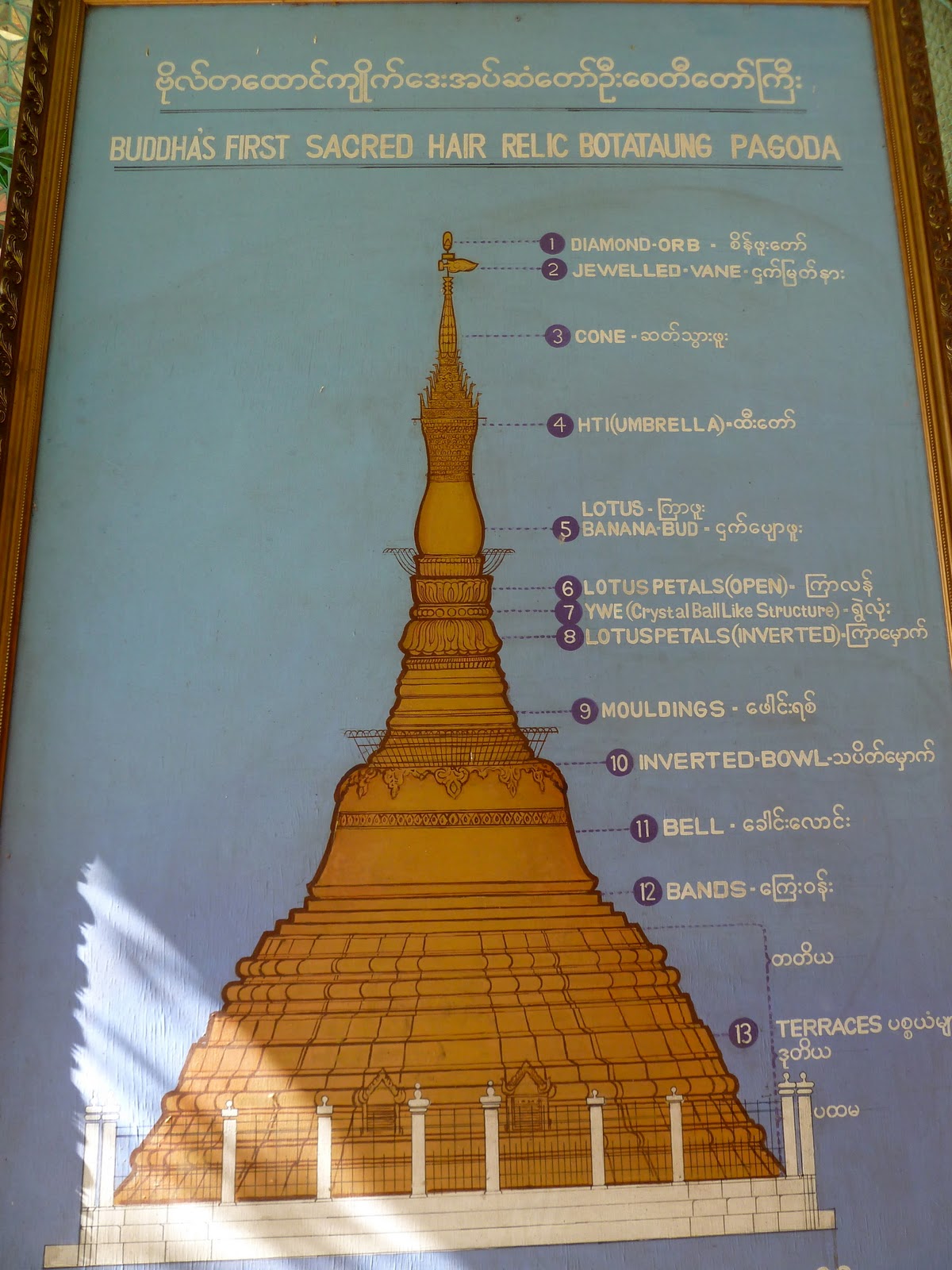
Before I witter on further, I think it is necessary to mention and explain the 'Stupa'. This is the bell-shaped edifice central to Buddhist temples. Regardless of whether you take an interest in religion or not, it should be mentioned and explained because, apart from anything else, Burma has more Buddhist temples per square mile than you can shake a stick at. It is the most enthusiastically Buddhist country ( maybe Tibet and Bhutan come close, but I think they might be a different variety of Buddhist ) in the world and they have a super abundance of extremely ornate, expensively decorated and remarkably impressive Buddhist temples each accompanied by its respective Stupa, or many more than one in most cases. It is impossible to tour Burma without being compelled to visit a selection of these. Right: A diagram of the typical Stupa. Enlarge to read and memorise all the various parts that go to make up the traditional design.


I remember cynically commenting on the Temple of the Sacred Tooth Relic ( supposedly housing one of Lord Buddha's molars ) in Kandy, Sri Lanka, and mentioning that we might well see some other odd body parts of his Lordship being revered elsewhere. I was not wrong. Here in Rangoon is the Botataung Paya ( temple ) which is also known as the '1000 Leaders Temple', and in which reposes an equally revered relic; a strand of Buddha's hair! I nearly guessed correctly earlier. I000 military leaders, so the story goes, escorted this strand of hair from India to Burma.


It is kept safely ( out of sight ) in an elaborate ivory and gold, solid gold, casket here ( right ). Visitors are expected to pop a bank note through a slot as they peer in. Out of view below the photo is a sunken floor which is piled six feet high with bank notes and this cavern is emptied weekly, or more often. The financial collections in Buddhist temples put even American TV Evangelist con-men to shame. Everywhere you go, at all points in these temples, there are multiple collection boxes and they fill up rapidly. Queues of people, including the very poorest, contribute non-stop around the clock in some places. Their next life ( reincarnation ) depends on it.


The stupa of this temple is gleaming with gold; gold leaf at the bottom and on all the interior walls and 1 ft square gold plates further up. I'm afraid you are going to get very bored with seeing gold stupas and temples and Buddhas here, with lots of diamonds thrown in, but I was rather flabbergasted at the opulence of these places. It is what Burma does to the extreme and I doubt anywhere else gets within a distance of it. Lots more to come, so brace yourself ( or turn off ).


After building the Botataung Paya they paid tribute to the workers and their families by putting  these sculptures of local children in the temple grounds. They are actually quite charming and make a refreshing change from more bleedin' Buddhas.


Burmese ladies, and some gents, wear this make up called 'Thanakha' on their cheeks ( left ), which is made from the bark of the thanakha tree. It is a traditional facial decoration and very fashionable still.  Indeed most girls and ladies wear it , but it originated as a practical and effective type of facial sun screen.


This bronze Buddha, amongst many in the grounds, was donated by the famous Burmese film actor Chau Hing. I'm sure you've heard of him. He did not star in Ben Hur or any of the Bond films. It is the done thing for wealthy people to donate Buddha statues; the bigger the better. There are hundreds of them in varying sizes on shelves and in alcoves throughout most of the many thousands of temples and pagodas.


A more famous Buddha statue in this temple complex is this one, again gilded bronze, which was taken from the temple by the British when they got rid of the last Burmese King, King Thibaw, in 1885. It was exhibited at the V&A museum in London until being returned in 1951. So we do give some things back.


Next stop was the gigantic 'reclining Buddha' ( right ) at the Changhtatgyi Paya. It is 68 metres ( 221 ft ) long and also has lots of collection boxes and people praying in front of it.
By the way, we were well into the shoes on/ shoes off routine visiting all these places. The British, when they ran the country, made themselves very unpopular with the Burmese by refusing to take their shoes off when entering Buddhist temples. Considering they probably wore expensive, smart, highly polished Messrs Lobbs' lace up boots and shoes, I have a sneaking sympathy for them. It's no big deal if you only wear flip-flops. I dislike wearing flip-flops.

Left: The 108 symbols carefully carved on Mr Buddha's feet are all decoded as representing some auspicious Buddhist phenomena or other. There is a large board on the wall opposite detailing what all these symbols represent. The whole Buddha story is beginning to go well over my head.
I was persuaded to buy a Burmese walking stick ( $5 ) in a local shop nearby. I had made my mind up previously to refuse to buy anything, but the Burmese are so charming. I don't need a stick. I didn't even want a stick, but I bought the damned thing anyway and it is too long to go in my case.


Right: The daddy of all the Payas in Burma, the Shwedagon Paya. The word 'shwe' means gold in Burmese and features widely in regard to Buddhist temples here, and lots of places, buildings, ships and hotel names too. It is not the biggest temple in either height or area but it is by far the most flamboyant and intrinsically valuable. Don't forget the 'schwe' word. You'll hear it again. And again.
All Burmese Buddhists are expected to visit this place once in their lives. This photo ( right ) shows a new initiate to the temple being carried and followed by his friends and family three times clockwise around the central stupa.

It has been added onto and reconstructed in part following earthquakes but has essentially been in it's present form ( left ) since 1769. It is decorated with and contains enormous amounts of gold and diamonds. It is truly astonishing in it's flamboyance. To give you an idea; the outside of the main stupa is covered in gold leaf at the bottom and has an estimated 20 tons of gold plates screwed on the upper area.


Left:  There are 2000 carats of diamonds implanted under the 'umbrella' and on the 'vane' which can ( just ) be viewed through a telescope in the grounds and there is a diamond of 280 carats ( invisible ) held in the 'bulb' on the top. Not content with that there are, reputedly, 60 tons of gold bullion stashed inside the 'bell'. I mean, this is incredible! It is more gold then the Bank of England has ever held in it's vaults. Actually, after that insane ex-Chancellor of ours, the 'Mad Broon', sold off our ( British ) gold reserves at  rock bottom prices, I probably have more gold in my teeth than is now held by the Bank of England. Anyway, the 60 tons is continually added to as the temple scoops in money from wealthy donors and the public ( and tourists ). You can guess how much I contributed.


The main stupa here is surrounded by 68 gold-leafed mini-stupas and the whole thing is surrounded by over 100 elaborately decorated and bejewelled pagodas and pavilions ( as per right ) on a 12 acre site.


And this is only the most fabulously endowed temple in the country; there are thousands of other gold embellished stupas and temples around. The wealth that is contained and invested in, and donated to, these temples is astronomical. I can't even begin to make an estimate of their intrinsic worth. All of this just sits there as some sort of 'good luck charm' it seems. It appears to satisfy the customers however.


All the while most of the population and tens of thousands of monks prostrate themselves in front of the multitudinous Buddhas country-wide and chant and pray as if their present lives, but more importantly their next, depend on it. They certainly don't seem to begrudge the wealth contained therein. There are also some weird wild-eyed beardy characters in ragged robes who also pray and chant like mad in the temple grounds either solo, or hold court with a group of followers, and are known as Alchemists ( I thought they made gold out of lead piping or something; maybe they do ). One tried to give me his business card! I never fully gathered what turns these crazies on. As you might have gathered from all of the above, Burma has a vast 'in-house' supply of gold, schwe, from it's mines up north.


A meditating monk. That is what they do when not eating or sleeping it seems. I suppose it passes the time; eventually.
I can never quite understand the Buddhist point of being 'reincarnated' as, maybe, someone better in the next life if you cannot remember what you were in the previous one.


We had an excellent lunch at a rather touristy cafe ( good steak sandwich ) and went on to see a few of the more 'earthly' sights. OK, I was encouraged to pop in to the Chinese version of a Buddhist temple, Kheng Hock Keong ( right ), in China Town and here we didn't even have to do the shoes-off routine. I think because the Chinese wear more substantial footware ( hirey porrished race-ups flom Messrs Robbs? ) Mr Clement was keen to give me a good run around all the sacred spots it seemed. I don't think I've seen the last of them somehow.


 Left: A good example of the Thanakha fashion. Most of the girls plaster it on.

There are some very impressive old colonial areas and buildings about the place. We passed by what was known as  the Mount Pleasant area on a hill in the centre of town. It looks most attractive with some tasteful and expensive looking residences. It almost retains the old British look and, I was told, the remaining colonial style residences are much sought after by those that can afford them.


Right: Probably the most impressive looking building in the city down near the river is, to my eyes, the old British Secretariat which is hardly given a mention in the guide books. It is a vast 'grand' 19th century Victorian Gothic style complex of offices with pillared passageways, colonnades, turrets and towers. I think it was the place from where Burma was administered by the British Governor, although in those days the country was effectively under command of the Government in India. It is, sadly, almost derelict although I was told there are a few offices still in use. It is also fenced off with wire mesh outer and iron-barred inner barriers. No entry, and even difficult to see inside. The photo was taken by poking my camera through the wire mesh. It has the dates 1889 - 1892 engraved on the top frontage; probably when it was built.


Left: Fortunately I could get a better view of it from the roof terrace of my hotel. I sincerely hope the powers that be renovate this place and don't, and I have a horrible suspicion that they will, pull it down to make way for glass and concrete office blocks.  Nobody can tell me they don't have enough money to do it, vis-a-vis stacks of gold and loot in the temples!


Right: We went on to have a look at the busy river dockside. There are still remnants of the British days such as the port administrative buildings and disused coal yards. There is now, amongst all the hundreds of smaller ship and boat moorings, a container port.


Left: Also on Strand Road down here is the impressive Strand Hotel. Very smart, and expensive too. Looking at old photos of this area, on display inside the hotel, it is noticeable how elegant these colonial buildings were, and indeed still are where they exist, but in those pre-WW2 days the surrounding streets and area were elegant too. The surroundings have gone considerably downhill since, if nowhere near on an Indian scale. I also noticed that several of the presumably wealthy ( western ) customers using the hotel looked remarkably scruffy too in T-shirts, shorts and flip-flops. I must admit I was not much better dressed, but then I only called in for a drink and a look-see and I certainly wasn’t wearing shorts!

Lots of places, stadiums and streets, have the name Aung San given to them. As you may be aware, General Aung San was the Burmese military/political leader who lent his support to the dastardly and cruel Japs when they invaded the country in 1942 and evicted the British. He then switched sides to support the British when they were recapturing the place. He knew which side his bread was buttered. He then led the Burmese National Party, or whatever it was called, and is credited with securing Burmese independence ( although without British control of India it would have occurred anyway I suppose ). He was assassinated, outside the Secretariat buildings, in 1947 and became a national hero. He was also responsible for producing, amongst other offspring, the redoubtable Mrs Michael Aris, aka Aung San Suu Khi, who is now free of house arrest and able to contest elections due to be held this April. 
That was a day and a half in Rangoon. So much to see and do and, so far, everything has been most efficiently organised by Miss Hnin Wai and her tour company. Incidently, I was previously under the impression that visitors to Burma had to have a tour itinerary booked in advance including a letter of authority. This may have been the case but is not so now. If you wish, it is easy to get a visa without any pre-organised travel plans. You can just turn up and do your own thing. I have the next few days on my own individual ‘tour’ which at times involves pre-paid guides. I think this may be a more economic and efficient way of seeing the sights but may feature a few too many temples and Buddhas for my liking. We shall see. 
Next off on the train to Bagan ( or Pagan ) one of the ancient Royal capitals of Burma. So far so good. 


The flag.