Saturday, 10 May 2025

MORE BISHKEK


 6th - 8th Apr 2025

The statue of General Mikhail Frunze, and his horse, down near the railway station.

General Frunze (1885 - 1925) was  a highly respected leader in the revolutionary Red Army, a national hero, and is entombed in the Kremlin Wall. He was born in this city. He died of an overdose of chloroform when undergoing surgery for an ulcer. There is a suspicion (unproven) that Stalin had him assassinated for various political reasons. Anyway, the city was named after him in 1926....until independence in 1991 when it was renamed Bishkek.
There is a museum, near my hotel, dedicated to Frunze (it was his old house). I was going to visit it on my last morning here but it was closed that day.
 
I walked up to the railway station at the southern end of the large boulevard (with park between the traffic lanes), Erkindik Av (left) to explore the possibility of an onward rail journey to my next destination; Tashkent (Uzbekistan).


Right: Transport up Erkindik was available, but this buggy looked as if it needed pushing.

I discovered that the train journey to Tashkent would be a very laborious, time consuming and infrequent service, in fact impracticable. A bus service was the viable alternative. 
While taking the photo of Gen. Frunze, I met a local couple sitting nearby namely Alex and his wife Dasha. He spoke excellent English and is a (rather wealthy!) civil engineer. They turned out to be a most amusing, helpful and indeed highly generous couple. He explained the bus service, which now operates from a 'temporary' base to the west of the city (more about that later!). He also offered to take me to the Ala-Archa National Park area, about 30 miles south-west of the city, the following day. I accepted!

In the meanwhile I continued my ramblings around town. I discovered (advised by Alex) a pleasant German watering-hole called 'Steinbräu' in the east to the city (left). I expressed my interest in 'Oirish Bears' and he told me there is one called 'The Lucky Leprechaun', but it is closed for renovations. I later found out (after I had left) that there is a Harat's Irish Pub on Chuy Ave (as per the one in Almaty). Drat!

Right: Apologies, another statue. This one is of Karl Marx and Friedrich Engels (in Oak Park). I don't know which is which.


I made a point of going to see the 'changing of the guard' in Ala-Too Square. Apparently they are guarding the flag.
They start to attention, motionless, for two hours before being 'changed'. Quite an arduous feat. It reminded me of a similar, if more elaborate, performance in Taiwan.


The 'changing' ceremony, every two hours, is a performance of extraordinary well drilled 'goose-stepping'. It attracts a few onlookers....but not that many when I was there.

I hope the video (below) I took plays OK. It shows most of the performance.


The following morning, good as his word, Alex and Dasha picked me up from my hotel...in his very smart BMW (he has two!). We went to a nearby apartment to collect a couple of friends of his, Pavlo and his wife, and then on to visit his mother who lives in a pleasant retirement village on the way to the park. 

Ala-Archer National Park (diagram left) is at the foot of the vast Tien Shan mountain range and is at an altitude of about 5000ft at its lower end, going up to over 16000ft at the far south (we didn't go up that far!). In fact we stuck to the modest tourist trail at the bottom. It is popular with energetic hikers and I think has some skiing resorts.


Right: Our group assembled at the park.

Me, Alex, Dasha and Pavlo and his missus whose name I have forgotten.


The park is renowned for its wildlife, especially the rare snow leopard (didn't see any of those), plus various deer, ibex, wolves and many bird species. Can't remember what else but there were many tame little non-man-eating creatures such as this squirrel (left) which let me feed it some nuts without taking my fingers off.


Right: We came well supplied with liquid rations. Here relaxing by a very clear mountain stream with wine and beer.


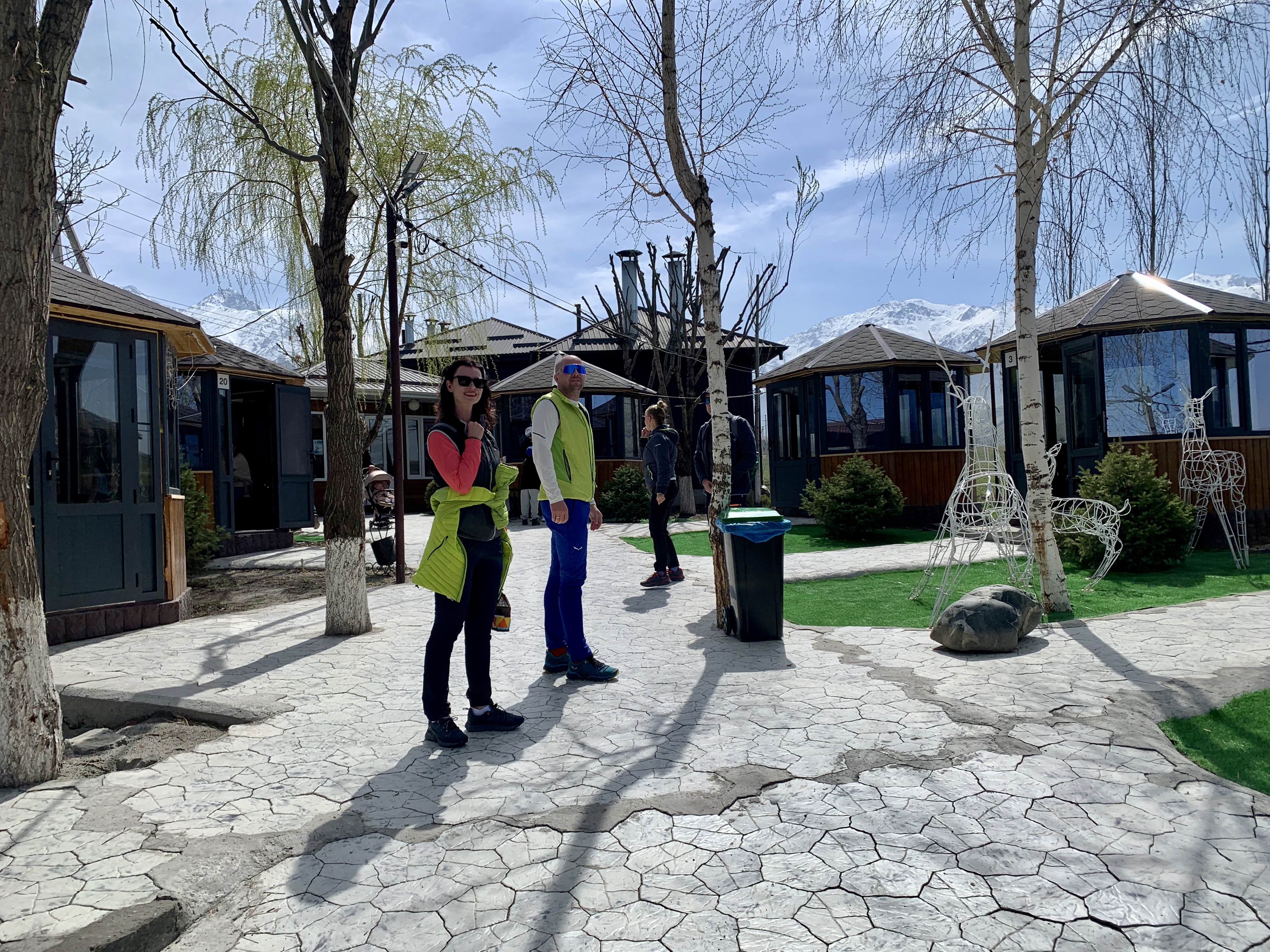
Left: Standing on a platform next to a smart locked 'yurt-shaped' hut which, I was told is, or was, the venue for Presidential meetings.

Right: Horse-riding expeditions were arranged from here.


Left: We built a snowman.


Right: Which was completed by the donning of my cap.


Left: Next on to a restaurant on the way back to Bishkek. It was a popular place called 'Yaku', or similar. It featured individual dining 'cabins' and specialised in fish.


Right: There is a tank, seething with large trout. You go to the tank and someone nets the trout for you (2 big ones in our case), whacks them on the head and sends them to be cooked, then delivered to your cabin.
A very fresh meal, and probably wouldn't be allowed in UK! According to Alex, in previous days they had a pond well stocked with large trout and you were given a rod to catch them (easily). My sort of fishing!

Left: Me being given the honour of serving the main course. Big grilled trout.


Right: Part of our team enjoying lunch, and the trout was delicious. All these meals are accompanied by veg and tea. Tea is the normal drink with meals (no alcohol...due to Muslim culture I suppose) and tradition dictates you only fill your cup, or dish, half full. I think they have many different types of tea and maybe regard it in the same way as we do different wines.


Left: Another view of the 'restaurant' with Dasha and Alex. These photos don't show how popular it is. Most of the 40 or so 'cabins' were occupied and there was a high balcony and terrace overlooking it with a more traditional restaurant inside, plus a children's playground.

On back to Town via another call in at Alex's mother's house where she gave me a large bag of home-made scones for my onward travels. She had a couple of big Alsatian dogs in residence which apparently are very friendly....other than to intruders.

On the way back we passed a grassy area with a small herd of horses. I saw several of these on my train journey here. I asked what they were for. Alex told me that these are bred for eating. The male horses are killed for meat at about 1 year old. The mares are kept for breeding. The locals here, and in the other 'Stans', also make a lot of use of horses for riding, transport and, indeed, sport.

They play a particularly dangerous, and popular, game, somewhat equivalent to polo, except that instead of a ball it involves fighting for and carrying a beheaded dead goat or sheep. Apparently there are many casualties! In Kyrgyzstan it is called Ulak Tartysh, in Afghanistan Buzkashi and in Kazakhstan Kok Baru (I may have got those the wrong way round).


You score by dumping the carcass into a pit. I know nothing of the rules (how do they kick-off?) but it attracts big crowds and apparently spectators can get injured as well!
I somehow don't think it will catch on in UK, although in some parts nowadays you never know.


On arriving back in Bishkek we dropped off Pavlo and Mrs. I then mentioned to Alex that I had not been able to find a good tourist office as I wanted a map of the town. Sure enough, he, or rather Dasha, knew of one which was well hidden. Useful tourist advice 'bureaux' are not easy come by here...and I got a map for the time I had remaining. I suppose everyone nowadays just uses GoogleMaps or similar (as I have been doing...but without a local Sim card). He also suggested that another great place to visit was Lake Issyk Kul, where he has another lakeside house (he is a man of means!). It is a vast lake and a popular holiday resort, but is far away to the east and I wouldn't have time to do that.

All today's entertainment and expenses were paid for by Alex. I was not allowed to put my hand in my pocket! It was incredibly generous of him and nothing asked for in return. 'Raschmat' very much Alex and Dasha!
He also said that he would pick me up on my departure to take me to the 'temporary' out of town bus station. That ongoing journey to follow, eventually.

I think that will do for Bishkek and Kyrgyzstan......


Monday, 5 May 2025

BISHKEK - KYRGYZSTAN

5th - 6th Apr 2025

Mr Bishkek (a 19th century 'batyr'...knight/hero) after whom the city was named in 1991. 

The history of this part of the world is thoroughly complicated featuring several brutal invasions and empires from Mr Genghis Khan onwards. I believe a nation called 'Sogdians' ruled the roost for a bit, then the 'Khanate of Kokand', then Russia and the Soviet Union and finally independence in 1991. Its original name was Pishpek, then in 1926 it was named Frunze after a renowned Bolshevik Soviet General who was born here. After independence in 1991 it was renamed, as now, Bishkek. Another city on the ancient  'Silk Road'. 

I forgot to mention currency exchange rates, which took some getting used to and which fluctuated significantly, daily. In Kazakhstan there were about 690 Tenge to £1 sterling. In Kyrgyzstan, 115 Som to the £1. The ATM machines seemed to work OK and better rates for cash (I brought some US$) at exchange offices.

Left: The city map. It is built on a grid system and features several wide boulevards and vast Soviet style buildings and squares. The two biggest streets are Chuy Avenue, an 8 lane road running east-west across the centre, and Erkindik Avenue, another 8 lane route with a wooded park between each 4 lanes, running south to north from the train station to the main official buildings, squares and parks at the northern end. (BTW, all spellings of these places in English are variable as they are translated phonetically from Cyrillic or Kyrgyz script). It was often necessary to use underpasses to cross the main streets which, at times, became very busy with traffic

Right: The Kyrgyz flag. This enormous flag (50ft x 35ft) was hanging from a 150ft ft flagpole in the centre of the vast Ala-Too Square. It was a useful landmark!


Left: The State History Museum behind the flag at the northern end of Ala-Too Square. The monument in front of the museum was that of Mr Vladimir Lenin. It is now under scaffolding being replaced by, I think, a statue of the iconic and legendary Kyrg warrior 'Manas'. The 'Epic of Manas' is (arguably) the longest epic poem in the world at 20 times longer than the '0dyssey'. I have not read it.


Right: A statue of Manas the Great somewhere else in town.


Left: Mr Lenin's statue has been moved to a less prominent location behind the museum.  


At the risk of boring you I will report on my visit to the large and spacious museum. As well as the tedious 'ethnology, anthropology, paleantology' stuff (old stones and bones etc.) there were some quite interesting exhibits from Kyrgyzstan's past.


Right: An uncomfortable looking old army uniform.


Left: A more modern uniform and memorabilia once belonging to a 'hero' officer in the past Soviet era. He wore so many medals he must have walked a bit lopsided.


Right: A display of ancient musical instruments.


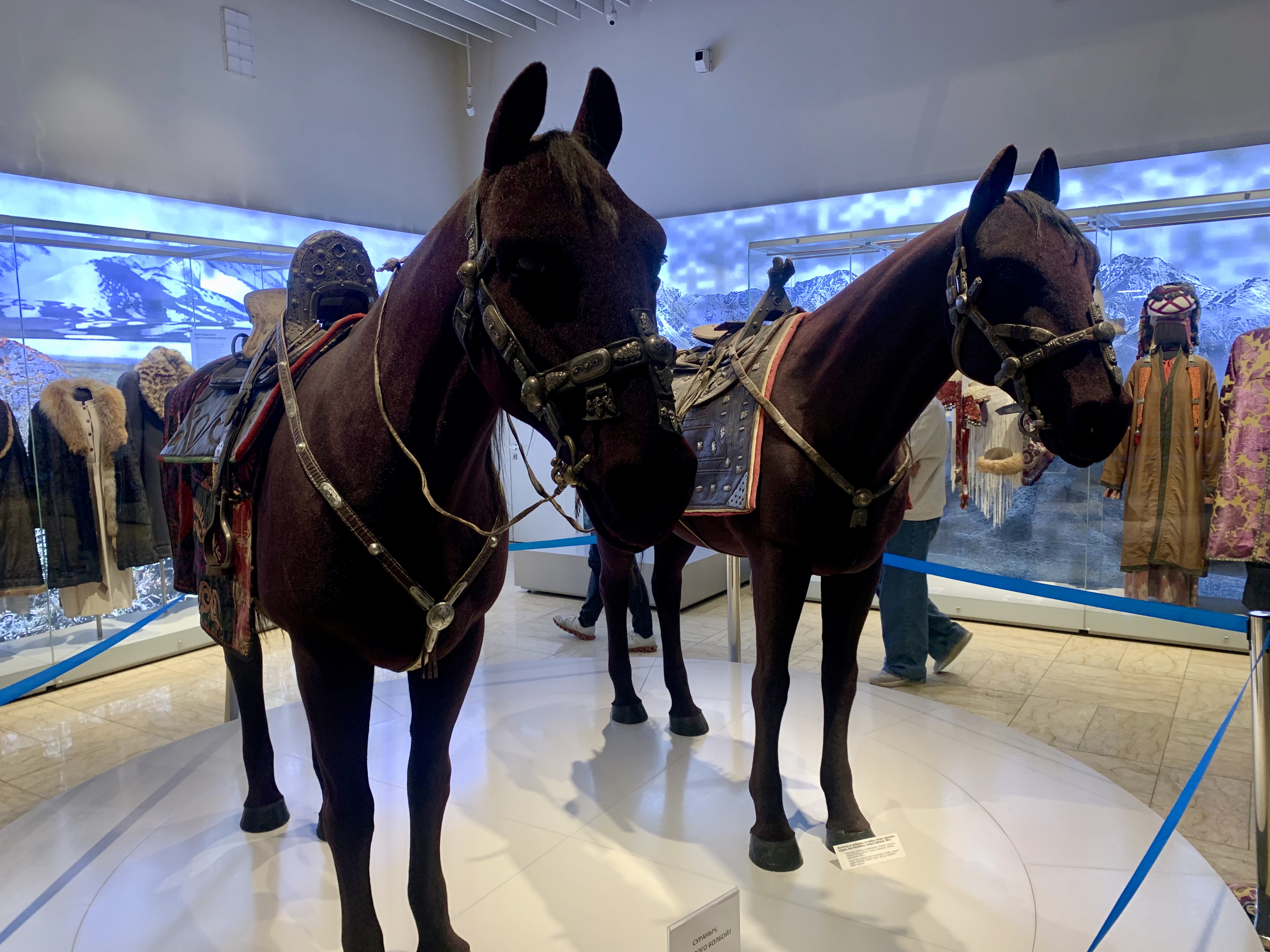
Left: A couple of stuffed horses.


Right: 16th? century saddles. Very elaborate and maybe comfortable?


Left: Another Yurt.


Left: Some weird religious talismans and amulets (animal claws etc.) and a tambor. I think they are Jewish. There was a large Jewish community in this part of the world, but is now predominantly Muslim.


Right: An 18th century hat. The Kyrgyz are fond of their hats.

The weather here up until today had been warm and sunny. I left my waterproof jacket (thinking of chucking it away) in the hotel. On leaving the museum it started to rain heavily and drizzled for the rest of the day. Typical! I found a decent bar to shelter in.


Left: These tall hats, called kalpaks, are on sale at many stalls. I didn't buy one. Too difficult to pack.


Right: They are worn by all the well-dressed men about town.


Left: A toff in his local 'titfer'.


Behind the museum to the north there are several delightful park areas which are well used by the locals for picnics and relaxing etc. The main one (right) is called Oak Park.


There are many jolly forms of transport to take you around the place.


Right: Most are of the self-drive variety, either electric........ These two girls gave me a lift!


Left:.....or pedal powered.


Right: You might recognise some of the drivers.....
Left:......and this one!


Right: To the west of Oak Park is (in the distance here) Panfilov Park (named after the same Russian General as the park in Almaty). This is a large 'children's amusement park' with a big wheel and lots of swings, roundabouts, dodgems etc. I went to have a look and it was mostly closed down. Apparently there had been a bad accident on one of the rides a week ago and it was going to be closed pending investigations and alterations.


To the east of Oak Park is Victory Square, dedicated to the victory over Nazi Germany in WW2. Left: The centre piece of this square is a 'yurt' styled monument. It has other monuments surrounding it.


Right: Under which is an 'eternal' flame and a statue of a lady 'waiting for her husband to return from the war'.


Left: A monument to the soldiers.


Right: ....and another, to soldiers reunited with their children.


Left: Also on the Square, a statue of Urkuya Saliva (1910-1934) dedicated to the Martyrs of the (Russian) Revolution; the socialist warriors that died at the hands of 'rich peasants', apparently. Erected during the Soviet period.


Right: Some happy local lasses relaxing in the Square.


The town is festooned with statues and monuments, so I will try not to bore you with too many. However this one (left) caught my interest. It is on the west side of Ala-Too and is in memory of the victims of 'freedom uprisings' in the town of Asky in 2002. This part of the world has been plagued with 'uprisings' and 'revolutions' involving many fatalities.


My guidebook mentioned that the Osh Bazaar, in Bishkek, is worth a visit. Osh is an ancient town in the  mountainous southwest of the country and is worth a visit, according to my guide book, but I didn't have time.  It is the biggest bazaar in the region. It was a long walk, 40 minutes, west along Chuy Ave. So I went. It took me past the 'Presidential Offices' (right).

Left: I got to the 'spectacular' Osh Bazaar, and most of it was closed. It was Sunday and yes, it semi-closes on Sundays!


Right: A bit of an operating section of Osh Bazaar. Rather disappointing. In fact one bit of any of these bazaars and their maze of passageways is much like another. I've decided that I am not a bazaar fan.


Left: A happy stall holder.


I had changed hotels. Nothing wrong with the 'My Hotel', but I found an equally inexpensive and charming establishment called 'Smart Hotel' which was more centrally located and had an excellent roof-top bar and restaurant. Right: This view over part of the city was taken from there, looking south towards the mountains.


Left: The grand opera/playhouse which was on the street opposite.

I seem to be taking far too long with these 'journals' and have barely scratched the surface. In fact I am now back in UK and have more than 3 weeks of travellin' yet to cover. It keeps me occupied I suppose and will get to the end eventually.....😖😧