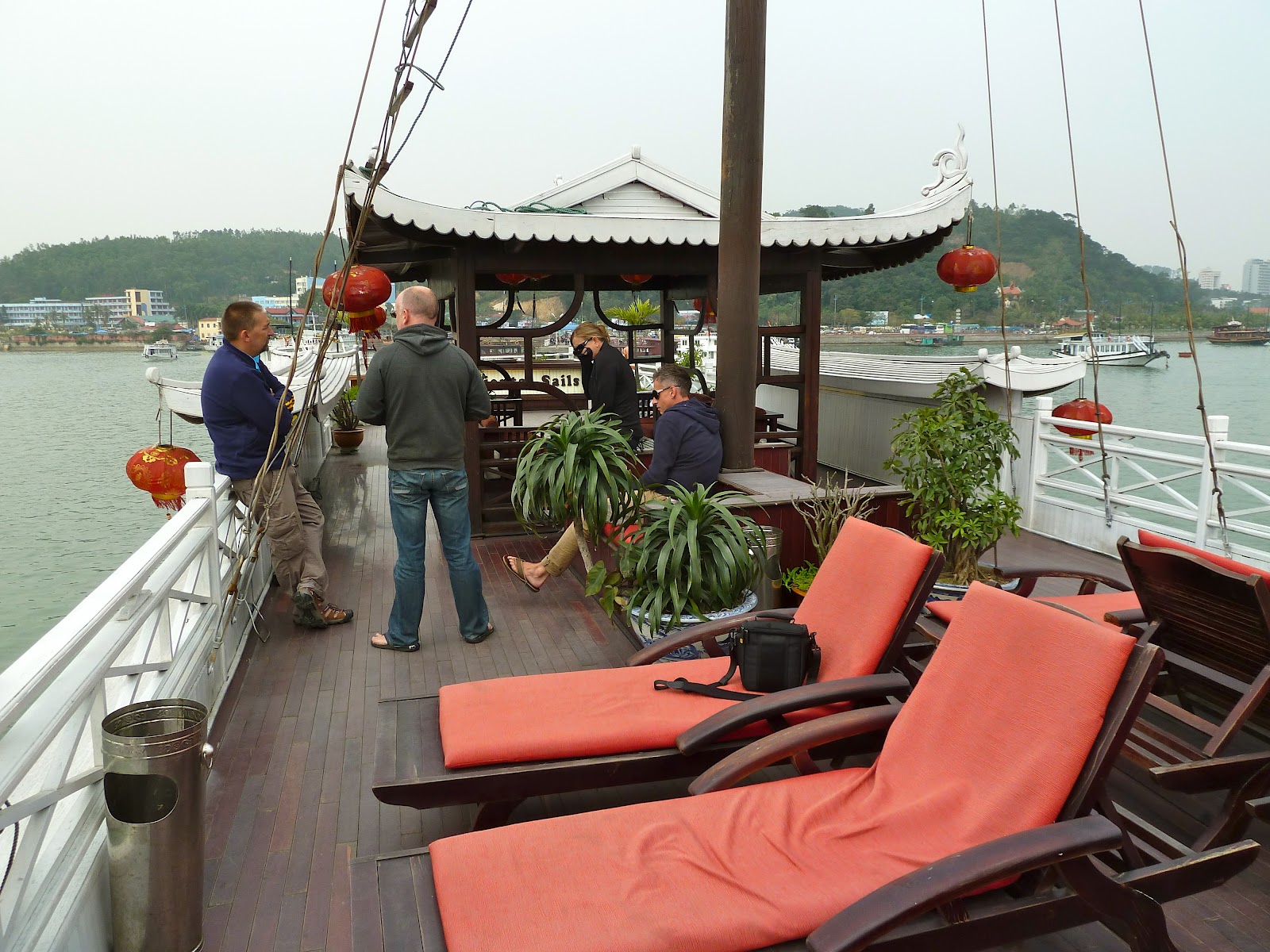
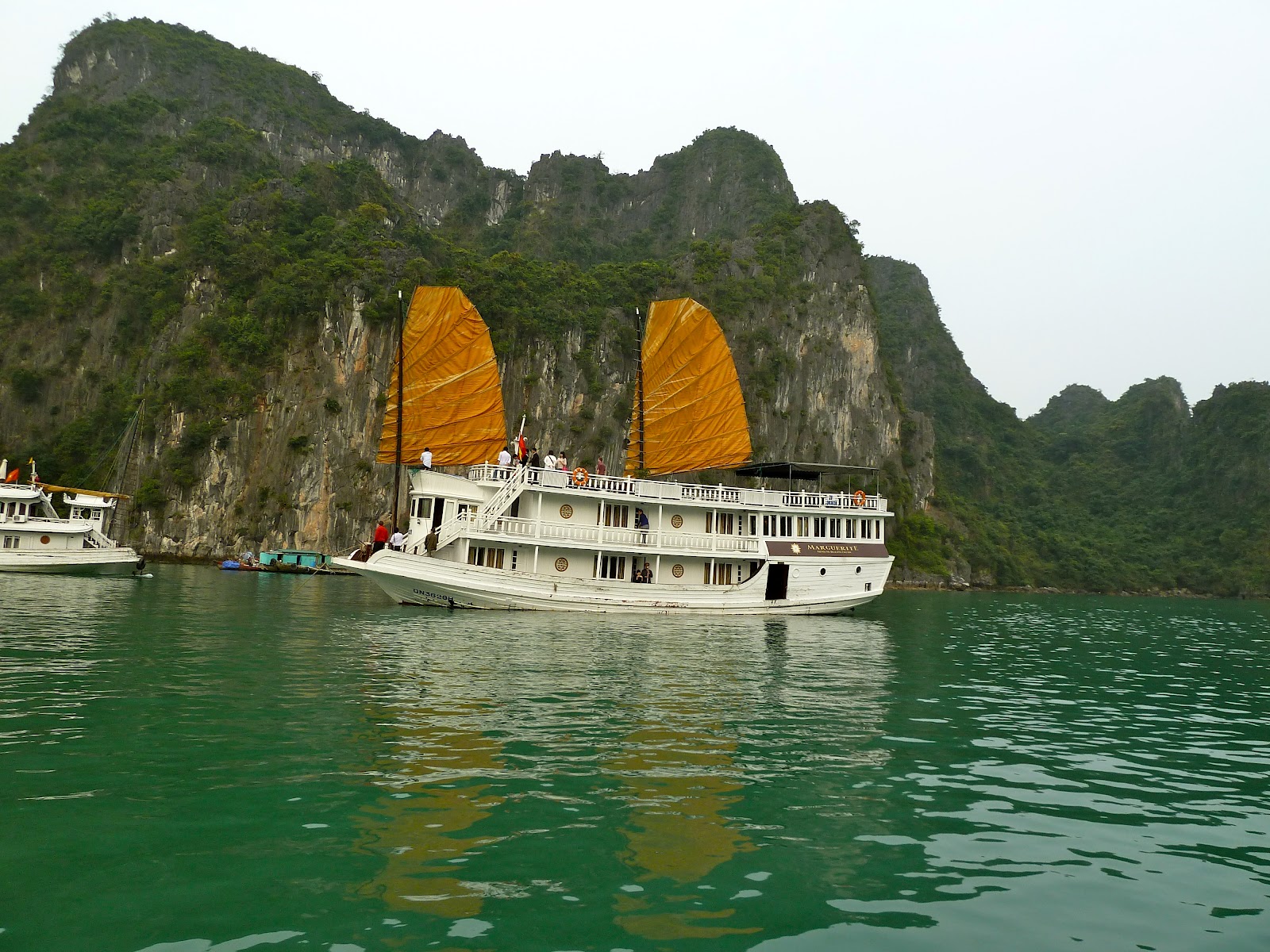
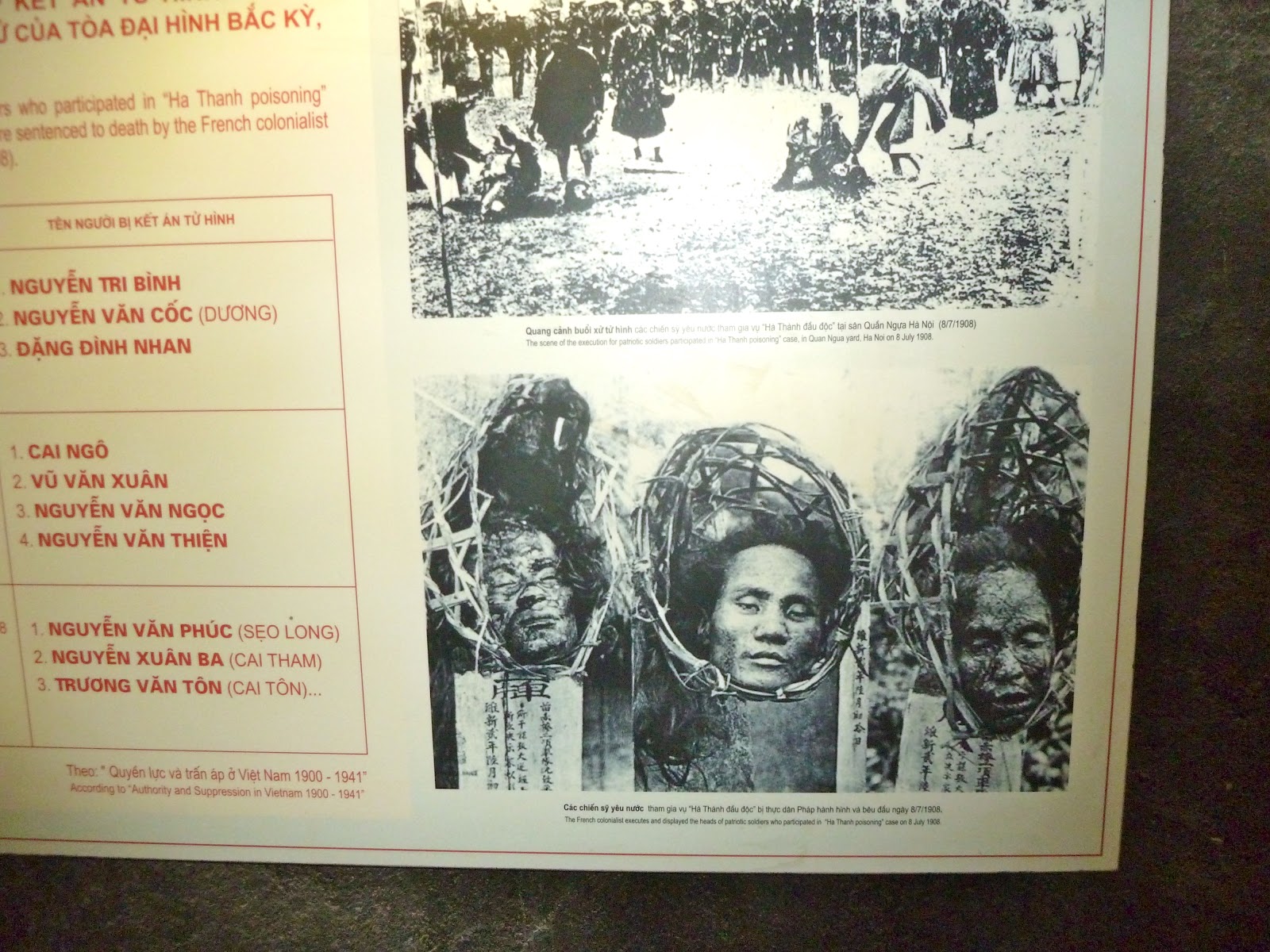
27th Mar - 1st Apr 2012

There were only three of us on the 6.30pm train out of Hanoi heading for Beijing where we were due to arrive on the 29th at 12.30pm. Two nights on board. It consisted, initially, of an old diesel engine and one carriage. This was to take us to the Chinese border at Dong Dang ( Friendship Pass ) where the narrow ( 1 meter ) guage changes to wider Chinese guage track. It was probably the noisiest and slowest train I have ever been on. We were overtaken by cyclists and even, I am sure, by old ladies pushing shopping trolleys.

Left: My travelling companions were an American retired landscape gardener and now vintage car and boat restorer called Mick and a Swiss ‘ecologist’, whatever that is, called Martin. Mick’s home is in Amish country in Pennsylvania and he sported a most peculiar white beard. He is mildly eccentric. Martin was from Basle and had recently completed a solo walk from Los Angeles, across the Mojave desert, and then all the way to Boston! He was big into renewable energy and ‘ecology’. Perhaps he is mildly eccentric as well. So that made three of us.

We completed exit and immigration procedures quite painlessly at the border and then boarded the Chinese train. I shared a cabin with Mick ( right ). Martin, who was getting off earlier than us at 'somewhere' to go walking in the hills, had a cabin to himself. Again, we were the only three occupants in our carriage. Lots of Chinese in the others.
The Chinese train gave a remarkably smooth ride; you hardly noticed that you were moving, and it was a fast one. The beds were reasonably comfortable ( the Asians like firm mattresses which tend to give me a back-ache. Indeed Asians can sleep quite comfortably on stone floors, or motor-bike seats for that matter, even when stone-cold sober. It must take practice or a particular shaped body ).

It was clean, even the loos were clean, with carpeted cabins and corridor, a wash-room in each carriage and there was a pleasant restaurant car ( left ). Hot water was provided in thermos flasks in the cabin and hot water points were at the end of each carriage. The locals always seem to carry dry pot-noodles and tea with them for which hot water is a vital necessity. Blissfully, no pestilential announcements. The Chinese sensibly assume that passengers know what to do, or not to do, or have the wit to work it out.
This two night 1st Class train journey, Hanoi to Beijing West station cost $330. Much cheaper still if you buy the ticket in China. It is remarkably good value when I think back to the Aussie Ghan which chugged along at about 50mph from Adelaide to Darwin where a claustrophobic lie-down berth, bossy rule-bound jobsworths constantly giving ‘announcements’ to ‘guests’ ( how naff ) telling you what you can’t do, luggage restrictions, expensive food and ( limited variety) drink and no interesting scenery for a similar time and distance costs in the region of AUS$1500 with, in my case, bed bugs thrown in for free.
We passed the evening agreeably enough with Mick proudly showing myself and Martin his photo album ( he was carrying a photo album! ) of his large collection of restored antique vehicles. We duly expressed our admiration and subsequently slept well.
We arrived in Nanning ( a big station ) at 0600hrs the next morning and got off the train to wait in a vast empty waiting room furnished with giant sized armchairs ( reminded me of the Shrinking Man ) while the train was shuttled about to collect more carriages. Off we went again, initially through dramatic countryside in Guangxi province containing many ‘karst‘ type limestone hills as per Ha Long which was interesting and which were surrounded by little rice paddys, but the weather was grey, drizzly and overcast and the scenery later became flat and dull.

There was a continous mist and poor visibility caused by the damp conditions and smog from many enormous industrial chimneys belching smoke. The towns and some large cities we passed through, or stopped at, all had a dour and dirty appearance. The buildings were dismal, often enormous monolithic blocks; purely utilitarian, and the lowly mass accommodation looked like stacked concrete rabbit-hutches. Some of these drab constructions were clearly derelict, some were clearly being built and with some it was not clear which. I think they must be rehousing the proletariat. The cities and towns all had the appearance of building sites with little colour or even shops or lighting to break the monotony. I did not see a single building of any architectural merit. Other than concrete grey the only other colours visible were the dull grey-green flat grass fields and occasional blue corrugated iron roofs. There was also a surprising lack of people about, and I never saw any children. Indeed, all the scenery until we got well into Beijing was somewhat dreary and depressing ( not helped by the gloomy weather and spring not yet having sprung ). Impressions, so far, of China; grim and austere, but it might be that the railway lines just go through the grotty parts.
We arrived at Beijing West station at 1300hrs, just a shade late. Self and Mick went to the large information desk to ask about taxis and in Mick’s case where he could get some ‘Renmibi’, or ‘Yuan’ the local dosh. Don’t know why he didn’t get some in Hanoi; it wasn’t difficult. As it happened the staff at the windows did not speak English, so we went our separate ways.
Fortunately the station had English, as well as Chinese, signs. I presume the previous Olympics here played a large part in promoting English signage. A few ‘touts’ were trying enthusiastically to con foreigners into using vastly expensive ‘cowboy’ taxis ( I was not asleep this time ). There was a long but fast moving queue for the official Beijing versions; the dark blue, red or green with gold stripe jobs. I had to cross the city from west to east, a one hour journey, and it only cost 60 RMB or Yuan or Kuai ( less than US$10 ). The Chinese currency description is confusing. I think the official term for money is Renminbi ( RMB ), the basic unit is the Yuan and the coloquial term for this is Kuai. It has Yuan marked on the banknotes.
I am using an agency for onward travel via Mongolia to Moscow called ‘Monkeybusiness’. They have an internet site called ‘Monkeyshrine’. They had proved most helpful and my contact, coincidently called Matt ( from Melbourne ), had provided me with lots of useful info by e-mail. They advised me that it would take two weeks to fix my Russian visa in Beijing, and I had plenty of time in hand to do this. I filled in the extremely bureaucratic application form at their office ( names, dates, addresses and telephone numbers required for previous two schools, plus previous places of work, countries visited and dates in the previous ten years etc. etc! ). It severely tested my memory and imagination. Matt said he would go to the embassy for me that afternoon; done it many times before for clients, no problem. The next day I got an urgent and apologetic e-mail from Matt to say that the goddamn Rooskies had refused to process my visa. They are recently enforcing a ‘strictly by the book’ rule that British, German and Swiss nationals have to have ‘residence’ permits in China. Bloody hell! What has the British government ( or the Swiss and German for that matter ) done to upset the Russians recently? The least worst option was for me to go to Hong Kong where, I was informed, the visa could be processed in three days. This was complicated by the fact that the blasted Easter holidays and a Chinese ( grave cleaning ) holiday closes everything in HK from the 4th - 10th April. OK, no real choice, I bought a train ticket for the high-speed train to HK on Sunday 1st April which would get me there at 1.00pm on Monday 2nd. I’m writing this on the train.
In the meanwhile I had a bit of time to have a decco around some of Beijing.
The metro system in this city is magnificent; ultra-modern, clean, reliable, fast, quiet, easy to navigate and incredibly cheap. 2 Yuan ( 30 cents ) covers most city routes. It must have been installed for the Olympics. It is the best underground system that I have encountered by far. I went off to look at Tiananmen Square.

Left: Looking north to the Gate of Heavenly Peace, the entrance to the Forbidden City. The Square and the Forbidden city are aligned south to north.

Right: On the west side of the Square is the Great Hall of the People. Vast edifice which has a banqueting hall which can seat 5000 people. Hell of a lot of washing up to do after a big dinner there. Someone must take ages doing the seating plan!

Left: The monument to the People’s Heroes towards the southern end of the Square.

Right: The China national Museum, on the eastern side of the Square. You will notice that in these photos the sky is blue and the visibility is excellent. I am told that this is a rare occurrence. Lucky me.

Left: Soldiers on guard on the north side of the Square outside the Gate of Heavenly Peace and the large portrait of the Great Leader Chairman Mao. Despite the horrors which occurred during the ten year ‘Cultural Revolution’, and to which no Chinese now look back with pleasure or pride, the old Chairman is still revered.

Right: Lots of squads of well drilled soldiers marched about the Square. I could not work out where they were marching to or from or what purpose they served, but they added to the spectacle.
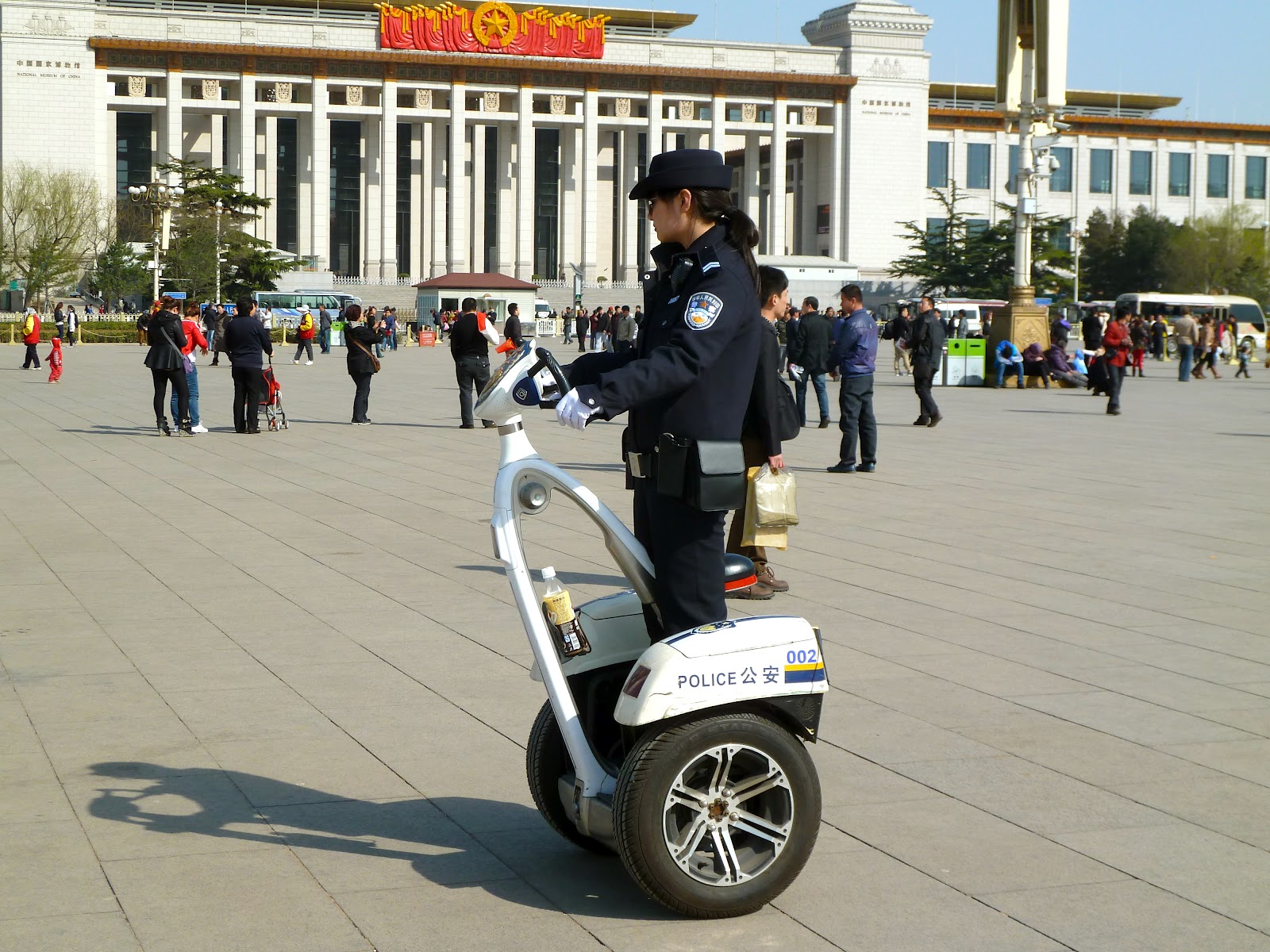
Left: The Chinese police use this imitation form of Segway vehicle. These handy and environmentally friendly modes of transport are regularly used by many police forces and other organisations throughout the world, even by old age pensioners in the USA; except, of course, in Britain where for no other reason that they fall ‘between’ vehicle categories, they are effectively banned.

Right: Looking south to the Monument to the People’s Heroes and Mao’s mausolem ( open most mornings ).

Left: One of the vast Soviet, or Kim Il Sung, style monolithic ministerial buildings on the enormous street leading east from Tiananmen Square. Things are build to vast proportions here. It should be noted that everywhere was immaculately clean. ( India take note! It can be done ).

Right: Off Wangfujing Street was the entrance to a large old fashioned market complex and ‘food on sticks’ outlets.

Left: Wangfujing Street is the Oxford Street equivalent in the centre of Beijing, just east of Tiananmen Square. Lots of smart ‘designer’ shops in a pedestrian zone and the street is about 50 yds wide. Plenty of space.
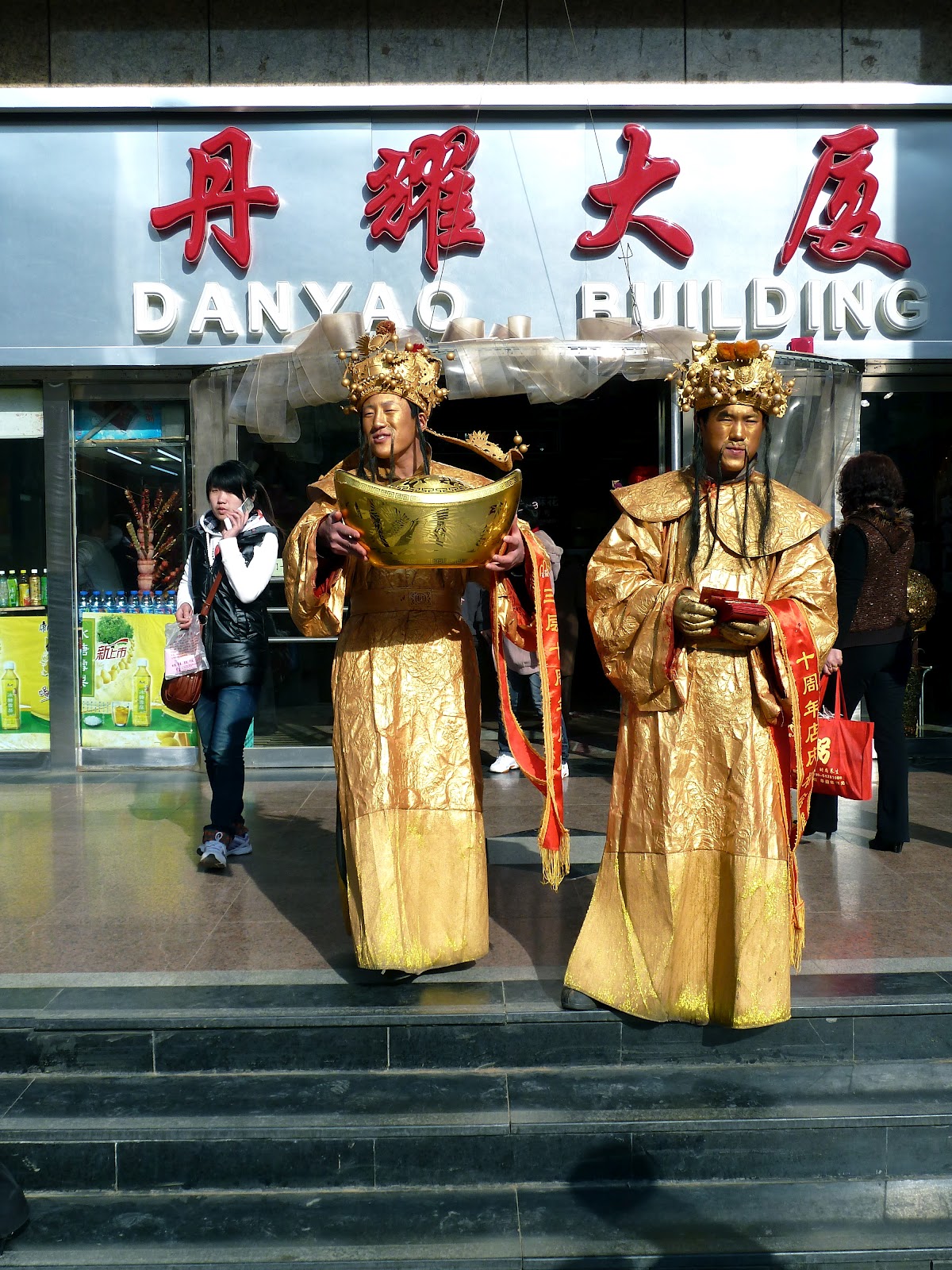
Right: Plus smart restaurants with some extravagantly dressed chaps dishing out menus.

My hotel was an inexpensive but clean and modern establishment ( free Wi-Fi ) in the Sanlitun area on the east side; an area that houses many embassies and has lots of good shops, bars and pubs. Very much an ‘ex-pat’ part of the city. This sign ( left ) was on a street nearby. It conjures up visions of police patients with their weaponry slung over their beds. Presumably the ‘unarmed’ police don’t get such special treatment.

Right: This poor chap was begging on the street. I gave him some money. Now, either he is severely handicapped, or he was fine and standing in a deep hole in the pavement. I suspect the former, but I wasn’t prepared to put it to the test. One assumes he has a minder somewhere.

Left: One of the quaint Beijing ‘tuk-tuk’ equivalents. Very neat, practical and cheap form of public transport.
Twenty four hours on the speedy and comfortable ( and very full ) train to Kowloon, Hong Kong. It was the time the Chinese go to visit the graves of their ancestors....and Easter to make things worse. This was not part of my intended itinerary but needs must to get a Rooshan visa, and a good opportunity to revisit the place since the Brits handed it back to China and to say hello to some unsuspecting victims resident there.
PS. I hadn't realised previously that your Chinese visa is stamped 'exit' on arriving at HK 'cos HK is the Special Economic Zone or whatever and one has to get another Chinese visa to return to Beijing. I suppose it's to stop a mass migration to and from this prestigious and wealthy part of China....and another way of getting money from farang tourists. Very cunning these Chinese.