
We were instructed to arrive at the station at least one hour before departure at 1225hrs. This gave the baggage handlers time to weigh all the bags and clap with glee if they found one weighing even a gram over 20kg and therefore bossily refuse to touch it further. I put a little bag in 'baggage' and carried my bigger one on-board myself. I am learning.
The first thing I noticed about the 'Ghan' train is how astronomically expensive it is. By sheer good fortune, when I was at the YHA in Sydney, I was advised to buy a 'Trans-Aus' rail pass. Mine cost $598 which, at the time, I thought was an somewhat pricey. It allows me unlimited journeys on all the main railways except in Queensland, for 3 months. The cost of a single one-way 'Red' ( economy ) seat for the 3 day, 2 night journey from Adelaide to Darwin is $746! My rail pass is beginning to look good value. For a 'Red Sleeper', which is a tiny double coffin sized cupboard which you might, somehow, have to share and contains two fold-down bunks is $1412. No meals or any extras are included. For a 'Gold' sleeper which has a reasonably decent cabin, an exclusive bar and lounge car with meals included ( but you would have to pay a 'single' supplement ) the basic cost is $2033, and for a 'Platinum' service, and I never bothered to find out what that involved, the cost is $3072. 'F**k' me, I thought. Anyway, I settled for the Red seat-only option.

Left: One of the 'cabin crew'. They varied between being charming and helpful, this girl on the left was such, to being bossy officious 'jobsworths'. Rules and regulations prevail ( for your own safety, of course ) and many announcements tell you what you can and, mostly, can't do. Any thought of smoking cigarettes anywhere on the train is stamped on with threats of immediate execution, followed by less than capital punishments for more minor offences. They refer to us 'passengers' as 'guests' ( yuk! ) with great vigour. We 'guests' in Red economy were treated within the rules of the Geneva Convention. "Jawohl Herr Obersturmbahnfuhrer!". I suspect those in 'Gold' were given more leeway. I noted that in 'unguarded' moments in radio comms between staff we were referred to as mere 'punters'. I prefer that to the obsequious 'guest' label. The train was, on this occasion, 16 carriages long with two engines to pull it. Average speed during the day is 80kph ( 50mph ), so it's a fairly stately ride.

Right: The history of the Ghan. As you can see it is named after the hardy Afghan camel-riders who crossed this dry and inhospitable land before the train was there. The line to Alice Springs was completed in 1929, but the connection to Darwin was only completed in 2004.

Left: We first passed through the vast wheat growing area of the Adelaine Plains about which they described some statistics concerning amounts grown etc. Then on through such places as Snowtown, Chrystal Brook.....

.....past ( right ), looking east, the long line of the Flinders Range of hills, the Spencer Gulf to the west and Port Augusta ( a stop ). It got gradually more flat and arid.....
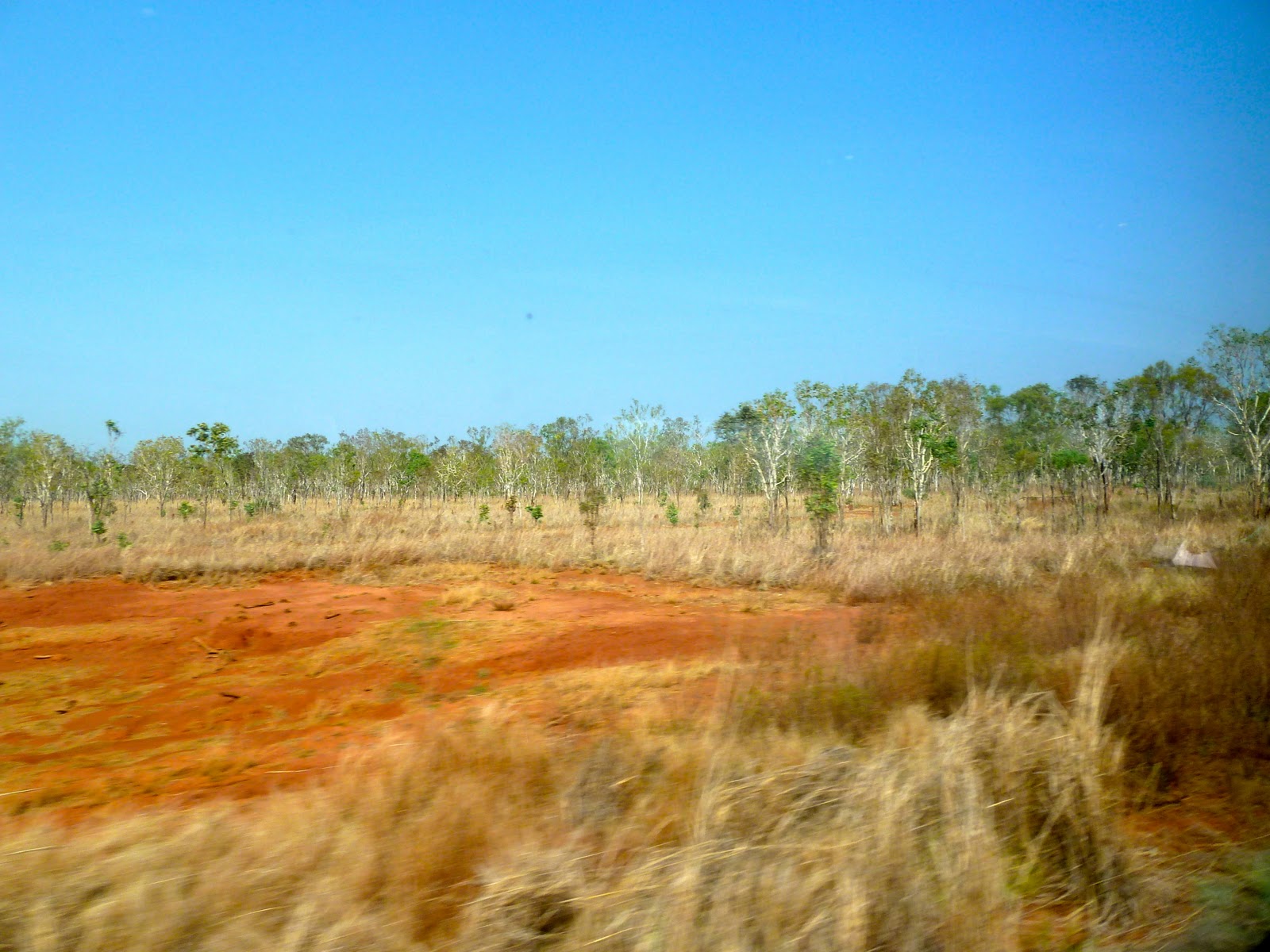
.....until the countryside became like this ( left ), other than when stopping at a couple of towns, for the rest of the journey. This is the 'outback'. and is just scrub, some green bushes, grey-green tufts of spinifex grass and the omnipresent terracotta coloured earth.
There are supposedly lots of unemployed camels let loose into the wilderness between Adelaide and Darwin, but I saw bugger all. No kangaroos either. The only animal life I saw were occasional cattle and a few horses.

Right: The Gold lounge, which had it's own bar at the far end. I was only reluctantly allowed to escape our Red zone to view this. They don't like the riff-raff to infest the more elegant end, and considering the price the 'guests' pay, I don't blame them! We poor Red pax had the Matilda buffet and some vinyl tables to sit at when eating. The buffet food was not too bad actually ( certainly 100% better and cheaper than the US Amtrak rubbish ). There was also a Red Sleeper lounge, and we seat-bound rabble could use that, if there was room, at a cost of $15. I did so and it would have been very pleasant if it hadn't been for a family from hell with two highly disruptive and noisy children rampaging around the place.

Left: The Gold class dining room. Very much on a par with the VIA trans-Canadian service for 'sleeper' passengers, but much more expensive. I wasn't allowed through to dirty the floor of the Platinum class accommodation. My imagination ran wild thinking of what went on in there.
We had 'lights out' at 2200hrs and sleep in the reclining chairs was not too uncomfortable. Whether anyone else managed to sleep through my snoring I never discovered. The only problem I had was my left hand and wrist started to itch quite severely.
Reveille was at 0700hrs with a call that breakfast was being served in the Matlida buffet. There was a glorious 'sunarise' which I failed to get a good photo of. I noticed that my wrist and hand were covered in itchy red spots. I suspect, in hindsight, that the seat was infested with fleas or bed-bugs or whatever.

There was very little scenery of any note, but we were treated to a breathless announcement that we were about to pass the 'Iron Man' statue. This was erected to commemorate the placing of the millionth concrete sleeper between Tarcoola ( wherever that is ) and Alice Springs. The train would be slowing down to allow us to take photos. I was expecting some enormous and impressive monolith. Instead, what we got was this...( right ). It was a sleeper mounted on a stick about 4ft high! It would probably win a Turner art prize, so I shouldn't mock.

The next announcement of a scenic wonder was given about an hour before we got into Alice Springs. This concerned the Finke River ( left ). By the way, that is sand, not water, you are looking at. It has, according to the lady reading rather badly from a script, got some waterholes in it's predominantly dry sandy riverbed. These waterholes hold a fish unique to the River Finke. It is about 5cms in length with a blue spot on it's fin. It is called the Finke Guppy, or something similar. I could hardly contain my excitement.

Right: A statue of an Afghan 'cameleer' at the Alice Springs railway station. We reached Alice Springs ( known locally as The Alice ) at about 1200hrs for a 4 hour stop-over, and had been given the opportunity of doing some 'whistle-stop' tours. I chose to do a local charabanc tour of various sights. I expect the Platinum 'guests' were carried in sedan chairs to waiting Rolls-Royces for a champagne fuelled meander around the town so they could point sticks at the locals.
I found our tour quite interesting. We visited several places of note. The only slight hiccup was that Alice had experienced several large bush fires in the area recently and the visibility was poor due to smoke. Our driver kept apologising for this but none of us had blamed him for it, as far as I was aware.

The first stop was the reptile house. It featured many strange and some highly venomous creepy-crawlies. This little chap, about a foot long, is a 'thorny devil'. Reasonably common in the area. They move in stops and starts to imitate a dead leaf moving in the wind. If they are attacked they put their heads down because they have a 'false' head just behind the real one, and the attacker will go for that, allowing them to run off. They drink through capillaries in their feet. Not a bad idea.

The reptile house guide was very knowledgeable and enthusiastic about his charges. He had pet names for most of them. He kept getting them out to walk on the floor around us. Can't remember what this iguana type creature was called, but we were told that it could do serious damage with it's claws and it's skin was like dry mini beads. He then picked it up so we could stroke it. No thanks; I thought he had just told us that we might be ripped to pieces by it's claws.

Left: This is a perentie monitor lizard, about six feet long. They are very aggressive with savage claws and big dirty teeth, something along the lines of a Komodo dragon. Thankfully he left this in its compound.
Lots more snakes and a 4 metre long saltwater croc, called Terry, in a pond. He went in to show us, with the aid of a long stick, how a 'saltie' will always whip round to snap at something which splashes the water nearby. They have sensors in the scales on their backs to locate sound. They are highly aggressive and territorial. I suspect, from what I was told, I will be getting many more photos of 'salties' in action.

We next visited the Alice Springs Flying Doctor Service. They do a good job. We were given a film show and a brief talk and then taken into their museum. I was impressed. They have two main types of aircraft; Beechcraft King-Air B200C, and the single engined Pilatus PC12. The doctors and nurses are, as far as I can remember, seconded on 6 month tours of duty from various hospitals. I presume volunteers. Anyone looking for a job?
We were then shown around the ex-prison ( closed in 1994 ) which has been restored and features a Special Australian Women's museum, as well as all the old prison set up. I think I've seen enough prisons by now.

The Todd river ( left ) sometimes flows, it is normally dry sand, through the middle of the town. It is named after Sir Charles Todd who was the Superintendent of Communications of South Australia when Alice Springs came into being. It is on this river that they hold the annual Henley-on-Todd Regatta. The boats are made in various styles and powered by runners up the dry riverbed. It is the only regatta which is cancelled if it gets wet.

On to the Telegraph Station ( left ), which is on a hill about 3 miles east of the town. This is why Alice Springs came into being. The aforementioned Charles Todd sent an engineer, William Mills, to find somewhere to locate a telegraph 'repeater' station to link communications between Adelaide and Darwin. He arrived here in 1872. We were given an amusing tour around the station by an old man who had actually lived on the station as a child in the 1930s. All the old buildings and some equipment has been preserved. It was a crucial telegraphic ( morse ) station to allow communication across the country and thence to Asia and Europe.

Right: This seemingly ordinary view is out the back of the Telegraph Station. Between the rocks, behind the near trees, are a couple of springs. This was the water supply that allowed William Mills to set up here in 1872. He named the springs Alice after the wife of Charles Todd, his boss. Hence Alice Springs. Most towns and geographical features in Oz seem to be named after someone. The road linking Adelaide to Darwin, 3169 kms ( with only 2 sets of traffic lights ), is called the Stuart Highway after the explorer who crossed the country in the late 1800s. 'The Alice' is about halfway.

Left: This plaque describes it all rather better than I can. Click on to enlarge.

We were taken up to the top of Anzac Hill which overlooks the town and the McDonnell range of hills to the west. The view was rather spoilt by the smokey atmosphere. This monument ( right ) is to the Anzac fallen at Gallipoli.

Before I forget, this flag ( left ) is that of the Northern Territories which Alice is in. It was flying at the Anzac Memorial. I find it very difficult taking pics of flags. They rarely show all of themselves at any particular second while they flutter in the wind.

....and a rather hazy photo of most of The Alice, with the McDonnell hills in the background ( right ) taken from Anzac Hill. It will have to do because I doubt if I will ever come back here again. Our driver insisted that at all other times the skies are blue and with crystal clear visibility.

On the way back to the train we stopped to look at this extraordinary mural, known as the Panoramic Wall. It depicts significant episodes in the history of Alice. Very well painted and with not a speck of graffiti. The tail of the horse on the right is painted on the wall around the corner.
We motored back to the train and boarded again for the next leg of the journey up to the town of Katherine. Something interesting had happened. The air-conditioning in our Red carriage had packed up and could not be mended. I suspect cunning sabotage by a clever and disgruntled Red class passenger was the cause. As a result we were all ( about 21 of us ) put into Red Sleeper cabins! All shared, except me when I explained that they would have to be deaf to sleep in such close confines with myself. They must not have had too many occupants in this class before because there was only one carriage of these Red sleepers. By crikey, they were a squash and not much room for luggage, and that was with just one occupant, but at least it meant being able to lie down on a bed for the night. They were cunningly designed, even having a small fold-away wash basin and two tiny wardrobes. I suspect the Japanese had a hand in designing these. So, thanks to the ( possible ) saboteur, we had now been upgraded!
We then did not depart. We waited. We were told that there were more bush fires around the line ahead and we would have to wait for as long as it took to get these under control. We finally left 6 hours later at 2230hrs.
On to Katherine which we reached at about 1300hrs the next day, after a good kip, in my case, despite the itching livid spots on my hand. The train had made up most of the delay by going quick-quick through the night. This was another chance for a Whistle-Stop Tour. I chose to go on a boat trip down one of the Katherine Gorges.

Right: Our tour boat going down one of the gorges. This one did a 'cream tea plus scones' service which was very pleasant. Our boat driver/guide, called Chris, described himself as a member of the local Jawoyn aboriginal tribe. I think he said his father was half aborigine and his mother Italian. He was an amusing guide, and a good boat driver too. He explained that the explorer Stuart, of highway fame, was sponsored by a bloke called James Chambers and named the town after Chambers' daughter Katherine.

On the way down the gorge ( left ) Chris described all the local flora and fauna. The river is a breeding ground for freshwater crocodiles ( 'freshies' ). These are the ones with a long narrow snout and live on fish. They are, apparently, not dangerous to humans, unlike the 'salties'. Lots of people were kayaking down the gorge so they were obviously not too worried. Further down people were swimming in it.

Right: This is one of the sandy shores where the crocodiles lay their eggs. They are protected and the sign here says 'keep off', or something like that. The tracks down the sand were not those of a croc; they were human. I was keen to see a 'freshie', but there was no sign of one. We were told lots about various trees instead. Not quite so interesting.

We disembarked to be shown some ancient Aboriginal wall paintings. Some reputedly 10,000 years old. Chris, that is he in the black outfit, eloquently gave us the full mystical works on these. Some were painted high up on the cliff face and involved, of course, mythological gods and creatures. One such god was called Mimi. Legend has it that they were able to get the painting so high up the cliff face because the god Mimi had somehow become a floating 'canvas' and had drifted up there. Chris suggested that they had probably used a ladder.

Right: Some of the wall paintings. They were painted using various shades of ocre mixed with water or animal fat. They are not easy to see even at a short distance. The white smudgy bit contains the image of the god Mimi, and various other things. They were not great graffiti artists these people.
All these paintings are vested with big spiritual and sacred significance and are always made out to be very ancient. I have my doubts!
Anyway, the boat trip, despite not seeing any crocs, was a relaxing and amusing way to see a bit of the area and hear a bit of local history.
Bus back to the train which was delayed a further hour or two because some other driver had reported a buckled track further up the line. We got into Darwin at 1830hrs, not too late. Interestingly, Darwin rail station is 26 kms out of the city and they run a shuttle bus ( $15 ) into town. A taxi would cost $45. It seems extraordinary that after getting the line across 3169kms of near desert they couldn't have gone that extra 26 kms. I must assume there is a good reason. Maybe the taxi drivers objected.
So, that was my first Ghan trip. I will be coming back the same way but stopping off at The Alice for a trip to Ayers Rock. I reckon the Ghan is fine (ish), but I suspect it would be considerably more enjoyable if one were able to afford the Gold class.
Now Darwin for a few days. Still haven't seen a goddam kangaroo.


