Tuesday, 13 December 2011

THE ANCIENT CITIES - SRI LANKA

6th - 8th Dec 2011

The Rock at Sigiriya.

I set off with chauffeur/guide Jim at 0830hrs from the Juliana Hotel ( shabby but good value ) in Colombo bound for Sigiriya in the centre of the country, about 5.5hrs drive away. Sigiriya is in the middle of what is termed in the guide books as the 'Cultural Triangle' of the Ancient Cities. Jim is a remarkably sensible and safe driver. He would certainly not qualify as a bus pilot here. He is also obsessively proud of his car which he religiously washes every day. I remember I once had a car which I never washed for 15 years, before it fell apart. We had a few 'pit stops' en route and the roads were relatively new and in good condition so, apart from evading some lunatic charging buses, we had a comfortable and uneventful journey. Jim's in-car sound system plays old 60s and 70s records which I found relaxing. There is a rigorously enforced speed limit of 70kph on all roads and Jim, for one, will wisely not exceed it. It is expensive to do so with on the spot fines levied by the many eagle-eyed and avaricious police with radar guns along the way. The buses must do, but I suspect they have an 'arrangement' with someone, or just don't care because their company will pay the fines.

I stayed at the Sigiriya Village hotel which is down a dusty potholed track in the small touristy village. Good hotel with a very open plan layout ( the reception and bar left ) with cabins for guest accommodation widely scattered in the surrounding woods. It was about a 10 minute walk through the trees to my cabin!
It would, especially if you overindulged at the bar, be quite possible to get completely disorientated on your way back in the dark and end up lost in the forest for days as far as I could see.


Left: Lots of tourists rode around the vicinity on elephants. You could even book your own 'self drive' animal. For some reason I had no particular desire to ride one.


The first thing to do here is climb the Rock. This volcanic plug rises majestically out of the jungle. Local legend has it that on the top was a Royal Palace, but more recent and accurate research has revealed that it was indeed inhabited BC and then became an important Buddhist monastery in the 10th century before being abandoned ( as was much of the civilisation around here ) in the 14th.


There are many 'unofficial' guides who offer you a helping hand. I was far too proud ( and mean ) to accept  their offer. There are 899 steps ( yes, I counted them ), either stone or metal stairway, plus some ledges to walk along, to get to the top. It was quite good exercise and some fairly dramatic vertical drops to unnerve vertigo sufferers like me. Halfway up, under a protective ledge, there are some very well preserved murals ( right ), painted in the 11th century I was told, of several ladies with enormous gazonkas. They are supposed to represent Tara, an important Mahayana Buddhist goddess.


The carved lion's paws ( left ) are part of what was a much larger carving of the whole lion's head which has either collapsed or was destroyed. Those metal steps supported on the rock face looked a bit dodgy but I expect they are safe enough. Nobody told me of any previous problems and I didn't hear anyone plummeting and screaming to their death while I was there.
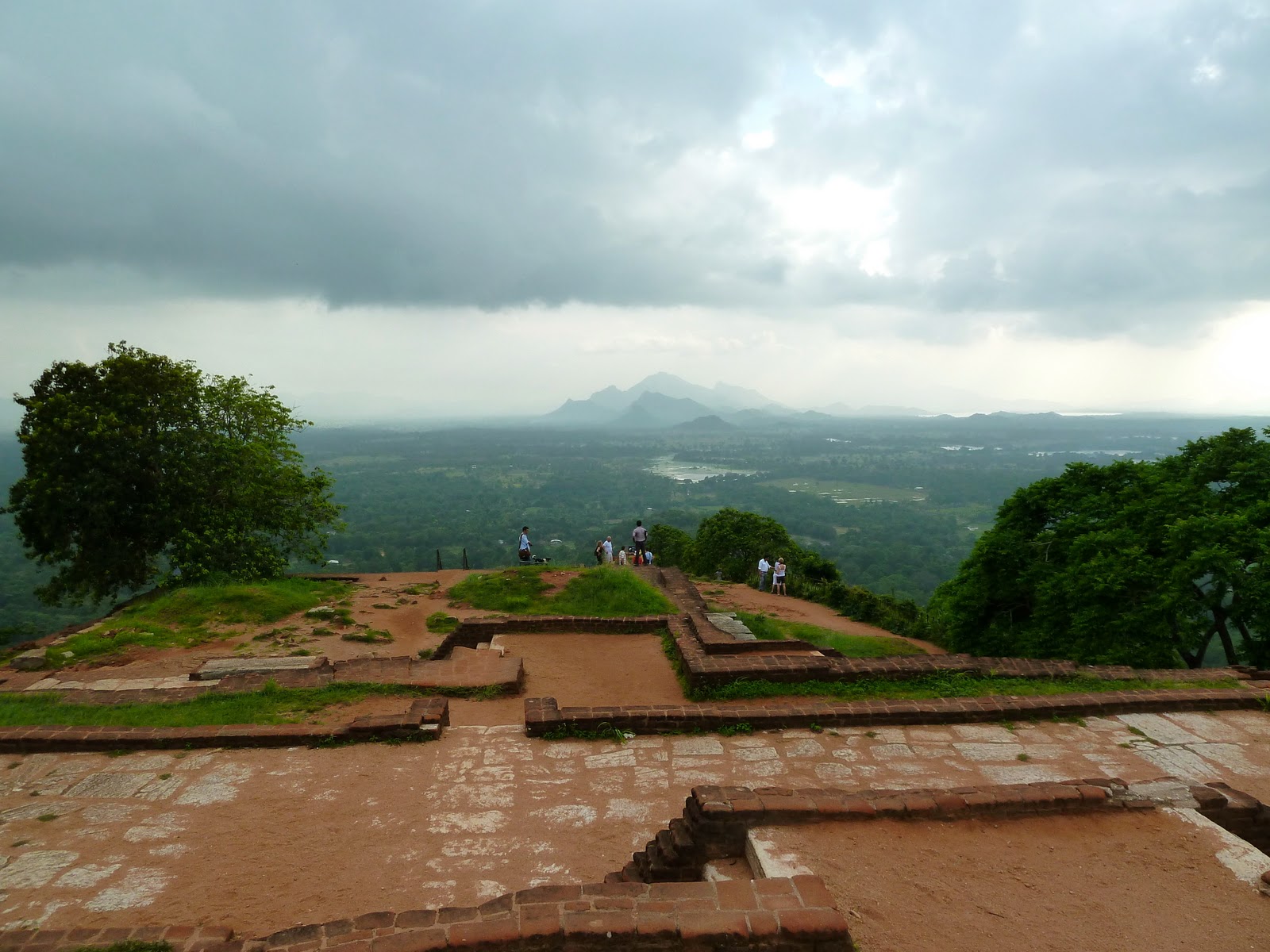


Great views from the top ( right ) where there are the remnants of ancient monastic buildings including a rain-water filled reservoir. Some of the buildings, made out of small clay bricks, seemed to have been very well constructed considering their age.


Left: A couple from the Czech Republic who posed on the summit. A Buddhist Czech Point.


This sign ( right ) was displayed on the top. I kept very quiet.


The steps felt a bit less secure going down. There was a different route from halfway down which led you to somewhere in the trees at the bottom with no signposts pointing out where to go from there. I'm sure it was a cunning ploy by those 'unofficial' guides to take you, for a small consideration, to the exit car park. I refused all assistance and eventually, later than anticipated and sweating freely, got back to where Jim was waiting with the car. He then insisted on taking me to a Sri Lankan massage parlour to soothe my aching joints where I was oiled, beaten up and steamed for an hour or more. Nothing erotic about that place, I can assure you.

The next day we went to visit the old Royal Palace ( right ) and surrounding compounds and markets at Polonnaruwa, about 40 miles away. This was one of the two commercial and religious centres dating from the 12th century. The place was sacked and destroyed by invading Indians in 1415. Unlike the Mexicans and other 'protectors' of ancient ruins these buildings have not suffered the indignity of 'reconstruction'. They are as they were found with a bit of tidying up and all that you see is original stonework.


There were lots of monkeys around of two types. This one ( left ) is a grey monkey. It reminds me of someone.......


This one ( right ) is a Toaq monkey ( I have probably got the names wrong ). Nice toupee. It reminds me of someone else.


Left: The ornamental reservoir filled from a local man-made lake. The building and design of these structures is complex and sophisticated by any standards. They were built in the 12th century don't forget. I suspect they were in advance of anything that was around in what is now Europe and UK at that time.
The guy standing in front is one of the local guides, Rashid. He is very knowledgeable not only about the buildings here but about all the flora and fauna, especially the birds, in the country.


This ( right ) is what is left of their parliament building. There is much impressive stone carving and decoration still in evidence even after the place was trashed and burnt by the Indian invaders.
Something that Rashid explained:
CEY|LON
LON|DON
They spell the same downwards as across. He says that this is not coincidental. I don't know. Do you?


The whole area was covered with Buddhist temples, as per left, of one sort or another. There were a couple of Hindu ones as well. They seem to share a number of 'Gods'.


The remains of this one here ( right ) proclaimed to be the original 'temple of the sacred tooth' There was another nearby that said it was the 'subsequent temple of the sacred tooth'. The present one being in Kandy.


Left: This is one hell of a big and ancient 12th century Buddhist 'stupa' in the vicinity. It is at least a hundred feet high and built out of millions of those tiny clay bricks. Nobody is allowed inside it. I asked if anyone is curious to look inside, but was just told it is forbidden. Somebody must have been in there.


Right: More ancient Buddhas. To be quite honest, I was getting rather bored of looking at images of the Lord Buddha. Apart from anything else you have to take off your shoes in the vicinity. On this tour I had to do the shoes off/on routine about five times and I have lace-up walking boots. The procedure begins to wear thin after a bit.


Left: On the way back we passed over a river where a chap ( well known to Jim ) has set up a small cottage industry by hand feeding a collection of large monitor lizards which live in a pool beneath the bridge. Tourists, like me, stop and watch in some fascination as he feeds these ugly creatures meat. You are then expected to give him 100 rupees. He has a collection of about 15 of these fat, idle and pampered lizards. This is probably another guy with a holiday chalet in Gstaad who drives a Rolls-Royce.


We then proceeded to another Buddhist shrine, the Royal Rock Temple at Dambulla. This place is a very commercial concern and was helped by large Japanese financial contributions. They commissioned this rather vast and tasteless golden Buddha at the entrance ( right ). After paying a considerable entrance fee you walk up a lot of steps, I didn't count but it took 30 minutes, passing beggars at every level before you arrived at......


.......a series of five shallow caves in the rock face behind the white facade ( left ). These are supposed to  have originated from the 1st century BC and subsequently enlarged and embellished by various kings. Collection boxes for further donations are placed at every entrance.


They  contain about 150 Buddha images in various postures The big ones are reclining of course. Well, they have to, or they would need to crouch in a rather undignified way.
Note the collection box in front.


......and the smaller ones are sitting cross-legged or standing up.
There are more temples, Buddhist or otherwise, in this country than you can shake a stick at. Many more per acre, even, than churches and cathedrals in Central and South America. One wonders if the money and effort put into constructing and maintaining these and the vast amounts gathered from them could not be better spent on improving the infrastructure and other facilities in what is a cash strapped country.
I think I have seen, photographed and wittered on enough about temples and Buddhas. Shoes back on and no more mention of them, for the time being anyway.


Of more secular interest, indeed more interesting altogether to me, was this amazing cricket ground at the same town, Dambulla. It is the Rangiri Dambulla International Cricket Stadium. Jim said we would not be allowed in, but I told him to tell the guard on the gate that I played cricket for Rutland 3rd X1 and wanted to check the place for possible future fixtures. No problem, we were escorted in and given a full guided tour of the place by the ground staff. One suspects that few people have visited this ground for a long time and they welcomed the opportunity to show the place off.
I think it was built about 3 years ago and is in the middle of the back of beyond. It has been carved out of the jungle and the reason for it being here is not immediately apparent.

 It is magnificent ( left ), with a vast car parking area, an impressive set of stands, albeit in need of a bit of sprucing up, and a cricket pitch in pristine condition. It has hardly been played on. The grass is in immaculate condition and it has a picturesque backdrop of the surrounding forests, hills and a lake. It cannot be bettered by most international grounds. It has, however, seldom been used. The staff members here, I was told, as with the Sri Lanka team themselves, have not been paid for several months. Sri Lankan cricket is not in a good financial state at the moment. Unlike the temples.
I believe England are due to play a Test against Sri Lanka here in May next year, and nothing happens before that! What a waste of a superb facility ( if I have been informed correctly that is ).
The third ancient ex-capital city in the Triangle is Anuradhapura which is about 90 kms to the north. I have seen enough of ancient capitals by now and enough Buddhas to last me a lifetime. So, tomorrow, we are due to set off to Trincomalee ( Trinco ), which was unfortunately caught up on the front line of the 'war' with the Tamil Tigers until that ended in 2009.

Saturday, 10 December 2011

GALLE - SRI LANKA

3rd - 5th Dec 2011

Part of the Fort wall at Galle.

There are basically three types of bus in Sri Lanka; Government buses, Private buses and Tour buses. The first two you get from the bus stations. The third only work, and not many of them, for tour companies. I was therefore compelled to get one of the first two. Government buses are near wrecks, uninsured and belch black smoke. They are coloured red. They don't care much whether they get you to your destination on time, or at all for that matter. Private buses ( in either small 'air-con' or larger 'open the windows' configuration ) are also in less than pristine condition and are in competition with each other, therefore they take all sorts of risks to get you to your destination quickly, or die trying. Both varieties are remarkably cheap. Some of the roads in Sri Lanks are now quite good ( a new motorway between Colombo and Galle has just been opened, but not for buses ); many are not. They are all populated by packs of dogs and herds of cows as well as every sort of vehicle imaginable. Driving is on the left or, more normally, in the middle of the road.

I chose one of the smaller 'air-con' buses for the 4 hour journey to Galle ( about 180 kms I think ) along a notoriously busy two lane road through many interlinking towns en-route. It started off promisingly at the Fort bus depot in central Colombo. The 'conductor' was standing outside the bus shouting what sounded like "wallywallywallywally!" to drum up customers. When all the seats were taken we set off. 250 rupees ( $2 ) for the journey; can't complain.
The bus ( left ) had a sound system ( wailing ethnic music ) and, as you can see, a kitchen clock nailed to the ceiling. My seat was reasonably comfortable, and there was even room for my bag on a space in front of me. So far so good. The slight problem was, this being a private 'money making' bus, it stopped at every possible place en-route with the conductor leaning out of the door shouting his "wallywallywally etc." to get in more pax. Actually it didn't stop it just slowed down and people leapt on or, occasionally, off. It soon began to resemble that over-packed train. It was another sardine can with people sitting and standing wherever they could. I kept my seat but lost contact with my bag and it became leg-crampingly uncomfortable. I never saw how the conductor chappie managed to collect any fares, but he obviously did. Sitting squashed behind the driver I had a reasonable view of the road in front and perhaps wished that I hadn't. The technique of driving these buses is quite simple. You overtake without hesitation any vehicle going slower than you at any point or road condition and anything coming towards you has to brake or take avoiding action. It is the ultimate game of 'chicken'.  Cows and dogs in the road provided the added unforeseen and unpredictable 'joker'  hazard. It got the adrenaline going.
We passed through several towns, I think, because one built up area led into another with little chance of seeing a sign. The road runs down the coast and a couple of places looked like they might attract tourists. An interesting feature of Sri Lankan towns and villages is that, with the notable exceptions of Colombo, Galle, Kandy and Trincomalee, the remaining 99% all have names ending in the letter 'a'. Isn't that fascinating?
We made it to Galle unscathed! It is possibly because of the buses that there are so many temples of whatever religion in this country. People here do a lot of praying.


Galle ( pronounced Gawl ) is the fourth largest city in Sri Lanka famous for it's port ( the most important until Colombo took over ) and it's fort. It was originated by the Portugese in the 16th century, then enlarged by the Dutch in the 17th century before being taken over by the British in 1796. The large Fort contains attractive and picturesque streets, small hotels and shops and is popular with tourists. The old bell tower ( right ) was erected by the British in 1901.


The Dutch East India Company coat of arms ( left ). This example was in the Maritime Museum. It hung over one of the Fort gates.........


.......until the Brits stuck their's up in 1796 ( right ).


The walls of the Fort proved remarkably effective against the tsunami in 2004. Most of the area inside this old quarter was unscathed, whereas big damage and scores of deaths occurred in the newer part of the town, especially around the busy bus station area. Just goes to show that the very old constructions are often the best ( vis-a-vis floods in the UK ).

The sea around the walls is remarkably clean, clear and blue with many little beach areas and lots of bathers.


One of the maze of narrow streets inside the Fort ( right ). Quaint little tea shops, antique shops and restaurants abound. Strangely there are no bars or alcohol served in the restaurants! This is to do with some Government licensing restriction or possibly it is just too expensive for the small places to obtain one. Nothing to do with the local Muslim community I was assured. I never did discover the real reason. Fortunately some places ( including the hotel I stayed at ) had an 'arrangement' with the police and sold drink 'under the counter', so to speak. Thank goodness for that.


A view of the inside of the charming little hotel at which I stayed. It was inexpensive, it had free wifi and computers for use, and the rooms were clean with pleasant balconies overlooking the street.


Outside the Fort the town was just like most others; 'bustling', hot and dusty with plenty of hawkers and markets but with not a lot of great interest other than, to me, the Galle Cricket Stadium ( right ) which has hosted international and Test matches. It was not in bad condition at all and has the walls of the Fort as a backdrop. Sorry; it's difficult to get decent pics of cricket grounds. They are too big for my little camera!


While I was at the travel agent in Colombo organising my Indian visa ( which they did, at a price, and which I could probably have done myself quite easily ) I made the mistake, for the first time, of booking a hotel through the travel agent at the beach areas to the south. I wanted to stay at Unawatuna, a beach which had been recommended. The agent said that all the decent hotels there were fully booked ( in retrospect I realised that the hotel which gave them a commission was fully booked ). They suggested instead that I go to a 'resort' hotel at Mirissa, about 30 miles further south. Stupidly I agreed ( big commission for the agent I suspect ).

The bus I took was of the larger 'windows open for ventilation' variety ( left ). Actually it was much less crowded and more comfortable than the smaller air-con model, if driven in marvellously kamikaze and adrenaline pumping style. It gives one a delightful 'frisson' of danger and a wonderful sense of achievement to actually arrive at your destination in one of these.


The 'boutique hotel' I had been booked into was called the Mandara Resort ( right ). It was bloody expensive! After celebrating my arrival at the Mirissa bus stop I discovered that I then needed a three-wheeler to get me there. It was over a mile out of the village down a potholed dusty track. It had comfortable enough rooms, but no international TV and a dangerous split level floor ( over which I tripped and nearly killed myself ). It had a swimming pool and, indeed, free wifi but only in the ouside 'lobby' area with no useable seating. It had a dull looking bar and an expensive restaurant. It had a beach of clean sand. But that was it. Service, as always, was good but the hotel was surrounded by a tall wire fence which gave you the impression of being in a prison. I saw only 3 other guests, one of whom, an elderly English lady, I found making a vitriolic complaint about something or other to the poor startled looking manager. I suspect she had gone stir-crazy. After dark there was no ( very limited ) lighting to be able to do anything ( that needed lighting ) outdoors and the midges and mosquitoes were ravenous. Apart from that there was no transport easily available and bugger-all other places to go. Trapped. One lives and learns.


The beach area ( left ). There was actually a local walking on it at the time I took this. I saw nobody else and there was no form of activity ( windsurfing, kite-surfing, boats etc ) available. In short, I found it very boring. It may, however, suit those who want a totally undisturbed get away from it all escape from the world.


The next day I escaped on a three-wheeler. I had intended to go by bus up to Unawatuna but found the three-wheeler driver amusing company, and it wasn't expensive, so decided to go the whole distance in his 'tuk-tuk'. The driver, Indee, also runs a small hotel and surfing school a short distance away. He showed it to me and it looked a lot more fun, and much better value, than the Mandara Open Prison. It was an amusing and surprisingly safely driven trip.
Unawatuna proved to be everything I was told it to be. To get to the sea-side involves a mile long drive down a track, but on either side are pretty little shops and cafes. It has a spectacularly beautiful beach ( right ) and a startlingly clear and turquoise coloured sea with fine clean golden sand. It was not crowded, but had quite a few tourists and locals swimming, lounging on deck-chairs or just wandering about plus some jet-ski activity on the water. There is good snorkelling ( I was told ) on a reef and scuba diving on wrecks. There are many restaurants and hotels, some tiny, some larger. Of course there were many places of varying price and comfort which had rooms available. I spent the night at a lovely hotel called the Thaproban where I met an amusing young couple on holiday from Gloucestershire. All in all, this place I thoroughly recommend. On ( maybe ) the down side, it was badly hit by the tsunami. Indeed it was wiped out, and many people died because they were washed into the forest which lies directly behind the buildings and from which there is no easy escape. They were advised to rebuild a sensible distance behind the beach, but greed and commercial advantage prevailed and they didn't. They have rebuilt exactly where they were before, about 10 yards away from the sea. So, in the ( hopefully ) unlikely event of another tidal wave striking, exactly the same destruction will occur. There are, however, good tsunami warning systems in place now to give people plenty of time to evacuate.
Apart from that the message is, "don't trust travel agents, necessarily, to give you the best advice". Like banks and just about every other commercial organisation, they are primarily concerned with making money out of you! Much better deals can often be had by just turning up and doing it, on the spot, by yourself. At least you see what you are getting and can frequently negotiate a substantial discount just by asking the price, looking horrified and starting to walk away!
Back to Colombo by bus ( I hope ), and then off to explore the more 'historic' sites in the middle of the country. I have booked the redoubtable Jim and his shiny car for this venture. There are limits to my enjoyment of dodgy transport and I don't do praying!
Hasta la vista............

Thursday, 8 December 2011

BACK TO COLOMBO - SRI LANKA

28th Nov - 3rd Dec 2011

Local industry.

Before the train left from Kandy back to Colombo there was time to go to visit the elephant orphanage at Pinnewala, about 20 miles west. This place is supposed to look after orphaned and injured elephants.


On the way there we passed several sights including this ( left ) across the hills to Bible Rock on the horizon in the distance. Also dozens of roadside stalls selling snacks to passers by and seemingly not many takers.


The Elephant Orphanage is a very tourist oriented commercial concern. It is suspected that elephants are deliberately bred here to keep the herd strong and available for human viewing. Having said that they all look in remarkably good health and are obviously well fed. Not much need for them to do much foraging, and some young elephants are selected every morning to be hand-fed bottles of milk by eager tourists which they drink by the gallon.


There were about 80 elephants on display which live in a large enclosed area and in a life of comparative luxury. Lots of photo opportunities to be had with tourists ( me included ) standing next to the creatures and patting their heads. The 'mahouts' make lots of pocket-money from this. They probably all have second homes in Monte Carlo and drive Ferraris.


Right: One of the more impressive 'tuskers' being given a pedicure. I didn't gather which elephants grew big tusks and which didn't. Maybe it's obvious? I know that Indian elephants have smaller ears, but that is about as far as my knowledge goes.
I expect someone will explain.
These elephants are fed at 10.00am each day for both their and the tourists' benefit. They are then, at 12.00pm, herded down to the river for a bathe, and for more gawping at by us tourists.


On the way down to the river we, and the elephants, pass through a sort of shopping street. Lots of hustlers selling all kinds of tat as always. There are many places ( as per left ) advertising the sale of 'elephant dung' paper products.


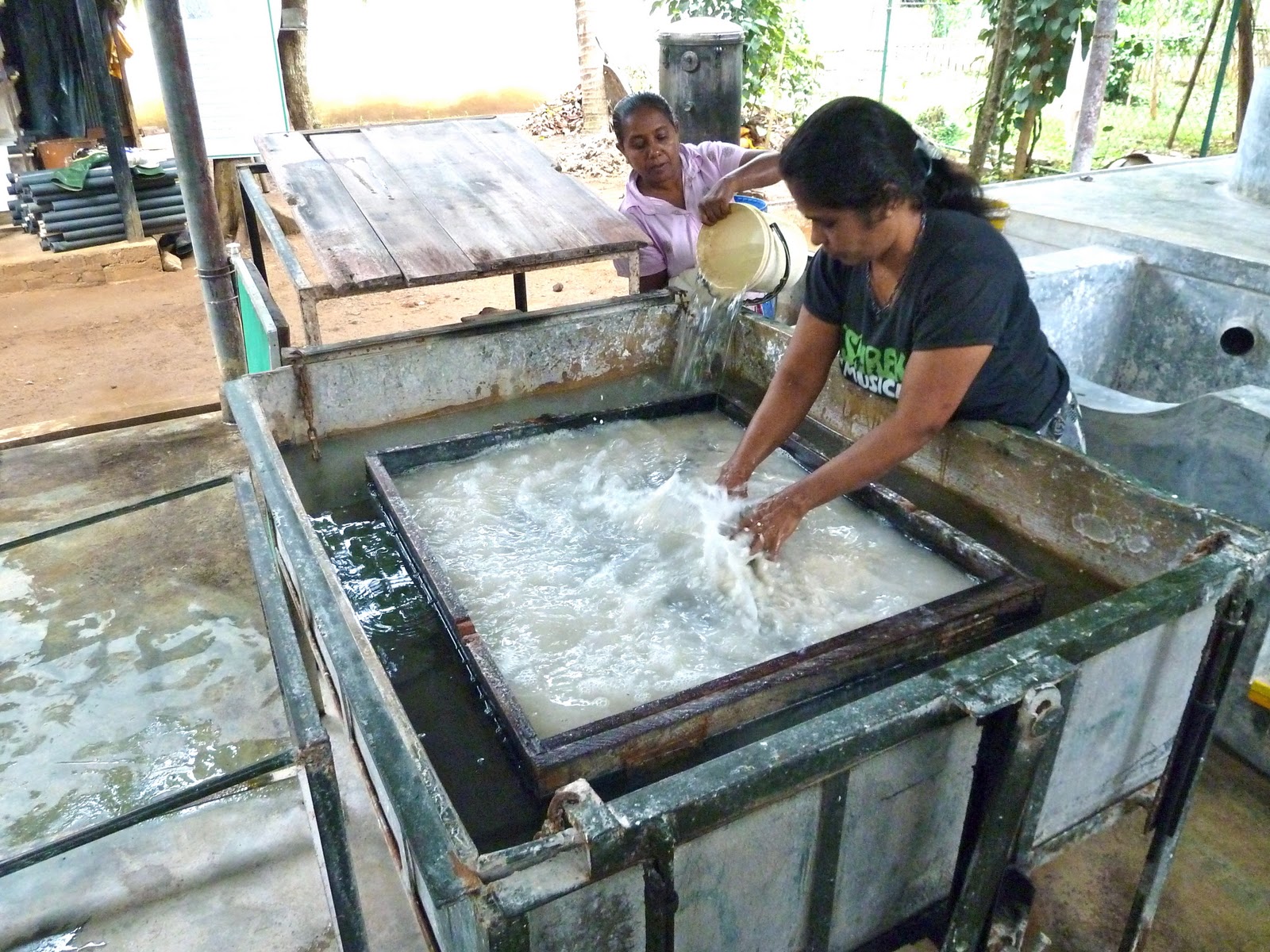
Right: We were given a demo of how the shit is converted into paper. Quite a simple process really. I was then persuaded to by a notebook made from the stuff. Is is possible to write on it with biro. I doubt if it will ever be a best seller in Smythson's of Bond Street.


Left: The jumbos wade in. They seem to enjoy themselves, especially the little ones which cavort about and play with each other, frequently submerging themselves. The mahouts, armed with long poles with spikes and hooks on the top, make sure they don't wander away too far. Actually the elephants seem remarkably biddable and responsive to commands.


Right: This one ( right ) is not dead. It was singled out for a special wash and scrub. The beast seemed to think it was in seventh heaven. It languished like this for over an hour, occasionally raising it's trunk to breathe, only moving at the half way point to turn over onto it's other side.
PS. I never saw any injured elephants.


On the way back to the station in Kandy we passed this tree, amongst others similar, over a river which was crowded with hanging bats. They go eating fruit after dark. We also stopped at a 'Herb Garden' where I was taken on a most interesting tour of a large area of many different exotic herbs and plants and included a back and neck massage with some special gunge or other. Of course it was a clever way of convincing the customer ( me anyway ) of buying some exotic life-enhancing herby liquid at the shop at the end. I was told I would look ten years younger if I drank it, or was I meant to rub it on somewhere, can't remember.
We returned via a visit to the nursery school which Jim's wife ran; it looked a very smart and jolly place with, I was told, 80 children under 5yrs. A quick lunch at The Pub in Kandy and then the train ( the 1st Class job ) back to Colombo. So far so good.
I had booked into the Mount Lavinia Hotel for that night. It is a fairly luxurious place on the beach at Mount Lavinia which is about 15 miles south of Colombo. Because I was already at the station I decided to go by train. In the rush hour. This was cheap ( 15 rupees, 10 pence ) and because I didn't know where to go a local chap kindly went and bought my ticket for me! He didn't even want repayment. Extraordinarily generous, and the train was on time. I had a bag and small backpack with me. I managed to get inside the carriage, as did about 5 thousand others with another few hundred hanging onto the outside. To say it was a crush is something of an understatement. It was suffocating and impossible to move any part of my body. I have never experienced anything like it before. The rush hour tubes in London are positively deserted in comparison. I lost contact with my bag and all feeling in one leg and an arm. It was difficult to breathe. There are 8 stops, I was laughingly told by a bloke with bad breath standing on my foot with his elbow in my ribs, before Mount Lavinia. For the next 4 stations even more people, incredibly, fought their way on board and clung to the windows outside. It was actually quite frightening! I was not sure if I would last the journey and had every confidence that if I did get off alive it would be without most of my possessions.  By stop 6 ( after an interminable 25 painful minutes or so ) people started to thin out a bit. I made it to Mt Lavinia alive if dazed, sweating profusely, numb and desperate. Curiously I found my bag on the floor and as much as I checked I could find nothing missing from my person. I will think more than twice before doing that again.
It was a short walk to the hotel.


Right: The grandiose colonial style Mount Lavinia Hotel. In the foyer/reception area there was, inevitably, a decorated Christmas tree. We were welcomed to the refrain of "Walking in a Winter Wonderland". Winter Wonderland, MY ARSE! People here would be no more familiar with a poxy Winter Wonderland than the Sea of Tranquillity on the moon.


Left: The beach, outside the the fish restaurant, was surprisingly deserted. The hotel had several bars and restaurants, all quite expensive but good quality.  My only complaint about the place was that the distances you had to cover between these facilities and rooms ideally required a taxi ( or three-wheeler ).


Right: View of the beach from one of the bars. Nobody tends to swim in the sea. They use the hotel pool instead, because there are strong currents and under-tows which would tend to make you late for dinner or, indeed, entirely 'late'.


Left: One of the quaintly, and smartly, dressed staff in his colonial outfit. Reminds me a little of the wee chap 'Lofty' in the old TV series ( now too politically incorrect to receive repeats ) 'It Ain't 'Alf Hot Mum', if memory serves me right. It is a good hotel, no question.

I spent a second night at Mt Lavinia in another ( cheaper ) hotel. I won't bore you with more beach hotel photos. It was delightful too.

Back to Colombo central by taxi. I was not risking another 'normal' train for a bit. I had to be there for the next three days to 'organise' my Indian visa.

By another complete quirk of coincidence a friend of mine, Barbara ( she owned that magnificent old pub, The Grapes, in Narrow Street, Limehouse, until last year ), was holidaying in Sri Lanka and was due to spend her last night at the Galle Face Hotel in Colombo on Thursday ( 1st ). I think I showed a few pics of this antiquated establishment ( Colombo's answer to Singapore's Raffles ) previously. We arranged to meet for drinks at the Veranda bar at 6.30pm. Champagne was provided ( Barbara must have sold the pub well ) and then had dinner. A great treat, for me. Incidentally The Grapes is now owned by Ian McKellen ( actor ) who lives nearby and it is an iconic Dickensian London pub and fish restaurant that is utterly unspoilt and traditional and does the most fantastic Sunday Roast Lunch. Can't recommend the place highly enough despite some rather eccentric old fashioned 'locals', and their equally eccentric dogs, who prop up the bar.


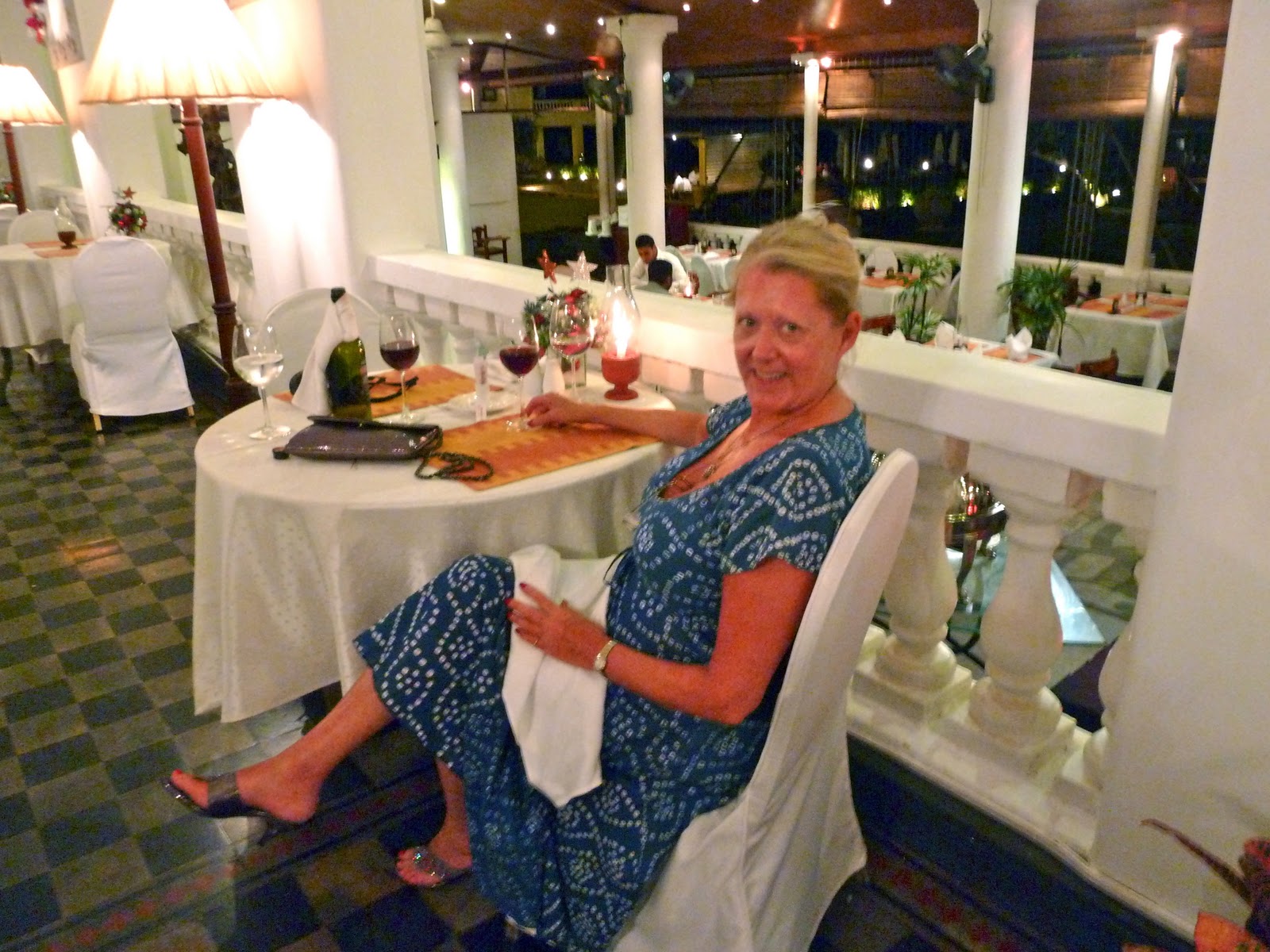
Right: Barbara looking sun-tanned and glamorous, with matching shoes and handbag, after a very good dinner at the Veranda restaurant at the Galle Face Hotel.
I'm sure Barbara won't mind if I tell you that she was a very senior and respected 'Bunnygirl' at the Playboy Club, Mayfair, in it's heyday in the 1960s. They had very high standards in those days, and Barbara has always sought to maintain them. Ex-Bunny Barbara ran her pub with a rod of iron.


Left: This is the board, mentioned previously, which hangs in the reception area of the hotel. It lists all the guests considered to be 'important' to have stayed here ( well, up to whatever date it states on the board ). For some reason it features the Queen of Denmark three times. She was obviously a popular guest. If you 'click on' to enlarge you might be able to make out a few names. You might even feature!
I like the entry of Prince Philip who, apparently, bought his first car in Colombo which is now owned by Cyril Gardiner, the director and chairman, who instigated this  board.


While in Colombo I took the opportunity to visit the International Cricket ground at The Sinhalese Sports Club, District 7, the posh part of town. There was a cricket match ( 50/50 ) in progress between two league sides; MAS Intimates v MAS Active. The captain of the Sri Lanka team, T. Dilshan, was playing for MAS Active. He was out for a duck.
The noise of trumpets and banging drums was continuous, plus thunderous volleys of firecrackers ( forbidden in UK, 'Elf 'n' Safety of course ) which belied a rather small crowd.


This was the final of the Singer Trophy. MAS Active won quite convincingly. Here they are ( left ) celebrating their victory. The presentations went on for ages and featured awards for everything from the Batsman of the Series to the Best Groundsman with about 20 others in between.
The Sri Lankan team are just about to depart for a Test match with South Africa. Locals tell me that it will be considered a 'success' if they manage to hold out for three days. The Sri Lankan team is going through a rough patch with lots of 'politics' and lack of pay at the heart of their problems. Good luck to them. The first Test ( maybe only one ) is on the 15th Dec. Good luck to them.


I adopted the Cricket Club Cafe ( district 3 ) as my watering hole of choice ( right ). It was close to my cheap hotel. This place was of Brit pub appearance and served very good Shepherd's Pie amongst other old fashioned English fare.


The service, as just about everywhere in this country, was superb. Lots of ex-pats were in evidence, not surprisingly perhaps.


Off next to have a look at Galle and it's nearby beach areas. I think I will be trying out the public bus services to get there. I am told there is a certain 'thrill' value to be had experiencing the skill of the bus driver over-taking using three lanes on a crowded two lane road. "Hold very tight please, ting ting".