Wednesday, 27 November 2013

VIDS FROM NORTH KOREA

A Selection of Little Clips


I think have managed to work out how to transfer vid clips from my camera to this blog. Not without a little help, I may add. If I had known it was possible I would have taken more from way back, and they might have proved more amusing than the still photos. You live and learn. So, below, not necessarily in the correct order, will eventually appear some glimpses of the 'action' in various displays ( if taken with a rather shaky hand on occasions ). They feature a Ladies Choir in Pyongyang, several from the highly impressive Arirang Mass Games in the Mayday Stadium in Pyongyang, the children, aged below 6yrs, performing at the Steelworkers' Kindergarten in Chongjin and a few from the 65th Anniversary celebrations ( of the DPRK ) in the town square at Wonsan. I regret not taking a vid of the fantastic and alarming trapeze act at the circus or the amazing 'human cannonballs' at the Mass Games. You should go and see them for yourselves.
Regarding the Arirang Mass Games; look at the backdrop behind the performers. As previously mentioned this is not a computer generated mass of pixels, it is 20,000 students switching coloured boards in perfect unison, and the performance goes on for nearly two hours. It is almost beyond belief in complexity and impeccable timing, and stamina. I will include the 'test card' display when the students were all mucking about before they got 'serious'.

Due to the slow download speed of my machine at 'base location' each clip seems to take ages to produce, so I will be adding to this over the period of a few days. Stand-by...............


Several more to come!!!!


Aren't they good?


The next is the last one. Unfortunately it is on it's side. Can't get it upright. Just to give you a glimpse of the rather OTT performance by the orator.


That's all folks. Off on another trip soon.

Friday, 22 November 2013

IMPRESSIONS OF NORTH KOREA

My Amateur Impressions.

It is often the case that people, especially journalists and others in the media, visit North Korea with an 'agenda'. They go determined to get dramatic photos and publish reports which back up preconceptions that North Korea is run by bellicose madmen and the population is miserable, oppressed and starving. The same might be said of some North Korean 'escapees' living in Seoul who are only too happy to collude with journalists and provide dramatic 'copy' for TV, books and newspapers. After all, the more dramatic and horrific the reports the better they sell, and 'reconstructed/staged' photos and film clips are not unknown. Some, if not all, of what we see and read in the West may have some truth in it, but, and it is a big but, I have yet to see any reportage which has been gained by independent travellers, or reporters, with unfettered access to the country and the ability to speak feely to the locals, because it's just not possible. I mean I too could, if my intentions so demanded, go to any country and city in the world and come back with photos and reports of squalor, crime, police brutality, oppression, poverty, death, destruction and general foulness. Even ( especially ) in parts of London, let alone the favelas in Rio, the shanty towns surrounding Mexico City or the vast slums of Bombay to name but a few. Or the opposite. However anyone, if they so desire and are feeling particularly brave, is free to visit these places. Not so in North Korea.

The lack of freedom of access is the overriding problem in North Korea. It certainly does not endear them to the outside world and fuels suspicion, something that they seem oblivious to. They maintain rigid control of where visitors can go and to whom they can speak ( if indeed any of them could speak sufficient Korean ). One's impression of North Korea is gained not just by what you see, it's by what you don't see. That and the fact that it is difficult to take at face value anything that you are told; in other words you are often spun a blatant load of bullshit.
So, it was with that in mind, that I joined the tourist group on a fairly comprehensive journey around the country to see what I could. I had a totally open mind and the sole reason for this trip was, for me, sheer curiosity. I did not have an agenda.

It was made clear to us before we arrived that we had to obey gracefully the restrictions placed on us by our guides who, incidentally, were charming and highly efficient. This was not to protect us from any repercussions, it was to protect them. If a tourist strays 'off-piste' or takes photos of prohibited sites ( normally involving the military ) they, the tourists, would not get into trouble, but the guides would. Also, we were aware that our guides had to tow the Party line. It was fine to discuss and question but would have been counter-productive to argue. Our guides had much knowledge of the West ( they get to read a lot of western newspapers and magazines shown to them by the likes of us ) and it's ways; they were intelligent and had much experience of dealing with Western tourists. In practice our guides were remarkably flexible about what we could do, so long as we asked permission. Apart from anything else North Korea is keen to attract tourists and is gradually opening up more sites. To get on the wrong side of them would simply mean that places would again be put out of bounds and the relevant tour company would lose carefully acquired access.

As shown and described in my previous ramblings, North Korea has it's own 'take' on the world and is beholden to the philosophies of 'Juche' ( literally 'Master of Oneself' i.e. control of the country, self reliance and two fingers to the rest ) and 'Songun' ( 'army first'; i.e. the protection of the country is paramount ). They are also patently brainwashed from cradle to grave into not just admiring but worshipping Kim Il Sung, the Great Leader, and the rest of the Kims as a consequence. Their history is somewhat 'adapted' to suit this purpose. This is reflected in their (mis)understanding of the 'liberation' of the country from the cruel Japanese colonialists in 1945 and the war-like Imperialist US aggressors in the 1950 Korean war. Incidently, when asked why they spend so much money and effort trying to produce nuclear weapons when other tasks seem more pressing, the answer is simple and commonly accepted; "if the US aggressors have them pointed at us then we must have a viable means of retaliation" ( Songun again ). Its their idea of Mutually Assured Destruction ( MAD ) I suppose; the dogma of the old Cold War. In effect I seriously doubt if they will ever launch an attack on another nation. They would risk having all their prestigious 'show-off' architecture bombed flat and lose much credibility in the likely lack of effective support from outside. Their army might be massive and robotically impressive on display, but I suspect it's technical capability is somewhat lacking due, in large part, to the fact that they ain't got much fuel and industry to replenish military hardware. In other words there will always be much 'sabre-rattling' to appease and impress the local population and project war-like capability to the South, but I believe it's 'all mouth and no trousers'. After all, unlike some nations, they haven't actually invaded anywhere in the last 60 years and they don't harbour any lunatic terrorists ( woe betide any Al-Qaeda operative who tries it on in DPRK! ) . OK, I'm no military expert, but that is my view.

There can be no doubt that the system of government in the country is dictatorial and the powers that be are obsessive control freaks. The fact that the hierarchy of the Korean Workers Party and the Armed Forces, fronted by whichever Kim happens to be around, maintains an iron grip on society and viciously suppresses any form of dissent, is pretty apparent. It is also apparent that this hierarchy lives in a luxurious style, hidden from the masses, and enjoys much privilege ( unlike our politicians and civil servants? ), unless they screw up when the consequences to their standing and welfare are profound ( unlike our politicians and civil servants ). They are, nevertheless, feared and respected. Having said that, they are improving the way of life, bit by bit, for the population. If Joe Soap thinks that things are getting better, however slowly, he will be relatively content. The experienced French 'professor' in our group has seen big improvements in the agricultural system and infrastructure over the past 10 years. The impression given by outside commentators is that the North Korean rulers  are 'mad'. They are patently not. For good or evil they have held this country together and resisted all kinds of opposition, sanctions and survived several natural disasters during the past 65 years. It may all collapse but I wouldn't bank on it happening any time soon, and I don't believe South Korea would be too happy to sort out the wreckage.

So, this is a relatively small nation ( pop. 22 million ), dividing a peninsular, which is paranoid, full of jingoistic national pride and maintains an insane worship of Kim Il Sung. Propaganda and 'selective history education' is rife, but one cannot help be impressed by their sheer bloody mindedness in pursuing their own programme, lifestyle and, despite intense international criticism, US sanctions and other embargoes,  giving two fingers to the rest of the world.

My observations, in no particular order:

The country is so clean. This is mainly due to the fact that they haven't got much to make it dirty with. City streets, and main roads, are constantly swept, by hand. Not much fuel so little industrial pollution ( apart from the alarming wood-burning fuelled lorries ) and there is a lack of consumer goods. Eco-warriors, Green-activists and Climate Change zealots should hold the place up as a shining example to us all.

It is the ultimate Socialist state. Everything is Government controlled with few markets or shops and little free-enterprise, but I suspect there is a flourishing black market somewhere. No neon signs, adverts or noticeable shop fronts. The benevolent Government supplies your every need ( vouchers for necessities obtained from Government outlets ). All live in the same state of impoverishment apart from the select cadre of 'apparachiks',  of course, who are afforded the finest of luxuries in true communist tradition.

Despite rumours and western propaganda, and the fact that we were escorted, I believe that the population is now relatively well fed and self-sufficient as far as agricultural produce is concerned. I did not see any hungry looking people or signs of severe deprivation. I can't believe there is anywhere on the same scale of crowded squalor that exists in parts of the sub-continent, South America or Walthamstow. The people we saw all looked perfectly healthy, fit and smiley. Village housing may have been basic, but relatively clean, neat and tidy.

Traffic congestion is definitely not a problem, bicycles are the main form of personal conveyance and the wide city streets are remarkably free of bustling crowds. I remember inventing a 'bustle rating' for cities in India from 1 to 10, where most registered 8 to 10 ( packed to nightmare chaos ). North Korean ratings would be 0 to -1.

The monopoly of the makers of statues and monuments to Kim Il Sung and Kim Jong Il. I saw no statues of anyone else. Heaven forbid. I believe that the makers of these shiny bronze statues are employed internationally by the sort of countries that want grandiose monuments to their dictators. It is one of the main North Korean exports.

Many industrial sites with nothing being produced. Lots of talk of things being produced.

Hardly any wildlife observed other than magpies, two pigeons in Wonsan and many egrets near Nampo. No horses anywhere. I suspect it will be some time before they have a runner in the Derby.

The only country in the world where they don't have a following of the Royal Family, Premier League Football or Mr Bean ( or Tom and Jerry for that matter ).

They don't celebrate Christmas. A very sound reason to go there over the Yuletide period.

Their ability to stage mass displays must be the best in the world. Even little displays ( as in the kindergartens, schools and circuses ) are impressive. Probably achieved by rather Pavlovian techniques, but impressive nevertheless.

I believed it when I was told that their hospitals and health services are both free and good ( in the major cities ). Song Sim waxed lyrical about this, and she had experience of the system. OK, if you get seriously ill out in the bundu you will probably just die. I don't expect they whinge about it quite so much as we do.

No terrorist problem or racial conflict or illegal immigrants or welfare scroungers or football hooligans or race riots or any riots for that matter. No chewing-gum on the streets and no drunken night club revellers, or any night clubs, or revellers. We were told that the country is relatively ( serious ) crime-free. I can sort of believe that.

Lack of electricity and hot water, but they did their best to switch it on and stoke it up for us tourists.  By the colour of the water that came out of many hot/tepid water taps it was apparent that they hadn't been used much. It was rapidly switched off when we left most establishments. Lifts in hotels outside Pyongyang only worked on arrival and departure.

The only 'locals' we had any contact with were hotel and restaurant staff who were, on the whole, charming and pulled out all the stops to make us feel welcome ( except for that flash hotel at Mt. Kumgang ). I believe they were genuinely pleased to see us, probably because of the 'hard' currency we provided.  Maybe they were being 'monitored'. Maybe they should monitor some of our surly staff in UK.

So many impressive and vast buildings in Pyongyang, mostly of the monumental Stalinist architectural style. It was apparent that many were ongoing building sites and many others might just have been facades ( nobody ever seemed to go in and out of them ). Reminded me a bit of a Hollywood film set in places. We never set foot inside any of the grand theatres and museums, other than the new and indeed impressive Victorious Fatherland Liberation War Museum ( featured earlier ). I think several of the few shops displaying 'fancy' goods were doing just that; displaying but not selling. Much 'image' without substance.

The deification and worship of Kim Il Sung. It serves a vital political need. How genuine? Your guess is as good as mine.

That will do for now and I hope this blurb comes across as I intend, however inexpert, as 'unelaborated and unbiased' and not too boring. I may think of a few more things to add. I hope to find a way of showing some of the video clips I took, but this might prove beyond my computer expertise.

In the meanwhile "Anyung-Ee" ( goodbye ).


Friday, 15 November 2013

THE FINALE

14th-17th Sept 2013

Overlooking the Forbidden City from Jingshan Park
So back to the charming YoYo hotel in 'trendy' Sanlitun district to recover. Still sore and lame I took a taxi from the station. The 'official' Beijing taxis, the two tone coloured jobs, are the only taxis that I have ever used which are good value. The 35 min ride cost 50 Yuan (about £5). The drivers, who nowadays often speak a little English, even give you a printed receipt. There are cowboy taxis at the stations and persistent hustlers who try to persuade you to use them. Some good advice, Don't! (unless you are feeling very generous).

A lazy day spent hobbling around and a welcome visit to Paddy's Bar for sausage and mash. Spent some time sitting around in what is an excellent 'travellers' bookshop cum pub/restaurant/library; The Bookworm in Sanlitun (look it up....@bookwormbeijing). 

Next day I met up with a friend who works in Beijing and was taken for lunch at the prestigious Quanjude restaurant north of the Forbidden City. This place specialises in Peking Duck and there is a serious ritual when serving it (right). The place is always full, bookings essential, and has many photos of international dignitaries on the walls, including a few Presidents and Prime Ministers, who have been entertained there. Not a good place if you are on a diet. We went on a walk to Jingshan Park afterwards to do some token 'calorie reducing' exercise.

The following day, Sunday, I was invited to watch a cricket match. Aforementioned friend, Richard (who's father kept wicket for Northumberland), was playing for the Peking Ducks X1, a team of ex-pat Brits. They were up against a team of Aussies predominantly from the Australian Trade Mission.

The pitch is in the grounds of the Beijing Dulwich College out towards the airport and what a pleasant venue it is. There were several bars and a large barbecue tent set up on the boundary. Quite a few spectators too, enjoying picnics in the sun.

It was a Twenty20 match and batsmen had to retire on scoring 30 runs. The Peking Ducks were first to bat. Richard (photo left), who plays a lot of cricket in England, scored his 30 in rapid order. After that there was a bit of a collapse and they were all out for about 90 runs.

Come 'half-time' and lunchtime refreshments I was informed that the Ducks only had 10 players and 11 is definitely an advantage when fielding. Would I like to play? Well, being utterly incompetent and still somewhat unsound but nevertheless enthusiastic, I duly volunteered. It's not every day that one gets to play cricket in China.
Donning a Ducks' shirt and my cloth cap I took to the field, but insisted on being given a 'cowards' fielding position, somewhere I could do least damage. I was duly stationed at fine-leg on the boundary. I can't say that I contributed much and fortunately the Ducks had an excellent wicket keeper. 


After a slow and measured start and against some fiery bowling (Richard being rather adept at flinging the pill down with considerable velocity) the Aussies got into their stride and won with a few overs and wickets in hand. I think I touched the ball twice but, fortunately, don't think that I greatly contributed to our defeat.


Left. The prize giving. I suppose this gave the Aussies a degree of satisfaction following their rout in the Ashes series.

Next day it was back to the airport, and I  remain seriously impressed by all the new, shiny, and cheap, transport systems which take you there.  I believe Boris Johnson, our flamboyant attention seeking London mayor, during a recent visit to China, made much mention of technical innovation in this country, especially in regard to railways (the high speed bullet trains in particular) which put our antiquated British systems to shame. He is correct and we in the UK are beginning to lag far behind. OK, the Chinese have more space and distance to cover and don't worry too much about such niceties as 'consultation', so if Mr Mee Noh Go objects to his house being frattened, their response is simply "Yu go. Yu lucky. Here 50 quid. Bulldozer come tomollow".   The airport itself is excellent (as far as airports go) with very clear signage and decent restaurants. The only hiccup I faced was when I went to buy some duty free drink. The prices were very reasonable (£14 for a litre of Grouse whisky), however I was advised that as I was going to transit through Helsinki the Finnish (or maybe EU) regulations forbade the import of duty free alcohol and would most likely confiscate it! (possibly using the old max 100ml liquid restriction scam). The same stuff costs, 'duty free' in Helsinki airport, £35. What a rip-off.

So, back to Blighty after what was a most entertaining and educational journey. For what it is worth I will post my entirely idiosyncratic impressions of North Korea at some point. 


Wednesday, 13 November 2013

TRAIN TO BEIJING

12th-13th Sept 2013

Our team in Pyongyang


Lots of farewells to fellow tourists in the hotel foyer and six of us went off on our final short bus trip to Pyongyang central station ( left ) for the 24 hour rail journey to Beijing. Slight hiccup here as the 'through' train was fully booked and we were to take the later 10.30am departure to Dandong on the river Yalu, the north-west border with China. We would then transfer to the sleeper onwards to Beijing.

Imperialist US Aggressors are forbidden to use the train; they obviously can't be trusted and have to go by air. Freight probably.


Song Sim and Mr Lee ( right ) stayed with us until the train moved off. We all waved at each other furiously. They were incredibly attentive, and I don't suppose it was just that they feared someone might jump ship at the last moment.
They had indeed looked after us remarkably well and it had involved, for them, a lot of conscientious hard work and long hours. However we might have railed at being too closely shepherded from place to place, this very packed tour had run like clockwork. If anything had gone wrong, or somebody inadvertently ( or deliberately ) strayed into the wrong place I have no doubt that they, not us, would have got into trouble. Maybe they did a lot of paddling under the water, but we had to respect our guides' polite and efficient efforts. They don't get much time off either. Song Sim, who has a 2 year old daughter, has one day off after we have gone and then starts another tour. She hardly manages to get home and relies on her extended family to cope.


Six of us were in one compartment for the initial stage to Dandong ( China ). A comfortable and smooth four hour ride through pleasant looking farmland to the north-west border town of Sinuiju.

We had been warned that the customs formalities at the border on the way out would be stringent, and the procedure on the Korean side could take over four hours to complete. It has been known for the officials to search through all bags and even check through photos on cameras and delete those they, for whatever reason, took a dislike to. As a result, most of us had removed and hidden camera memory cards and taken lots of boring photos of the fields on the way to the border on spares. As it turned out, with much smiling and grovelling on our behalf, they were remarkably laid-back and polite. They only opened a couple of small bags and had a cursory look. The only thing they asked was did we have any mobile phones. Everyone emphatically shook their heads, and that was fine. We must have looked very innocent.

Across the Yalu river ( right ) and into Dandong, China. Perhaps as a deliberate attempt to show off, the entrance to the city was high rise and garishly neon lit. I don't remember seeing any neon lights in N.Korean cities and certainly no adverts that were so much in abundance here. It was quite a striking contrast. Our passports were again taken away and we got off the train to await the connection. It is ( for me ) always a worry that the passport might never return and we end up on a train to Yingtong Tiddleyepo, or some such backwater, passportless.


No such misfortune and we boarded the sleeper to Beijing. Because of the change of train we had been downgraded into six berth cabins ( rather 3rd Class ) but there were many empty cabins in our carriage so we thought we would be able to spread out a bit and have plenty of space. I was not the only one who confessed to ( allegedly ) snoring like a frenzied pig at feeding time. We opened some wine and all was hunky-dory... until the next stop. Crowds of Chinese came on board with large bags, boxes, prams and much else, probably including many kitchen sinks. Our tickets indicated that we were in several different compartments and no chance of staying together. It was mayhem. I found my bunk on the top level ( 3 up ) in a packed compartment with a family ( I think ) of parents, daughter and grandparents and enough luggage to suggest they were moving house. Our 'gang' decided to gather together and take refuge in the restaurant car, but that was fully occupied by the 'superior' class passengers. We did eventually get a table and had a remarkably decent meal, of fish and other unidentifiable fare plus the rest of the wine that we had brought and plenty of beer purchased at the bar. We met up with another group of tourists ( 1st Class ) and then perhaps overdid the tasting of that revolting chemical effluent that the Chinese optimistically describe as 'gin'. Anything, in fact, to delay going back to the sleeper compartments. In retrospect this might have been a bit of a mistake.

After being kicked out of the restaurant car when it closed it was a long weave and stumble back to our bunks. As said, mine was three up. The compartment, filled with gentle snoring, was in darkness and the climb up was not easy. The Chinese family were soundly asleep and blissfully unaware of the storm about to hit them. Suffice to say that due to a surprising lack of coordination and poor visibility I caused considerable turmoil; a veritable bull in a China shop. I think at one point I fell into the bunk occupied by granny and stepped onto the faces of most of the others. After much thrashing about and several failed attempts to reach the summit amid cries of surprise and pain and no doubt Mandarin curses from below I reached my perch with only minor injury ( to myself anyway; can't speak for the others ). Peace was eventually restored until, a couple of hours later, I had to go for a pee. The descent was no less hazardous and dramatic. I think granny got another surprise visit and I seriously misjudged the final step to the floor. I fell about three feet onto some sharp edged case and painfully jarred my shins, not without yells of agony and a few good old British oaths. On return to the compartment I noticed that the light was on. They were waiting for me. I expected to be lynched or at least made to suffer some Chinese torture. Instead of which grandpa and son who, to avoid further carnage, had got out of bed and quite gently pushed and lifted me up, only gently cracking my head on the ceiling in the process, to my roost with nothing but smiles. 
Come morning and reveille, even though conditions were more favourable, I was dreading the climb down and the reception I might meet. I suspect that my snoring alone would have been grounds for a Chinese kangaroo court. I had no need for concern. All of them made sure I reached ground level safely and even granny gave me a smile and a wink.

With a sore head, pain in my ribs and limping badly I managed to locate most of our team again and we headed for the restaurant car to revive on gallons of coffee. Washing could wait. The others seemed to have had a comparatively peaceful night. The train, although not incredibly fast, gave a very smooth ride, probably because their railway tracks go in straight lines and despite the unexpected crowd in the sleeping compartment was generally much roomier and more comfortable than most of the UK cattle tucks. Even the loos and washrooms were clean and tidy. There were seats along the passageway next to the windows where I sat amongst my new-found Chinese best friends who were incredibly hospitable despite no common language and remarkably sanguine following the pandemonium in the night. They even offered to share some noodles which despite my distinct lack of appetite I felt obliged to accept.

We pulled into Beijing Main Station at about 10.00am, shook hands and went our separate ways.


Wednesday, 6 November 2013

NAMPO AND BACK TO PYONGYANG

11th Sept 2013


Chollima Steelworks
Up in time for a hot bath in a 'spa jacuzzi' in my bathroom which was, by some miracle, working. The egrets had all disappeared back to where egrets go in the daytime and the route back to the main hotel building was accomplished without the navigational difficulties of last night. This was to be our last full day in DPRK.


First port of call today was the West Sea Barrage ( left ). This consists of a remarkable 8km dam/causeway across the bay to the west of Nampo leading to a series of locks and a large control tower. The purpose of this is to regulate the fresh water river flow ( from Pyongyang, into the West ( Yellow ) Sea, and vice versa. It prevents flooding or low water levels upstream and allows shipping in and out through the locks.
This was constructed, largely by hand, by a workforce of 30,000 soldiers between 1981-86, and not without a few casualties. There are some alarming stories of divers getting into trouble when examining the construction.

The journey there was enlivened by a race with the bus full of Belgians ( the loud ones with their Fuhrer from last night ) who were determined to get there first to attend the 'presentation' on arrival.  They had set off in front, but somehow we won. I think our splendid driver managed to jump them at a road junction. 
The talk we were given explained how the system operated but was cut short due to the video machine being inop. The diagram ( right ) shows the causeway from the left to Pea Island and the locks. Nampo, being a main seaport, supposedly receives a lot of cargo ships and they queue up to go through the locks. There wasn't much of a queue while we were there. I suspect trade has been somewhat curtailed in recent days due to various trade embargoes.

On through Nampo city where the docks housed a few ships but there didn't appear to be the slightest sign of activity. All the cranes were standing idle and noone appeared to be working on the wharves. Maybe it was NAAFI break. Song Sim told us an amusing story concerning a visit by a US President ( Reagan or Bush Snr? ) who was accompanied by Kim Il Sung on a boat ride from here up to Pyongyang. I have forgotten the story and denouement to this tale; suffice to say it made Reagan, or whichever Prez, look rather stupid.

Next visit, the Chollima Steelworks to the west of Nampo, named after the fabled horse ( statue in Pyongyang ). A vast complex, but obviously very eco-friendly and 'green' because there was hardly any smoke emanating from it. We were kitted out with safety helmets and then led, inevitably, into the steelworks museum. Much memorabilia which featured, as we had come to expect, photos and items concerned with visits by Kim Il Sung (47 visits), his wife (14 visits), and Kim Jong Il (22 visits). Outside was this ( left ) treasured rock on which Kim Il Sung sat while addressing and inspiring the workers on one of these visits. He had shunned the use of a chair because all the workers were sitting on the ground.


We were then escorted to one of the sheds housing several smelting crucibles. One was in operation. I am not familiar with the technicalities of steel production, but from what I saw it involved tipping some scrap metal into this 'crucible', chucking in some lime and firing it up. Lots of orange smoke and sparks was the result.

We were told that this steelworks produces 510,000 tonnes of steel per annum, or up to 500 tonnes per day. It employs 17,000 workers. I think I counted 6 in this particular shed. Indeed there were more people cutting the grass outside. I really don't know what to make of it. We asked where was the steel which is produced and were told that they wouldn't be producing steel until later in the day. As with the potato processing plant where we didn't see any potatoes and the fertiliser factory where we didn't see any fertiliser, we never actually saw any steel.


On back to Pyongyang and the Yanggakdo Hotel ( I gather rather rudely nicknamed 'The Alcatraz of Fun' because of it's location on the island in the river ) for lunch. After a previous failed attempt this was to be in the revolving restaurant on the 47th floor. Another delightful meal and a good rotating view over the city, or at least it would have been if it hadn't been foggy and you can't blame the Imperialist US Aggressors for that. Yes, the restaurant actually revolved, although it stopped pronto as soon as we left the table.


Next on the agenda was the new 'Folk Museum Theme Park'. This is a large recently constructed site featuring a scaled down mini-Pyongyang, some ancient replica weapons, a reconstruction of a famous imperial warship which had beaten the Japs in a sea battle in the 15th century ( powered by ranks of oarsmen ) a model traditional village and a large reconstructed pagoda ( right ). It has been designed to provide a 'history' of the country, with a decidedly DPRK flourish.


Left: Inside the warship. The original, according to our guide, is in Paris. Our French professor had no inkling of this.


Right: A bird's eye view, from the top of the pagoda, of the 'mini-Pyongyang'. All the famous buildings feature in small scale. Kim Il Sung Square, with a model parade going through, is the size of a couple of tennis courts and a 30ft high Juche Tower.


Left: A mini-Ryugyong Hotel ( the unfinished 105 storey pyramid ) and the May Day Stadium to the right.


Right: A replica typical Korean village.

After this a visit to the Paradise Store to stock up on victuals for the forthcoming train journey tomorrow. This is indeed quite a large well stocked three floor supermarket which I am sure is off-limits to the 'normal' people. It must be, because all the prices were in dollars or euros. Not many customers as expected, but quite a choice of drink, foodstuffs, clothes and general goods. I managed to stock up on various snacks, and a couple of bottles of wine.

This evening was our Farewell Dinner for Song Sim, Mr Lee and our gallant bus driver at the Paradise Restaurant downtown. They deserved a good send off and a couple of amusing little speeches were made to thank them. Another fine nosh and plenty of that rice liquor which, I have learnt, is called Soju ( maybe ). Not sure if it is on sale at Waitrose yet.

Back to the Yanggakdo for a late night playing pool, ten pin bowling and making sure we kept the bar open for as long as possible. Some of us depart by train tomorrow morning for the 24 hour journey back to Beijing. 
At this point it might be useful to show you a map indicating where we went in North Korea. Not great clarity, but if you 'click on' it might enlarge and be legible. The yellow circles indicate the major visit points.

I will continue this travelogue with an account of  the journey to Beijing and finally bore my small readership with a summary of my experiences in, and opinions of, the  DPRK.

Chap sidaa cheem-deh balli balli!


Thursday, 31 October 2013

BACK TO PYONGYANG AND ON TO NAMPO

10th Sept 2013


The lake at Sinphyong

Early start and 'everybody back on the bus' for a four hour journey west, initially to Pyongyang. Our bus driver was back outside even earlier washing down his vehicle. The man is clearly a devoted and indefatigable worker who likes a shiny bus. 
The initial part of the route took us through mountainous country and involved passing through many long dimly lit tunnels. As always, we had the road, a good one, almost entirely to ourselves. Even so, at various junctions, there were the smartly dressed traffic police standing on duty. I expect they had to be there in case a high-ranking official passed by and required a salute.
About 30 miles west, towards Yangdok, we were told we were about to pass the new 'top world class' ski resort which had been instigated on the instructions of the Dear Leader. This is a project which had been estimated to take several years to complete but now, due to the diligence and enthusiasm of the People's Working Parties and despite a Swiss company refusing to provide ski lifts, is due to be completed this year, well under time and budget. We all looked out and saw......not very much. Of course at this time of year there is no snow, but it crossed our minds that perhaps this ski resort might not be on quite the same social and sporting level as the likes of St Moritz, Gstaad, Val d'Isére or even Cairngorm. I suspect that they will have not really grasped the concept of 'aprés ski', and the thought of skiing down a mountainside accompanied by two Korean 'guides' in case a tourist might venture 'off piste' does not bear thinking about. I expect some intrepid tourists will go, if only out of curiosity. Book now to avoid disappointment.

Left: We stopped for a coffee en-route at the Sinphyong Tea House situated on a pretty lake with impressive views and some boats.

Further along the road, and for miles, we saw hundreds of workers painstakingly cutting the grass verges by hand using small sickles and clippers. I suppose it keeps the people busy and the place clean and tidy.


Today in Pyongyang was another public holiday to allow the populace to relax after the excitement of the festivities and parades yesterday. We were taken for lunch at the only Pizza Restaurant in the country. This was set up to demonstrate that Pyongyang is indeed a modern and swinging place. The chefs had all been trained in the traditional pizza making art and ingredients were specially imported from Italy. 
It was a large establishment and despite the holiday, we were the only customers. There was a vast, empty, main restaurant but we were given our own private room tastefully decorated with green plastic padding on the walls ( right ). The menu was enormous but several of the items were unfortunately 'off'. The 'salami' pizza was 'on', but without salami. There was a piano ( and TV ) at the back of the room and we were entertained to a recital by a lady on the joanna while we waited to be served. Just as well because the service took rather a long time. Perhaps they had to fly ingredients in from Rome. Some of us took the opportunity to have a snooze. OK, the pizzas eventually arrived and they were very 'thick crust' but perfectly edible nevertheless. It was the only meal we had where kimchi was lacking. We all signed the visitors book after the meal adding such pithy comments as 'best pizza I've ever had in DPRK'

Right: The bus on the main road outside the pizza restaurant. I expect the holidaying citizens were all busy tucking in at other establishments.


Next on to the Metro. Left: the entrance at 'Revival'. There are two Metro lines under the city. The stations are all named with nationalistic slogans which might sound impressive but it doesn't give you much of a clue as to where you are. Not sure how much a ticket costs; we got in free.


Right: The escalators descend 300ft ( 100m ) below ground. The stations make good air-raid shelters.


The platforms below, or at least the ones we saw, are cavernous and beautifully decorated in a classical style. Left: This is the one at Revival.


There are elaborate mosaic murals depicting various rural, urban and military scenes and, of course, the Great Leader. They are lit by extravagant chandeliers.


Left: Another typical mural.


We weren't travelling at rush hour and the carriages were not exactly packed. Having started at 'Revival' we stopped and got off at 'Glory' before re-boarding and passed through 'Reunification', 'Victory' and 'Torch' before emerging at 'Triumphant Return' which happens to be at the Arch of Triumph monument in the city centre ( which featured earlier ).
At least, unlike the London Underground, there are no constant pestilential 'announcements' to tell us to 'make sure we take enough water to drink' and to 'use all available doors' ( never have understood that one; I normally find it necessary to use only one ).
Left: The platform at 'Glory'........


....which features a gleaming staue of the Great Leader.


Onwards to the Fun Fair and Amusement Park ( left ) to the east of the city. 5 Euros to get in and extra for the rides.


Lots of rather tame 'rides' and roundabouts featured. The only ride of note being quite a decent roller-coaster which some of us tried. We were kindly allowed ( to our embarrassment ) to jump the long queue to get on.


Left: Looking back at the top of the climb. 

We also ventured into the large hall which housed lots of screen games and computerised car/motor-bike driving simulators. It was a most popular venue. It was apparent that as we entered the light levels went up and the air-conditioning magically started. I began to suspect we were being specially treated!


The park is spread over a large area involving much walking and, frankly, most of the 'entertainments' were not exactly a threat to Alton Towers. Ice cream was on sale. We rather vainly tried to explain to Song Sim and Mr Lee the concept of toffee apples, candy floss and hamburgers, which most certainly didn't feature. Possibly because of their provenance in the Imperialist US. Having said that, the children are undoubtedly healthier without.


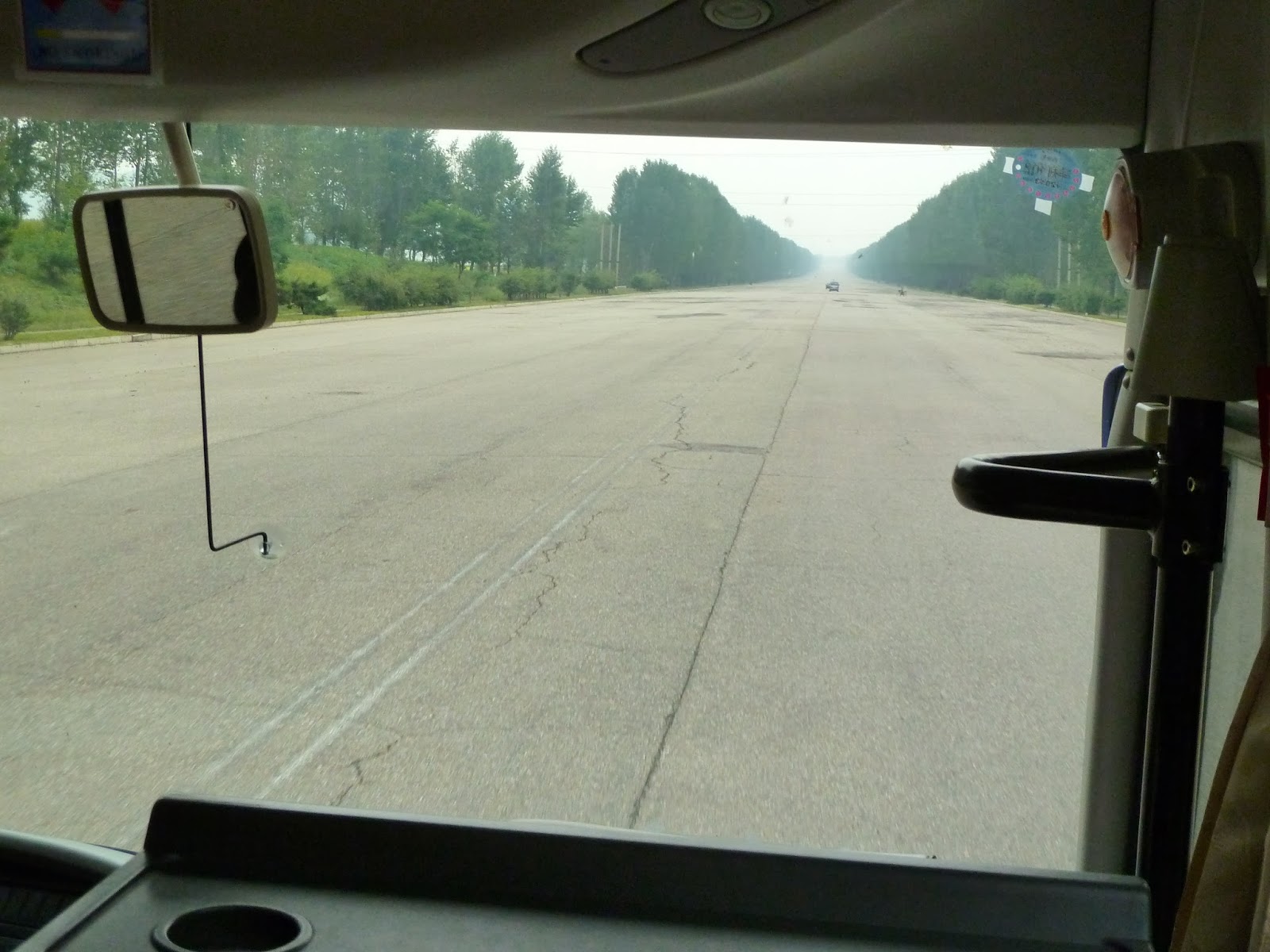
'Everybody back on the bus' and off towards a hotel near Nampo, a port city on the south west coast of the West Sea ( or to non-N.Koreans, the Yellow Sea ). It was an hour and a half's drive through a mainly agricultural area. Leaving the outskirts of Pyongyang there is a vast runway of a 6 lane motorway, the biggest I've seen yet. This ( the Freedom Highway or some such ) was constructed on the orders of the People's Workers' Party in the 1990s. As with most of these big projects the army and civil pioneers built it mostly by hand. These are constructions of pure vanity as, in this case, the road is still only half completed in places and it peters out before Nampo. Nobody seems to use it anyway. Maybe the intention was to connect it to the Nampo seaport. We then branched off onto some B roads which took us through what seemed very drab and poor countryside and many derelict looking buildings and dilapidated housing. Quite a lot of workers were bicycling or walking from work in the fields. My overriding impression is that these people must live remarkably repetitive and dull lives. No pubs.

We arrived at the Ryonngan Spa Hotel, seemingly in the middle of nowhere, a venue frequented by visiting VIPs ( we were told ). This features quite a smart central reception and dining building surrounded by outlying chalets in the woods which are, in some cases, a bit of a walk along a maze of roads. The chalets all look the same and are indistinctly marked. There was no hot water but, we were promised, the hot spa water jacuzzis in each room would 'activate' between set hours. Seems strange that hot spa water should only be hot, or operate, at certain times. Another peculiar feature here is that the trees surrounding the place are roosting sites for thousands of egrets. They came swarming in at dusk ( together with lots of magpies which kept me saluting madly ). The trees were totally blossomed-out in white by all the egrets, and they made quite a noise. This was by far the biggest ( indeed the only ) collection of birds that I had seen so far. At least I think they were egrets; white heron-like things with long bendy necks. I rather conform to the 'Geordie' Ornithological School which only recognises three types of birds; Spuggies ( small birds ), Craas ( crows ) and Shitehawks, or sometimes Fookin' Shitehawks, ( anything else ). 

After another good supper, and other tourists were here including a particularly raucous group of what turned out to be Belgians led by a loud and aggressive man who looked and sounded like Mr Hitler, we retired to the billiards room for a few games of pool. This proved amusing and involved drinking a fair amount of beer and the remnants of a rather disgusting bottle of ginseng spirit which one of our party had been trying to get rid of for some time. Then back to the chalets in the woods; we were in several different ones. That's when the problem started. It was of course pitch dark by now. There were lamp-posts on the surrounding maze of roads which we had spotted during daylight and assumed they would gaily illuminate our way home but, of course, no lights worked. Noone had thought to bring a torch. We split up and staggered off, slightly the worse for wear, in varying directions. I seem to remember passing several of our group, on many occasions, all in the same predicament; totally disorientated and lost, and some perhaps a touch the worse for wine. There was the occasional shout of glee from a distant part of the forest as someone actually found their chalet. It was a question of slowly 'quartering' the area and putting your key hopefully into the door of any unmarked chalet you stumbled across. I had visions of spending the night with the egrets as, by now, the main building was also dark and closed. I can't remember how long I, and others, spent blundering around before eventually, and by shear luck, finding refuge. Perhaps some never did. We hadn't been taught the Korean for 'HELP'!

Another day of cultural and industrial excitements to look forward to on the morrow. 


Monday, 28 October 2013

WONSAN AGAIN

9th Sept 2013


The causeway at Wonsan
Today ( 9th Sept ) is the 65th Anniversary of the foundation of the Democratic People's Republic of Korea ( DPRK ), i.e. North Korea, and a public holiday. Parades and celebrations everywhere no doubt. By far the biggest is in Pyongyang where one of their spectacular parades is to be held in Kim Il Sung Square. Attendance here is by invitation only and for some inexplicable reason we were not invited ( must have been an oversight ). Instead we are on the road again back up the coast to Wonsan which we visited briefly en-route south a few days ago. The three hour bus journey was broken again for a leg-stretch and coffee at the beach-side cafe at Sijun beach. 
After booking in and lunch at the Tongmyong Hotel; not a bad place at all by the looks of it, we walked to the main square ( left ) where the assembled company was preparing for an open-air concert. 


I estimated the band and choir on parade numbered 1300 ( I spent a long time counting ), mostly made up of students, and different 'acts' came on to sing or dance in front. Lots of very 'patriotic' songs and also some rather jolly ones.


The performance lasted for an hour and a half with no breaks. Two conductors took shifts to wave their batons and got very sweaty in the process. The ranks of choir, mainly girls at the front, showed remarkable stamina. They waved things and swayed from side to side, but I never saw even one move their feet for the entire performance.


The most impressive act was a group of drummers ( right ), who really did do rather spectacular things with their drums and sticks.


....and we were subjected at one point to a long, loud rabble-rousing speech, no doubt highlighting the importance of the occasion and their eternal gratitude to the Great Leader.


Right: A photo of one of the pictures in the gallery visited a few days previously. I thought at the time it was the only place I hadn't seen a picture of a Leader, but I found this and was obviously mistaken. It features the Dear Leader, Kim Jong Il, being entertained to nosh in the field ( range stew? ) by his devoted soldiers. Big chips on offer by the look of them. Might account for the Dear Leader's strapping figure.


Left: A bad photo of the passenger ship which has apparently not set sail for decades.


Later that afternoon we took a stroll along the causeway ( right ) which led out to a small lighthouse. Being a public holiday there were lots of families sitting on the rocks cooking on barbecues. Many, children mainly, were fishing and catching small crabs using ingenious methods. Some were amusing themselves with 'crab races' ( which I last witnessed in the Green Tortoise hostel in San Francisco ). Several groups of lads and lasses were dancing fuelled, I suspect, by a few bottles of beer. They were enjoying their short holiday.


Sitting out under the trees around the lighthouse one got covered in small hairy caterpillars which seemed to drop relentlessly from above. Some of us climbed up inside the lighthouse for a good view, and to avoid the caterpillars.


On the way back down the causeway Song Sim and Mr Lee had organised an impromtu barbecue for us. It involved sitting around a small charcoal stove precariously balanced on tiny stools toasting fresh clams and some recently caught little fish with a delicious spicy sauce. It involved lots of eating things that had dropped on the ground and several burnt fingers. This scoff was accompanied by lashings of that vodka/rice wine which we had grown to enjoy. I suspect it helps disinfect the food and aids the digestion . Very good it all was too.


In the far distance on the peninsular, is a vast hotel built to entertain wealthy visitors. As with many other such grandiose projects it is still awaiting completion after several years.


Wonsan is trying to develop itself as a tourist area. It is the only city we visited that did not have a statue of the Leader(s). In fact we saw them in the initial process of building one, on the harbour next to the static ship. We were not allowed to take photos of them at work. As previously mentioned, we were never allowed to take photos of people working, for whatever reason.

Another curious feature of the seaside here; I never saw a single seabird.

This evening a mass 'dance' was held in the square. Hundreds of locals, mostly in traditional costume, were formed up in circles of about 50 people each doing various kinds of elaborate eightsome reel type folk-dances to rather loud music. Other tourists were present and we were encouraged to join in. Some did, to their great embarrassment and to the amusement of the locals. I most certainly did not, I'm ashamed to say.

Back to the hotel for scran and drinks afterwards in an intriguing bar on the top floor which had great views over the sea and causeway and was furnished as a pine forest. As usual, we were the only people in. There were more trees than customers.

Off on another long drive tomorrow back to Pyongyang.