Thursday, 20 March 2014

MENDOZA

12th -15th Mar 2014


Preventiores. I wish they had.
After another comfortable 12 hour overnight bus ride, including a decent on-board hot beef supper, I arrived in Mendoza, having passed through Calcete and San Juan, at 9.00am on the dot as scheduled. More warm and sunny weather and I got a taxi, remarkably cheap these Argentinian taxis, to the Hotel Casino on Chile Plaza which again proved most satisfactory (£25 per night).


Left: The hotel foyer and dining area. Can't think why anyone would be interested in this but I took it for memory's sake. Decent enough hotel but they still couldn't manage anything but a starvation rations breakfast. Coffee and two dry croissants, not even any fruit juice.
Another curious feature in all the Argentinian hotels that I have used is that none of them have plugs for the bathroom sinks. It must be a general policy, but can't work out the reason. Reminds me of military Mess accommodation where we nicked the bath plugs to 'reserve' the bath for ourselves.

It seemed a very jolly place, Mendoza, with four tree lined plazas set about the large central one,  Plaza Independencia (right). I gathered that Mendoza is located in very dry, almost desert-like, surrounding countryside. They make a big effort to keep the city well irrigated from the nearby mountain rivers with plenty of grass and trees. I believe that the stoney dry ground, and climate, is partly the reason it is such a good wine producing area.


Left: There are lots of touristy outdoor cafes and restaurants lining the central pedestrian boulevard. I was having a very pleasant lunch at one of these and happily reading my Kindle book. There were several pesky niños wandering around coming up to the tables trying to sell trinkets. They were politely told to vamos by both me and my fellow diners either side. Eventually one came up to me with an A4 sized card containing a sewing kit. He held it in front of my face with his back to my neighbour. On being asked to bugger off he duly did so, and when I looked down two seconds later so had my Kindle! The little bastardo! So blatant and so quick. I was extremely pissed off because I was only half-way through a good book. I was told that the tourist police who are normally on  duty around this street with 'preventiores' written on their hi-vis jackets have a habit of taking a siesta at this time of day; hence the influx of the little bandido street kids.

Right: The so called 'preventiores' cops move about (when present) on these rather natty machines, a sort of three-wheeled version of the Segway. Unfortunately they are not much use at preventioring when the riders are away at lunch! (see top).


The next day I took a local bus to a recommended winery, the Vistalba vineyard, about 40 mins south of the city near the township of Luyán de Cujo. There are many vineyards surrounding the city. It took me a bit of walking finally to locate it, and it is a very smart place indeed.
The highest peak in South America, Cerro Aconcagua at 22,700ft is not far to the west of here.


There was a group of seven of us to be given a conducted tour and tasting session.
The girl guide, Maria Paz (right), was both knowledgeable, enthusiastic and absolutely charming. The only slight problem was that she spoke very fast in heavily accented English and, frankly, I hardly understood a word of what she was telling us, except when she asked 'any questions'. It didn't bother me.


Left: One of the cellars. Most of the wine they produce is from Malbec grapes. There were other varieties and even some 'Champagne process' wines which were maturing in bottles which had to be turned at regular intervals. I think.


Right: Our tasting session. We were given 6 glasses including (at a price) their finest vintage on offer. Very good they were too but I think my taste buds must have been shot out years ago because, maybe apart from the best one, they all tasted much the same to me.


Left: The winery price list if you are interested. I think you will need to click on to enlarge to view. In comparison with decent wines sold in UK outlets they really weren't too expensive.....but I don't know how to put a value on wine.

The wineries here took a bit of a hammering during the latest  serious earthquake in 2010 (I think) but have since recovered. This is an earthquake zone with hotels providing emergency instructions in the event of such an occurrence. Previous major earthquakes occurred in 1861 and 1968. I have yet to experience an earthquake, or even a minor tremor, so far.


Right: A popular traditional drink in Argentina is 'maté'. This is a tea-like infusion containing no alcohol or mind-altering substances, as far as I am aware, which is made from the leaves of a particular tree. It is brewed with hot water and supped with much ceremony through a silver straw. It has, apparently, health giving properties.
It tasted like green tea to me.
The maté cups and straws are of specific design and sold as popular tourist souvenirs. 


Left and below: A couple of pics of statues in the centre of plazas. 

The whole city centre was most attractive and 'green'.


Left: A large and pleasant park, christened with unerring inevitability the 'Parque General San Martin', in an affluent area to the west of the city, afforded a good walk around a central lake......


...with cafes overlooking it....


....and a modern sports centre featuring a full-size competitive swimming pool.


Right: Further sights in the city featured a night-time parade of vintage cars. I think they were off on a rally of some sort. This one is a 1930s 15 litre Whizzbug Firecracker...or something similar.


Left: ...and a bored looking chap with very long legs.


Right: A view of the city, mostly hidden by trees, from the vantage point of the Plaza Mirador on  top of the City hall.

A recommendation: The 'wine tasting' bar, Vines of Mendoza, near the Plaza Independencia, is well worth a visit. Great value for money and a mostly female staff of wine experts give you an entertaining and informative experience.


So, all in all, that was a most enjoyable visit to Mendoza; apart from losing my Kindle that is. I'm still a bit pissed off by that slight misfortune, but it reinforced my 'attention to protection' of my valuables. Perhaps I had become a bit blasé. I'm now in danger of becoming a bit paranoid!

Next bus trip will be over the Andes to Chile.............Santiago beckons.


Tuesday, 18 March 2014

CORDOBA

8th - 11th Mar 2014
Iglesia Cathedral, Plaza San Martin. As per all other plazas.Yawn.
A comfortable 14 hour (9.00am to 11.00pm) bus journey south to Cordoba. No great landscape to observe and mostly across flat and featureless savana, or is it pampas, type countryside. The big double-decker buses throughout South America offer three classes of seat; Cama ( sleeper. almost fully reclining), Semi-cama (half-way reclining). and Standard (not very reclining). They play, mostly American, films on TV screens (dubbed in Spanish), have a decent loo, hot and cold water on tap plus light meals and coffee/tea served en-route. It is a bit like travelling Club Class in an aeroplane. They are also surprisingly cheap (this journey, cama class, cost about £35). Competition between a bewildering array of companies at the airport style bus terminals offer lots of schedules and I have never found it difficult to get a seat, on spec and without pre-booking, to wherever I want to go. It was a mistake travelling 'cama' because these seats are downstairs and don't offer such a good view. I have learnt, travelling by day, to get an upstairs 'semi-cama' seat (even cheaper), preferably at the front, for a great vantage point. The roads are smooth and I have yet to experience roadworks or a traffic jam.

Left: Typical downstairs 'cama' class. Without much to look at I spent my time reading and kipping. It gets a bit boring after a while playing solo 'I Spy' especially when all you can see is  grass, the occasional tree, sky and at one place a small cemetery in the middle of nowhere. At some point the conductor conducted a game of bingo. We were all issued with numbered cards and there was a prize of a bottle of wine. My next door neighbour (who had somehow acquired 3 cards), a quiet and decent enough looking young chap, helped me check my numbers. Neither of us won. Just before we passed through Tucumán, or was it Santiago del Estero, there was a small drama. We were stopped at a police check-point. The cops came on board and latched onto my neighbour. They searched his bag and were giving him a bit of an interrogation. He was then escorted off the bus, and went quietly. An old, ethnically dressed woman wearing an Andean bowler hat, possibly his grand-mother, went with him. Never discovered what that was  all about.

Anyway, without further ado, we arrived at Cordobá. The hotel I had earmarked was within 100yds of the terminal, according to the Lonely Planet guide. After towing my bags around every surrounding street and over an hour of fruitless sweaty toil involving much asking and subsequent misleading directions, I found it hidden away down a small alley. It was only 100yds from the terminal. The Alex Hotel, if you're interested. Not a bad place for 250 Pesos (£20) a night.

Off to explore Cordobá the next day and, quite frankly, I thought it a fairly dull place. It is the second largest city in Argentina and seems to revolve around many religious buildings, churches, monasteries, nunneries, convents etc. and lots of universities. The first full day I was there it pissed down with rain plus violent thunderstorms in the morning. The first rain I have so far experienced in Argentina. The main plaza, unsurprisingly called San Martin, was bordered on three sides by  glass and concrete shops and businesses. On the fourth was the cathedral (at top) and the Cabildo (left), the restored colonial town council building. 
........In the middle of which was, of course, a statue of the great General Don Jose de San Martin (right).
I spent a whole day wandering around the city and even ventured into the cathedral (left). I find these over-ornate temples, dripping with ostentatious gold and silver, rather spooky and, despite myriad burning candles, a bit gloomy. They are sided by dimly lit mini-chapels in alcoves which often feature tacky painted life-size statues of a crucified and bloodied Christ and his virgin mum in front of which there is normally some old dear supplicating and crossing herself with great enthusiasm; more in hope than expectation perhaps. 
Most of the bars and restaurants that I saw seemed to lack the charm, variety and joie-de-vivre of those in Salta. Maybe I just didn't find the good ones, or wasn't out late enough. One exception was a lunchtime only eatery, the Novocento, which was in and above a splendid courtyard inside the Cabildo (right). Good nosh here and very cheery and helpful staff.
There is a large and pleasant park, the Parque Sarmiento (left), which features some modernistic sculptures and shady picturesque spots for picnics, canoodling (many were at it) or just lazing around.
There were also, as always, several statues of Argentinian heroes (right). I failed to make a note of which this one was.

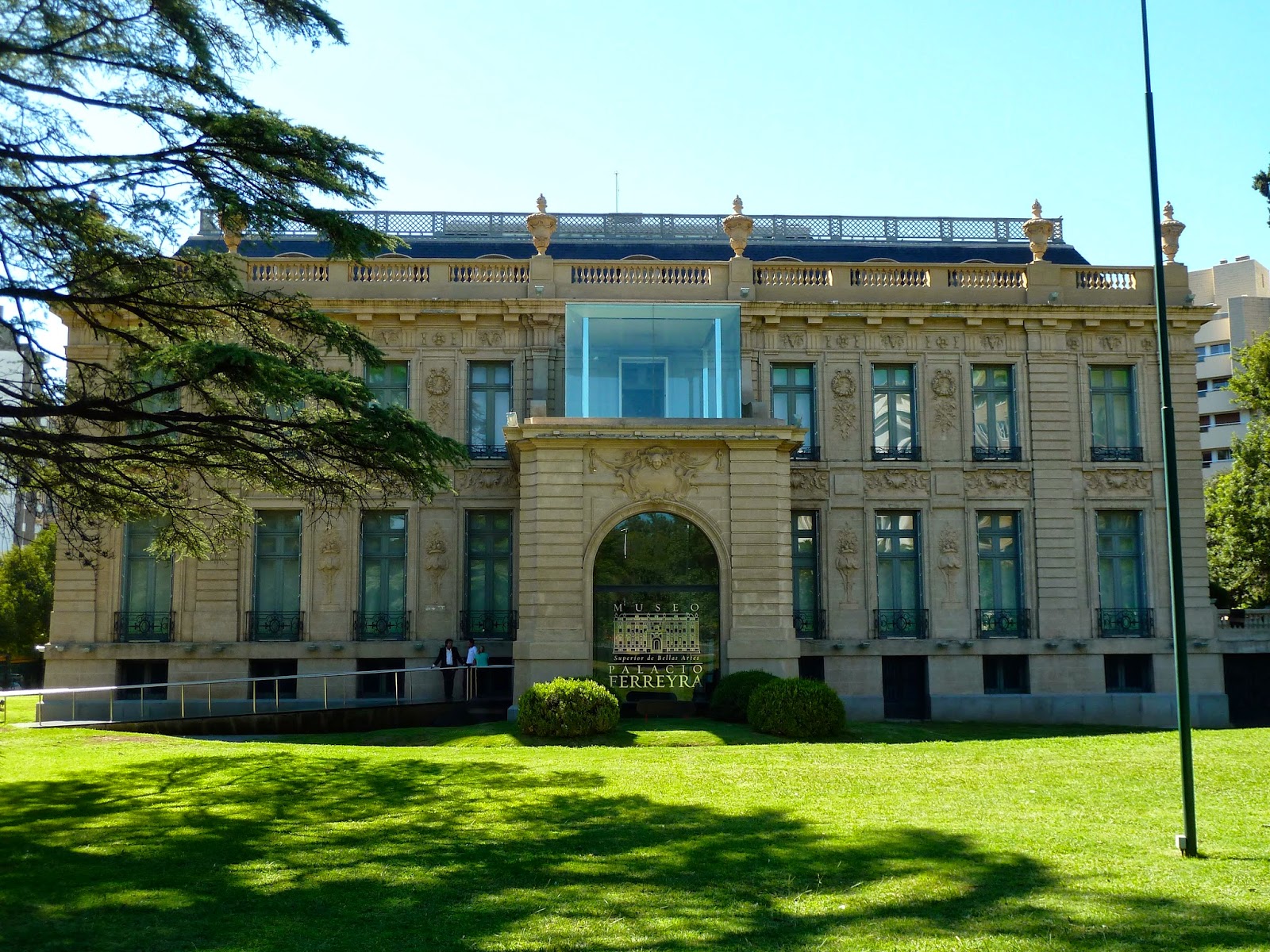
There are many museums and art galleries of course. This one (left), the Palacio Ferrerya, is just outside the park and, according to my guide book, featured some excellent paintings by famous Argentinian artists (name one, I challenge you).......
....could have fooled me! I went in up this magnificent staircase (right) which led to several spacious galleries on the two upper floors in which were many, to my philistine eyes, rather uninspiring exhibits.
The only person I saw in here was a lady at the desk in the foyer.
After breakfast on day three I decided I would explore a bit of the local countryside. Talking of breakfasts, all the hotels that I have stayed in so far  provide pathetic fare at these meals. You seem only to get a cup of tea or coffee, maybe a small glass of orange juice if you're lucky and, here, two sticky dry croissants. Not even any toast and butter and I have yet to experience any hot food or even any eggs. Haven't seen any hens anywhere for that matter. They obviously don't take 'desayuno' very seriously.

So I took the bus to the small town of Alta Gracia in some foothills, an hour's journey to the south-west. It has quite a pretty town centre with a grassy plaza, a reservoir cum lake and a notable 17th century Jesuit church and estancia (left). This was closed to visitors due to renovations, or lack of Jesuits.


Right. The tourist information centre, in the bottom of the tower, by the lake. Two helpful ladies were manning it and I don't think they were overworked.


Alta Gracia is also the place where Ernesto 'Che' Guevara lived during his childhood up until when he went  to medical school in Buenos Aires and then off on his travels . He was born in Buenos Aires but the family moved here, a healthier environment, because he suffered badly from asthma. His family house (left) is now a museum.


Amongst many fairly innocuous exhibits is the motorbike (right) he travelled vast distances on throughout South America.
Photos of Che from his schooldays adorn the walls. He was, by all accounts, a bright and charming young lad, but  still frequently suffered from asthma attacks.

Left: A photo of Che with his second wife and children....after the revolutionary overthrow of President Batista of Cuba by Fidel Castro in 1959.


He was appointed Trade Minister in Castro's government and made frequent visits abroad to speak at conferences. Right: Speaking at some meeting alongside Fidel Casto. He subsequently went on to try to stir up revolutions in the Congo and Bolivia, with little success.
I may be imaging this but, in my opinion, he has a more than passing resemblance to the groom at the wedding we attended in BA.


Left: Fidel and Señor Chavez of Venezuela on a visit to the museum in Alta Gracia in 2006. 
Right: A photo of Che in a more characteristic revolutionary pose. He was wounded and captured in Bolivia by the Bolivian army in 1967 and subsequently executed by a Bolivian police chief while in jail. He would be 86 years old if alive today.


Next stop will be Mendoza, to the south-west near the foothills of the Andes. This as you are no doubt aware is the main wine producing area in the country. I expect I will be visiting a winery or two.

Saturday, 15 March 2014

SALTA

5th - 8th Mar 2014


General Don José de San Martin in Plaza 9 de Julio in Salta, and his pigeons.

Off we set on the several hour road journey to the Finca Valentina just to the south-west of the provincial capital, Salta. We took the high road, not the wimpy low road, out of Jujuy. It was one of those 'don't look down and hope for the best' cliff-hanging white knuckle rides up and over some vertiginous, twisty and narrow mountain roads where you hoped not to meet an unexpected vehicle , or animal, coming in the opposite direction. It always feels safer when you are on the uphill side of the road, and mostly we weren't. Our magnificent back-seat driver was insisting we put on our safety belts. I positively refused on the grounds that I had a rear door seat and was poised, with hand on door handle, to leap out at the slightest indication we were going over the side. Fortunately our front-seat driver knew what he was doing and there was seldom a cause for alarm. After a pit-stop at a mountain guesthouse for a great lunch (spaghetti bolognese....the first spaghetti we have so far found in Argentina), we descended safely towards the city of Salta. From here on the directions we had been provided with proved wanting. We got lost. I had, for some reason, been co-opted as front righthand-seat navigator and having previously berated all members of the female race as being utterly incapable of telling their north from their south, was taking considerable flack from the back. Anyway, to cut a long story short, involving a few U-turns, we made it to the Finca in time for tea.

What a pleasant place it is. I was not booked in here; I was to stay at another, and I must say almost  equally pleasant place (with a jacuzzi in the bathroom..which they didn't have, yah boo sucks), about  3 miles away. The proprietor of the Finca Valentina is a charming Italian lady called, would you believe it, Valentina. She and her husband moved here a few years ago having fallen in love with the place. She mentioned that she was not on the best of terms with her neighbour, a German. This, as you can imagine, provided much amusing speculation concerning flag-raising ceremonies and jack-booted goose-stepping guards.

It was warm and they had a swimming pool. I hadn't been in a swimming pool for years, but succumbed to the temptation. OK, I'm not in the picture here because I'm taking it. I definitely did get in.

The person missing is our erstwhile chauffeur. The stress of the arduous driving had rendered him comatose.

The guy with the long hair and beard, on the right, is a BBC film producer who had just returned from a riding trip in the mountains to our west. He had previously been up in Brazil preparing a documentary on the preparations for the World Cup Fútbol. Interestingly he is an Old Etonian (as, by coincidence, is the guy on the left) and I thought there can't be many Old Etonians working for the BBC. He seemed a very decent well spoken chap. As we were splashing around it transpired that he thought Ed Milliband is a charming, talented and much-underestimated political leader, he disparaged David Cameron, expressed a liking for Nick Clegg and he reckoned that Ed Balls would make a great Prime Minister.  I'm not joking, and I don't think he was. He has obviously become, for whatever reason, a rabid lefty 'Guardianista'. One need speculate no further on how he got the job with the BBC. He had to catch a taxi back to the airport shortly afterwards which might have prevented a rather heated debate before dinner.

Due to the indisposed chauffeur, poor chap, I was lucky enough to take his place for a free and excellent dinner. A great finca, and I left by taxi to mine afterwards. Amazing taxi driver; he was very cheerful and chatty and only charged 30 pesos (£2.50) for the 3 mile ride. I offered him 40 pesos but he refused to accept the tip saying 'you are an honoured guest in my country'! I am beginning to have great faith in Argentinian taxi drivers. At nearly midnight, from an out of town location, a Brit cabby would have been reluctant to turn out and even if he did would have charged at least £20 for a bolshy service.


Left: This was my place, the Finca El Prado. Also great hospitality although I wasn't at it for long. I was looking forward to my jacuzzi in the morning.

After breakfast, and Argentinian breakfasts tend to be very meagre affairs which never consist of much more than tea or coffee and bread or dry croissants (never any eggs or cooked food) it took ages to fill the jacuzzi with water. I tried to switch it on. Nada!. Assistance from the management failed to get it to operate. So much for my much anticipated jacuzzi experience. During this disappointment my upmarket mates turned up in a hurry to get to Salta; they had to get on to another finca further south, pronto. Quick dress, pack and payment and off we went. They dropped me in the centre of Salta and, somewhat sadly, I said goodbye. That was the end of our joint tour. I was now back 'solo mio'.

I towed my increasingly battered suitcase, on spec as always, to a hotel (The Alcazar, if you're interested) near the city centre. No problem, and it was a fairly basic but very comfortable place. I find it amazing that you can get such cheap and decent, by European standards, accommodation with no hassle in Central and South America so easily. This place cost me 250 Pesos per night (£20) and it was the equivalent of an establishment in Europe that would happily have charged at least £100 for similar, and they would have probably been booked up months ahead. The staff here were, as always, extremely courteous, welcoming and trustful. They didn't even require a down-payment or passport details. I suppose that is the advantage of travelling alone; one doesn't have the responsibility of booking in advance (at greater expense) to avoid disappointment and, if so, no ensuing arguments between travelling partners.

One of the main reasons I came to Salta was to experience a trip on the 'Tren de la Nubes' (Train of the Clouds). This is a return-route 15 hour train ride from Salta and back, up west into the mountains, and is one of the three highest rail routes in the world. It climbs up mountains, through tunnels and across spectacular gorges to an altitude of about 14,000ft. It also includes a comfortable dining car and lots of spectacular photo opportunities. Right: See photo, taken from a postcard.
I went to the tourist info centre to enquire about bookings. I was told it had been temporarily CANCELLED due to flooding in the mountains, and not due to restart until April. What a bummer. Can't think why there should have been floods when for the past week or two there had only been sunshine but it was, nevertheless, cancelled. 
I had to go to the nearest bar, of which there were many, to drown my sorrows.


Left:The main square, Plaza 9 de Julio. All towns and cities in Argentina have plazas, streets  and parks called Independencia, San Martin (the general who helped get rid of the Spanish in both Argentina and Chile), 9th of July (the date of independence in 1816) and 25th May (haven't a clue).


The cathedral on the northern side of the plaza. Again, as with all Central and South American towns/cities, there is always an ornate and expensively kitted out cathedral on the plaza. They just love their cathedrals. No expense spared.


Also on the plaza is the Museo de Arqueologiade Alta Montana (high altitude museum). As with  a similar museum in Arequipa, Peru, this houses the mummified remains of children, sacrificed by Incas to the volcano gods. There are three such mummies displayed here, one boy and two girls, which are rotated, one at a time, at 6 monthly intervals through the museum. Their bodies were discovered on the Llullaillaco volcano in 1999. 
Left. Not a good photo due to the fact that photography was prohibited and I had to take a quick shot. It shows the remains of the 9 year old boy, called the Niño, the one currently on display. His head, wrapped in a cloth headband, is facing to our left.


Right: Another mummy on display is that of an Inca girl, La Reina del Cerro (Queen of the Mountain), whose provenance is unclear but was looted from an Inca tomb in the 1920s. She doesn't look very happy.
These children were normally sacrificed (a great honour to the family, apparently) by getting them to swallow a stupefying drink and then knocking them on the head.


There is a marvellous cable-car which takes you up to the top of Cerro San Bernado (left) and offers a great view over the town. I don't normally like cable-cars; they cause me to suffer from vertigo and I constantly imagine the cable snapping. This one is OK because it follows the terrain and is never a great height from the ground.


Right: The view over the town from Cerro San Bernado (named after the patron saint of municipal agitators in and around the small district of Plasto Grande, a certain Bernardo Guignardo).

The green area in the town (centre of pic) is the Parque San Martin (of course), which was a pleasant place to wander around and features a couple of boating lakes, fountains, statues (mainly of yet more Argentinian heroes) and lots of stalls selling home-made things.


I went on a 2 hour open-air bus tour of the town. To be honest it was rather dull, but at least they had a commentary in Ingles. Lots more statues of heroic Argentinian generals in various leafy plazas, the railway station in which was standing the only train, the Tren de la Nubes, immobilé, and several churches. It culminated in a 30 min stop at a large 'artisanal' shopping centre where I didn't buy any of the vast amounts of touristy tat on display. 

Left: Another Argentinian military hero. Forgotten which one.


One area which I found the greatest fun was around the street running up to the railway station. This is home to the many Peña establishments. Peñas are sort of bars cum restaurants which feature traditional music and dancing. As it was night time and I didn't think there would be anything worth photographing I failed, for once, to take my camera. What a mistake. Not only were the restaurants, mostly outdoor seating, excellent featuring empanadas, steaks and llama, but the music and dancing on display was simply fantastic! Brilliant groups of drummers and guitarists were accompanied by amazingly talented and energetic gaucho clad dancers wielding whips and capes and leaping wildly all over the place. You had to hang on to your glass of wine. I wish I had some photos as a reminder. Strongly recommended. Talking of wine, it is difficult to order just a glass of the stuff here. They tended only to serve a minimum of a half-bottle and it was extremely cheap and surprisingly good. I left around 1.00am and that was considered early...I still haven't got into the South American routine of going out for meals at 10.30pm and staying until at least 3.00am for all the entertainment. I must be feeling my age.

So Salta gets the thumbs-up from me. The only irritant, during the day, was the constant unwanted attention from the many persistent shoe-shine boys who, despite the fact that my grotty ex-suede shoes could never be revived by polishing, were difficult to discourage. They were a pest, but a minor issue really, I suppose.

Next stop is to be Cordoba, a 12 hour bus ride to the south. Avante avante.........


Wednesday, 12 March 2014

JUJUY PROVINCE

3rd - 5th Mar 2014

Part of the colourful Quebrada de Humahuaca gorge
Against my principles of travelling solo and not, unless unavoidable, by air, I joined up with some amusing friends, because they are amusing, and flew with them to the north-western town of Jujuy (pronounced 'Hoo Hooey' of course). 
Things did not get off to a good start as I had to buy my ticket last minute at the airport and for some reason the name on my passport, my real one I hasten to add, was not recognised by the Aerolineas Argentinas computer. I must be on their black-list. After sorting out that little misunderstanding with little time to catch the plane, and in a rush, I nearly broke my leg falling over my suitcase, then had to surreptitiously prop my knee up under the bottom of it at the check-in to make it weigh below the restrictive 15kg max. Luckily that worked and the check-in guy didn't notice the weight fluctuating somewhat. Such are the hassles of air travel, and the dodges.

It was a 2 hour flight up to Jujuy and my friends, who are frightfully well organised, had booked a hire car;  or rather large 4x4 pick-up. I, of course, had booked 'nada' as is my wont. We drove up to the small Andean town of Purmamarca where they were booked into a very elegant hotel, El Manatial del Silencio with all mod-cons; an ex-monastery (silent order) I think. No room for me, thankfully as it turned out, as I found a rather cheaper and more modest place just down the road which was comfortable and the room had good views over the spectacular valley. I must, however, put in a good word for the excellent hotel El Silencio. Despite me not  actually staying there the manager and staff were most helpful in trying to sort out computer problems and letting me use their telephone. I must say, so far all hotel and bar staff in this country have proved incredibly efficient, polite and 'wilco'.

Purmamarca is a quaint Andean 'Quechua' style village/small town situated towards the northern end of the dramatic Quebrada de Humahuaca george, not far from Bolivia, and is a popular tourist venue. It was also, unbeknown to us previously, Carnival Time!

Right: Part of the village taken from a small but steep  (phew) hill nearby.


On first walking into the village we were greeted by a loudish local band and some quite sedate and organised dancing (left), rather like a Scottish reel..........


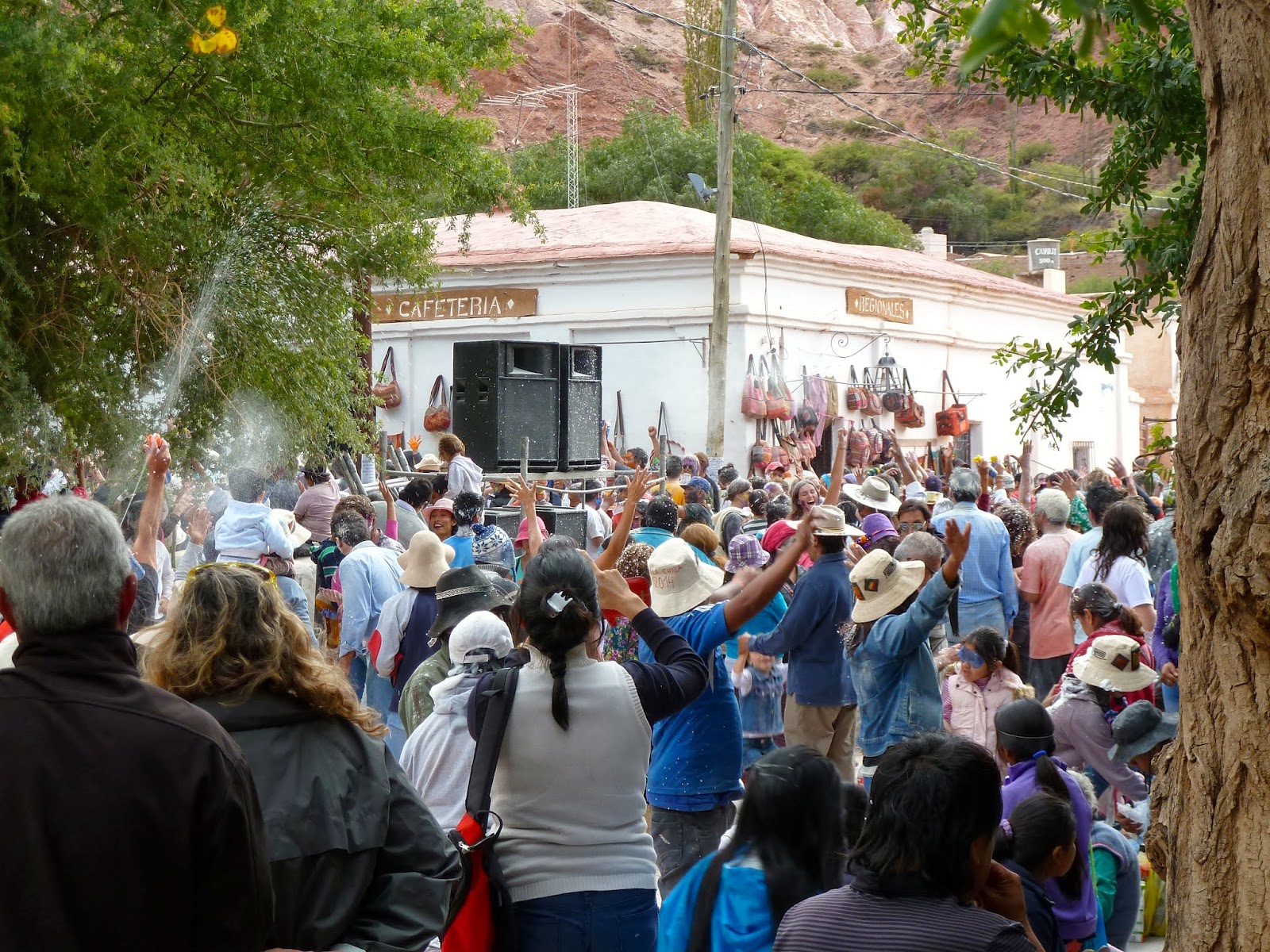
....then as we moved further in it became a  barrage of loud electrically enhanced music from several venues and much frenetic dancing amid enthusiastic spraying of foam and water. Some en-masse such as this (right)......


Most people were armed, including us eventually as a means of defence only, with cans of foam spray (someone was making a fortune from selling these at 20 pesos a can) and it was impossible to avoid getting blasted at some point whether you were armed of not ( as per left).
What happened to the 'Yellow Card' procedures, I asked myself.


Admittedly some of the hits we took were 'blue on blue' friendly fire engagements. Right; one such example, but she bloody well started it!
Fortunately the foam just evaporated with no lasting marks. It was much worse to get hit by a 'flour and water' combination, something I think we managed to avoid.


In amongst all this mayhem there were many stalls selling all kinds of colourful Andean type clothing and stuff. I remember the woollen garments being sold in Andean Peru around Cusco which always promised '100% baby alpaca' and we were told by all the guides 'Yes, a bit !00% baby alpaca but also 80% acrylic'.


Right: These simple felt conical hats were all the rage. Lots of people were wearing them but I don't recognise their provenance. I bought one anyway, rip-off price I'm sure, and when I put it on it came down over my eyes.


Left: Lots of fancy dress. It mostly seemed to include demonic looking bulls heads with masks through which the occupants made scary roaring noises.


Right: Another example; three small devils posing rather coyly.


...and little bands (left) which paraded loudly and  enthusiastically if somewhat tunelessly around the narrow streets.


Despite frequently asking I don't think we ever  discovered what this carnival was in aid of. What we did find out was that it was due to go on for three days throughout the valley, and this was Day One.


As per the Recoleta cemetery in  Buenos Aires, the Argentinians seem very keen on 'individualistic' graves, tombs and crypts. At the far southern end of the village, up the hill overlooking a simple but dignified little church was the graveyard (right). It was laid out in fairly ramshackle fashion but there was definitely much qudos involved in the size, and frankly, opulent eccentricity of your place of rest. One large tomb was in the shape of Noah's Arc. Some coffins were on open display in locked tombs, others were well buried.


Many of the graves were nothing more than  rough scrapings in the stoney ground with, maybe, a simple wooden cross at the end. Left: These ones are tiny and presumably contain the remains of small children from poor families.
We are most certainly not all equal in death here. Status is very important.


Right: An example of a local family out for an afternoon of fun.


This rave-up went on until goodness knows what time in the early hours of the morning. I had long since gone to sleep despite the noise from 'down-town'.

The place was a ghost town at 9.00am the next morning. They certainly know how to enjoy themselves up here and, despite much drink taken, there was never any hint of aggro or drunken loutishness.  It was all smiles and good humour.


Right: Llamas made their appearance in the grounds of the El Silencia Hotel. I may have explained before that, for purely idiosyncratic reasons, I dislike these silly 'camelid' creatures intensely, and especially their cousins, Alpacas. They have a rather supercilious look ( especially alpacas ) and spit at you if you are not careful. It's always tempting to kick one up the arse, I find.
llamas are much on the menus here. In Peru they refuse to eat Llamas because their meat is considered tough and sub-standard. They also consider their fleece too coarse to make decent clothes from. Llamas in Peru are only used as mountain pack animals (max legal load 80kg). Alpacas have excellent, tender and totally cholesterol free meat and their fleece, when not diluted by acrylic, is vastly superior. Guanaco and Vicuña are another rarer, protected, relation and live above 14,000'. So the only good alpaca is a dead one as far as I am concerned. I can't think why the Argentinians don't eat more of them in preference to Llamas. They may worship the stupid creatures for all I know.

Left: This cactus was lurking somewhere in the village. I think it is trying to tell us something.


Right: One of the tracks leading into the village. The  colours of these rock formations is quite extraordinary, varying between yellow, pink, red and various shades of brown and they are often exaggerated in different light conditions. I have no knowledge of geology so perhaps someone else can explain. A book describes the scene as 'a jagged formation resembling the marzipan fantasy of a megalomaniac pastry chef'.


Left: The view from my hotel window


The next day we motored further north up the valley, initially to the little village of Uquia which boasts very little indeed except for a pretty church inside which there are several large portraits of saints, all armed to the teeth, apparently. I didn't actually go in. I chose to go to the village shop to buy a large bottle of beer instead (it was hot). There is a custom in Argentina, strange to us but with a sound reason, that when you buy a bottle of beer, and they normally only sell very big ones, you pay extra for the bottle. When you return the bottle you get your money back. I didn't understand this at first, but have now got the hang of it. It seems another sensible idea, to avoid people chucking bottles away, that we should adopt in UK.


Then on for another hour or so down to the town of Humahuaca, from which the name of the river gorge/canyon (mostly dry at this time of year) is taken. It is a bigger version of Purmamarca and it was just beginning to wind up for Day 2 of the carnival. Similar scenes as yesterday with maybe a few extra flourishes and more food and clothes stalls.

Right: The monument in the centre of Humahuaca.


Left: The massed bands of the Humahuaca  Household Brigade strutting their stuff amid much spraying of foam. I must remember to buy shares in the company that makes this stuff. By mid-afternoon the ground is covered in empty cans.


Right: Sharing a joke with my new best friend at the festivities. Not sure what he was saying but he was making strange grunting noises. I am wearing my new local style hat. Devilish smart, don't you think?

After a decent lunch of delicious empanadas, I've taken a fancy to empanadas, in a local cafe we drove back south to Purmamarka. I decided I was far too knackered for more touring, so the others went on without me to see the salt flats (salinas grande), about 60 kms to the north-west. I thought it would just be a long flat drive to see long flat salt flats. I was proved wrong. For a start the drive took them up a winding road from 5000ft to about 12,000ft! The salt flats themselves are, apparently, impressive expanses of well....white salt. Unworldly, as someone described them.

Some of the photos they brought back I relay here. This is touring without moving as far as I am concerned i.e. cheating, anyway...........


Left: The winding road up a few thousand feet to the salt flats.


Right: An energetic salt flat leap. Surprised she had the breath and energy up that high.


Left: A salt flat family group photograph.


Right: Oh yes, there were some alpaca up there. They can stay there for all I care. Actually the really irritating alpaca are the small fluffy 'aren't they cute' coochy-coochy white ones that the Chechua ladies, in colourful full-fig Andean dress, drag around so that tourists can pay to have their photos taken alongside. These here are blameless in that respect I suppose.

Despite the raucous shenanigans outside, we had a great supper, plus mandolin music, in the Tierra del Colore restaurant in Purmamarca that evening. Recommended, so do drop in if you are passing.

Next off down southwards to the area around Salta. I think we are staying at a Finca.

 On the losing end, as always.