Friday, 18 April 2014

TIERRA DEL FUEGO 1

1st - 4th Apr 2014

Ushuaia, the southernmost 'city' in the world.
The bus left El Calafate at 0300hrs, initially for a four hour journey to the staging post of Rio Gallegos on the east coast. This industrial and rather dull port city has a major military base and played an active role during the Falklands war in 1982. It is also the home town of the previous and current Presidents from the  Kirchner clan. I couldn't credit it; standing in the bus terminal there was the 'talkative' Uruguayan I had tried to avoid on the journey to El Calafate. He hadn't been on the previous bus. Where had he sprung from? Was he following me? I continued to avoid him. 
Next onto a rather more workmanlike bus with a metal grille over the windscreen, again indicating the sort of roads that we were to face further south.

The ensuing 14 hour journey took us through Chile, and the Chilean customs/immigration procedures are much more tedious than the Argentine equivalent. They even made us get all our bags off the bus to be searched. Bloody boring. Onwards to the Chilean harbour at Delgada for the 30 minute ferry crossing of the Strait of Magellan onto the main island of Tierra del Fuego. 


Right: The ferry approaching the little port on the northern tip of Tierra del Fuego which is, technically, an archipelago. The main island, Isla Grande de Tierra del Fuego, is approximately two-thirds the size of Scotland and is split down the middle between Chile to the west and Argentina to the east.


The northern part of the island is predominantly flat grassland with many many sheep. We were held up for about 20 minutes while an enormous flock of countless sheep was on the move. Several of us went to sleep.


As in Patagonia the landscape gets progressively more hilly the further south you go until it becomes mountainous in the far south.


Left: Lots of guanaco, wild horses, and a few foxes.

Back into Argentina at the town of San Sebastian and then through the seaport of Rio Grande, about half-way down the island. This is another rather dull industrial place but renowned as one of the world's greatest sea-trout fly-fishing capitals. It was also a major Argentinian air-base during the Falklands war and has a large memorial to prove it.

It was shortly after this that the roads became, for a while, gravel tracks.... and then the bus broke down. We had to wait an hour for a following one which, by the time we had all transferred across, was rather packed.

After another four hours and a journey through mountain passes, by now on good roads again, we descended into the town of Ushuaia at about 2200hrs.


Although Ushuaia boasts of being the southernmost 'city' in the world, it is really only a  mid-sized town on the north side of the Beagle Channel with a busy seaport (and airport). In fact there is a more southerly small township, Puerto Williams, across the Beagle Channel in Chile, but it is indeed very small. I believe the Argentinians and Chileans have had many spats over who owns what in this part of the world, as indeed the Argentinian government still does with us. I don't suppose ships go from here to the Falklands any more, which aren't too far away. 


Fortunately I found a delightful guesthouse quite close to the bus station called the 'Martin Fierro', although a steep walk to it as the town is all seriously uphill from the port. I was greeted by the owner like a long-lost friend and was put up in a room which had all mod-cons including a kitchen. Right: The charming owner, Xavier, who is a lawyer by day and speaks fluent English. I strongly recommend this place should you be passing by.

Speaking to Xavier he said that most Argentinians down here are rather pissed off that their government makes such an issue of the Falklands/Malvinas ownership because before the conflict in 1982 they all got on very well with each other and had a good trading and tourism relationship.

Another bonus; just across the  street is an 'Oirish bear', the Dublin (left). It does great nosh and stays open until 3.00am (I'm told), much to the annoyance of Xavier, but was most welcome  as far as I was concerned as I had arrived rather late.


It is a very lively and popular watering hole and was nearly always packed (right). I would like to think the owner is called Pat O'Gonia.


Left: The local brew around here is 'Beagle' beer which comes in three varieties; pale lager, gold and a dark stout.


The original inhabitants of Tierra del Fuego were the nomadic Yámana tribe whose members (right) faced the sometimes brutal weather conditions almost entirely naked. Apparently they didn't have any permanent shelter to keep clothing dry and believed that the natural oil of their skin was better protection than soaking wet animal fur. There aren't any left now. Am I surprised!?
Back in the 19th century Capt Robert Fitzroy kidnapped 4 of them and took them to England to be educated and paraded around as examples of 'gentrified savages'. One died of disease and, due to public criticism, he returned the rest to their homeland. Really? Bit of a wasted journey.

Left: Part of the port. Ships, including an increasing number of cruises, go to the Antarctic from here. Much tourist trade is in this direction during their summer (Nov to Feb).


The town boasts lots of decent cafes, restaurants, bars and shops, including as in Patagonia, many chocolate emporiums. It is a remarkably jolly place, quite tourist oriented and even the weather was kind during my stay. I was expecting rain and gale force winds, which never materialised.

Right: Another Oirish pub. They get everywhere, don't they. 


Left: A bust of Evita Peron down by the harbour.


Right: The local golf club. This is, of course, the southernmost golf course in the world. I'm not a golfer but it looked quite a smart place and probably attracts quite a few enthusiasts who like to play in 'out of the way' venues.

There is also a substantial rugby club which has four very decent looking pitches including a substantial grandstand.

I called in at the tourist office to see what was on offer in the area. The Uraguayan guy was in the queue behind me. I'm sure he is following me.
There are some interesting things to see and do.
I was also keen to arrange another day's fishing, and did so (at considerable expense I may add). This is the Mecca for trout fishing so it would be foolish not to take the opportunity while I am here.
Revelations to follow.............


Tuesday, 15 April 2014

EL CALAFATE

29th - 31st Mar 2014


End of the Perito Merino glacier
El Calafate (pronounced El Calafarty) is in the southern part of the Parque National Los Glaciares, and quite a charming little town, if somewhat touristy. The main street is dotted with restaurants, bars (didn't see an Irish one), souvenir shops and again, like Bariloche, lots of shops selling chocolates. These Patagonians really seem to go in for chocolate.

I took residence on spec in a smallish old hotel, La Loma. It helps that this is not the tourism high season as, so far, I have had no problems with fully booked hotels, and anyway there are so many to choose from.


Left: The lounge/dining area. The rest of the place was mostly wood panelled with ancient wooden floors which made alarming creaking noises when you walked on them. It was also very comfortable with free wifi (as in all hotels) and so cheap! £25 per night, including breakfast.


The main attraction around here are the glaciers which you get to see either by trekking across them or, if you are lazy like me, by a boat trip on the vast Lake Argentino. I booked onto one such 'cruise' and paid a little extra for the added comfort of sitting in the 'Captain's Lounge'. This boasted more comfortable seats plus complimentary snacks and drinks.

Right: The driver's seat. It was a modern twin-hulled vessel which took on board about 100 pax, at a guess.


We set sail from the port of Puerto Bandero at 0830hrs for an eight hour cruise around various parts of the lake. The scenery was rather stunning and fortunately it was sunny with blue skies. I came dressed for the cold. I had lugged a warm coat, fleece and sweater around for long enough without needing them and was damned if I wasn't going to wear them at some point. It was actually quite warm.


We were served croissants (stuffed with processed cheese and ham) and coffee or tea for breakfast. This was followed, for some reason but quite welcome, by a glass of Scotch whisky at NAAFI break! Self service after that. I presume this is a requirement for the more chilly days. Later in the day it was sandwiches (cheese and ham of course) and as much wine, coffee etc. as you wanted. Rather a good deal in my opinion.
I have yet to fathom out why 99% of all South American sandwiches consist of processed cheese and ham. The remaining 1% are cheese and salami. There must be a market for a bit of variety I would have thought. Never got an answer to that one (nor to the question of why there are never any plugs in bathroom washbasins for that matter). Research continues. 

Left: There were many icebergs floating around but fortunately no Titanic moments for us.


Most of the floating ice comes from the Upsala glacier (right). This is because the leading edge is lying on the water and bits keep breaking off.


Left: The skipper steered the ship into a raft of broken ice. Some of the ice was roped up and given as (temporary) souvenirs to punters who had their photos taken holding and licking the stuff.


Right: A smaller model, the Spegazzini glacier which we passed somewhere en-route.


As with drivers of all vessels and vehicles the skipper was constantly supping at his mug of mate. They can't operate without it. At least he didn't get stuck into the whisky.

Left: The 'hostie' passed around the mug (it's a sort of gourd actually) so  we could all have a suck. I can't say that I am likely to become addicted to it.


Then on to the 'big daddy' of the local ice-flows; the Perito Merino glacier (right). This one does not regularly shed ice, but has periods when it 'calves' and great walls of ice break off and collapse into the water which, apparently, makes alarming groaning and crashing noises. Nothing like this happened on our visit. The leading edge of ice here runs vertically down to the lake bed.


Left: Another view of the Perito Moreno. By the way, just in case you are interested, Perito Merino was a great 19th century Argentinian explorer whose major claim to fame was diverting the course of a river from flowing into Chile and thus stopping Chile claiming the headwaters. The unremarkable small town of Perito Merino (at which we stopped on the way down) is named in honour of this achievement.


I think we were told it is 250ft high above the water, and moves damned quickly for a glacier at 2 meters a day, or is it a week, or maybe a month. To be honest, I've forgotten.


Left: Not all of us were entirely enraptured by the views. Or maybe this chap had been over-doing the free hand-outs. In fact there were quite long periods when we were just sailing along with nothing much different to look at....and it had been quite an early start. 


Right: Another picturesque scene viewed from the stern.


We were even served champagne (Argentinian) on the final leg home. All in all a very interesting , relaxing and enjoyable day out. I think the bus dropped us off at our hotels at about 1700hrs.


The rest of my time in El Calafate was spent wandering around the town and enjoying on at least one occasion a very good supper. They do cook extremely good trout in this part of the world.

Right: Just in case you are wondering, the old chap on the bench with me is in fact a stuffed dummy. I was telling him all about my travels. He proved a much better listener than most of the other people I have regaled.


On further south next to 'El Fin del Mundo', Tierra del Fuego.


Wednesday, 9 April 2014

RUTA NATIONAL 40

27th - 29th Mar 2014


Typical central Patagonian landscape. 

The bus we boarded at 6.30am was not of the luxury variety. The fact that it's windscreen was covered in wire mesh gave some clue as to the character of the journey we faced which, in total, would be about 800 miles over two and a half days. It was a 60 seater bus but there were only 6 of us passengers and a lady 'organiser' on board, plus two drivers who took shifts at the wheel. I can't describe the lady 'organiser' as a guide because she spoke no English and never gave us a clue where we were or where we were going. The other pax were a Uruguayan man, a Dutchman, an Indian/Canadian girl and a British couple. The Uruguyan was the only one of us who spoke Spanish and I got the impression he lived in the USA. He was one of those (to me) irritating people who never stopped talking and giving 'advice' whether you wanted it or not. Fortunately he latched onto the Brit couple and the Dutchman. Off we went on good roads south through El Bolsón (notable only for the Gayastri Casa Hindu restaurant) and then we stopped at the small town of Esquel about 100 miles south. It was never made clear why; nobody got on or off. I suspect the driver had a friend there, or needed a resupply of mate. This town is near Trevelin at the west end of the Chubat Valley. At the east end, on the coast, are the towns of Trelew and Puerto Madryn. It was at Puerto Madryn that a number of Welsh settlers arrived in 1865 and they spread out along the Rio Chubat and eked out a precarious living by farming. I suspect, for whatever reason they left Wales, they thought they were going to Australia but due to a cock-up at the local Thos. Cook travel agency the three letter abbreviation on their tickets was mistakenly printed ARG instead of AUS. They probably wouldn't have spotted the difference when they got there as they all spoke Welsh and the local Indian language (Tehuelche) could have been 'Australian' for all they knew. Anyway, I was quite keen to witness some 'Welshness', but there was no sign of the Yakkida tribe or anyone wearing funny tall hats and Eisteddfod costumes. Not even a sign saying 'Bienvenidos Boyo'. I was told that most of the Taffs (now rather cross-bred with the locals) are at the eastern end of the valley where they do still hold the occasional Eisteddfod, wear leeks in their hats and specialise in quaint tea-rooms serving Welsh cake...at vast price to the tourists.

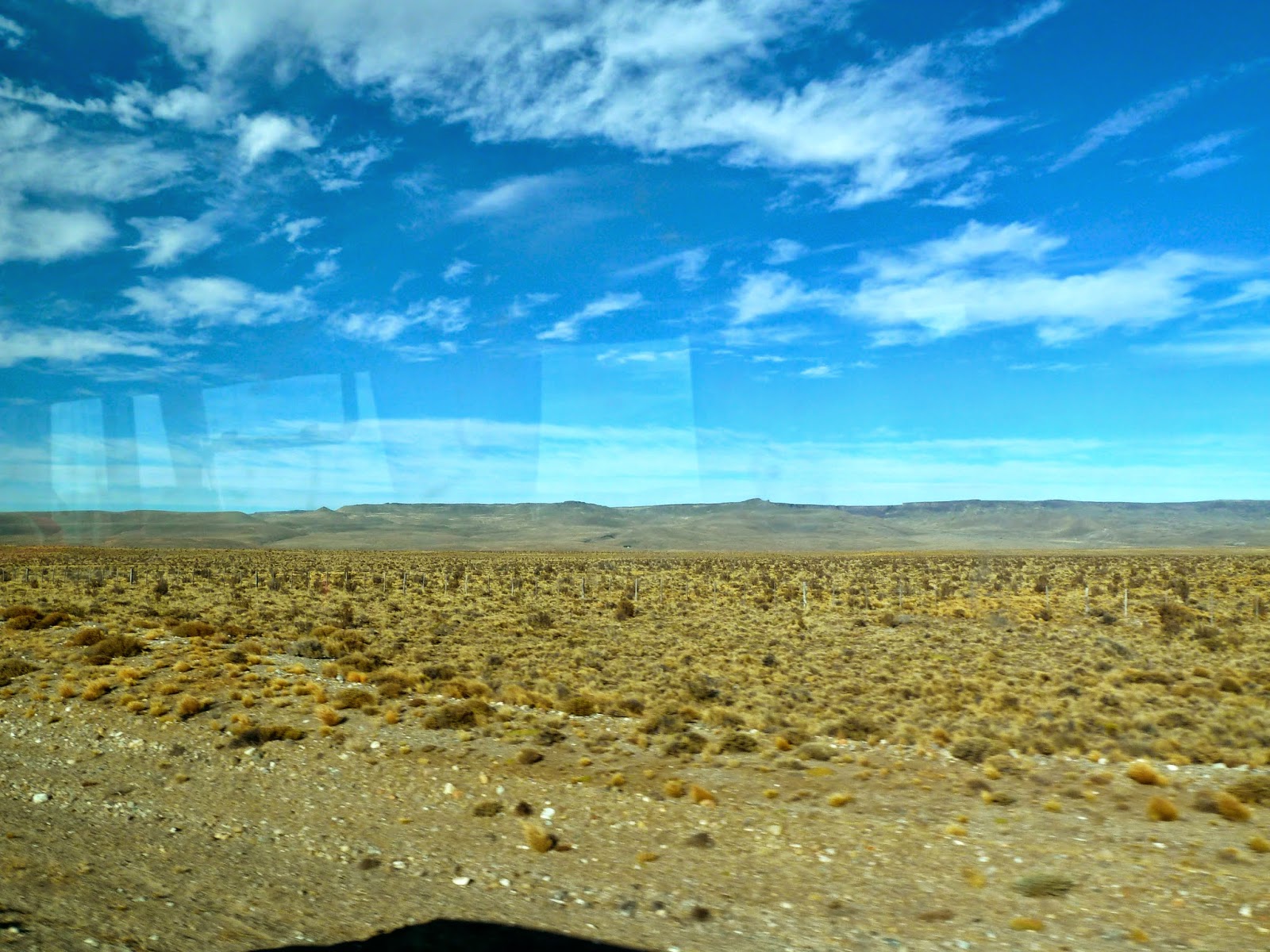
The journey on the first day was through flat and relatively featureless 'steppe' countryside covered in clumps of pampas grass, or sage-brush (left). It was a vast empty space, but I did see some sheep so the Welsh couldn't have been that far away. I think there are some sheep in this photo.


Other wildlife consisted of many groups of guanaco (right), herds of wild horses, the occasional fox and large flightless birds called, I think, ñandús, a sort of rhea.

Down the whole length of the route, even when the road turned to gravel track, there were well kept fences along the roadside and the occasional cattle-grid across the road. The whole area must be divided up into enormous 'estancias', or maybe the fencing is just to keep the animals off the road. There was no sign of human habitation for hours at a time.

We stopped for lunch, not provided, at the half-horse town of Gobernador Costa. We had to scavenge for something to eat as our 'organiser' and the drivers just disappeared somewhere and there didn't appear to be anything resembling a cafe. I dug into my rations. Onwards across the barren landscape, mostly on metalled road but occasionally onto  gravel. It was noticeable that efforts are being made to tarmac the route as we passed occasional road-building gangs. We arrived at about 8.00pm at the uninspiring township of Perito Merino and the Belgrano Hotel. The Lonely Planet guide, which normally has some good things to say about even the most filthy dump, had nothing positive to say about Perito Merino. I suspect the Lonely Planet even has some good things to say about what, in my opinion, are the two most horrid and depressing towns in the world, namely Luton and Cowdenbeath. I worked out of Luton for six months and once got diverted off the motorway through Cowdenbeath (Fife), and luckily escaped with all the wheels on my car.  If ever someone is searching for sites to test nerve gas or tactical nuclear weapons then I couldn't recommend two more suitable places. Actually I rather liked the Belgrano Hotel. The room was basic and clean, the bed was comfortable and it had a fully functioning bathroom, plus a TV (which admittedly didn't actually work}. However, and happily, this was a place where 'elf 'n' safety diktat had not reached, or was purposely ignored. There were ashtrays on the dining-room tables, the food was good and cheap and a large glass of perfectly drinkable wine cost 6 pesos (about 50p) The bottled water cost 15 pesos!

There was the opportunity (extra price) to set off at 6.30am the next morning to visit some prehistoric site with hand-prints on the roof and walls of a cave known as the Cueva de los Manos. I'm sure there are much more accessible places with dirty hand-prints of primitive people, and much else, on the walls. Public lavatories in Luton and Cowdenbeath spring to mind. None of our little group chose to do this and settled for, by Argentinian standards, a relatively decent breakfast with hot toast and butter and a 8.30am departure. 

Onwards for another 12 hour drive, sometimes along rutted and stony track (hence the metal windscreen grille) which slowed us  down a bit (left). Our lady 'organiser' was not on our bus now. She must have got a better offer, or went with some others to the 'hands' cave. Anyway, we didn't see her again.


......and sometimes along  newly constructed metalled road which stretched straight ahead as far as the eye could see (right). There were increasing number of road-building gangs the further we went south. I expect in a couple of years the whole route will be tarmac.


Left: We passed this sign/monument/marker, or whatever welcoming us to the tiny hamlet of Rio Mayo. It was bigger than most of the houses. We stopped at a garage here for lunch and a refuel. It sold coffee, sandwiches and snacks. It was in the middle of absolutely nowhere and I don't think I would like to live there somehow.


Right: The metropolis of Rio Mayo. It was like a little oasis in the middle of a vast desert where the drivers watered their wagons and  themselves.


Left: A photo of our little group at one of the short stops.


From here on the scenery became more craggy, and then mountainous in the west with rolling hills in between. Good 'tank' country.


Trees even began to appear; hadn't seen any of those things for a day and a half.


It was at the lunch stop that two Argentinian ladies joined us. After this the driver left the main road and without explanation made a detour of quite a few miles to this Estancia, a rather run-down place, called Estancia La Siberia. The ladies got off here and the drivers went inside for a snack and to replenish their mate equipment. I expect they were just giving these two women, friends of their's perhaps, a helpful lift.


Eventually we came to the next night-stop location, El Chaltén. We were now in the northern Parque National Los Glaciares (glacier country) and the landscape had changed dramatically. On approach to El Chaltén there is a magnificent view of Mount Fitzroy and the surrounding range (left).

El Chaltén has become a successful tourist magnet with much building in evidence catering for those who like arduous hiking, climbing, pony trekking, fishing and visiting the biggest glacier in Argentina (if not the most famous) at the bottom of Mount Fitzroy, Glacier del Torres.

We were put up in a very jolly Alpine style hostel which was obviously popular with the younger crowd. I was given a smart room with all facilities so had absolutely no complaints. I hadn't unpacked, fortuitously, and was tucking into a glass of wine in the restaurant when the receptionist came up and said there had been a bit of a mix up. My room had been double booked. Oh hell, I thought, with visions of perhaps having to share a billet with the non-stop talking Uruguayan. No such misfortune; I was upgraded into a 5 star luxury hotel next door. What a pleasant surprise. This place, for the first time I had experienced in Argentina, had plugs in the bathroom sink and eggs and bacon for breakfast (free)!

Off again the next morning for the final leg to El Calafate which was only a 7 hour hop in a different, a luxury double-decker, bus. We stopped at a rather pleasant little cafe on the riverside for a snack. It was apparent that we had now entered a much more touristy area, as indeed the whole of the Parque National Los Glaciares is.

Right: This unfortunate flat fox was pinned up on the wall. Road kill or maybe the result of a successful hunt by the El Chaldrén and District Foxhounds?


And so on down into El Calafate (left) which is situated on the shore of the enormous Lake Argentino.


Welcome to El Calafate and to a quaint and hospitable guesthouse/hotel, the Los Loma. This had been quite an interesting trip and, amazingly, the whole package (including accommodation, but not meals) only cost $190! Well worth it, I think. 

Next, off to see some glaciers.


BARILOCHE

23rd - 26th Mar 2014
General Julio Angentino Roca, who kept changing his appearance.

Left: The spectacular view from my hotel room window over  the lake to the west. My small camera does not do the scene justice.
Bariloche is at the north-west corner of Patagonia on the eastern edge of the Andes, and is part of the Lake District with all that implies vis-a-vis fishing, canoeing, hiking etc. It is a very scenic, and touristy, part of the country.                                                             
I had arrived on the Sunday when the town was 'celebrating', if that is the correct expression, the demonisation of Gen. Roca in particular, and Argentinian  dictators in general. Something to do with the 'disappearance' of many leftist agitators in the late 1970s and early 1980s. Another case of a draconian government taking a rather robust attitude to it's opponents. How many 'disappeared' or were killed is open to wild speculation. 

Suffice to say that there were killings by both sides, but the leftists hold the moral high ground and this is an annual festival to give them the opportunity to wave their red flags (right) and have a jolly holiday. They were making the most of it.


....amidst much dancing, singing and rabble-rousing speeches from a stage in the plaza, later to feature very loud pop music. Any excuse for a piss-up!

General Roca was the man responsible for establishing, no doubt brutally, Argentine control in Patagonia, by effectively removing the hitherto dominant Mapuche nation in the 1880s. He is labelled here (right) 'ASSASSIN'. I wonder why they continue to have a statue of him in the main plaza if he is so unpopular, but I suppose if it wasn't here they wouldn't have a statue to demonstrate against. He must have some enthusiastic supporters as there are still many streets in towns (including Buenos Aires) named after him.
Monday was an 'anti-dictator' holiday in the town and festivities continued, but it was not great for a tourist as most of the shops were shut. Extraordinary architecture predominated. It was all Alpine ski-resort stuff, without snow. Many of the buildings were of this half-timbered chalet style (left). Maybe they do have snow on the mountains in winter with skiing facilities. 
Right: More banging of drums and making whoopee.
Left: Just to add to the Alpine ambiance there were, curiously, St Bernard dogs knocking about the place with barrels of brandy? hanging around their necks. It was 80º in the shade, and these poor animals were panting their hearts out in the heat. They were the ones needing revival with copious supplies of water.                             
I'm not sure if Pedro here was enjoying himself, but he earnt 15 pesos a shot to have his photo taken with you. Kept him in Kennomeat no doubt, (and petrol for his owner's Porsche).

Another curious aspect of the town was the proliferation of chocolate shops. Almost every other shop on the main street sold the stuff with vast shop-front displays. It is 'chocolate city' here. I was told it is something to do with Italian immigrants.                                                               The only thing missing was 'gluwein', but maybe  it was called something different in Español.
Also, as is the case in the touristy parts of all Argentine towns, arrays of mate (pronounced martay) mugs for sale (left). 
....together with the silver filtered straws with which to suck the stuff up the (right).                             The drinking of mate is not just a gimmick. All the locals thrive on it and every bus driver, and probably all the airline pilots for that matter, keep sipping it on the job. They all carry mate mugs, bags of mate leaves and thermoses of hot water to top it up. I was to be subjected to much 'passing around' of the mugs. They insist it is a very healthy and reviving drink. 
Left: Even people relaxing by the lake shore were passing around the mate mugs and thermos. They seem to be addicted to the stuff, and it is passed around with great ceremony amongst a group. It tastes just like green tea as far as I could tell.


The next day I went off fishing. I had insisted on going to a local river (rather than a trip in a boat on a lake). The area is renowned for it's trout, both brown and rainbow,  and fly fishing is 'de rigeur'.
I was met by my guide (or ghillie), Marcello, at 8.00am and off we went in his 4X4 Toyota for what I assumed would be a short trip to a nearby stream. Two hours later we were bumping cross-country over some extremely rugged terrain to the Rio Pichi Leufu which must have been about 50 miles to the east of the town. Beautiful countryside (right) with large cattle estancias.

Left: On down to the river, which involved some severe slopes and much 4-wheel drive. The railway bridge crossed it here; part of the line from Bariloche to Viedma on the east coast. I was hoping to travel on this later, but that's another story.


Marcello, fortunately, spoke excellent English and was most adept at tying on the various flys  and lengths of casts we tried. He exuded great confidence that there were great trout to be caught. Everything was just 'perfecto', a word that I was to hear very often in due course. After about an hour I had actually caught four trout, but all tiddlers ranging from 2" to 4" long!
It was very hot and, to my eye, the water looked far too clear and still to be productive. Lots of changing of flys, from small nymphs to 2" long beetles, took place, and we did indeed see many rather indolent looking trout at various points; presumably not very hungry ones.
We moved up the river to a deep creek where, I was told, along the banks the conditions were absolutely 'perfecto' for catching a large trout. Marcello was wearing the polaroid glasses and I wasn't. After much scrabbling over large rocks he pointed out a large brown trout (not seen by me). I casted. "Perfecto!" he called. "Streep, streep", he yelled (i.e. pull in line), and then "he take fly, strike up!" I hadn't felt anything and then I turned to see Marcello lying on the ground beating his chest in frustration and telling me that a 10lb trout had just spat out my fly. I wish I could have taken a photo of him. I was, according to him, far too slow to react. I'm not so sure. I think we had a picnic lunch at that point.

Anyway, I fished on for another couple of hours with nothing to show for it, not even a nibble. Left: A photo of the great angler not holding a mammoth brown trout.

We eventually called it a day, with Marcello still waxing lyrical about the enormous brown trout that had escaped me due, he hinted, to my utter incompetence.

There were certainly many big fish around, but none too enthusiastic at taking the fly. Apparently the best period for fishing here is November/December. I must remember that in future. It had been an amusing day out with a great view of the impressive countryside and at least the weather had been 'perfecto' if not the fishing.

I had hoped to take the train across the country from Bariloche to Viedma on the east coast. It was advertised (as of two years ago) as a comfortable and interesting journey on one of the last long distance South American railways. I found out at the tourist office that it was now 'suspended', or it went, sometimes, about a quarter of the way across. Having looked at the railway line which we crossed by road, or dirt track to be exact, to and from the fishing I think that it must go very slowly. The line I saw looked very wonky and even overgrown with weeds. I'm afraid that rail travel in South America is now all but totally defunct. Due to the efficiency, comfort and price of the bus services, I suppose the cost of keeping rail traffic going is just not competitive any more.

So, my plan now was to head south through Patagonia on the three day bus ride down Route 40 to El Calafate. 'Route 40' is a renowned journey along the western side of the country and  apparently across, in some places, pretty rough going where the metalled road runs out. We shall see.

Right: Another half-timbered house in Bariloche.

I took due precaution to stock up on emergency rations prior to the impending marathon bus trek which was to start at 0630hrs the next day.

PS. I never did see the party of Japs again. They are probably still holding out in the hills nearby.