25th -27th Mar 2016


There are lots of grandiose buildings dotted around the city centre which is not an unpleasant place at all. Decent modern shops abound.


Right:.........and the opera house
 Left: A side view and the 'tourist' entrance.
 Guided tours are on offer; you can't wander around the place at will. Anyway, if you did you would probably get lost in there for weeks. The tours are organised in groups according to language. There is a pretty chaotic and crowded entrance hall to buy tickets and to assemble involving, in my case, a long wait. Surprisingly, and disappointingly, there is no café. Perhaps they didn't have room.

The overall impression is of vast empty marbled spaces, vast carpeted marble corridors, vast marble staircases, vast pillars, vast everything in fact. We were told how many thousand tons of marble had been used (I forget), and it and all the other building materials were sourced in Romania. There must be a very big hole in the ground somewhere.


Left: The chandelier hanging over the centre weighs 5 tons and contains 3000 light bulbs which, incidentally, were recently changed to the 'eco-friendly energy-efficient' variety. As you can imagine the electricity and heating used in this place could power a small town. Ironically, this place was used as a venue for a 'World Resource Management' conference.


Right: One of the conference rooms with a rotating camera mounted in the centre of the table. Possibly to record those who had fallen asleep. Note the old-fashioned cinema screen on the right onto which was, no doubt, projected Tom and Jerry cartoons.

Left: Another conference room containing 1002 neatly lined up chairs. The '2' were separated at the back for whatever reason.

 On the way back up Victoriei St, I passed the Natural History Museum. I don't know what's inside it but on the steps outside is this very odd statue (left). I'm told it is much mocked but is nevertheless the most photographed statue in Bucharest. You can possibly understand why.
 The part of Bucharest which is undergoing a revival as 'hip, old-fashioned and traditional' is the 'old town' Lipscani area. Indeed there are some attractive and trendy looking bars and restaurants there. I had supper in such a place, the touristy 'Caru cu Bere'. It is a very jolly venue with modestly priced good food and good service. Despite the bad photo (right) it is impressive inside with old wooden minstrels' galleries and glorious stained-glass windows. It also provides traditional musical entertainment and gets packed out later in the evenings...booking a table is essential then.
So that's what I managed to do in half a day and evening in Bucharest. Not a bad place at all as far as I could see and, as I have met so far across Eastern Europe, very helpful and polite locals and staff.
Next off on what might be a slightly more laborious journey south across Bulgaria. We shall see.
 |
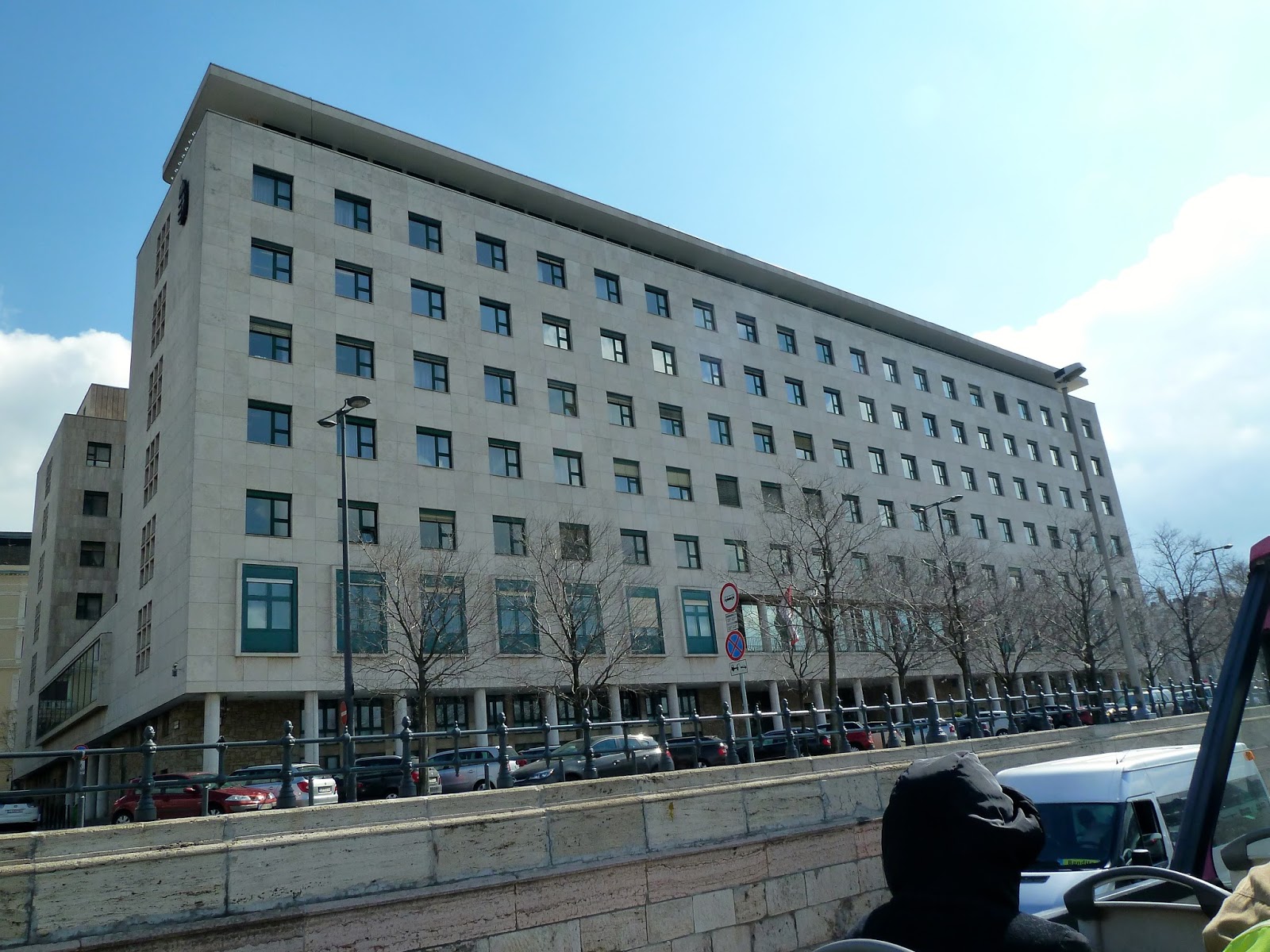
| The People's Palace. A 'Des Res' in Bucharest |

The train from Brasov to Bucharest was a straightforward 2½ hour journey (although for the first time so far my train was delayed...30 minutes). The scenery approaching Bucharest was of the Soviet industro-wasteland variety. Even the views from London to Folkestone were pleasant in comparison. The first sight arriving at Bucharest North station was of, almost inevitably, a MacDonalds (left).
A fast and cheap Metro underground journey took me to my hotel, The Athenée, just off Piata Revolutiei in the centre of the city.
It was from the balcony of the Central Committe of the Communist Party building here, on 21st December 1989 (Sahagun Day for those in the know), that the late President Nicolae Ceausescu gave his last speech. It did not go down very well. He was rescued by helicopter from the roof after the crowd revolted and the Securitate police started shooting at them from the Athenée hotel (yes, my hotel). As you probably know, Nick and his wife Elena were summarily executed the following Christmas Day.

Right: The 'Rebirth Memorial' in Piata Revolutiei, which has a sort of birds nest around the top with what looks like blood dripping from it. The building and balcony from which Ceausescu gave his final much unappreciated address, now the Interior Ministry, is in the background.
A fast and cheap Metro underground journey took me to my hotel, The Athenée, just off Piata Revolutiei in the centre of the city.
It was from the balcony of the Central Committe of the Communist Party building here, on 21st December 1989 (Sahagun Day for those in the know), that the late President Nicolae Ceausescu gave his last speech. It did not go down very well. He was rescued by helicopter from the roof after the crowd revolted and the Securitate police started shooting at them from the Athenée hotel (yes, my hotel). As you probably know, Nick and his wife Elena were summarily executed the following Christmas Day.

Right: The 'Rebirth Memorial' in Piata Revolutiei, which has a sort of birds nest around the top with what looks like blood dripping from it. The building and balcony from which Ceausescu gave his final much unappreciated address, now the Interior Ministry, is in the background.


Left: Piata Revolutei looking towards the Hotel Athenée (in the background) from which the Securitate fired at the crowd. It's only about 100yds, but looks further here. Several dead.
There are lots of grandiose buildings dotted around the city centre which is not an unpleasant place at all. Decent modern shops abound.
Right: The Regal Palace.

Left: The Circul Militar National. (Palace of the National Military Circle). This was built in 1911 and is now used for 'protocol' events, whatever they are. It also has a restaurant open to the public.

Right:.........and the opera house
These buildings are all dotted along Victoriei Street, a grand central artery of the city, which eventually leads down to the area on which is built the Mother Of Them All, the Palace of Parliament, or People's Palace (see photo at top of the front view). This is the second largest building in the world.
It was Ceausescu's plan to build this monster to house all the Government institutions as well as being his Presidential Palace. 50,000 homes in the area had to be demolished to accommodate it, with most of those dispossessed given paltry compensation.
 Left: A side view and the 'tourist' entrance.
What you don't see of this 12 storey monolith are the 9 storeys below ground. Down below it has, or had, a vast nuclear bomb-proof shelter, and lots of other facilities including several escape tunnels which lead to safe areas way out in the countryside. There may also be an indoor Polo ground and several full sized football pitches for all I know. Ceausescu sadly met his demise before the place was ready for his occupation. It would have been some house-warming party.
It now houses the Romanian Parliament and Senate. It also offers almost unlimited space for conferences, weddings, film sets, banquets and anything else you can think of. Perhaps the ideal place for an intimate, and original, 'Dîner a Deux'. Book now to avoid disappointment.
 Guided tours are on offer; you can't wander around the place at will. Anyway, if you did you would probably get lost in there for weeks. The tours are organised in groups according to language. There is a pretty chaotic and crowded entrance hall to buy tickets and to assemble involving, in my case, a long wait. Surprisingly, and disappointingly, there is no café. Perhaps they didn't have room.
I was amused by the 'General Rules' displayed in several languages in the foyer (right). I think I managed 'to stay clean'.
My little party was guided by a very charming, and amusing, university graduate. The hour long 'regular' tour does not include any underground bits and, as we were told later, takes in a mere 5% of the rooms and passageways. I can't remember how many rooms are contained in this place, but it is certainly many thousands.


Right: This was originally intended as a theatre, but now used as a conference room.

Left: The chandelier hanging over the centre weighs 5 tons and contains 3000 light bulbs which, incidentally, were recently changed to the 'eco-friendly energy-efficient' variety. As you can imagine the electricity and heating used in this place could power a small town. Ironically, this place was used as a venue for a 'World Resource Management' conference.
I don't envy the chap tasked with changing a light bulb.
Other than the scale of the place, the other over-riding impression was of very tacky furnishings and decoration which seemed completely out of scale with their surroundings. It gave the feeling of dolls' house furniture placed in the rooms.

Great expense was involved in obtaining the best materials for enormous carpets, wall coverings and sometimes 100ft long silk curtains, but the overall effect was......naff!
It was mentioned that one '100ft' curtain had collapsed onto someone standing underneath and crushed him/her to death. Dangerous things curtains.
Right: The Presidential Reception Room........

......which is possibly one of several to meet visiting dignitaries. There were microphones on the table and even plywood booths at the back of the room to house reporters, television crews and interpreters.

Right: One of the conference rooms with a rotating camera mounted in the centre of the table. Possibly to record those who had fallen asleep. Note the old-fashioned cinema screen on the right onto which was, no doubt, projected Tom and Jerry cartoons.

Left: Another conference room containing 1002 neatly lined up chairs. The '2' were separated at the back for whatever reason.

This room led out onto the enormous balcony (right), looking down the main processional drag; Bulevardul Unirii. It was the platform from which Nick Ceausescu had planned to address his adoring masses but, unfortunately for him, never got the chance.
In fact the only person to address the masses from here, and this was in 1992 before the building had been completed, was Michael Jackson (the late and very weird pop singer). To the assembled throng his memorable first words were "Hello people of Budapest". It is surprising that he didn't have to be evacuated by helicopter after that. His little gaffe was put down to tiredness (and possibly the drugs he was on).
Several other rooms in this incredible edifice visited, many of which contained serried ranks of plastic chairs, cheap tables and all rather uninteresting. In one hall area a fashion parade was taking place with flashing lights, several temporary stages, bars and lots of electric cables over which we had to pick our way. Curiously, I never saw a single loo in the place. Probably have outside ones.
During the course of this tour our guide was obsessed with making sure nobody had got left behind or wandered off in an unapproved direction. I'm not sure if this was for our benefit, or his.
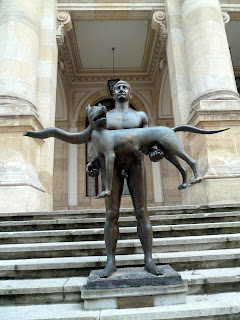
 On the way back up Victoriei St, I passed the Natural History Museum. I don't know what's inside it but on the steps outside is this very odd statue (left). I'm told it is much mocked but is nevertheless the most photographed statue in Bucharest. You can possibly understand why.
It is supposedly of Emperor Trajan holding a Dacian wolf (whatever they are when at home). Apart from the fact that Mr Trajan is somewhat informally attired, what on earth is that long trunk-like protuberance on the left side? Both his arms are holding the gormless looking wolf. I couldn't work it out. Any suggestions?
 The part of Bucharest which is undergoing a revival as 'hip, old-fashioned and traditional' is the 'old town' Lipscani area. Indeed there are some attractive and trendy looking bars and restaurants there. I had supper in such a place, the touristy 'Caru cu Bere'. It is a very jolly venue with modestly priced good food and good service. Despite the bad photo (right) it is impressive inside with old wooden minstrels' galleries and glorious stained-glass windows. It also provides traditional musical entertainment and gets packed out later in the evenings...booking a table is essential then.
So that's what I managed to do in half a day and evening in Bucharest. Not a bad place at all as far as I could see and, as I have met so far across Eastern Europe, very helpful and polite locals and staff.
Next off on what might be a slightly more laborious journey south across Bulgaria. We shall see.