Thursday, 10 December 2020

MAINLAND TANZANIA AND BACK

 16th - 22nd Nov 2020
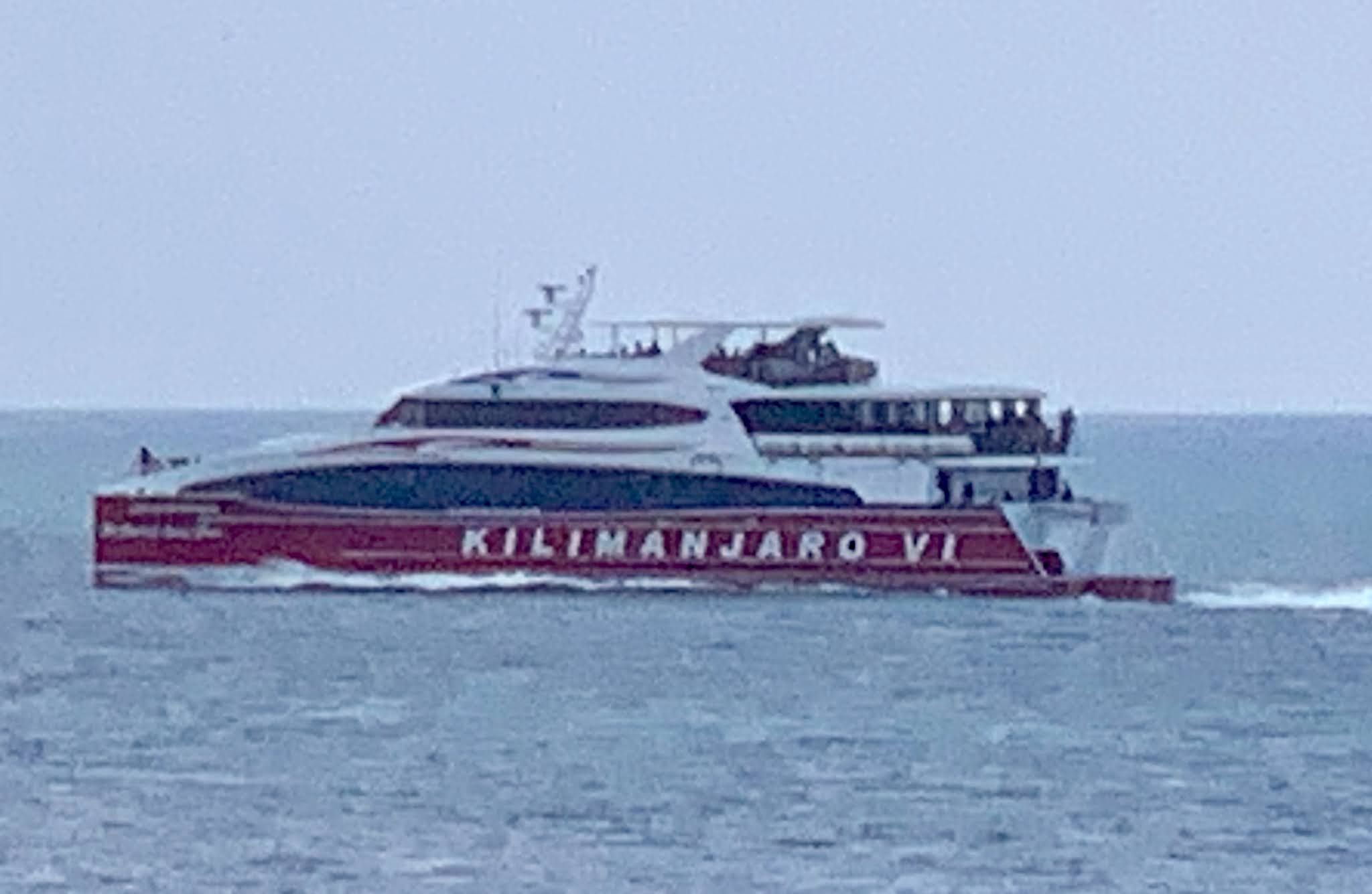
One of the twin-hulled fast ferries to Dar-es-Salaam

I have now been in Zanzibar and mainland Tanzania for 6 weeks and am still enjoying the relaxed pleasant lifestyle here. I have met up with several 'escapees' from other countries which have extraordinary 'covid' restrictions. None of us can understand why a bug from which well over 90% of those who catch it suffer merely a cold, cough, sniffly nose, or nothing at all, has resulted in populations becoming so supine in their subjugation to these draconian and often utterly illogical rules and regulations which are so damaging to social life, the economy, psychological welfare and other unrelated health issues. The fact that so many otherwise robust people are still keen to cower behind their (arguably) useless dehumanising face-masks (not here, I hasten to add, and with no dire consequences), fuels and spreads unnecessary anxiety. 'Covid wimps' as I've heard them mockingly described!  From the outside it all looks as if the world has gone stark raving bonkers and, despite a vaccine, no end in sight to this madness.

I took the opportunity to visit friends who live in Tanzania, about 20 miles north of Dar-es-Salaam, in a rambling beachside house with numerous dogs, cats, geese, guinea fowl and other livestock, plus children. They were incredibly hospitable hosts but, for various 'political' reasons did not wish to feature in this blog. 

Left: Part of the packed economy class section on the fast modern twin-hulled ferry, a 1½ hour journey from Zanzibar to 'Dar' (that is the common abbreviation for Dar-es-Salami).

It is necessary to show passports and fill in immigration forms to go from Zanzibar to the mainland. I'm still not quite sure what the political relationship is between the island and mainland although all part of Tanzania.

There are 4 ferries daily. The waiting hall at departure was full for the mid-day run.  Economy class (price for foreigners $35; much cheaper for locals). Right: The economy class was full to the point of people sitting on the stairs.


For an extra $15 you can travel in VIP Class, which was almost empty. Here you get good WiFi, comfortable seat and a complementary cup of coffee and bun served to your seat. I splashed out for this. There is also a 'Super-VIP' class, but not sure what 'extras' that gave you.


Right: Looking back at the frontage of the luxury Park Hyatt hotel on the point of Stone Town. Not a patch on Bottoms Up I'm sure.

I had booked in, on spec, to a hotel for the first night in Dar. It was within easy walking distance from the ferry terminal. It is called 'The Chelsea Hotel' and, at $23 pn, was  great value. Comfortable air-con room, big TV, good bathroom and excellent bar and restaurant, plus a very helpful Indian manager. I merely mention this in case anyone reading this is looking for accommodation in Dar.

My host owned (or rather 'leased', because you can't legally own) a 350 acre farm a 2½ hour drive north-west of his house. This bordered a large river and he farmed cattle and goats in an innovative and modern (by African standards) style by encouraging a form of rotational grass husbandry. Grass growing is the key to success. To get to the place involved driving through some boggy, bumpy tracks, impassable during a rainy period, and struck me as being very hard work! 

His manager was Tanzanian and the 'herders' were, predictably, Maasai.

Left: A daily count of the cattle. They are all branded but cattle rustling can be a problem.

I have discovered the Maasai (Maa) word for "hello". It is "subai", pronounced "soub eye". The response is "Eba". Could come in useful?


Right: Counting the goats. They keep giving birth so hopefully increasing the population. They are also prone to dying of one disease or another which means that the status quo is probably maintained. 


Left: A shed full of bulls. The long-horned ones are the African Ankole or Watusi breed. I think! Useful to hang the washing from.


The three or four Maasai herders live in extremely spartan accommodation, miles from anywhere and with no running water or electricity. They are a hardy breed. Nevertheless, the owner has to pay for an expensive Government 'elf 'n safety' survey (a money-making scam) which includes the requirement for a 'Fire Assembly Point' (right). No logic to this of course. They must have looked up some useless British bureaucratic document.

I had thought of going to visit the game parks of the Serengeti, Ngonogoro Crater and Mt Kilimanjaro, up North via Arusha, having done similar, cheaply, in South Africa a few years ago. However, on investigation, the prices offered including a flight to Arusha were exorbitant! Going by shoddy bus to Arusha (630 km) would take up to 12 hours! With so few tourists visiting the country at the moment you would think there might be some 'good deals' to be had. However African economic thinking means charging ever more and so very few people (other than a few wealthy Americans or Russians perhaps) can now afford to go, hence the Law of Diminishing Returns! To give you an idea, one supposedly 'respectable' travel company was going to charge $3000 for a 4 day safari to the Serengeti! Blimey! Not my idea of a bargain to ogle a few flea-bitten lions, stripey horses and big things with horns and tusks. I can see them on the internet. 

Nevertheless I had a pleasant stay here, including being over well fed with visits to a rather ex-pat oriented 'craft fair' and restaurants on the Peninsular, an upmarket 'Embassy' area north of Dar city. 

Back to Zanzibar....and more to come from there Including a very rare, for me, attendance at church; a Swahili service in the Anglican Cathedral. It was quite extraordinary.


Friday, 4 December 2020

TEMPLE, SHOPS & SLAVES - ZANZIBAR


13th - 16th Nov 2020

Kasuku, the fearless whistling parrot at Bottoms Up.

As previously mentioned there is a diversity of cultures in Zanzibar; predominantly a mix of Arabic, African and Indian and all seem to rub along happily. The complicated history has involved Swahili people, Portuguese, Omani, German, Indian and British. Look it up if you are that interested and it takes up several volumes.

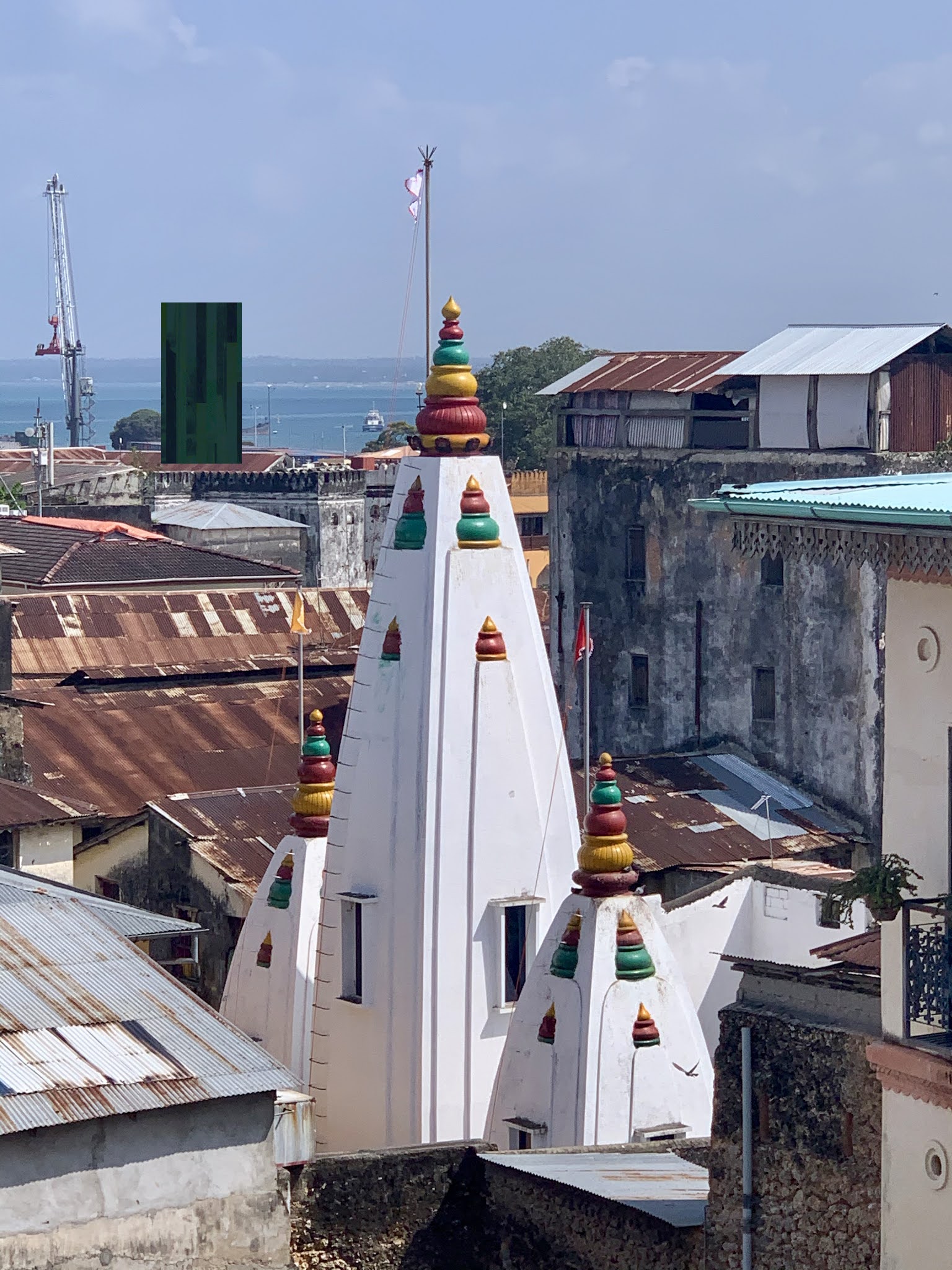
Left: I noticed this pointy colourfully topped building from above when having breakfast on the roof of Bottoms Up. It was close-by but still difficult to find in the maze. Impossible to get a good photo from ground level. It is the Shree Shiya Shakti Hindu Temple.


I went inside out of curiosity (shoes off). I have no idea how large the Hindu community is here, but Indians came to be here due to big trading involvement throughout the 19th/20th centuries.
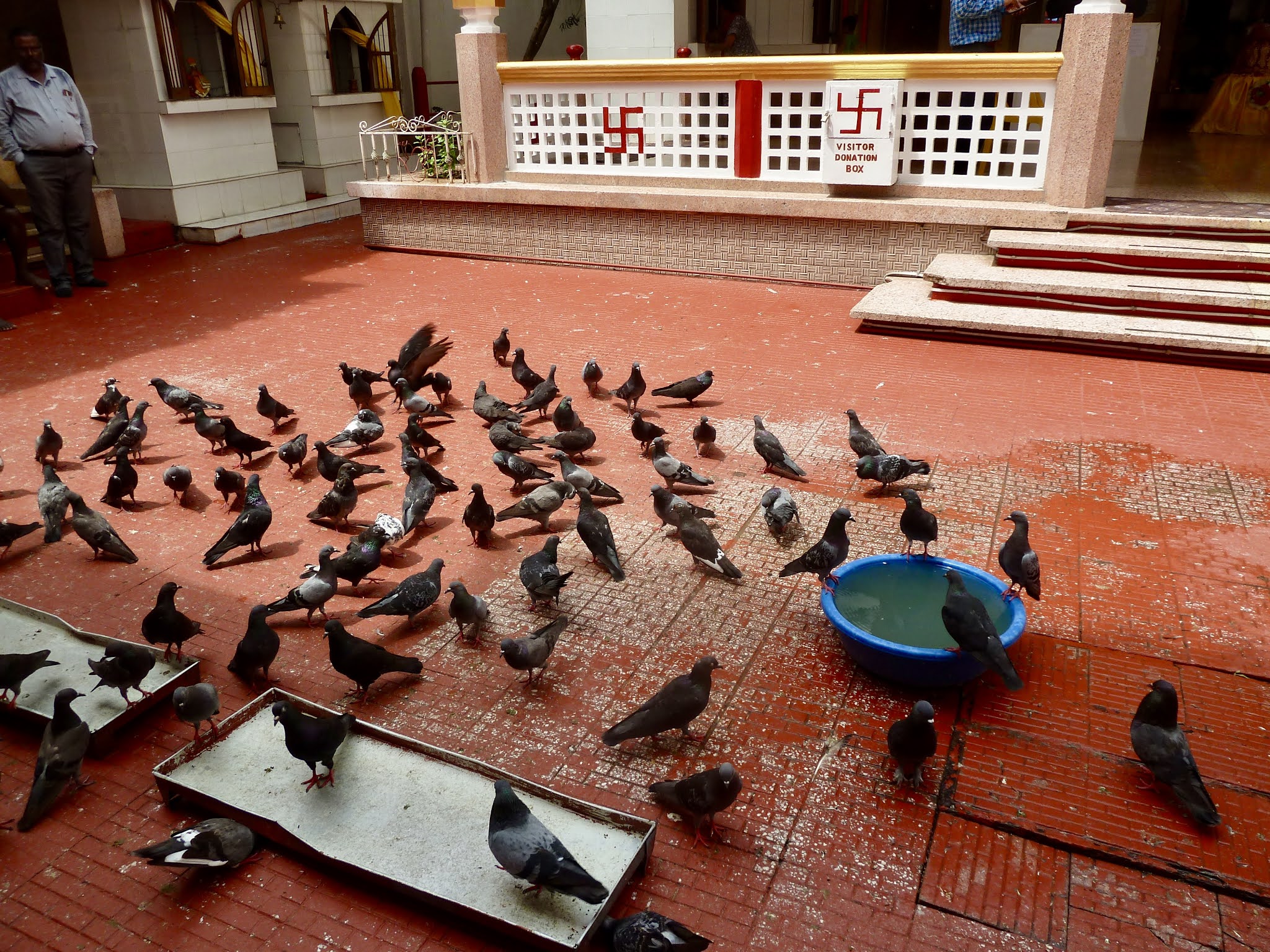
I thought my town had a pigeon problem, but nothing compared to the flocks living here. Maybe they are revered in Hindu culture. They are shot where I come from!


Left: One of the several little shrines.


Right: The main shrine. I think Hindus worship many Gods. Most of which have at least four arms, and I know one of them is the elephant headed Ganesh. 


Left: More Hindu pigeons. The swastikas on the wall are a common Asian religious symbol for 'good fortune'. The word comes from the Sanskrit language but the symbol, turned 45ยบ anti-clockwise, was hijacked by Mr Hitler's National Socialist German Workers' Party in the 1930s.


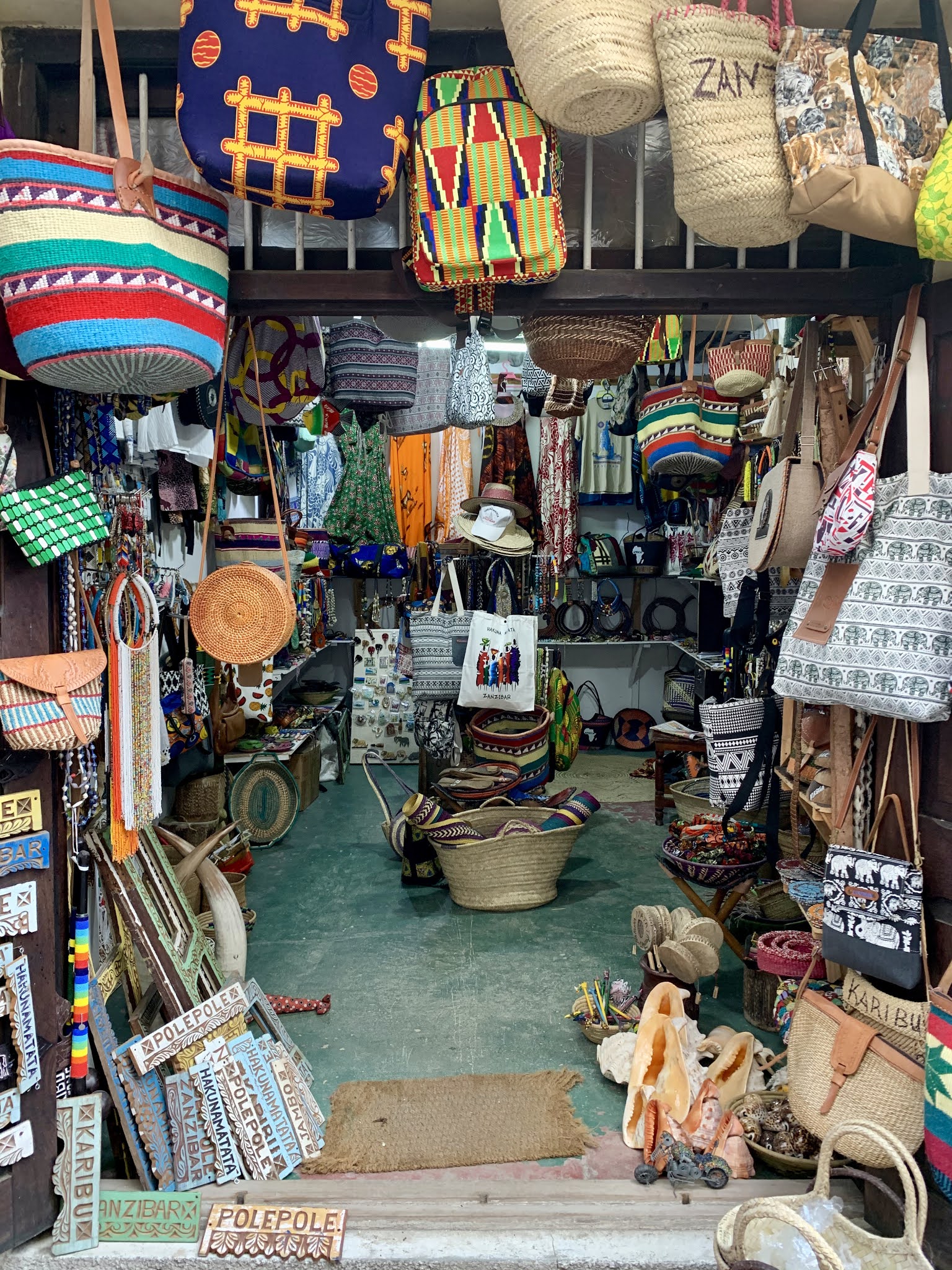
Wandering, mostly lost, around the narrow alleyways of Stone Town you pass lots of little shops (right). There are certainly no Waitrose, or even Lidl, equivalents. You would be forgiven for thinking that these are rather scruffy and downmarket but a surprising number, despite their humble fronts, conceal smart and elegant interiors.


Such as this clothes shop (left).


Right: All the dresses are locally made.


Left: Many skilfully carved wildlife pieces on display.


Right: Another mini-emporium selling beautifully made and colourful hand-crafted bags.

I may have mentioned that plastic bags are, very sensibly, banned in Tanzania. All goods bought are given to you in paper or fibre bags. Why can't we do that in UK? Just lots of words decrying them..."all mouth and no trousers", so to speak.


Left: A small coffee shop which sold excellent varieties of Tanzanian coffee and little dolls made by orphans. It was selling these (with the help of an NGO) to fund the orphanages. 


Right: One of the many 'Maasai' shops which sell elaborate bangles and beads and things to wear around your neck. 

I now realise that I have been spelling Maasai wrong, but buggered if I am going back to correct. Maasai are renowned for 'jumping', cattle herding and speak their own language, 'Maa'.

There are little shops that sell just about everything you may need, but you have to know where to find them. I wanted some electric insulating tape. I relied on Ali (one of the hotel receptionists) to take me to one, which he did, on his scooter. I could never find it again by myself. It's that sort of place.

Actually I slightly exaggerate. I have belatedly discovered the magic of a phone navigation 'App' called 'maps.me'. A real saving grace around here and it doesn't rely on a phone or internet connection. I'm probably the last person in the world to discover it.

Left: I think this little shack might be over-stating its credentials. It advertises 'Georgio Armani of Zanzibar' over the door. Maybe not; I didn't go in and their prices were probably well beyond my reach.


I have noticed an increasing number of tourists around town. I expect more people are discovering the freedom this place offers from their countries' 'lockdowns' and social restrictions. There are many Russians and Eastern Europeans. I am told there are direct flights from Moscow and other Russian airports. I have also met up with some amusing Brit escapees amongst other nationalities. 


Left: A little gaggle of Muslim schoolgirls. Sometimes there are swarms of them. 


Right: A gathering of students (I think) who were keen to pose for their photo to be taken.


Onwards to another interesting 'site' at the rambling village of Mangapwani, on the coast 20km north of Stone Town. Ali, my helpful friend from the hotel, suggested this and took me, free of charge (I paid for his petrol) on his scooter, safely and skilfully weaving through the bus and car jams out of town.

The slave trade here was 'officially' ended in 1873. But it wasn't. It went, literally, underground. The market in Stone Town was closed down. Slaves were then imported and held at other locations, undiscovered by the British or any other interfering nations. 


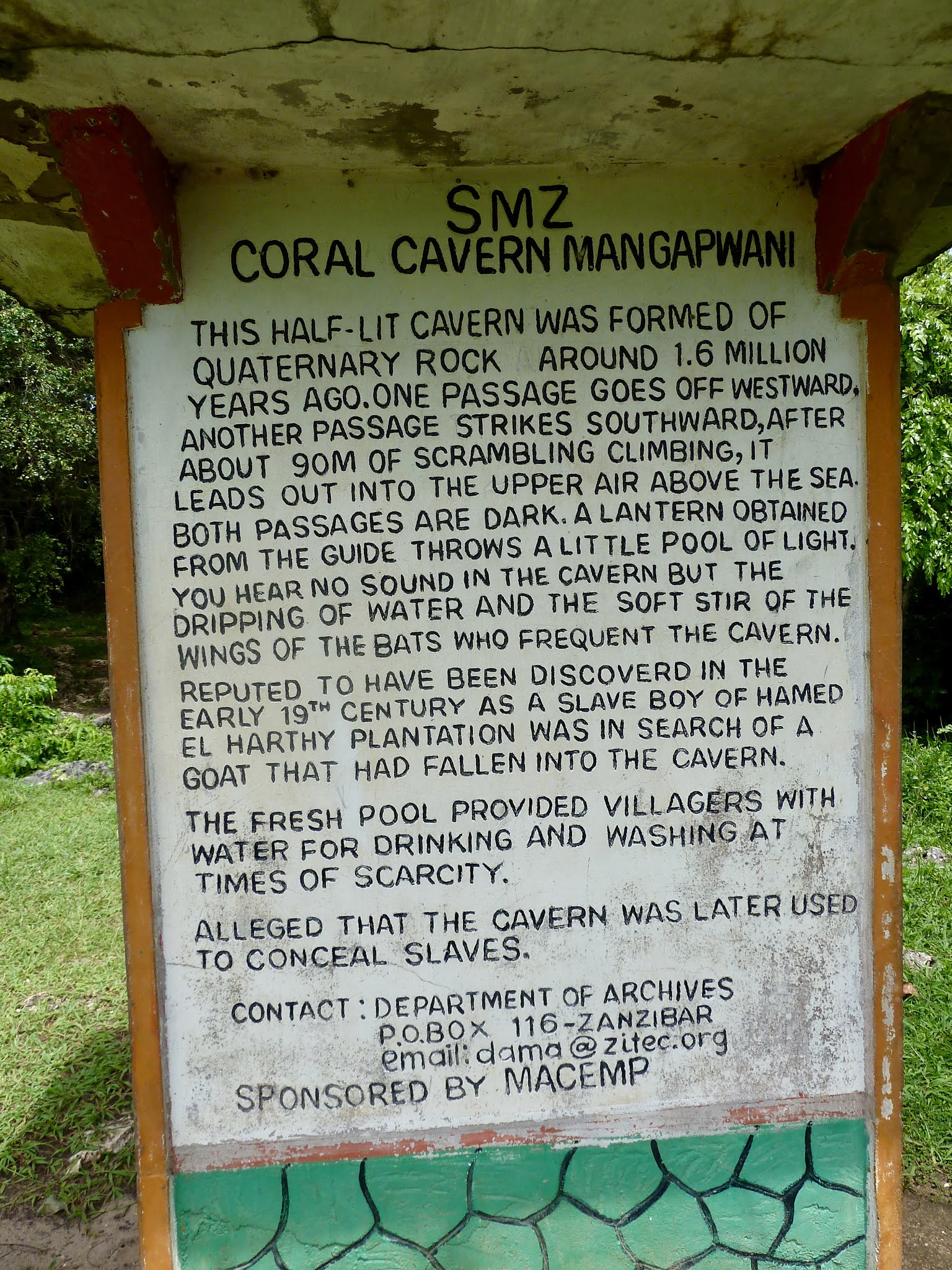
One site was this cavern at Mangapwani. 

Previously used by the villagers, it then housed slaves in extremely uncomfortable damp conditions. There is a tunnel, running almost a mile from the entrance to the beach, down which the slaves were brought in and out, to and from ships.


It was dark and dripping damp in there with a very rocky, slippery and uneven floor. A fresh water pool supplied their water. The tunnel to the beach was now partially closed off and no way would I have wished to scramble down it. A torch shone inside triggered a swarm of bats to escape to darker places. Up to 100 men, women and children "slaves' were kept in here at any one time.

Right: Daylight from the entrance flooding into the cave. 


Left: One of the exits nearer to, but not at, the beach.


About 2 miles away was another covert site at which slaves were held.


Left: This time in semi-underground cells. There were concealed pathways down to the beach.


Right: Not exactly 5* accommodation. This slave trading, crucial for the labour and hence wealth of the Arab traders, was not truly abolished here until about 1909 following the death of the infamous 'Big Man' Tippu Tip in 1905. I suspect, in one form or another, in many parts of the world, it still goes on. We fool ourselves otherwise.
Perhaps bargains on 'Black Friday'! (whatever that is).


Left: The redoubtable Ali with his scooter. We had to negotiate several very muddy, slippery and potholed tracks which he managed skilfully without what could have been an unpleasant capsizing.


Right: A more traditional form of local transport.


The longer I am here the more I find interesting things to report on. Stand-by for further fascinating insights.  

Sunday, 29 November 2020

TORTOISE & SPICE - ZANZIBAR


10th -12th Nov 2020

Giant tortoises on 'Prison Island'.

Zanzibar is not perfect in many respects (what country is?). It appears to suffer from irregular power cuts...sometimes lasting for as long as half a day which has played havoc with my daily lunchtime ice-cream, courtesy of a charming Italian lady who runs an ice-cream parlour in the town centre. The electricity supply comes from mainland Tanzania and, either through malice or incompetence, frequently fails.

I met up, by chance, with a couple of Brits on a morning tour to Changuu Island, about 4 miles off-shore north-west of Stone Town. It is otherwise known as 'Prison Island'. 

Left: The long jetty at 'Prison Island'. Long jetties are needed because of the tides.

It was originally made into a prison for recalcitrant slaves by Sultan Sayeed in the 1860s, but was bought by the British First Minister of Zanzibar, Lloyd Mathews, in 1893 and became a quarantine centre (not a prison) for immigrants to protect against the spread of Yellow Fever and probabaly Cholera (prevalent in East Africa). Good idea. If people are so worried about Covid-19 (a pathetic disease in comparison) perhaps we should use the Isles of Wight, or Man, as similar!

Right: Our transport, 'The Gladiator'. The tide was in so we beached at the island. 

There are lots of these little outboard-motor powered boats to ferry people all over the place. All had awnings with names. Some quite amusing........


,,,,,Such as this one (left). 


....which changed its name a bit when the awning was pulled back.


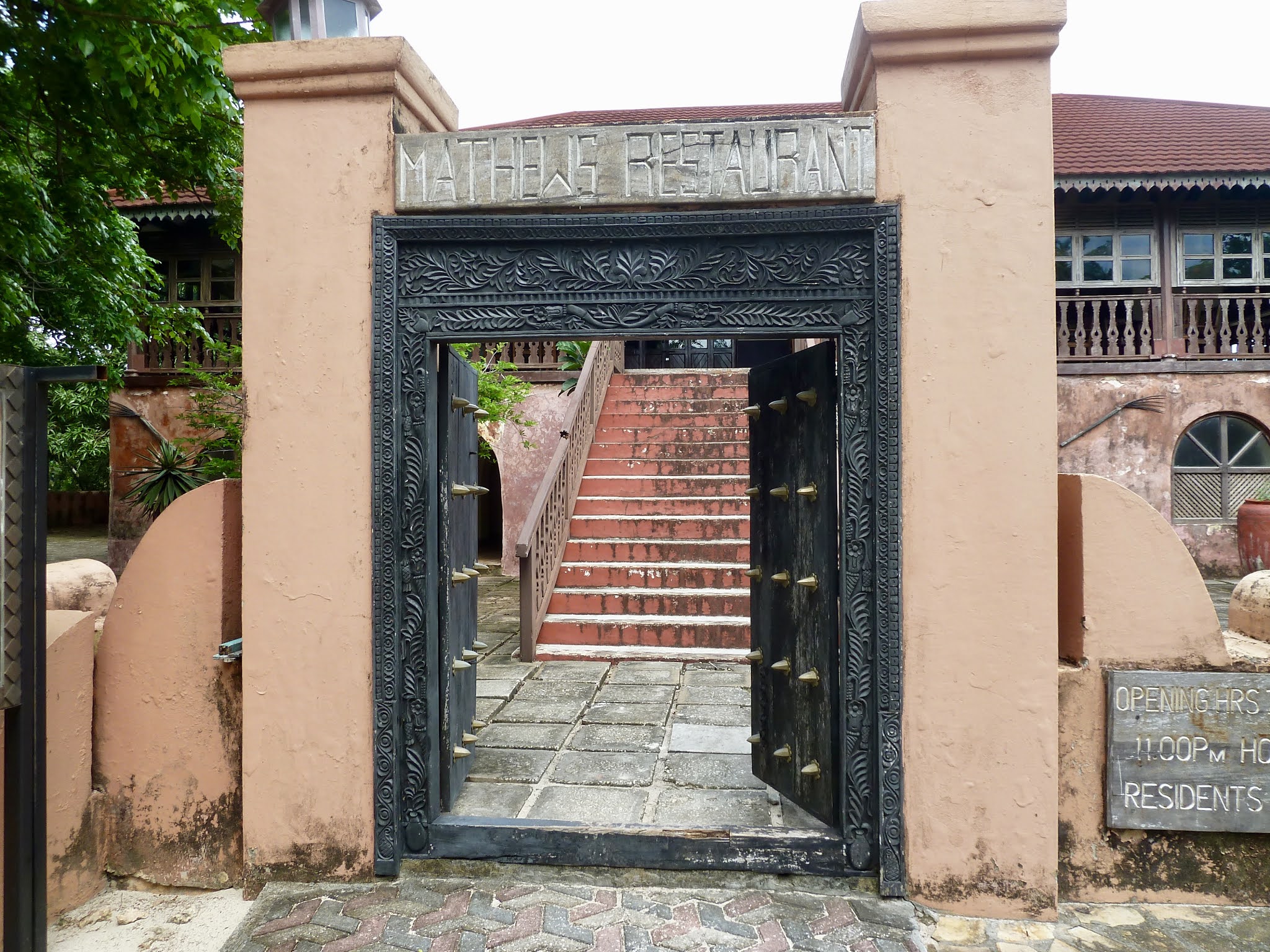
The island was only used for quarantine during half the year, as most incoming traffic relied on trade winds which blew tthe boats in during that period. During the other half it was a holiday island and a lodge was built, now called Mathews Restaurant (left), which is closed.


The main attraction on the island are the Aldabra giant tortoises. Four of these were sent as a gift by the British governor of the Seychelles in 1919. They multiplied exceedingly. There are now around 180 of the critters plus lots of baby ones. They have numbers and dates of birth painted on their shells. The oldest one, I was told, is 160 years old.
Our guide tried to be very helpful but sadly his English was all but indecipherable, so we probably missed a lot of detail.


We were encouraged to feed the beasts with greenery. They have a voracious appetite and jaws like car crushers. You feel they could take your fingers off  if you are not careful. Fortunately they can't run too quickly. Riding on the tortoises is prohibited (as if I wanted to!). The only tortoises I have ridden, in races, were 'equine' ones.


Right: There is a pen housing lots of baby ones, I think called 'hatchlings', or maybe 'fingerlings'. I'm not sure (expert advice from my 'adviser' will be forthcoming). They obviously look after them well; they are a tourist money-spinner after all.


Left: The original gates to the quarantine centre; the grey ones.


Right: The inside courtyard with cells/rooms surrounding it. I think it has been smartened up a bit since its original use.


Left: There is even a fully stocked bar with a portrait of Sultan Sayeed Said on the wall by the drinks. Our guide was keen to have his photo taken against this. Were Sultans enthusiastic tipplers?
We sailed back via a coral reef where the lady in our little group, an enthusiastic diver, donned flippers and snorkel and went for a look-see down under (the sea!). She seemed to enjoy it. I am not particularly keen on submerging myself unnecessarily.

Right: The 'Travellers' Cafรฉ' on the beachfront of Stone Town. It is a popular haunt for European tourists and ex-pats and is in fact a very pleasant bar/restaurant with charming staff and good WiFi. They have a decent (especially seafood) menu and a large glass of very palatable red wine costs about £1.80p. It has become my regular watering hole.


Left: The sunset view from the bar. The net is lowered when people play football on the beach, which they often do. Nothing worse than a football landing in your soup.


As well as football and swimming, lots of exercise is done on this little beach, especially, as I gathered, by the local police force. Right: This is a group of them pounding around a temporary running track.
I failed to get a video of an impressive dance group practicing their 'routines' with lots of gymnastics.


Left: A passing dhow. The colour of the sea around here always amazes me.

The next trip was to a Spice Farm, of which there are many, about 15km north-west near the town of Bububu. Zanzibar is historically renowned for spices, especially cloves and vanilla. It was indeed known as Spice Island during the 19th century. The notorious Tippu Tip (see previous blog) had a handle on the trade in this, as well as his ivory, and everything else.
I was travelling alone and was met by a guide and his young 'assistant' guide, neither of whose names I remember but, of course, they were very knowledgeable and charming. These spice farms operate as a local cooperative and cover, collectively, a large area.
I took several photos of the fruit trees and spice bushes I was shown, but pics of these are rather boring so I will just list an impressive selection of the things they were growing: Nutmeg, Cloves, Cinammon, Vanilla, Black pepper, Ginger, Tumeric, Curry leaves, Bread fruit, Jack fruit, Star fruit, Lychees, Cardamon (black, white and green), Cocoa, Coffee, Pepper, Limes, Avocado, Lemons, Pineapples, Lemon grass, Lipstick (Annatto), Quinine, Aloe Vera, Durian, Melons (various), Banana, Papaya and, of course, Coconuts. I might have missed a few. Some of these, I forget which, are used in the manufacture of perfumes. Not Durian, I hasten to add. There is a local dangerously (illegal) potent drink, Gongo, made from distilled papaya, much on the lines of the Irish Poteen and causes a few fatal hangovers. Similar to a cocktail I am familiar with, the 'Spiney Norman', but that is another story.

Right: The assistant guide displaying stars stuck on his face from cutting the tops off star fruit.


During the course of our walk he had been weaving, rather skilfully, a tie made out of palm leaf strips (or were they banana leaves) and a hat, plus flowers for my tie and  buttonhole. I was encouraged to wear them so, in danger of embarrassing myself, here is a photo.


Right: I was treated to another fine display of palm tree climbing. A cloth strap tied between his ankles to grip the trunk and up he went like a scalded cat. Unlike a fat idle cat called Gordon of which I know which wouldn't try even with a shermooley stuck up its arse.


Left: I was persuaded to drink all of the coconut milk from one and then all the flesh. Not bad, and very healthy, but more than I would have normally wanted. Burp!
I'm really not sure that the hat suits me, but he (the guide) was quite fond of mine.

After this I was given lunch from a barbeque. Meat with spicey rice. Haven't a clue what it was. It tasted OK but plentiful, too plentiful. 
There were stalls selling various spices and little bottles of perfume made from some of them. I bought one of them and will present it to an unsuspecting victim on my return. Probably Durian.

More to come from this place. I am beginning to find my way around and have much appreciated the genuinely welcoming nature of the locals and their fascinating diversity of cultures. Hope that doesn't sound too 'woke'.

I will leave you guessing!